

Reconditioned vs Used Audi Engine Which Is Better?
Your Audi's engine has failed, and now you're staring down a decision that feels a lot bigger than it should. Do you buy a used Audi engine and hope the donor vehicle's history checks out.
Your Audi's engine has failed, and now you're staring down a decision that feels a lot bigger than it should. Do you buy a used Audi engine and hope the donor vehicle's history checks out? Or do you pay more for a reconditioned unit and trust that the rebuild was done properly? Get this wrong, and you're not just out of pocket, you're facing the exact same breakdown a second time.
We're not going to tell you that reconditioning is always better, because that's not true. We're also not going to tell you a used engine is a false economy, because in the right circumstances, it isn't. What we will give you is a straight, workshop-level comparison based on how these engines are actually sourced, tested, and installed, so you can make the right call for your Audi, your budget, and how long you plan to keep the car.
What's the Real Difference Between a Used and Reconditioned Audi Engine?
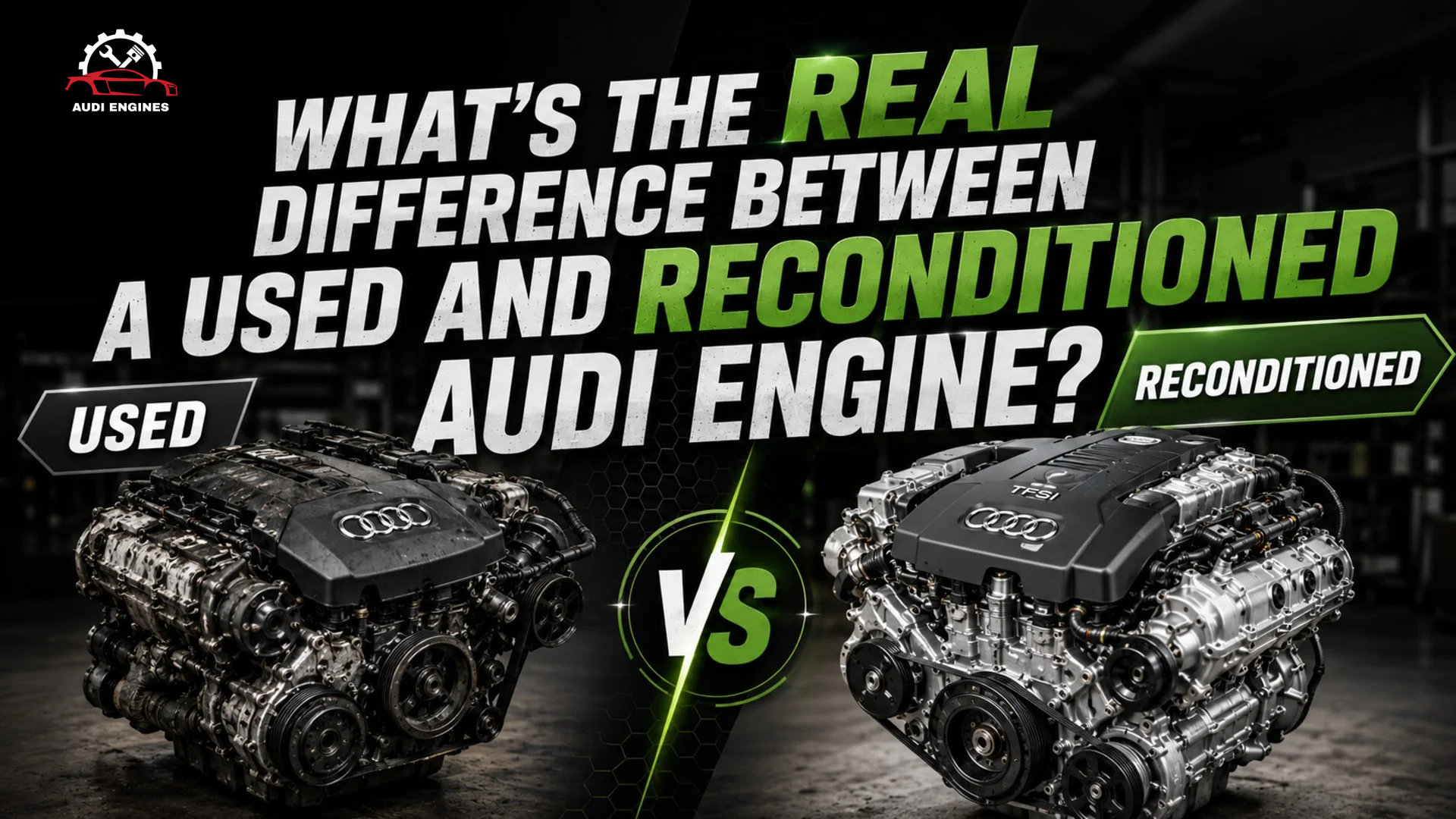
The short answer: a used Audi engine is removed from another vehicle and sold largely as-is, while a reconditioned Audi engine has been stripped down, inspected, machined, and rebuilt with new or renewed internal components before it goes anywhere near your car.
That distinction matters more than most buyers realise, because it directly affects reliability, lifespan, and what you're actually paying for.
What Is a Used Audi Engine? (Donor History, Mileage and Testing)
A used Audi engine typically comes from a donor vehicle, often a car written off after an accident, where the engine itself survived undamaged. It carries its original mileage, its original wear, and whatever history it had before it was removed.
Quality varies enormously here, which is exactly why we don't recommend judging used engines as one single category. A genuinely good used engine will have:
- Verified mileage from the donor vehicle's documented history
- A known donor vehicle, ideally one written off for bodywork or electrical reasons, not engine failure
- Compression and oil pressure testing carried out before sale
- Some form of warranty, even if limited
A poor used engine has none of this. It's simply "removed from a scrapped car" with no verified mileage, no testing, and no comeback if it fails within weeks.
What Is a Reconditioned Audi Engine? (Inspection, Machining and Rebuild)
A reconditioned Audi engine goes through a completely different process. The engine block is fully stripped down to its individual components, crankshaft, pistons, connecting rods, camshaft, cylinder head, and each one is measured against original equipment manufacturer (OEM) tolerances.
A proper reconditioning process typically includes:
- Cylinder head inspection and resurfacing to restore a flat, sealing surface
- Crankshaft grinding and inspection for wear beyond factory specification
- Cylinder honing to prepare the bore for new piston rings
- New bearings, seals, and gaskets throughout
- Timing chain and tensioner replacement, where worn
- Pressure testing, compression testing, and often a run test before the engine is signed off
Because the engine is rebuilt to factory specifications rather than simply reused, wear-prone internal components are effectively reset, which is the core reason reconditioned engines tend to outperform used ones on long-term reliability.
Is "Reconditioned" the Same as Rebuilt, Refurbished or Remanufactured?
Not necessarily, and this is one of the most overlooked issues in the entire replacement engine market. These terms get used interchangeably by sellers, but they don't always mean the same thing.
- Reconditioned generally implies a full strip-down, machining, and replacement of worn parts
- Rebuilt can mean anything from a full recondition to a partial repair with select parts replaced
- Refurbished is often used loosely, sometimes for engines that have had only cosmetic or minor work
- Remanufactured usually follows the strictest process, often to a documented industry standard, with full component replacement
Before you buy, ask the supplier directly what work was actually carried out, don't rely on the label alone.
What Parts Actually Get Replaced During Reconditioning?
A genuinely thorough reconditioning job replaces or renews:
- Piston rings and, where necessary, pistons
- Main and big-end bearings
- Timing chain, tensioner, and guides
- Oil pump and water pump (where worn)
- Valve seals and gaskets throughout
- Any internal component found outside tolerance during measurement
If a supplier can't tell you which of these were done on your engine, that's a red flag worth taking seriously.
Which Option Is More Reliable, and Which Lasts Longer?
This is the question that actually matters most, and the honest answer is: it depends on documentation and testing, not just the label on the listing.
Reliability Compared: Engine History vs Rebuild Quality
A used Audi engine's reliability depends almost entirely on its donor history. A low-mileage engine from a vehicle written off in a minor collision, with a full service history and no signs of previous issues, can be a genuinely dependable choice. But an engine with unknown history, no service records, and no testing is a gamble, you're inheriting someone else's wear and tear, sight unseen.
A reconditioned Audi engine's reliability depends on rebuild quality. A professionally reconditioned engine, machined to OEM tolerances with documented testing, resets much of the internal wear that would otherwise be a concern. A poorly reconditioned engine, rushed, with parts reused that should have been replaced, can be just as risky as a bad used engine, if not worse, because it looks new on paper but isn't.
How Long Does Each Option Actually Last?
There's no single number that applies to every engine, but the general pattern holds up across the industry:
- A well-documented, tested used engine with genuinely low mileage can often deliver another 60,000–100,000 miles of reliable service, assuming it's maintained properly after fitting.
- A professionally reconditioned engine is typically expected to perform close to a new unit, often exceeding the remaining lifespan of a comparable used engine, because key wear components have been renewed rather than reused.
The determining factor isn't really "used vs reconditioned" in the abstract, it's testing and documentation vs guesswork.
Used vs Reconditioned Audi Engine: Full Comparison Table
Factor | Used Audi Engine | Reconditioned Audi Engine |
| Initial purchase price | Usually lower | Usually higher |
| Internal wear certainty | Depends on donor history and testing | Higher when professionally rebuilt |
| Existing mileage | Carries over from donor vehicle | Wear components typically renewed |
| Warranty | Varies considerably by supplier | Often stronger, but still provider-dependent |
| Testing before sale | Supplier-dependent, always ask | Should include inspection, machining checks and pressure/compression testing |
| Long-term predictability | Depends heavily on donor vehicle history | Depends heavily on rebuild quality and documentation |
| Best suited for | Lower upfront budget, short-to-medium term ownership | Long-term ownership, reduced uncertainty |
Does a Warranty Prove an Engine Is Genuinely Reliable?
A warranty is a strong signal, but not an automatic guarantee. What matters more is what the warranty actually covers, parts only, or parts and labour, and how long it lasts. A 3-month parts-only warranty tells you far less about confidence in the engine than a 12-month warranty covering both parts and fitting labour. Always ask for the warranty terms in writing before you commit.
How Much Does a Used or Reconditioned Audi Engine Cost?
Price is usually the first question buyers ask, and understandably so, but focusing on the headline engine price alone is exactly how people end up overpaying in the long run.
Used Audi Engine Price vs Reconditioned Audi Engine Price
As a general rule, a used Audi engine costs less upfront than a reconditioned one, sometimes significantly so. That gap reflects the labour, machining, and parts that go into a proper reconditioning job, you're paying for renewed internal components and testing, not just the metal itself.
That said, price within each category varies widely depending on the specific engine code, model, mileage, and whether the engine is being supplied only or supplied and fitted.
What's Included in the Total Installed Cost?
This is where a lot of buyers get caught out. The engine price is only one part of the total bill. A realistic total cost includes:
- The engine itself (used or reconditioned)
- Delivery to your garage or address
- Removal of the failed engine
- Installation of the replacement unit
- Fluids, seals, and ancillary parts needed during fitting
- Coding or adaptation work, where required for Audi's ECU to recognise the replacement
- Any unexpected labour if additional issues are found during fitting
A cheap used engine that seems like a bargain on price alone can end up costing more overall if it needs extra diagnostic work, additional parts, or fails shortly after fitting and needs removing again.
Why Audi Engine Code and VIN Matching Affects Your Final Price
Every Audi engine has a specific engine code, for example, variants of the EA888, EA839, or EA897, and it needs to match your vehicle's specification closely enough to work with your existing ECU, wiring, sensors, and gearbox. Getting this wrong doesn't just cause fitting problems; it can mean buying a second engine after the first turns out to be incompatible.
A reputable supplier will ask for your VIN or engine code before quoting, and match the replacement engine's specification, including turbocharger configuration and emissions standard, against your original. If a seller doesn't ask for this information, that's worth questioning before you buy.
Which Should You Choose, Used or Reconditioned Audi Engine?
There's no single right answer here, the better choice depends on your budget, how long you're keeping the car, and how much certainty you want about what's inside the engine.
When a Used Audi Engine Is the Better Choice
A used Audi engine tends to make sense when:
- Budget is the priority, and you need a working car back on the road without a large upfront cost
- You've found a genuinely well-documented engine, verified low mileage, known donor vehicle, tested before sale
- You're not planning long-term ownership of the vehicle
- The specific engine variant is common and widely available, reducing the risk of struggling to source a replacement later if needed
When a Reconditioned Audi Engine Is the Better Choice
A reconditioned Audi engine tends to make more sense when:
- You're keeping the car for years, and want internal wear components renewed rather than inherited
- You want documented testing and machining, not just a supplier's word
- The engine variant has known failure points, certain timing chain or turbo issues on specific TFSI and TDI variants make a fresh rebuild more appealing
- You want a stronger, more meaningful warranty, covering both parts and labour
Our Verdict: Reconditioned vs Used Audi Engine
Here's the balanced answer most pages won't give you straight: a high-quality reconditioned Audi engine is generally the better long-term choice when the rebuild is documented, professionally machined, and properly tested. But a low-mileage, thoroughly tested used engine with verified history can absolutely be the smarter value option, particularly for short-to-medium term ownership.
The label on the listing matters far less than the paperwork behind it. Ask for testing records, warranty terms in writing, and confirmation of engine code compatibility before you commit, whichever route you choose.
Get a Free Quote for Your Audi Engine Replacement
If you're weighing up your options, we're happy to talk you through what's realistic for your specific Audi, model, engine code, and mileage, and give you an honest recommendation, not just a sales pitch. Get in touch with Audi Engines for a straightforward quote on supply, or supply and fit, with clear warranty terms from the outset.
Frequently Asked Questions
What is the difference between a reconditioned and a used Audi engine?
A used Audi engine is removed from a donor vehicle and sold largely as-is, retaining its original mileage and wear. A reconditioned Audi engine has been fully stripped down, inspected, machined, and rebuilt with new or renewed components before sale.
Are reconditioned Audi engines reliable?
Yes, when the rebuild is professionally carried out with proper machining, quality parts, and thorough testing. Reliability depends heavily on the standard of the reconditioning work, so always check what was actually replaced and tested.
Is a used Audi engine a good idea?
It can be, provided the engine has verified mileage, a known donor vehicle history, and has been compression and oil-pressure tested before sale. Unknown-history used engines carry considerably more risk.
How long does a reconditioned Audi engine last?
A professionally reconditioned engine is typically expected to perform close to a new unit, since major wear components are renewed during the rebuild, though actual lifespan depends on maintenance after fitting.
How long does a used Audi engine last?
This depends heavily on the donor engine's condition and remaining wear. A well-documented, low-mileage used engine can often deliver 60,000 to 100,000 further miles, while an untested unit is far less predictable.
Is it cheaper to rebuild or replace an Audi engine?
It depends on the extent of the damage. If only a few components have failed, a rebuild of your existing engine may be more cost-effective than a full replacement. If the damage is extensive, a replacement engine, used or reconditioned, is usually more practical.
Does a reconditioned Audi engine come with a warranty?
Reputable suppliers typically offer a warranty on reconditioned engines, though terms vary. Always confirm in writing whether it covers parts only or parts and labour, and for how long.
How do I know if a used Audi engine is genuinely compatible with my car?
Check the engine code against your Audi's specification, and provide your VIN to the supplier so they can confirm compatibility with your ECU, wiring, sensors, and gearbox before you buy.
Can I install a different engine code in my Audi?
Sometimes, but it usually requires additional coding, wiring work, or ECU adaptation, and isn't guaranteed to work smoothly. Matching the original engine code closely is almost always the simpler, more reliable route.
What should I check before buying a used Audi engine?
Ask for the engine code, verified mileage, donor vehicle history, results of any compression or oil-pressure testing, and clear warranty terms before you commit to a purchase.