Are Audi RS Models Reliable? A Complete UK Reliability Guide
You have found an RS3 or RS6 with the right spec and a price that makes sense. Then a forum thread tells you these cars are money pits, while the next one swears they run forever. Which one is right? Both, depending on the car. Audi RS reliability is not one score for the whole range.
You have found an RS3 or RS6 with the right spec and a price that makes sense. Then a forum thread tells you these cars are money pits, while the next one swears they run forever. Which one is right?
Both, depending on the car. Audi RS reliability is not one score for the whole range. It depends on the model, the engine, the gearbox, how the car was serviced, whether it has been tuned, and how it has been driven. A well-maintained RS can cover big mileages without drama. A neglected one can turn into a very expensive lesson.
This guide covers the Audi RS common problems we see most, how reliability differs from RS3 to RS6, what upkeep really involves in the UK, and how to check a used car before you commit. If you already have a warning light, a misfire or a loss of oil, our team at audiengines.co.uk can diagnose it for you.
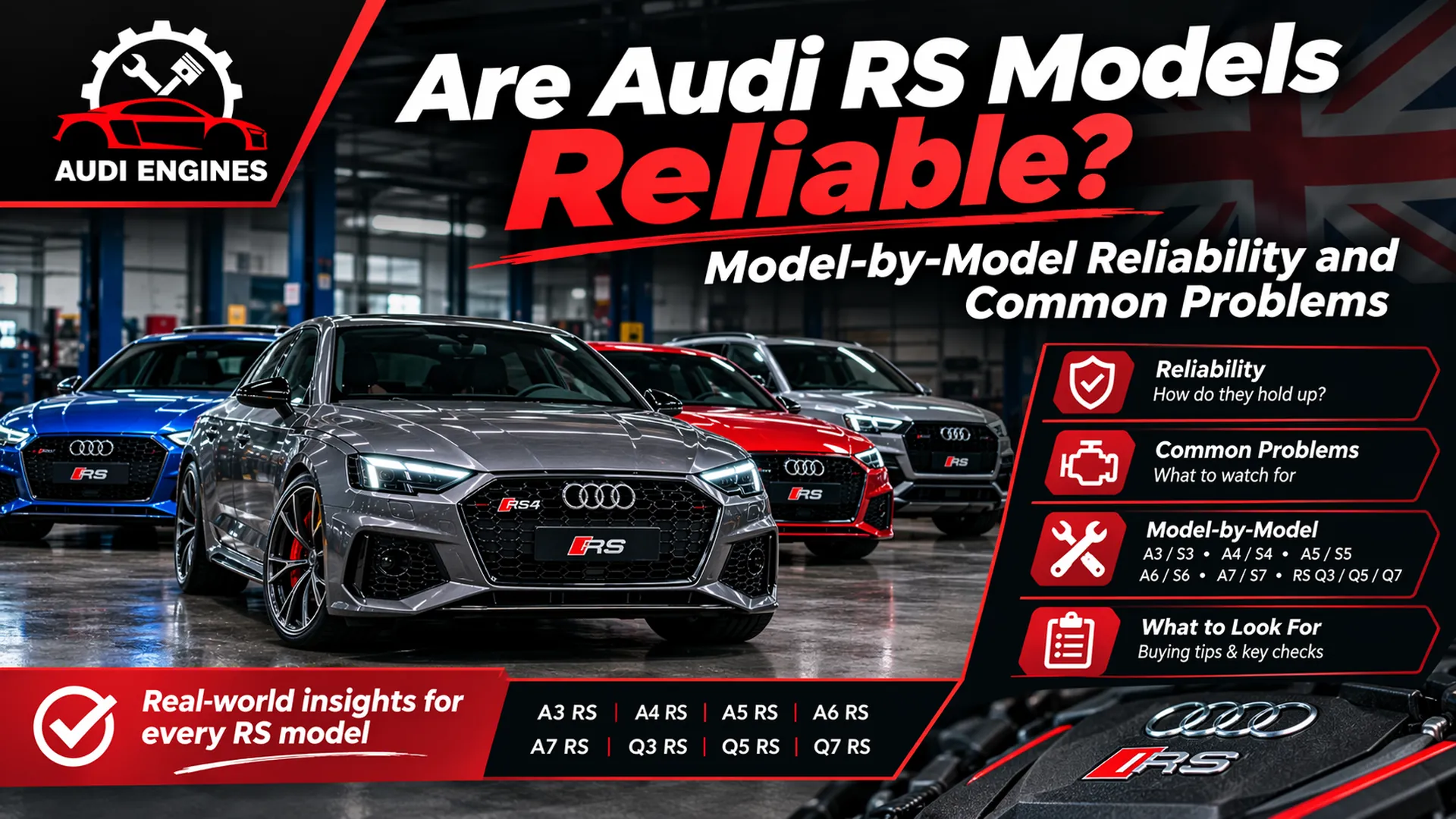
Are Audi RS Models Reliable? Model-by-Model Reliability and Common Problems
Audi Sport builds RS models to deliver far more power than their standard A and Q siblings. That means higher cylinder pressures, more heat and heavier loads on the drivetrain, brakes and suspension. An RS can have a strong engine and still cost more to keep healthy than a regular Audi.
Reliability and affordability are two separate questions. A car can rarely break down and still be expensive to run, because of specialist labour, performance tyres, large brakes and complex all-wheel-drive hardware. Keep that distinction in mind as you read.
Which Audi RS Model Is the Most Reliable: RS3, RS4, RS5, RS6, RS7 or RS Q3?
No single RS is the definitive winner, and anyone who claims otherwise is guessing. The honest answer is that the most reliable RS is usually the one with a complete service history, no heavy tuning and sensible ownership behind it. Within that, the table below shows where each model and generation tends to need attention.
Model and generation | Engine | Gearbox | Main watch points | Repair complexity |
| RS3 8P | 2.5 TFSI five-cylinder, CEPA | 7-speed S tronic, DQ500 | Haldex servicing, ageing cooling parts, carbon deposits | Moderate |
| RS3 8V | 2.5 TFSI five-cylinder, DAZA on early cars | 7-speed S tronic, DQ500 | Coolant leaks, Haldex, Magnetic Ride dampers, brake wear, tuned cars | Moderate to high |
| RS3 8Y | 2.5 TFSI five-cylinder | 7-speed S tronic | Newer, so less long-term data; check software updates and rear torque splitter | Moderate to high |
| RS4 B7 | 4.2 naturally aspirated V8 | 6-speed manual | Intake valve carbon, oil and coolant seals, clutch wear | High |
| RS4 B8 | 4.2 naturally aspirated V8 | 7-speed S tronic | Timing chain wear, carbon build-up, oil leaks | High |
| RS4 B9 | 2.9 twin-turbo V6 TFSI | 8-speed ZF automatic | Younger cars, so inspect for leaks, software issues and neglected servicing | Moderate to high |
| RS5 8T | 4.2 naturally aspirated V8 | 7-speed S tronic | Timing chain and tensioner condition, carbon, coolant leaks | High |
| RS5 F5 | 2.9 twin-turbo V6 TFSI | 8-speed ZF automatic | Servicing history, oil and coolant seepage, brake wear | Moderate to high |
| RS6 C5 | 4.2 twin-turbo V8 | 5-speed automatic | Turbochargers, ignition coils, Dynamic Ride Control, age-related wear | High |
| RS6 C6 | 5.0 twin-turbo V10 | 6-speed automatic | Very complex engine bay, cooling system, suspension | Very high |
| RS6 and RS7 C7 | 4.0 TFSI twin-turbo V8 | 8-speed automatic | Oil consumption, coolant pipes, turbo-related leaks | High |
| RS6 and RS7 C8 | 4.0 TFSI twin-turbo V8, mild hybrid | 8-speed automatic | Newer cars, so check software, electrical faults and servicing | High |
| RS Q3 | 2.5 TFSI five-cylinder | 7-speed S tronic | Haldex servicing, cooling, carbon deposits | Moderate |
Two patterns stand out. First, the five-cylinder 2.5 TFSI has built a strong reputation and won multiple International Engine of the Year awards, but it still needs correct oil, cooling system care and honest servicing. Second, the older naturally aspirated V8 cars are mechanically impressive but costly when timing chain components or intake valve deposits need attention.
For most buyers, the practical takeaway is simple. A newer car with a documented history carries less age-related risk. An older RS can be rewarding, but budget for preventive maintenance rather than hoping nothing goes wrong.
What Are the Most Common Audi RS Engine Problems: Oil Consumption, Carbon Build-Up and Timing Chain Faults?
These are the engine faults that come up most often across the RS range. Not every car will suffer from all of them, and many owners never meet most of them. Treat this as an inspection guide, not a prediction.
Oil consumption. Performance petrol engines use some oil, especially when driven hard. Trouble starts when consumption becomes heavy or the level is rarely checked. Low oil starves bearings and damages turbochargers. Ask the seller how much oil the car uses between services, and check the dipstick or oil level display yourself.
Carbon build-up on intake valves. Direct fuel injection sprays fuel into the cylinder rather than over the back of the intake valves, so nothing washes the deposits away. Over time they restrict airflow. Typical signs are rough idle, hesitation, a misfire under load and lost power. A professional carbon cleaning service restores performance when it is caught in time.
Timing chain and tensioner wear. On the 4.2 V8 engines in the RS4 and RS5, timing chain guides and tensioners are a well-known concern. A rattle on a cold start deserves immediate attention. Ignoring it risks serious internal damage.
Turbocharger and boost faults. Boost leaks, failed diverter valves and worn turbos show up as loss of power, whistling noises or a boost pressure fault code. Tuned cars place extra strain on these parts.
Coolant leaks, water pump and thermostat failure. Plastic coolant pipes and housings age with heat cycles. A dropping coolant level, a sweet smell or fluctuating temperature all point to the cooling system. Overheating can cause severe engine damage, so do not drive a car that is losing coolant.
Ignition coils and spark plugs. Misfires under acceleration often trace back to worn plugs or failing coils. This is usually a modest repair, but only if you deal with it before unburnt fuel damages other components.
Fuel injectors and the high-pressure fuel pump. Hard starting, rough running and fuelling fault codes can point here. Direct injection systems run at very high pressures and are sensitive to fuel quality and wear.
Warning signs worth acting on straight away:
- A flashing or persistent engine management warning light
- Oil or coolant level dropping between services
- Rattling or ticking on a cold start
- Misfire, hesitation or lost power under acceleration
- Unusual smoke, smells or temperature swings
Early diagnosis nearly always saves money. A fault code scan and a specialist inspection will usually tell you whether you are looking at a small repair or the start of something larger.
Are Audi RS Engines and Gearboxes Reliable After 100,000 Miles?
Many are, provided the car has been looked after. Mileage matters less than maintenance. A 90,000-mile RS with regular specialist servicing is often a safer bet than a 40,000-mile car that sat neglected with old fluids.
Use the bands below as inspection categories, not failure thresholds.
Mileage band | What to focus on |
| Under 30,000 miles | Check for gaps in service history, long periods of inactivity, and evidence of early modifications |
| 30,000 to 60,000 miles | Confirm gearbox and Haldex fluid changes, spark plugs, brake condition and any early oil or coolant seepage |
| 60,000 to 100,000 miles | Look closely at cooling system parts, ignition components, suspension dampers and signs of carbon deposits |
| Over 100,000 miles | Expect wear items to need attention; verify timing chain health, turbo condition and evidence of past major repairs |
On drivetrains, the S tronic dual-clutch gearbox, including the DQ500, is generally robust when its fluid and filter are changed on schedule. Neglect is what causes trouble: gearbox hesitation, judder, gear selection problems and, in worse cases, mechatronic unit failure. The Haldex coupling in front-biased quattro RS cars needs fluid and filter changes too, and skipping them can lead to vibration and loss of traction. The 8-speed ZF automatic in newer RS4, RS5, RS6 and RS7 cars is a conventional torque converter gearbox with a strong reputation, though it still benefits from fresh fluid.
Some useful context from the data: CarCostCheck reports an 89 per cent MOT pass rate from 668 Audi RS tests in its 2024 dataset. That is a helpful signal about general condition, but an MOT checks safety and emissions, not internal engine health. It cannot tell you whether a timing chain is worn or a turbo is tired.
If you are shopping for a high-mileage RS and notice oil loss, misfires or a warning light, book an engine diagnostic with audiengines.co.uk before you commit to buying or keep driving.
How do Audi RS models compare with BMW M and Mercedes-AMG? Every performance brand has its weak points. BMW M and Mercedes-AMG engines have their own well-documented concerns, and all three rivals demand specialist care. In practice, the car's history and maintenance record usually count for more than the badge on the bonnet. Compare individual cars, not brands.
How Much Does It Cost to Maintain and Repair an Audi RS in the UK?
Running an RS costs more than running a standard Audi, and the gap comes mostly from parts and labour rather than frequent breakdowns. We deliberately avoid quoting fixed figures here, because costs vary by model, generation, location and garage. Always ask for a written quote before work starts.
Are Audi RS Cars Expensive to Maintain, and How Does Servicing Affect Reliability?
Yes, they are generally expensive to maintain, but sensible servicing is the best protection against the large bills. Think of maintenance as the price of keeping the engine, gearbox and quattro system healthy.
The table below ranks typical jobs by relative cost, so you can plan without surprises.
Job | Relative cost | Notes |
| Annual service and oil change | Moderate | Use the correct specification oil and genuine or equivalent quality filters |
| Spark plugs and ignition coils | Low to moderate | Replace plugs on schedule to prevent misfires |
| Brake discs and pads | Moderate to high | Large performance brakes and Brembo components cost more than standard parts |
| Gearbox and Haldex servicing | Moderate | Fluid condition has a direct effect on drivetrain life |
| Carbon cleaning | Moderate | Worth doing when symptoms appear on direct injection engines |
| Water pump, thermostat and coolant pipes | Moderate to high | Labour is a big part of the bill on tightly packaged engines |
| Suspension and adaptive dampers | Moderate to high | Dynamic Ride Control and Magnetic Ride parts are costly |
| Timing chain work | High | Labour heavy, especially on V8 engines |
| Turbocharger replacement | High | Often paired with checks of oil supply and boost control parts |
| Engine rebuild or replacement | Very high | Decision depends on engine condition, car value and warranty needs |
Day-to-day running costs matter too. Performance tyres wear quickly, fuel consumption is high when you use the power, and insurance premiums reflect the car's performance and repair values. Factor these in alongside servicing.
Specialist or main dealer? Main dealers offer manufacturer backing and software access. Independent Audi and VAG specialists often provide the same standard of work with more personal attention, and they tend to know the model-specific quirks well. For older RS models out of warranty, a specialist who knows the car is often the smarter choice. Whoever you pick, keep every invoice, because a documented history protects both reliability and resale value.
Are modified Audi RS cars less reliable? Often, yes. Remaps, larger turbos, downpipes and aggressive launch control all add stress to the engine, clutch packs and drivetrain. A well-executed tune from a reputable specialist can run happily. A cheap file on a tired car is a gamble. If you are buying a tuned RS, ask for dyno sheets, receipts for the parts fitted and proof that supporting maintenance was done.
When does repair or replacement make sense? For an engine with serious internal damage, the choice is usually between a rebuild and a replacement unit. A rebuild suits cars with sentimental or collector value, or where the original engine is rare. A reconditioned or replacement engine often suits a daily driver where time and certainty matter. A proper inspection should come first, because an accurate diagnosis can reveal that the problem is smaller than feared. Our engine repair, rebuild and replacement services start with exactly that kind of assessment.
Should You Buy a Used Audi RS? What to Check Before You Buy

A used RS can be a brilliant purchase. It can also be a costly mistake if you skip the homework. Treat the car's paperwork and condition with equal suspicion until both are proven.
What Should You Check Before Buying a Used Audi RS: Service History, Modifications and Engine Condition?
Work through this checklist before you hand over any money.
- Full service history. Look for regular oil changes, gearbox and Haldex fluid services, and invoices from a recognised dealer or specialist. Gaps are a red flag.
- Cold start. Ask the seller not to warm the car up before you arrive. Listen for timing chain rattle, ticking or rough running in the first few seconds.
- Oil and coolant levels. Check both, then look under the car and around the engine bay for leaks, residue and stains.
- Fault codes. A diagnostic scan reveals stored faults that warning lights may not be showing. This is one of the cheapest checks you can make.
- Gearbox behaviour. On the test drive, feel for hesitation, judder, harsh shifts or slipping. Try the car in different drive modes.
- Quattro and drivetrain. Listen for vibration or noise under load and during tight turns at low speed.
- Turbo and boost. The car should pull cleanly through the rev range with no whistling, smoke or sudden loss of power.
- Brakes and suspension. Check disc and pad wear, listen for knocking over bumps, and make sure adaptive dampers work properly.
- Signs of tuning. Look for aftermarket parts, remapped software, non-standard exhausts and missing paperwork for modifications.
- MOT history. Use the DVSA online record to review past failures, advisories and mileage consistency.
Which RS cars need extra caution? Approach older V8 cars, high-mileage examples and heavily modified cars with extra care. Ask harder questions about timing chain history, cooling system work and fuel system condition. Newer cars need a closer look at software updates and warranty status.
Arrange a specialist pre-purchase inspection. A trained eye with the right diagnostic equipment can spot what a test drive cannot. It costs far less than finding a hidden fault after purchase, and it gives you solid evidence to negotiate. Book a pre-purchase inspection or engine diagnostic with audiengines.co.uk and buy with confidence.
Frequently Asked Questions About Audi RS Reliability
Which Audi RS model is the most reliable?
There is no single proven winner. Cars with the five-cylinder 2.5 TFSI, such as the RS3 and RS Q3, enjoy a strong reputation, but service history and ownership matter more than the badge. Judge each car on its own condition and records.
Are Audi RS cars expensive to maintain?
Yes, compared with a standard Audi. Specialist labour, large brakes, performance tyres and complex drivetrains raise the bills. Regular preventive servicing keeps costs predictable and helps you avoid major repairs.
How long do Audi RS engines last?
A well-maintained RS engine can last well beyond 100,000 miles. Longevity depends on correct oil, timely servicing, cooling system health and how hard the car has been driven or tuned.
Do Audi RS models have timing chain problems?
Some do. The 4.2 V8 engines in the RS4 and RS5 are the best-known examples, where tensioners and guides can wear. A cold-start rattle should always be investigated by a specialist.
Are used Audi RS cars worth buying?
They can be, if you buy carefully. A documented service history, a clean diagnostic scan and a pre-purchase inspection greatly reduce risk. Set money aside for preventive maintenance as well.
Are modified Audi RS cars less reliable?
Often they are, because tuning increases heat, pressure and drivetrain stress. Quality matters, so ask for evidence of professional work and supporting maintenance before buying a tuned car.
How can you improve Audi RS reliability?
Service on time using the correct oil and filters, change gearbox and Haldex fluids, fix small leaks quickly, let the engine warm up before hard driving, and use a specialist who knows the model.
Is the Audi RS3 more reliable than the RS6?
The RS3 is generally simpler and cheaper to repair, which makes ownership less stressful. The RS6 carries more complex hardware, so faults tend to cost more. Neither is automatically better, and condition matters most.
Are Audi RS engines reliable at high mileage?
Many are, when maintained properly. Focus on evidence of regular servicing, cooling system work and engine health checks rather than the odometer alone.
Are Audi RS cars suitable for daily driving?
Yes, and many owners use them every day. Expect firm rides, thirsty fuel use and higher running costs than a normal family car, and keep up with servicing.
Final Verdict: So, Are Audi RS Models Reliable?
Audi RS models can be reliable, but they reward owners who respect them. The cars that cause the most grief are the ones with missing history, deferred servicing and heavy tuning. The ones that give the most pleasure are looked after by owners who treat maintenance as part of the deal.
If you are buying, inspect the car thoroughly and get a specialist opinion. If you already own one, stay ahead of the faults covered above and act on early warning signs. And if your RS is showing symptoms of engine trouble, Audi Engines can diagnose the fault, repair it, rebuild the engine or supply a replacement. Get in touch with audiengines.co.uk today and keep your RS performing the way Audi Sport intended.