
Audi A7 3.0 TFSI High Pressure Fuel Pump Failure: Symptoms, Diagnosis and Repair
Your A7 cranks for far longer than it should before it fires. Or it hesitates when you press the throttle, throws up a warning light, or drops into limp mode on a motorway slip road. Naturally, you suspect the fuel pump.
Your A7 cranks for far longer than it should before it fires. Or it hesitates when you press the throttle, throws up a warning light, or drops into limp mode on a motorway slip road. Naturally, you suspect the fuel pump.
You may well be right. But here is the point that saves owners the most money: symptoms and fault codes tell you there is a fuel pressure problem, not which part is causing it. Audi A7 3.0 TFSI high pressure fuel pump failure is a real possibility, yet a sensor, a metering valve, an injector or a restriction on the supply side can produce almost identical symptoms. That is why testing must come before replacement.
This guide explains the symptoms, what the fault codes mean, how a proper diagnosis works and what affects the cost of repair. If you would rather have the cause confirmed by a specialist, you can book a fuel pressure diagnosis at any point.
What Are the Symptoms of Audi A7 3.0 TFSI High Pressure Fuel Pump Failure?
Fuel pressure faults rarely arrive all at once. They usually start as an occasional annoyance and build. Knowing the pattern helps you describe the problem accurately, and that speeds up diagnosis.
Why Does My Audi A7 Crank for a Long Time, Hesitate or Lose Power?
Because the engine is not getting fuel at the pressure it needs. The 3.0 TFSI uses direct injection, which means fuel must be delivered to the injectors at very high pressure. When the high-pressure fuel pump (HPFP) or the system around it cannot build or hold that pressure, the engine struggles.
The most common symptoms are:
- Hard starting and extended cranking: the engine turns over longer than usual before firing, sometimes only when hot or only when cold. Note which, because it helps narrow the cause.
- Hesitation under acceleration: the car feels flat or stumbles when you ask for power, because fuel demand rises with engine load.
- Rough idle and engine misfire: unstable running, sometimes with a flashing or steady engine warning light.
- Reduced power or limp mode: the engine management system restricts output to protect the engine when pressure deviates from what it expects.
- Intermittent stalling or failure to start: the engine cuts out at idle or refuses to restart.
- Engine warning light: often with stored fuel pressure fault codes.
Several of these overlap with ignition faults, so a misfire alone does not point to the fuel system. What matters is the full picture: when it happens, how often, and what the stored data shows.
HPFP versus LPFP, in plain language. The fuel system works in two stages. The low-pressure fuel pump (LPFP) sits in the tank and supplies fuel to the engine. The high-pressure fuel pump (HPFP) then raises that fuel to the pressure the injectors need. If the low-pressure side delivers poorly, the high-pressure pump cannot do its job, and the symptoms can look like a failed HPFP. Separating the two is a core part of diagnosis.
A note on engine variants. The 3.0 TFSI badge has covered more than one engine configuration, including supercharged and later turbocharged versions, across different model years. Component layout, pump location and test procedures are not identical across them. Always confirm the exact engine code and model year before assuming anything about your car. We confirm this from your registration before we start.
A safety point. Do not keep driving a car that stalls or loses power suddenly. Loss of power in traffic is a genuine hazard. Never open or disconnect the high-pressure fuel system without the correct procedure and equipment. The fuel is under very high pressure, and it is a fire and injury risk.
Recognise these symptoms? Book an Audi A7 fuel pressure diagnosis and we will find out whether the pump is really the problem.
What Fault Codes Point to a Fuel Pressure Problem, and Does P0087 Mean the Pump Has Failed?
No, not on its own. This is one of the most common misunderstandings in fuel system repair. A code tells you what the engine management system has measured. It does not tell you which part caused it.
What Do P0087, P0088, P0191, P2293 and P2294 Mean on an Audi A7?
Here is what each code generally indicates. The exact meaning and the right test depend on your engine and model year, so treat this as a guide, not a diagnosis.
Code | General meaning | What it points to | What else can cause it |
| P0087 | Fuel rail or system pressure too low | Measured pressure fell below the expected value | Weak HPFP, restricted supply, faulty metering valve, injector leak, sensor fault |
| P0088 | Fuel rail or system pressure too high | A different condition from low pressure | Pressure control or metering fault, sensor error |
| P0191 | Fuel rail pressure sensor range or performance | The sensor reading is questionable | Failing sensor, wiring or connector fault, or a genuine pressure problem |
| P2293 | Fuel pressure regulator performance | Pressure regulation is not behaving as expected | Regulation or control fault, metering valve, pump |
| P2294 | Fuel pressure regulator control circuit | A control circuit issue | Wiring, connector or control component fault |
The key message is simple. A code flags a deviation, not a culprit. P0087, for example, tells you rail pressure was lower than the engine wanted. A tired pump can cause that. So can a blocked supply line, a leaking injector or a faulty metering valve. Replacing the pump on the strength of the code alone is a gamble.
Other factors can also affect readings and symptoms, including weak battery voltage, wiring faults and connector corrosion. A good technician rules these out first.
A typical scenario. An owner has a stored P0087 and a car that cranks for several seconds when hot. A pump is fitted, but the problem returns. Testing then shows the low-pressure supply was delivering poorly, so the new pump was never the cause. The owner paid for a part they did not need and still had the fault. Diagnosis first would have found it at the start.
What Else Can Mimic HPFP Failure on a 3.0 TFSI?
Several components produce overlapping symptoms. This is how each is typically separated from the pump:
Suspect part | Symptoms that overlap | How it is ruled in or out |
| Low-pressure fuel pump or supply | Hard starting, loss of power | Check supply pressure and delivery before the HPFP |
| Fuel pressure sensor | Warning light, erratic pressure data | Compare sensor data with measured pressure, check wiring |
| Fuel metering valve | Pressure regulation faults, hesitation | Review control data and test the valve circuit |
| Fuel injectors | Misfire, pressure loss after shutdown | Test for leakage and check residual pressure |
| Restricted filter or fuel line | Power loss under load | Inspect and test supply side |
| Wiring, connectors, battery voltage | Intermittent faults | Electrical checks and voltage testing |
This is also why repeat failures happen. If the underlying cause is not found, a new pump can be asked to work against the same fault, and the problem returns. Finding the cause once is cheaper than replacing parts twice.
Want the cause confirmed before you spend money on a pump? Get the cause confirmed with a proper fuel pressure test.
How Is Audi A7 Fuel Pressure Diagnosed Before Replacing the Pump?
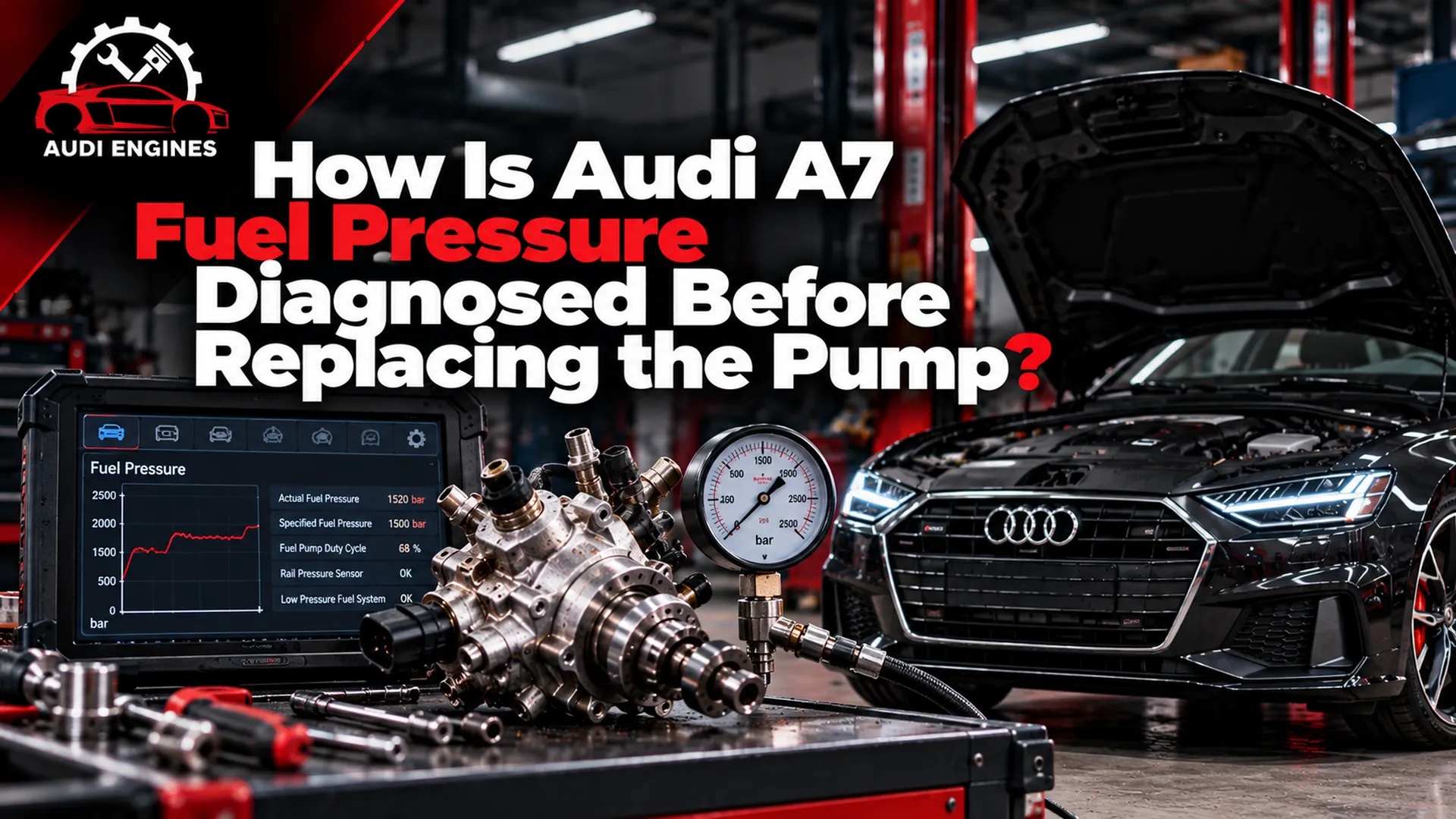
A structured diagnosis follows a clear order. Each step either confirms or eliminates a suspect, so by the end you know what is wrong, not what might be wrong.
What Tests Confirm a Faulty High Pressure Fuel Pump?
The process normally runs like this:
- Record the details. Engine code, model year, mileage and the exact symptoms, including whether the fault appears hot, cold or under load.
- Scan for stored and pending fault codes. This reveals what the engine management system has already flagged, along with freeze frame data showing the conditions at the time.
- Compare specified and actual fuel pressure. Using live data and the engine-specific procedure, the technician checks whether actual rail pressure follows what the system is commanding.
- Check the low-pressure supply and electrical control. Is the HPFP receiving fuel at the right pressure and volume? Are power and control signals reaching the pump?
- Assess the HPFP, metering valve, sensor and injectors. The test results indicate where to look next.
- Confirm the cause. Only then is a component recommended.
- Verify the repair. After the work, a follow-up test and fault code check confirm that pressure now behaves correctly.
You should receive the outcome in plain English: what was tested, what was found and what is recommended. Ask any garage to show you the evidence, not just the conclusion.
The repair itself follows a defined route. The correct part is matched using your VIN and engine code, the pump is replaced where testing supports it, and post-repair checks confirm the fault is resolved. A replacement part may need to be checked against the vehicle's engine management system, so ask whether any adaptation or software step applies to your car.
Diagnostic fees, duration and what the fee covers vary between garages. Ask for these in writing before work starts.
Can I Drive My Audi A7 With a Suspected Fuel Pump Fault?
It is safest not to. A fuel delivery fault can cause stalling or a sudden loss of power, and neither is something you want at speed or in traffic.
If symptoms are mild and intermittent, limit your driving to what is essential and book an inspection promptly. If the car stalls, loses power badly or shows a warning light alongside poor running, stop safely and arrange recovery. Driving on with a worsening fault risks leaving you stranded and can put extra strain on other components. A fault that is cheap to diagnose today can become a larger problem if you keep driving
How Much Does Audi A7 Fuel Pump Replacement Cost in the UK, and Who Should I Trust to Fix It?
The honest answer is that it depends on what the diagnosis finds. We would rather explain the cost drivers than quote a number that may not fit your car.
What Affects the Cost of an Audi A7 High Pressure Fuel Pump Replacement?
The main factors are:
- Diagnostic fee: confirming the fault properly takes time and equipment. Ask whether it is included or charged separately.
- Pump and parts cost: the price depends on your engine and the parts chosen.
- Genuine or OEM-equivalent parts: this affects both cost and warranty. A good garage states clearly which it fits.
- Labour and access: the time needed depends on the engine configuration and how easily the pump can be reached.
- Additional faults: if testing finds a worn sensor, a faulty metering valve or leaking injectors, those add to the work.
- VAT: always check whether a quote includes it.
- Engine code and VIN matching: the correct part must be identified for your specific car.
Be wary of any quote given without knowing your engine and without any testing. A fixed price for a pump, quoted over the phone, rarely accounts for what the diagnosis will find.
Before you approve a quote, ask:
- Is the diagnosis included, or charged separately?
- Are the parts genuine Audi or OEM-equivalent?
- What warranty covers parts and labour?
- What happens if further faults are found once work begins?
- Will the fix be verified with a follow-up test?
Replace or repair? Where testing confirms the pump has failed, replacement is the normal route. Where it points to a sensor, valve or injector, treating the real cause is both cheaper and more effective than fitting a pump.
How to choose a specialist. Look for these signs:
- Audi-specific experience with your engine type
- A genuine diagnostic process, not a parts-first approach
- Itemised, written quotes that show exactly what is covered
- A clear warranty in writing
- Genuine reviews and real examples of similar fault-finding jobs
The cheapest quote and the best value are rarely the same thing. Compare like with like, and favour the garage that explains its reasoning.
Ready for a clear answer on your car? Request an Audi A7 fuel system quote with your registration, and we will confirm your engine before we price anything.
Frequently Asked Questions About Audi A7 Fuel Pump Failure
What are the symptoms of a failing high-pressure fuel pump on an Audi A7?
The most common are long cranking before starting, hesitation under acceleration, rough idle, misfires, reduced power or limp mode, intermittent stalling and an engine warning light. These can also come from other fuel system faults, so testing is needed to confirm the cause.
Can a faulty HPFP cause an engine misfire?
Yes. If fuel pressure drops below what the engine needs, combustion suffers and misfires can follow. Ignition faults and injector problems also cause misfires, so the fuel system should be tested rather than assumed.
Does P0087 always mean the high-pressure fuel pump is faulty?
No. P0087 means rail pressure was lower than expected. The pump, the low-pressure supply, the metering valve, the sensor or the injectors could each be responsible.
What does P2293 mean on an Audi petrol engine?
It relates to the performance of the fuel pressure regulation. It points to a regulation or control issue, not automatically to a failed pump. The correct reading depends on your engine and model year.
Can a faulty fuel pressure sensor mimic pump failure?
Yes. A failing sensor can report incorrect pressure, triggering warning lights and poor running. Comparing the sensor's data with measured pressure helps separate a sensor fault from a genuine pump problem.
What is the difference between an HPFP and an LPFP?
The low-pressure pump supplies fuel from the tank to the engine. The high-pressure pump then raises that fuel to the pressure the injectors need. A fault in either stage can cause similar symptoms.
Can a faulty fuel injector cause low rail pressure?
It can. A leaking injector can allow pressure to fall, which may show up as hard starting or pressure loss after shutdown.
Why does my Audi A7 crank for a long time before starting?
Extended cranking often means fuel pressure is slow to build, or leaks away after shutdown. Causes include the pump, supply issues, injectors or the pressure sensor.
Can a bad fuel pump cause limp mode?
It can. When pressure deviates from what the system expects, the engine management may restrict power to protect the engine.
Can a weak battery cause starting problems that resemble pump failure?
Yes. Low voltage can cause slow cranking and erratic electrical behaviour. Battery and electrical checks are part of a sound diagnosis.
Does a replacement fuel pump need coding or adaptation?
It can depend on the engine and system. Ask your garage whether any adaptation or software step applies to your car, and make sure it is carried out where needed.
Why is fuel pressure still low after pump replacement?
Usually because the pump was not the root cause. A supply restriction, metering valve fault, sensor problem or leaking injector can remain after a new pump is fitted. Further testing finds the real cause.
How long does it take to replace an Audi A7 fuel pump?
It depends on the engine configuration and access. Ask your garage for a realistic timeframe in writing, including the diagnostic stage.
Can fuel pump failure damage the engine?
A running fault can strain other components and leave you stranded. Prompt diagnosis limits the risk and keeps repair costs down.
Is a genuine Audi pump better than an aftermarket one?
Quality varies between parts. What matters is that the part suits your exact engine, comes from a reliable source and is backed by a clear written warranty.
What details are needed for a quote?
Your registration number, the engine code if you know it, your mileage, the symptoms and any fault codes already stored.
Get Your Audi A7 Fuel Pressure Problem Diagnosed Properly
A fuel pressure fault is easy to misread and expensive to guess at. The surest route is to test first, confirm the cause and only then replace what has actually failed. That protects your money and your engine.
Send us your registration number and a short description of what the car is doing. We will confirm your engine, explain the likely cause and put our findings and figures in writing before you commit. Book your Audi A7 fuel pressure diagnosis today by phone, through our online form or with a registration lookup.