
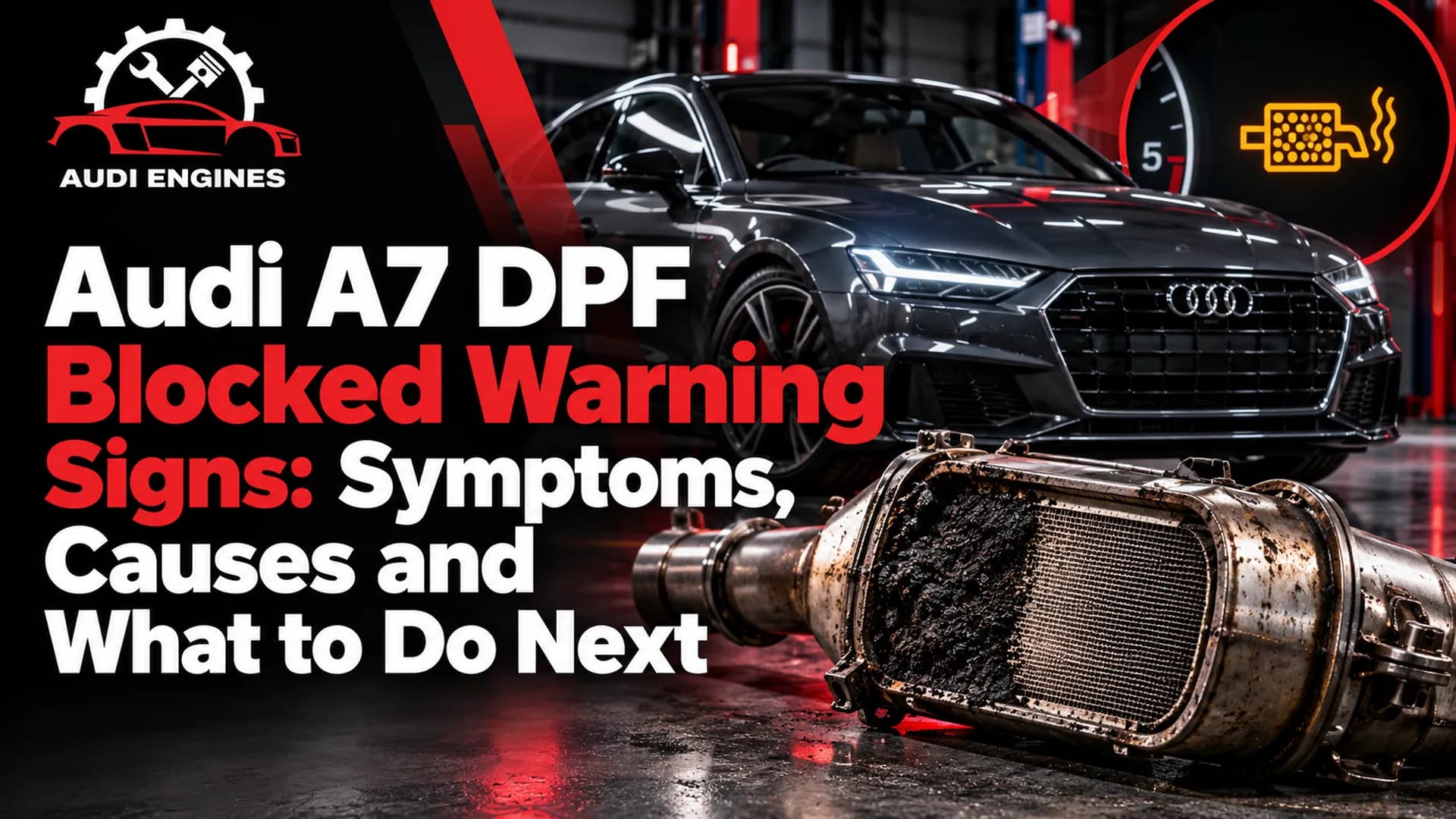
Audi A7 DPF Blocked Warning Signs: Symptoms, Causes and What to Do Next
Your Audi A7 has lost its usual pull, a DPF warning light has appeared on the dashboard, or the car has dropped into limp mode on a dual carriageway. Now you're wondering whether this is a simple fix or the start of a four-figure bill. If you're searching for Audi A7 DPF blocked warning signs.
Your Audi A7 has lost its usual pull, a DPF warning light has appeared on the dashboard, or the car has dropped into limp mode on a dual carriageway. Now you're wondering whether this is a simple fix or the start of a four-figure bill.
If you're searching for Audi A7 DPF blocked warning signs, you want to know what to look for, what else could be causing it, and what to do next. This guide covers all three.
One point first. A diesel particulate filter (DPF) is fitted only to the diesel TDI versions of the A7, such as the 3.0 TDI and 2.0 TDI. Petrol A7s don't have one, so these symptoms won't apply to them. Warning lights and symptoms also point to a system, not a proven failed part. A proper diagnosis confirms the cause before anyone replaces anything.
At audiengines.co.uk, we supply engines for Audi models across the UK. Most DPF problems are repairable, and we'll say so. We also know the rare cases where neglect leads to deeper engine damage, and this guide explains how to tell the difference.
What Are the Warning Signs of a Blocked DPF on an Audi A7?
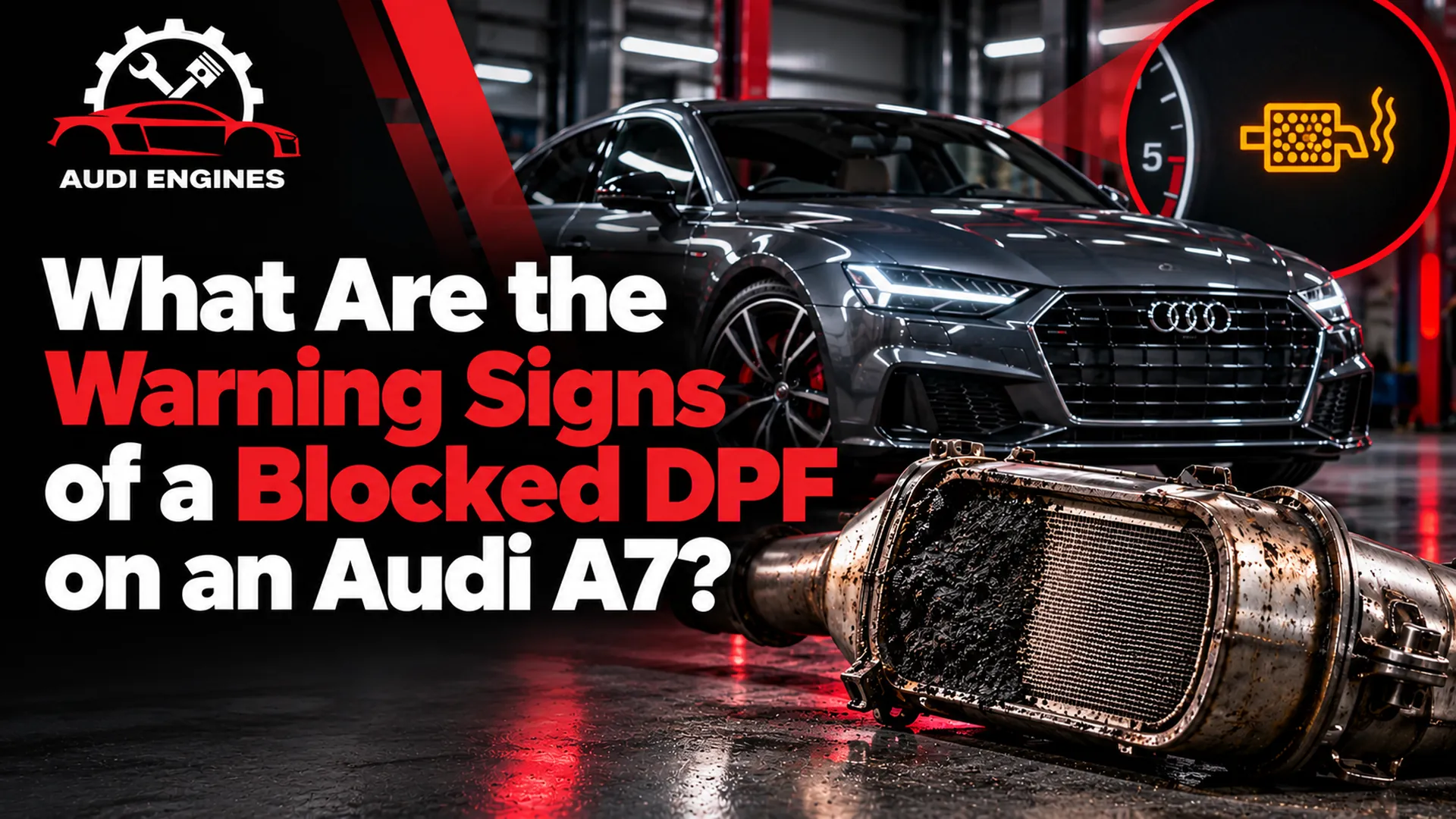
A blocked DPF on an Audi A7 typically shows up as a DPF warning light, loss of power, limp mode, black smoke, poor fuel economy, frequent regeneration and sometimes a diesel smell. The signs usually build gradually, and they often overlap with other faults.
First, what the part does. The DPF traps soot from the exhaust. When enough builds up, the engine runs a regeneration cycle, raising exhaust temperature to burn the soot off. If regeneration keeps failing, perhaps because most journeys are short, soot accumulates and the filter restricts exhaust flow.
Here's how that tends to show itself, from early signs to serious ones.
Early signs
- DPF or engine warning light: the engine control unit (ECU) flags that soot levels are high or regeneration hasn't completed. This is your cue to act, not panic.
- More frequent regeneration: you may notice the fans running after you switch off, a slightly higher idle, or a faint hot, burning smell.
- Poorer fuel economy: each regeneration burns extra fuel, so economy slips when cycles become frequent.
Moderate signs
- Loss of power and sluggish acceleration: a restricted filter makes it harder for the engine to push exhaust out, so the car feels flat.
- Black or grey smoke: the air and fuel balance goes wrong under load.
- Rough running or hesitation: the engine struggles against the exhaust restriction.
Severe signs
- Limp mode: the ECU restricts power to protect the engine when readings fall outside safe limits.
- A rising engine oil level or a fuel smell from the oil: failed regenerations can push unburned diesel into the oil. This is oil dilution, and it needs prompt attention.
- Overheating or heavy smoke: stop driving and have the car inspected.
A separate AdBlue warning is a different system. It relates to the exhaust treatment fluid, not the filter, so don't assume the two are connected.
Treat all of these as clues. As the next section shows, several different faults can produce the same symptoms.
Is It a Blocked DPF, an EGR Fault or Something Else?
This is the question that saves owners the most money. Loss of power and warning lights are shared by several faults, and replacing the wrong part is a common and expensive mistake.
Symptom | Possible causes to investigate | Sensible next step |
| DPF warning light | Soot build-up, failed regeneration, faulty differential pressure sensor | Scan fault codes and check live data |
| Loss of power | Blocked DPF, EGR valve fault, boost leak, turbo fault, airflow sensor | Test boost, airflow and exhaust restriction |
| Limp mode | DPF restriction, turbo or boost-control fault, sensor fault | Record codes and compare live data with expected values |
| Black smoke | Airflow or boost problem, EGR fault, injector fault | Inspect intake, test boost and check fuelling |
| Poor fuel economy | Frequent regeneration, sensor fault, EGR fault, driving pattern | Review regeneration history and live data |
| Rising oil level | Repeated failed regeneration, injector fault | Check oil condition and have the cause diagnosed promptly |
Here's a scenario that shows why testing matters. An A7 owner reports limp mode and a DPF warning. Everyone assumes the filter is blocked and expects a costly replacement. A proper check shows the differential pressure sensor is giving false readings, so the ECU believes the filter is more restricted than it is. The fix is a sensor, not a filter.
That's why a fault code identifies a system or a condition, not a guaranteed failed part. The same code can come from a blocked filter, a faulty sensor, a leaking pipe or a related EGR problem. The A7 EGR valve guide on our site explains how the two systems affect each other.
Not sure what's behind your A7's symptoms? Send us your registration and a description of what's happening, and we'll point you in the right direction.
Can You Drive an Audi A7 With a Blocked DPF?
Sometimes, for a short and cautious journey, but it isn't a fault to ignore. The answer depends on the symptoms.
A steady warning light with otherwise normal driving usually gives you time to book an inspection. Stop and get the car checked promptly if you notice any of these:
- Repeated or severe limp mode
- Heavy black smoke
- An engine oil level that keeps rising
- A rising temperature gauge
- Warning lights that flash rather than stay steady
Carrying on has real costs. Soot builds up, regeneration fails more often, the turbocharger works against the restriction, and diluted oil protects the engine less well. None of this is inevitable, but each week of delay raises the risk. Please don't take advice to remove the filter, either. Removing a DPF is illegal for road use in the UK and will fail an MOT emissions check.
How Is a Blocked Audi A7 DPF Diagnosed, Cleared or Repaired?
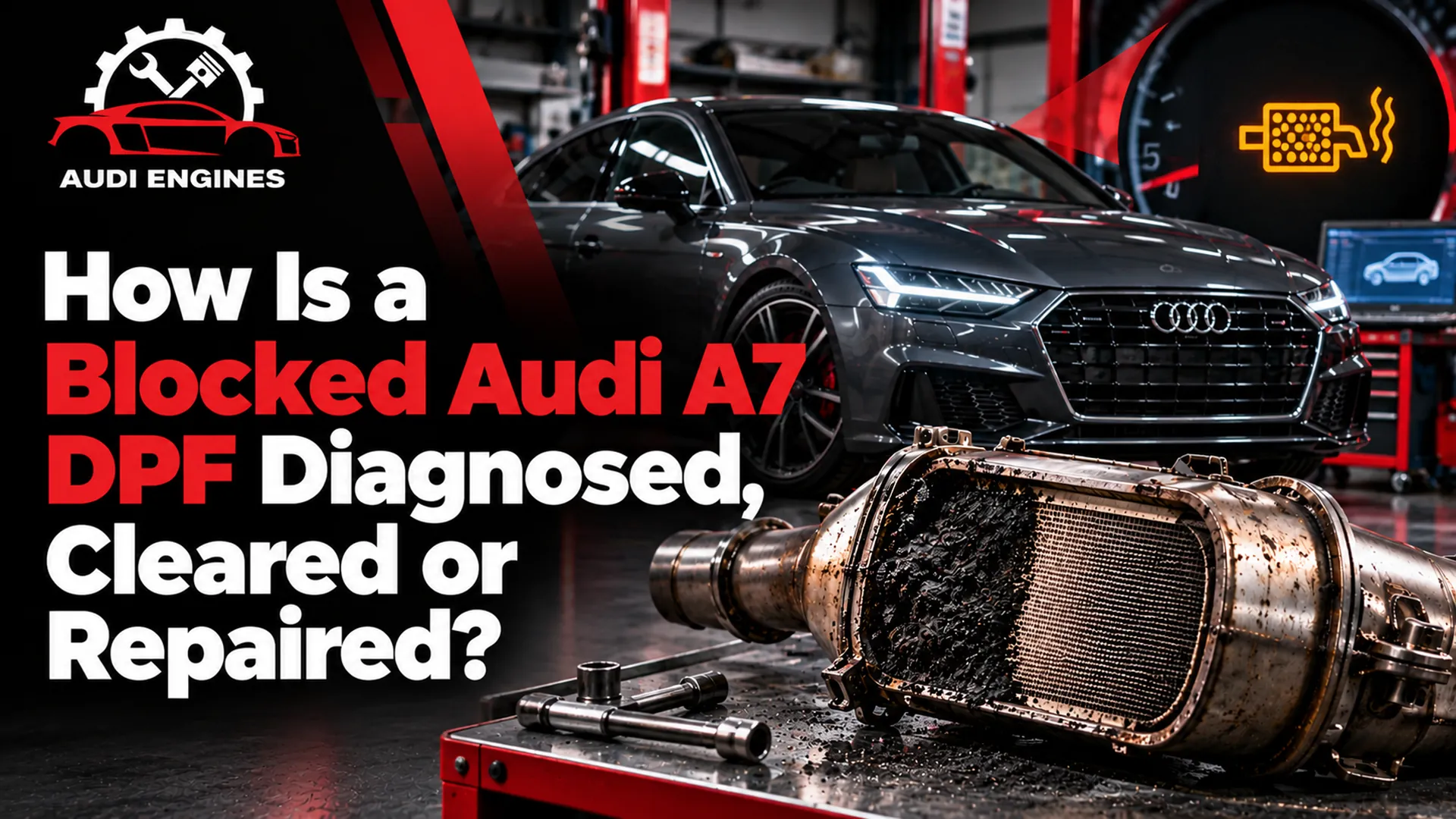
A proper diagnosis follows a sequence. A competent technician doesn't begin by replacing the filter. They begin by finding out what the engine is reporting.
A typical process looks like this:
- Read the fault codes with a diagnostic scanner to see which systems have logged faults.
- Check live data, including the differential pressure sensor, exhaust temperatures and soot loading, against expected values.
- Test boost and airflow to rule out leaks, a failing turbo or a faulty airflow sensor.
- Check the EGR system, because a sticking valve is a common reason soot builds up.
- Inspect pipes, connectors and the filter for damage or leaks.
- Confirm the root cause before any part is replaced.
Once the cause is clear, the options are fairly straightforward: a regeneration drive, a forced regeneration, professional cleaning, sensor or pipework repair, or filter replacement. Which of these is available depends on the garage you use.
Will a Blocked Audi A7 DPF Clear Itself, or Does It Need Professional Help?
Sometimes it clears on its own, but only when the car is otherwise healthy. Think of it in three levels.
Level | What you notice | Likely approach |
| Early | Occasional warning light, light soot build-up, car drives normally | A sustained run at steady speed may let regeneration complete, if there's no underlying fault |
| Moderate | Repeated warnings, noticeable power loss, frequent regeneration | Scan and diagnose, then a forced regeneration if suitable |
| Severe | Limp mode, heavy smoke, restricted exhaust flow | Professional cleaning or replacement after confirming the cause |
Be honest with yourself about the early stage. A long motorway drive can help the filter regenerate, but it's not a cure if a faulty sensor, an EGR problem or a boost leak is the real cause. Driving harder just repeats the problem, and a car that regenerates repeatedly and fails each time can start diluting its oil.
Need a specialist opinion before you spend money? Contact us and tell us what your A7 is doing.
Why Does the Audi A7 DPF Keep Blocking?
A filter that keeps blocking is telling you something. The usual causes are:
- Short journeys: the exhaust rarely reaches the temperature regeneration needs.
- Failed regeneration cycles: interrupted cycles leave soot behind, and the problem compounds.
- A related fault: a sticking EGR valve, a faulty injector or a boost leak can all raise soot output.
- Poor servicing: the wrong oil specification or overdue oil changes add to deposits and strain the filter.
- Fuel quality: low-quality diesel can increase soot.
Prevention is simple. Take regular longer runs so the exhaust reaches full temperature, keep to the service schedule with the correct oil, use good-quality fuel, and don't leave warning lights unchecked. These habits protect the DPF, the EGR system and the turbocharger together.
How Much Does an Audi A7 DPF Repair Cost, and When Does the Engine Need Attention?
The cost of an Audi A7 DPF repair varies widely, and anyone quoting a fixed price without seeing the car should make you cautious. The bill depends on what is actually wrong.
The main cost factors are:
- Cleaning or replacement: cleaning generally costs less, but only suits a filter in good physical condition.
- Parts quality: genuine, OEM-quality and aftermarket parts differ in price and durability.
- Labour time: access depends on the engine and its layout.
- Diagnostic fees: a proper diagnosis takes time, and it's money well spent.
- Related work: an EGR fault, a sensor problem, a boost leak or turbo wear found during diagnosis can add to the job.
- Oil and filters: if the oil has been diluted, it needs changing.
Ask for a written, itemised quote so you can see what's included. One tip from the trade: a very cheap quote often covers only the filter, with nothing allowed for the cause of the blockage. Fix only the symptom, and it tends to come back.
When Does a Blocked DPF Lead to Engine Repair or Replacement?
Most DPF faults are repairable and never reach this stage. But prolonged neglect can lead to deeper trouble.
Engine damage becomes a concern when:
- Repeated failed regenerations have diluted the engine oil and the car is still being driven
- Exhaust restriction has damaged the turbocharger
- The engine has overheated
- Warning signs have been ignored for a long period
If the engine has been seriously damaged, your options are a repair, a rebuild, a second hand engine or a reconditioned engine. A repair suits a single confirmed fault. A rebuild suits internal wear where the major components are sound. Replacement suits severe damage. Reconditioned engines are rebuilt to a defined standard and usually carry stronger warranty cover, while second hand engines cost less but vary more in condition.
At audiengines.co.uk, we supply engines for Audi models across the UK, and we confirm the right match using your engine code, VIN and year before you pay. Wherever you buy, get the engine's condition and warranty terms in writing.
Questions to ask any garage or engine supplier before you commit:
- Has the fault been confirmed by testing, or is this a guess?
- What does the quote include, and what might cost extra?
- Will the cause of the blockage be fixed, not just the filter?
- Is the engine's history and condition documented?
- What exactly does the warranty cover, and for how long?
Ready to talk? Request a quote through our website, or call us to speak to a specialist.
Frequently Asked Questions
What does a blocked DPF warning light look like on an Audi?
It's usually an amber filter-shaped symbol, often with an exhaust or engine warning light alongside it. The exact symbol and message vary by model and year, so check your handbook. A steady light normally gives you time to act, while a flashing one needs prompt attention.
Can I drive my Audi A7 with the DPF light on?
A steady light with normal driving usually allows a short, careful trip, ideally including a sustained run to help regeneration. If the car is in limp mode, smoking heavily, overheating or showing a rising oil level, stop and get it checked.
Will a blocked DPF clear itself?
Sometimes, if the soot build-up is light and the car is otherwise healthy. A longer run at steady speed can let regeneration complete. If a sensor, EGR or boost fault is behind the problem, it won't clear until that is fixed.
How much does it cost to fix a blocked DPF?
It depends on whether the filter needs cleaning or replacing, what caused the blockage and how much labour is involved. Ask for an itemised written quote, and be wary of a price given without a diagnosis.
Will a DPF fault fail the MOT?
It can. A DPF warning light, visible smoke or a removed or tampered filter can lead to an MOT failure. If your car shows any of these signs, get it diagnosed before the test.
Can a blocked DPF damage the engine?
Left alone, it can contribute to turbo strain and oil dilution, and in severe cases to engine damage. Most blocked filters are fixed long before that point, which is why prompt diagnosis matters.
Get Your Audi A7 Diagnosed Before a Warning Light Becomes a Big Bill
A blocked DPF is a common problem and usually a fixable one. The key is reading the warning signs as clues, confirming the real cause through testing, and choosing the right repair instead of the quickest guess.
If your A7 shows these signs, don't ignore them. And if the damage has gone beyond a repair, audiengines.co.uk can supply a suitable Audi engine, matched to your car and backed by clear, written warranty terms. Send us your registration and symptoms today, and we'll tell you honestly what to do next, with no pressure. Request your quote now, or call us to speak to a specialist.