Audi A7 EGR Valve Fault Symptoms: Warning Signs, Causes and What to Do Next
Your Audi A7 hesitates when you pull away, drops into limp mode on a dual carriageway, or throws up a warning light that wasn't there last week. Then comes the worry: is this a small fix, or the start of an expensive engine bill.
Your Audi A7 hesitates when you pull away, drops into limp mode on a dual carriageway, or throws up a warning light that wasn't there last week. Then comes the worry: is this a small fix, or the start of an expensive engine bill?
If you're searching for Audi A7 EGR valve fault symptoms, you want to know what the signs look like, what else could be causing them, and what to do next. This guide covers all three.
One point first. EGR faults mainly affect the diesel TDI versions of the A7, such as the 3.0 TDI and 2.0 TDI, so check which engine you have before reading further. Symptoms also point to a system, not a proven failed part. A good diagnosis confirms the cause before anyone replaces anything.
At audiengines.co.uk, we supply engines for Audi models across the UK. We know that most EGR problems are repairable, and we'll say so. We also know the rare cases where neglect leads to deeper engine damage, and this guide explains how to tell the difference.
What Are the Symptoms of a Failing EGR Valve on an Audi A7?
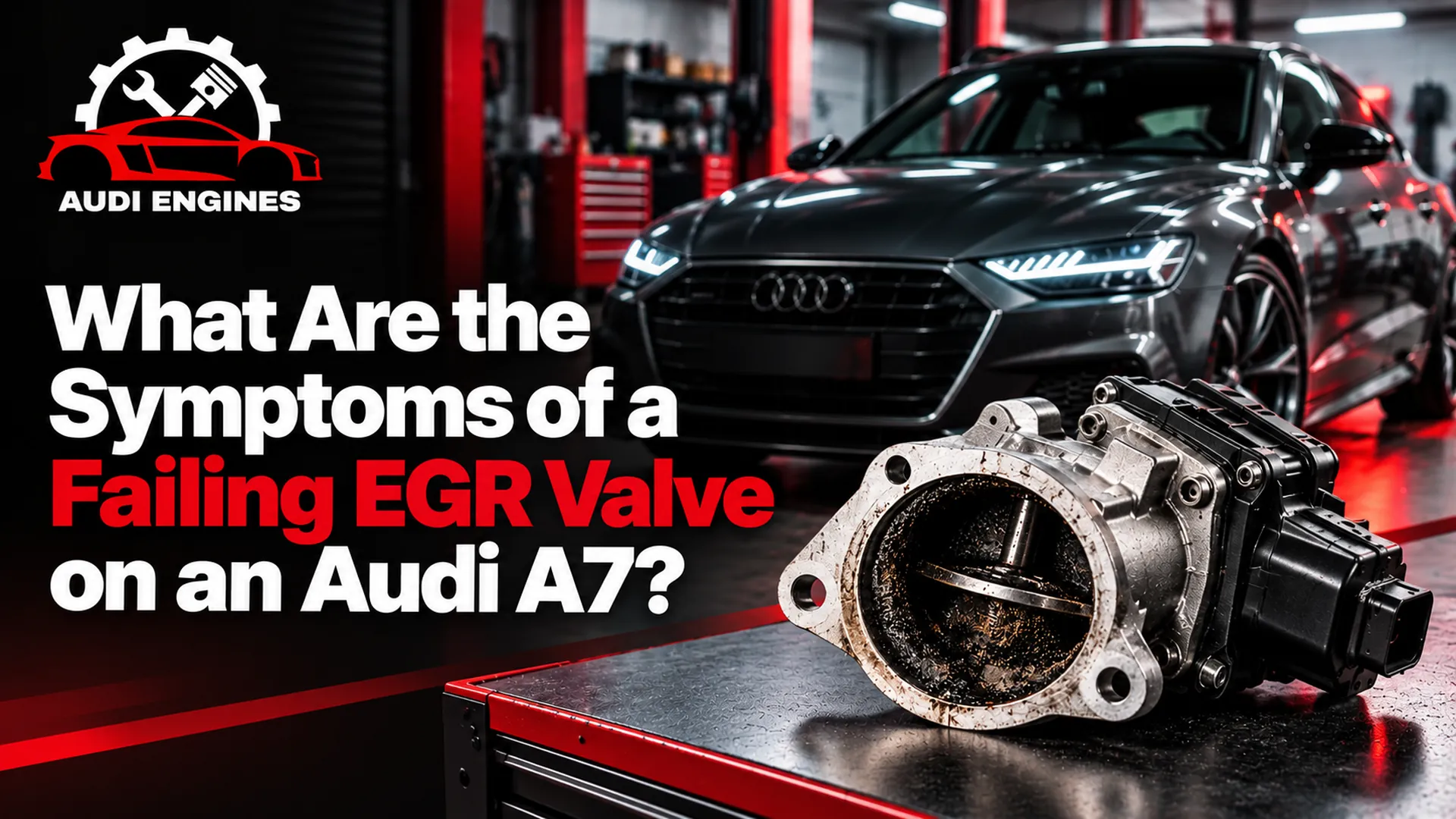
A failing EGR valve on an Audi A7 typically causes reduced power, limp mode, rough idling, black smoke, poor fuel economy and dashboard warning lights. The symptoms vary depending on whether the valve sticks open or sticks closed, and they often overlap with other faults.
First, a quick explanation of what the part does. The exhaust gas recirculation (EGR) valve sends a measured amount of exhaust gas back into the intake. This lowers combustion temperatures and cuts nitrogen oxide emissions. On a diesel, the valve opens and closes constantly, and soot builds up around it over time.
When it stops moving freely, the engine's air and fuel balance goes wrong. Here's what owners usually notice:
- Reduced power and hesitation: if the valve sticks open, too much exhaust gas enters the intake, so the engine gets less fresh air. The car feels flat, especially under acceleration.
- Limp mode: the engine control unit (ECU) restricts power when readings fall outside expected limits. You may see a "reduced engine power" message or a warning light.
- Rough idle or stalling: an open valve at idle can make the engine run unevenly or cut out at low speed.
- Black smoke: an upset air-to-fuel ratio can produce visible smoke under load.
- Poor fuel economy: the engine works harder to deliver the same performance.
- Engine warning light: the ECU logs a fault code when EGR flow or valve position doesn't match what it expects.
- Failed emissions test: an EGR fault can push exhaust emissions above MOT limits.
A stuck-closed valve behaves differently. The engine may run a little more smoothly at idle but produce more nitrogen oxides, run hotter and sometimes pull harder before triggering a fault. That's why the signs can seem confusing.
Treat these as clues. Many of the same symptoms can come from other parts, as the next section shows.
Is It the EGR Valve, the EGR Cooler or Something Else?
This question saves owners the most money. Loss of power, limp mode and warning lights are shared by several faults, and replacing the wrong part is a common and costly mistake.
Symptom | Possible causes to investigate | Sensible next step |
| Reduced power or limp mode | EGR valve, boost leak, turbo fault, DPF restriction, airflow sensor | Scan fault codes, then test boost, airflow and exhaust restriction |
| Rough idle | EGR valve stuck open, injector fault, intake carbon build-up | Check live data and inspect the intake and valve |
| Black smoke | Airflow or boost problem, EGR fault, injector fault | Inspect intake, test boost and check fuelling |
| Coolant loss with no visible leak | EGR cooler leak, hose, radiator or water pump fault | Pressure-test the cooling system |
| Warning light only | Many possible causes | Read stored codes and diagnose the underlying fault |
| Poor fuel economy | EGR fault, sensor fault, blocked DPF, driving pattern | Compare live data with expected readings |
The EGR cooler deserves a special mention. Many diesels route hot exhaust gas through a small cooler fed by engine coolant. If that cooler leaks, you can lose coolant without seeing a puddle, and the cooling system may show unexplained pressure or white smoke. This isn't the same as a valve fault, and it needs a different repair.
Also remember that a fault code identifies a system or a condition, not a guaranteed failed part. A code pointing to EGR flow, for example, can come from a clogged valve, a sticking actuator, a restricted passage or a sensor reading wrongly.
Not sure what's behind your A7's symptoms? Send us your registration and a description of what's happening, and we'll point you in the right direction.
Can You Keep Driving an Audi A7 With a Faulty EGR Valve?
Sometimes you can, for a short and cautious journey, but it isn't a fault to ignore. The right answer depends on the symptoms.
A single warning light with otherwise normal driving usually gives you time to book an inspection. Stop and get the car checked promptly if you notice any of these:
- Repeated or severe limp mode
- Heavy smoke from the exhaust
- Coolant loss or a rising temperature gauge
- A rough, shuddering engine
- Warning lights that flash rather than stay steady
Driving for long on a faulty valve brings its own risks. Soot builds up faster, the diesel particulate filter (DPF) can clog, and a small repair can grow into a larger one. If the EGR cooler is leaking coolant, driving on can lead to overheating, which is the type of damage that sometimes ends in a new engine.
How Is an Audi A7 EGR Fault Diagnosed and Repaired?
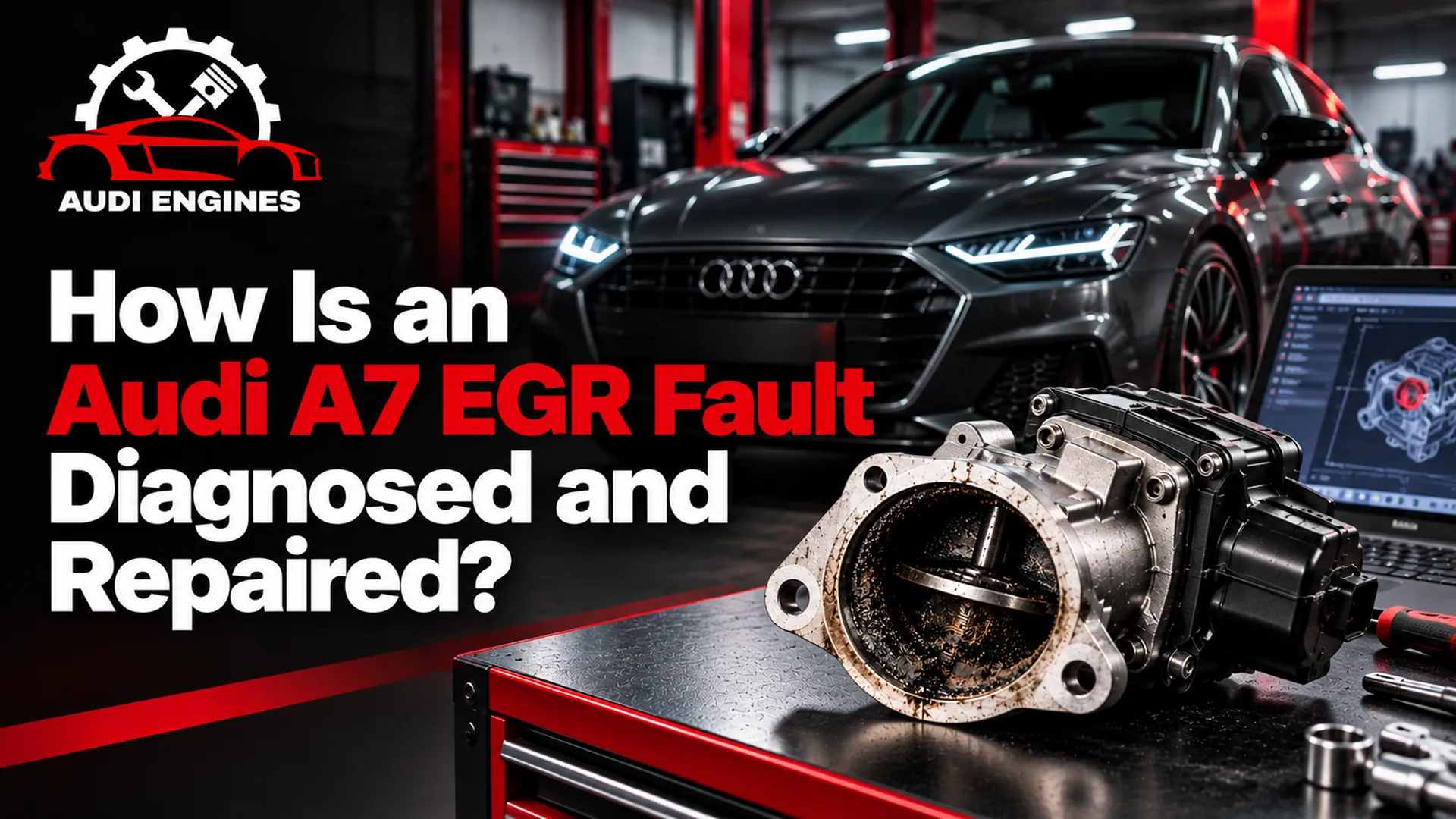
A proper diagnosis follows a sequence. A trained technician doesn't start by replacing the valve. They start by finding out what the engine is telling them.
A typical process looks like this:
- Read the fault codes with a diagnostic scanner to see which systems have logged faults.
- Check live data to compare EGR valve position, airflow and boost readings against expected values.
- Test airflow and boost to rule out leaks, a failing turbo or a faulty airflow sensor.
- Inspect the valve and intake for carbon build-up, a seized actuator or damaged parts.
- Pressure-test the cooling system if coolant loss is reported, to check the EGR cooler.
- Confirm the root cause before any part is replaced.
Once the cause is clear, the repair options are fairly straightforward: cleaning the valve, replacing the valve, replacing the EGR cooler, or repairing a related sensor, hose or connector.
Should You Clean or Replace an Audi A7 EGR Valve?
Both are legitimate. The better option depends on the valve's condition and what caused the problem.
Option | Best suited to | Things to consider |
| Cleaning | Light to moderate carbon build-up where the valve still moves and its electronics work | Cheaper, but only worthwhile if the valve isn't worn or damaged |
| Replacement | A seized valve, failed actuator or electronics, or heavy damage | Costs more, and may need coding or adaptation depending on the part |
| Cooler or related repair | Coolant loss, a restricted cooler or damaged pipework | Different parts and different labour, so confirm the fault first |
Here's a scenario that shows why testing matters. An A7 owner reports limp mode, and a scan shows a code pointing at the EGR system. Everyone assumes the valve is at fault. After boost testing, the real culprit turns out to be a split boost hose letting air escape. The EGR code was a knock-on effect. Replacing the valve would have cost money and fixed nothing.
That's the lesson. Test first, replace second.
Need a specialist opinion before you spend money? Contact us and tell us what your A7 is doing.
What Causes Audi A7 EGR Valves to Fail?
EGR valves rarely fail without a reason. Understanding the causes helps you prevent a repeat.
- Short journeys: engines that rarely reach full operating temperature build up soot faster.
- Carbon build-up: exhaust deposits gradually clog the valve and its passages.
- Poor servicing: old oil and neglected maintenance add to deposits.
- Fuel quality: low-quality diesel can increase soot.
- Age and mileage: moving parts wear and actuators weaken.
Prevention is simple. Keep to the service schedule, take the car on regular longer runs so the engine and exhaust reach proper temperature, and don't leave warning lights unchecked. These habits help protect the EGR system, the DPF and the turbocharger together.
How Much Does Audi A7 EGR Repair Cost, and When Does the Engine Need Attention?
The cost of an Audi A7 EGR repair varies widely, and anyone quoting a fixed price without seeing the car should make you cautious. The final bill depends on what is actually wrong.
The main cost factors are:
- Cleaning or replacement: cleaning costs less, but only suits valves in good condition.
- Valve or cooler: a cooler repair usually involves more parts and more labour.
- Parts quality: genuine, OEM-quality and aftermarket parts differ in price and durability.
- Labour time: access depends on the engine and its layout.
- Diagnostic fees: a proper diagnosis takes time, and it's money well spent.
- Related work: a clogged DPF, a worn turbo or a boost leak found during diagnosis can add to the job.
Ask for a written, itemised quote so you can see what's included. One tip from the trade: a very cheap quote often covers only the valve, with no allowance for cleaning related passages, fitting gaskets or checking the system afterwards.
When Does an EGR Problem Lead to Engine Repair or Replacement?
Most EGR faults are repairable, and they never reach this stage. But prolonged neglect can lead to deeper problems.
Engine damage becomes a concern when:
- A leaking EGR cooler lets coolant enter the engine
- The car is driven while overheating
- Soot and carbon contamination cause wider damage to the intake, turbo or DPF
- Warning signs are ignored for a long period
If the engine has been seriously damaged, your options are a repair, a rebuild, a second hand engine or a reconditioned engine. A repair suits a single confirmed fault. A rebuild suits internal wear where the major components are sound. Replacement suits severe damage. Reconditioned engines are rebuilt to a defined standard and usually carry stronger warranty cover, while second hand engines cost less but vary more in condition.
At audiengines.co.uk, we supply engines for Audi models across the UK, and we'll confirm the right match using your engine code, VIN and year before you pay. Wherever you buy, get the engine's condition and warranty terms in writing.
Questions to ask any garage or engine supplier before you commit:
- Has the fault been confirmed by testing, or is this a guess?
- What does the quote include, and what might cost extra?
- Is the engine's history and condition documented?
- What exactly does the warranty cover, and for how long?
- What happens if a problem appears after work?
Ready to talk? Request a quote through our website, or call us to speak to a specialist.
Frequently Asked Questions
How do I know if my Audi A7 EGR valve is faulty?
Common signs include reduced power, limp mode, rough idling, black smoke, poor fuel economy and a warning light. Because other faults share these symptoms, a diagnostic scan and testing are the only way to confirm the cause.
Can I clean an EGR valve myself?
Some owners try, but it takes care. The valve and its electronics can be damaged by the wrong cleaner or rough handling, and cleaning won't help if the real fault is elsewhere. A specialist can check the valve and the surrounding system properly.
Does a faulty EGR valve cause limp mode?
It can. If the ECU sees EGR or airflow readings outside expected limits, it may restrict power to protect the engine. Limp mode can also come from a boost leak, turbo fault or DPF restriction, so it needs diagnosis.
How much does it cost to replace an Audi EGR valve?
The cost depends on the engine, the part used, the labour time and whether related work is needed. Ask for an itemised written quote, and be wary of a price given without a diagnosis.
Can an EGR fault damage the engine?
A simple valve fault is unlikely to destroy an engine, but ignoring it can lead to soot build-up and a clogged DPF. If the EGR cooler leaks coolant and the car keeps being driven, serious damage can follow. Prompt inspection avoids this.
Can I drive my Audi A7 with the engine management light on?
A steady light with normal driving often allows a short, careful trip to a garage. Flashing lights, severe limp mode, heavy smoke or overheating mean you should stop and get the car checked.
Get Your Audi A7 Diagnosed Before Small Faults Become Big Bills
An EGR valve fault is a common problem and usually a fixable one. The key is reading the symptoms as clues, confirming the cause through testing, and choosing the right repair rather than the quickest guess.
If your A7 shows these signs, don't ignore them. And if the damage has gone beyond a repair, audiengines.co.uk can supply a suitable Audi engine, matched to your car and backed by clear, written warranty terms. Send us your registration and symptoms today, and we'll tell you honestly what to do next, with no pressure. Request your quote now, or call us to speak to a specialist.