
Audi A7 Engine Management Light Common Causes: Symptoms, Diagnosis and Fixes
The amber engine symbol has just lit up on your Audi A7 dashboard. The car feels fine, or maybe it hesitates a little, and you're wondering whether to carry on or pull over. Here is the short answer. The Audi A7 engine management light comes on when the engine control unit (ECU) detects a fault in the engine.
The amber engine symbol has just lit up on your Audi A7 dashboard. The car feels fine, or maybe it hesitates a little, and you're wondering whether to carry on or pull over.
Here is the short answer. The Audi A7 engine management light comes on when the engine control unit (ECU) detects a fault in the engine, fuel, ignition or emissions systems. The cause can be as minor as a loose fuel cap or as serious as an active misfire that threatens your catalytic converter. The light tells you something is wrong, but not what.
This guide covers the most common causes on petrol and diesel A7 models, what the symptoms mean, how a proper diagnosis works, whether it's safe to keep driving, and what affects the repair bill in the UK. By the end, you'll know what to do next.
Why Is My Audi A7 Engine Management Light On and What Are the Most Common Causes?
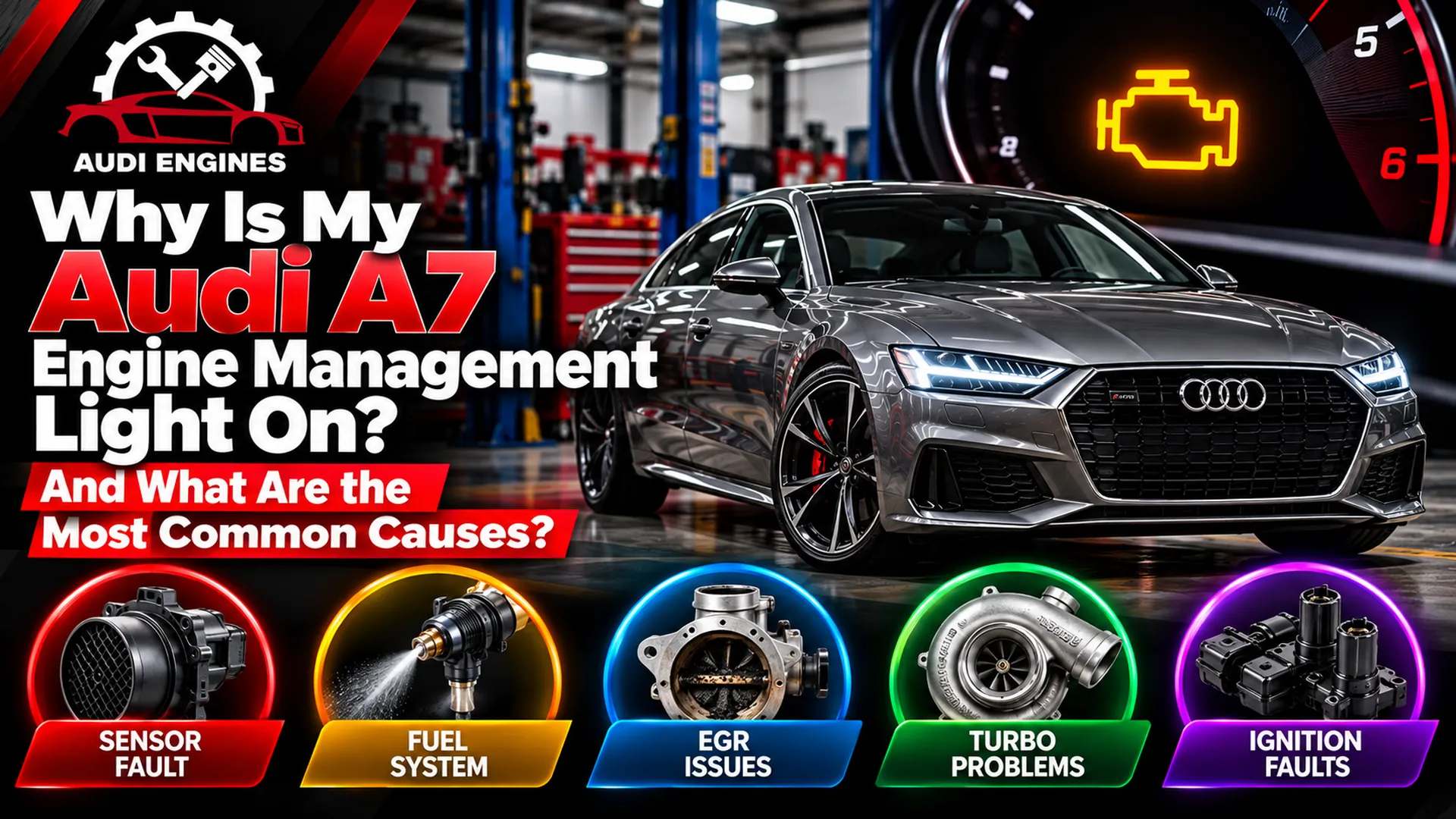
Your A7 runs a network of sensors that constantly report to the ECU: airflow, exhaust oxygen, crankshaft and camshaft position, coolant temperature, fuel pressure and boost pressure. When a reading falls outside the expected range, the ECU stores a diagnostic trouble code (DTC) in its fault memory and may switch on the warning light.
The wording you see varies: engine management light, check engine light, engine warning light, malfunction indicator lamp (MIL) or engine fault light. They all describe the same amber, engine-shaped symbol.
Some faults trigger the light straight away. Others need to appear on more than one drive cycle first, which is why some owners see the light come on, vanish, then return a week later.
Can I Still Drive My Audi A7 With the Engine Management Light On?
It depends on how the light behaves. This is the first thing to establish, so here is how to read it.
A steady amber light means the ECU has logged a fault that isn't immediately damaging the engine. Book an inspection soon. You can usually drive carefully to a garage, but avoid hard acceleration, heavy loads and long motorway runs until the car is scanned.
A flashing light is more urgent. It usually points to an active misfire, where unburnt fuel is entering the exhaust and can overheat the catalytic converter. Ease off the throttle, reduce speed and stop somewhere safe as soon as you can. Continuing to drive can turn a modest ignition repair into a much bigger emissions repair.
Three situations call for stopping rather than carrying on:
- The light is flashing and the car is shaking or juddering.
- The A7 drops into limp mode with a sharp loss of power.
- You notice a strong fuel smell, heavy exhaust smoke or other warning lights such as oil pressure or coolant temperature.
You may also see the EPC (Electronic Power Control) warning alongside the engine light. The two are related but not identical. EPC points to a throttle, sensor or power-management fault, and together with the engine symbol it usually means the car is protecting itself by limiting power.
Which Faults Trigger the Light on Petrol (TFSI) and Diesel (TDI) A7 Models?
The A7 Sportback has been sold in two generations, the C7 (4G) and the C8 (4K), with petrol TFSI and diesel TDI engines. The fault patterns differ between fuel types, so it helps to separate them.
System | Petrol (TFSI) common triggers | Diesel (TDI) common triggers |
| Ignition | Worn spark plugs, failing ignition coils | Glow plug faults |
| Mixture and fuel | Lean or rich mixture, fuel pressure faults, injector problems | Injector faults, fuel pressure sensor issues |
| Air intake | MAF sensor faults, vacuum leaks, intake manifold issues | Boost leaks, turbo control faults, intake flap problems |
| Emissions | Lambda sensor faults, catalyst efficiency, EVAP leaks | DPF blockage, EGR valve faults, NOx sensor and AdBlue faults |
| Electrical | Low battery voltage, wiring and connector faults | Low battery voltage, wiring and connector faults |
Engine codes, model years and equipment vary across both generations, including mild-hybrid systems on later cars. That is why a reliable diagnosis always starts with the exact car in front of the technician, not with assumptions about "the A7" in general.
Let's look at the most common causes one by one.
Faulty oxygen sensor or lambda sensor
Lambda sensors measure how much oxygen is in the exhaust, which tells the ECU whether the air-fuel ratio is lean or rich. When a sensor slows down or fails, the ECU loses accuracy in its fuel trim control.
Typical signs are poor fuel economy, a slightly rough idle and, eventually, a failed emissions check. A failing sensor can also mimic a catalytic converter fault, which is why testing matters before replacing anything expensive.
Dirty or defective mass airflow sensor and intake air problems
The MAF sensor measures the air entering the engine. If it's contaminated or failing, the ECU miscalculates fuelling. Vacuum leaks and charge-air leaks have a similar effect by letting unmetered air into the system.
Look out for hesitation, stalling at idle, fluctuating RPM and a light that appears after the engine warms up. A smoke test on the intake is often the quickest way to find a leak that a code alone can't pinpoint.
Ignition coil and spark plug faults on petrol models
Ignition coils and spark plugs drive combustion in a TFSI engine. When one weakens, the cylinder fires unevenly or not at all.
You will usually feel it as juddering under acceleration, a rough idle and hesitation. Fault codes in the P030x range point to a misfire in a specific cylinder, but the cylinder number identifies where the problem is, not necessarily which part has failed.
DPF and EGR problems on diesel models
The diesel particulate filter (DPF) traps soot. On cars that mostly do short journeys, it may not reach the temperature needed to regenerate and burn that soot off, so it gradually clogs. A blocked DPF can bring on the engine light, reduced power and, in some cases, limp mode.
The EGR valve recirculates a portion of exhaust gas to lower combustion temperatures. When it sticks open or closed, the result can be rough running, black smoke or a drop in performance.
Turbocharger, boost pressure and intake manifold faults
If the engine isn't delivering the expected boost, the ECU notices the gap between requested and actual pressure. Causes include split charge-air hoses, faulty boost control components, a failing turbo actuator and intake manifold flap faults.
The classic symptom is poor acceleration, sometimes with a whistling or hissing sound under load.
Fuel injector, fuel pressure and air-fuel mixture problems
Fuel system faults can set codes such as P0171, a lean mixture, or rich-mixture equivalents. Causes include a weak high-pressure fuel pump, leaking or clogged injectors and a faulty fuel pressure sensor.
You might notice a difficult cold starting, poor economy, hesitation and, in some cases, an unusual exhaust smell.
Electrical faults, battery voltage and engine sensors
The A7 depends on stable voltage. A weak battery, a struggling alternator or a corroded connector can make sensors send erratic signals, and the ECU may log faults that have nothing to do with the components named in the code.
A telltale sign is several unrelated warning lights appearing together, sometimes after a battery replacement. In that case, checking the battery, charging system, earths and CAN bus communication should come before chasing individual parts.
Can a Faulty Sensor, Ignition Coil or Blocked DPF Really Cause the Warning?
Yes, all three can, and they do regularly.
A faulty sensor gives the ECU bad information, and the ECU responds to that data whether or not the engine itself has a real problem. A failing ignition coil causes a misfire, which the ECU detects through crankshaft speed variation. A blocked DPF raises exhaust back-pressure, which the differential pressure sensor reports, and the ECU flags the fault.
The important point is that the light shows the symptom, not the root cause. A sensor code can come from the sensor, its wiring, an exhaust leak or the engine condition behind it.
To make this practical, here is how common symptoms map to likely causes and how a technician would confirm each one.
What you notice | Possible cause | How it's confirmed |
| Rough idle with a flashing light | Active misfire from ignition, fuelling or compression | Scan codes, check cylinder-specific data, test coils, plugs and injectors |
| Loss of power on a diesel A7 | Blocked DPF, EGR fault, boost leak or sensor fault | Review DTCs, live data and exhaust or boost pressure readings |
| Poor fuel economy | Lambda sensor, MAF sensor, mixture or ignition issue | Analyse fuel trims, sensor response and combustion performance |
| Light returns after a repair | Unresolved fault or a related circuit issue | Rescan, compare fault status, verify the original repair |
| Several warning lights at once | Voltage or communication problem | Test battery, charging system, power supplies, earths and network faults |
| Light on, no symptoms at all | Early-stage sensor drift, a small EVAP leak or an intermittent fault | Read freeze-frame data and stored or pending codes |
A quick scenario: an owner notices the engine light after a long motorway run, with no change in how the car drives. The scan shows a lean mixture code. A lazy fix would be to replace the lambda sensor. A proper diagnosis checks for an intake leak first and finds a cracked vacuum hose. The sensor was reporting accurately all along. Replacing it would have cost more and left the fault in place.
How Do You Diagnose an Audi A7 Engine Management Fault?
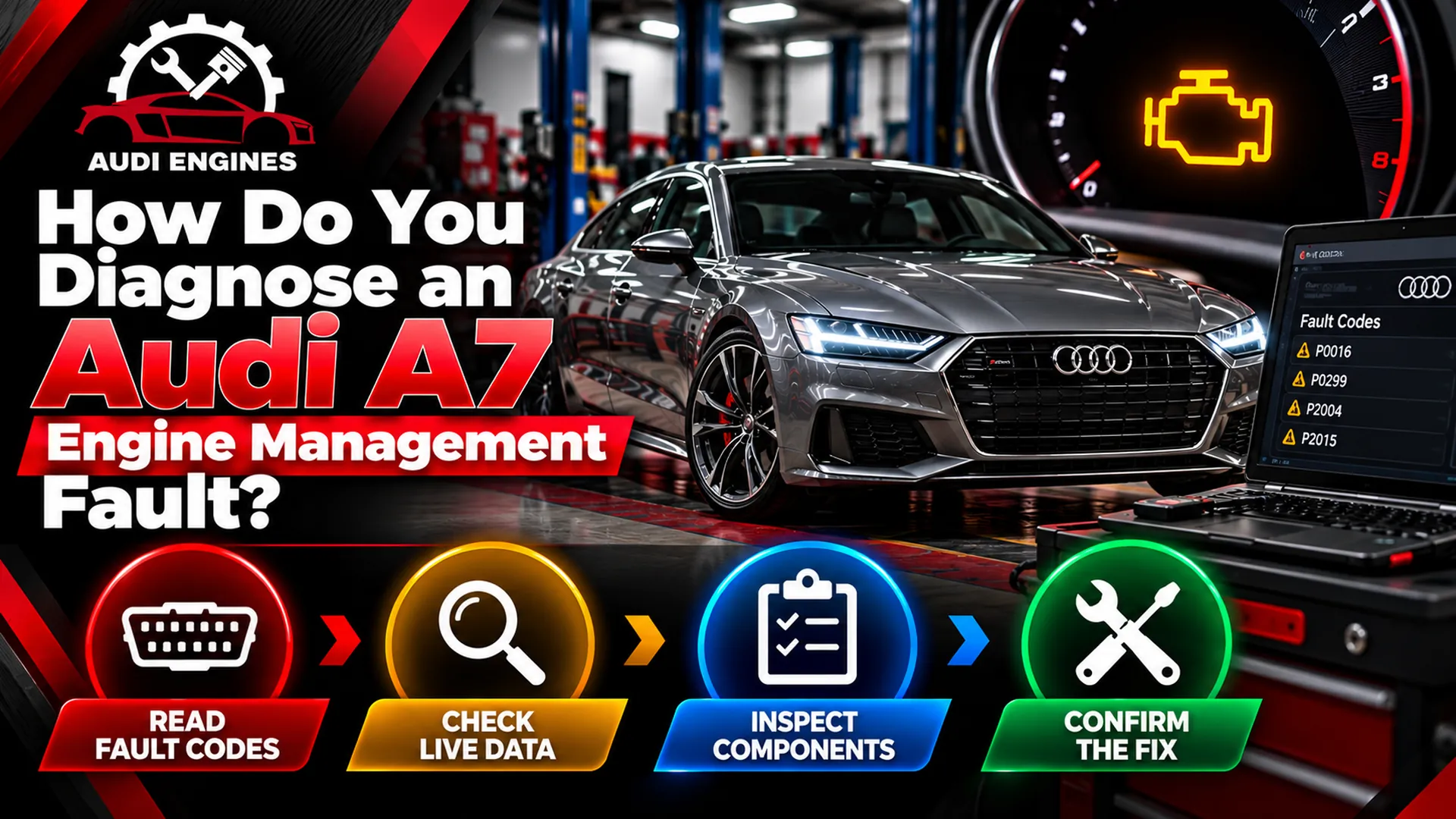
Good diagnosis is a process, not a code read. Following the sequence below is what separates a fix that lasts from one that sends you back to the garage in a fortnight.
What Do Fault Codes Like P0171, P0300 and P0420 Actually Tell You?
A diagnostic trouble code is a starting point. It tells the technician which system flagged a problem and under what conditions, not which part to buy.
Here are three of the most common examples:
- P0171, system too lean: the engine is getting too much air or too little fuel. Causes include intake leaks, a dirty MAF sensor, low fuel pressure and faulty injectors.
- P0300, random or multiple-cylinder misfire: combustion is failing in more than one cylinder, or not in a consistent one. Ignition, fuel delivery, intake leaks and mechanical wear are all candidates.
- P0420, catalyst efficiency below threshold: the catalytic converter appears to be underperforming. The cause can be the converter itself, but also a faulty downstream lambda sensor, an exhaust leak or an unresolved misfire that damaged the catalyst.
Audi also stores manufacturer-specific codes that generic readers can't always interpret fully, which is one reason a basic scanner sometimes gives a vague picture.
A proper diagnostic workflow looks like this:
- Scan and record all stored, pending and permanent codes. Nothing is cleared at this stage.
- Review freeze-frame data and live sensor readings. Freeze-frame shows engine conditions at the moment the fault was logged, such as speed, load and temperature.
- Inspect wiring and connectors. Corrosion, chafed looms and loose plugs cause plenty of false alarms.
- Test the suspected component. This may involve a smoke test, fuel pressure test, continuity check or boost pressure test.
- Confirm the root cause before replacing parts.
- Verify the repair with a follow-up scan and road test. This confirms the fault is gone and hasn't simply been hidden.
Many owners use tools such as OBDeleven or VCDS to read codes themselves. They are useful for getting a first look and for gathering information before a garage visit, and they give far more Audi-specific detail than a basic OBD-II reader. They also have limits. Reading a code is easy; interpreting it alongside live data and physical testing takes training and experience.
Clearing codes is not a repair. Disconnecting the battery or wiping the fault memory will often turn the light off, but if the fault is real, it will come back, sometimes with less information stored than before. If you're buying a used A7, treat a recently cleared fault memory as a warning sign and ask for a fresh scan.
Ready to find out what your A7 is actually reporting? Book an Audi A7 engine diagnostic scan with audiengines.co.uk and get the codes read, interpreted and tested properly.
How Much Does an Audi A7 Engine Light Repair Cost in the UK, and Who Should Fix It?

This is the question every owner asks, and the honest answer is that the price depends on what the diagnosis finds. A loose fuel cap costs nothing. A failed DPF or catalytic converter sits at the other end of the scale.
Nobody can give you a reliable repair figure from the warning light alone. Be cautious of any quote that arrives before a scan and test.
Several factors shape the final bill:
- The fault itself. A single ignition coil is a very different job from a clogged DPF or a failed turbocharger.
- Parts choice. Genuine, OEM and aftermarket parts vary in price and, in some cases, in reliability.
- Labour time. Some faults are quick to reach; others need intake or exhaust components removed.
- Engine and generation. Access, parts availability and complexity differ between C7 and C8 cars and between petrol and diesel.
- Diagnostic fees. Some garages charge separately for diagnosis, while others credit it against the repair. Always ask upfront.
Request a written estimate that states whether labour, parts and VAT are included.
Should I Choose an Audi Specialist or a Main Dealer to Diagnose My Engine Warning Light?
Both can read and repair an engine fault. The real differences are in approach, cost and flexibility.
Factor | Main dealer | Independent Audi specialist |
| Diagnostic equipment | Manufacturer tools | Often Audi-specific tools, such as VCDS-level software |
| Hourly labour rates | Typically higher | Often lower |
| Parts options | Mostly genuine | Genuine, OEM or quality aftermarket, depending on your preference |
| Fault experience | Broad, across the whole range | Often deep experience in common recurring faults |
| Flexibility | Fixed procedures | Greater scope to diagnose root causes and offer repair alternatives |
| Warranty | Manufacturer-backed on work | Varies by garage, so ask for it in writing |
The right choice depends on your car's age, warranty status and what you value most. If your A7 is still under manufacturer warranty, check the terms before going elsewhere. If it's out of warranty, a specialist who works on these engines every day will often diagnose faster and give you more repair options.
Whoever you choose, look for clear communication, a written estimate and a willingness to explain what they found and why. A good technician shows you the evidence, such as live data readings or a failed test result, rather than just handing you a bill.
Help your garage help you. Before you book, note down these details:
- When the light first appeared
- Whether it is steady or flashing
- What the car was doing at the time
- Any other warning lights
- Recent work such as servicing, refuelling or a battery change
That information can cut diagnostic time and sharpen the result.
Will an Engine Management Light Cause an MOT Failure?
An illuminated engine management light can lead to an MOT failure, and it can also hide other emissions problems. Fix the fault before the test rather than hoping it passes, and check the current MOT guidance on GOV.UK for the latest criteria.
How to Stop the Warning Light Returning
Prevention comes down to routine care:
- Follow the servicing schedule. Plugs, filters and fluids all affect combustion and sensor health.
- Use quality fuel. Poor fuel can contribute to injector and mixture problems.
- Give diesels a proper run. Regular longer drives help the DPF regenerate.
- Keep the battery and charging system healthy. Voltage problems cause confusing, unrelated faults.
- Act on early warning signs. A slight hesitation or a brief light is much cheaper to fix than a persistent misfire.
- Tighten the fuel cap after refuelling. It sounds trivial, but an EVAP leak from a poorly seated cap is a common trigger.
Frequently Asked Questions About the Audi A7 Engine Warning Light
Can you drive with an engine management light on?
With a steady amber light, you can usually drive gently to a garage, though you should get it checked soon. If the light is flashing or the car is in limp mode, stop as soon as it's safe.
What is the most common reason for an engine management light?
Sensor faults, particularly oxygen and airflow sensors, and ignition-related misfires are among the most frequent causes. Loose fuel caps and EVAP leaks are also common. On diesel cars, DPF and EGR issues are regular triggers.
Does an engine management light always mean a serious fault?
No. Some causes are minor and inexpensive. However, you can't judge severity from the light alone, so a scan is the only reliable way to know.
How do you diagnose an engine management light?
A technician scans the fault memory, reviews freeze-frame and live data, inspects wiring, tests the suspected component and verifies the repair with a follow-up scan.
Can an engine warning light clear itself?
Sometimes, if the fault was temporary and doesn't recur over several drive cycles. The code usually remains stored, though, and the underlying issue may return.
What is the difference between a steady and a flashing engine light?
A steady light signals a detected fault that needs checking. A flashing light often indicates an active misfire that can damage the catalytic converter and needs immediate attention.
How much does it cost to fix an engine management light?
It depends entirely on the fault found. A confirmed diagnosis comes first, and the quote follows from that.
Can a faulty oxygen sensor affect fuel economy?
Yes. Incorrect readings lead the ECU to mis-set the air-fuel mixture, which can raise fuel consumption and emissions.
Can a misfire damage a catalytic converter?
Yes. Unburnt fuel reaching the exhaust can overheat and damage the catalyst, which is why a flashing light should never be ignored.
What happens if you ignore an engine warning light?
A minor fault can become a major one. Over time you may see poorer economy, loss of power, higher emissions, a failed MOT and more expensive repairs.
Can a weak battery cause an Audi A7 engine warning?
Yes. Low voltage can corrupt sensor signals and trigger faults, sometimes alongside other warning lights.
Can I reset the light myself?
You can clear codes with a scanner, but this doesn't fix the cause, and the light will usually return. It's better to diagnose first and clear codes only after the repair.
Get Your Audi A7 Engine Light Diagnosed Properly
An engine management light is your A7 asking for attention. The cause could be small or significant, and the only way to know is to read the car's fault memory, test the system and confirm the root cause before spending money on parts.
At audiengines.co.uk, we focus on Audi engines and engine management faults across the UK. Whether your A7 has a steady light, a flashing one, a loss of power or a warning that comes and goes, we'll find out what's behind it and explain it clearly. Book your Audi A7 engine diagnostic today and take the guesswork out of that amber light.