

Audi A7 Engine Oil Leak Repair Cost: Causes, Diagnosis and Fixes
Oil spots on the drive. A burning smell after a long run. A dipstick reading that keeps creeping down between services. Then comes the worry that an Audi A7 repair means a four-figure bill. The Audi A7 engine oil leak repair cost in the UK depends mainly on two things: where the oil is escaping from and how much labour it takes to reach that point.
Oil spots on the drive. A burning smell after a long run. A dipstick reading that keeps creeping down between services. Then comes the worry that an Audi A7 repair means a four-figure bill.
The Audi A7 engine oil leak repair cost in the UK depends mainly on two things: where the oil is escaping from and how much labour it takes to reach that point. A simple gasket can be a modest job. A crankshaft seal that needs the gearbox out is a very different one. As a planning guide, many UK owners see bills from a few hundred pounds for an accessible gasket to well over a thousand for labour-heavy work. These are general indicative ranges, not a confirmed price for your car, and they can change with engine, garage and parts.
This guide explains what drives the price, which leaks cost the most, how a proper diagnosis works and when repair stops making sense. If you would rather talk through your own car, you can request a quote or book an inspection with the Audi Engines team at any point.
How Much Does Audi A7 Engine Oil Leak Repair Cost in the UK?

An Audi A7 oil leak repair price in the UK typically runs from roughly for an easily accessed seal or gasket, to more where the engine, turbo area or gearbox has to be disturbed. Your exact cost depends on the leak source, engine and the labour hours involved.
The table below links each leak source to its typical symptoms, access difficulty and an indicative price. Treat the ranges as general UK estimates for planning, not confirmed Audi A7 quotes. Always get a written estimate after diagnosis.
Leak source | Typical symptoms | Access difficulty |
| Sump drain plug washer | Drip under the car after a service | Easy |
| Rocker cover (valve cover) gasket | Oil residue on top of the engine, burning smell | Moderate |
| Sump gasket | Oil on the undertray, drips from the bottom of the engine | Moderate to hard |
| Oil filter housing or oil cooler seals | Oil around the filter area, residue low on the engine | Moderate |
| Turbo oil feed or return pipe | Oil near the turbo, oil consumption, smoke | Hard |
| PCV or crankcase breather components | Oil seepage, rough running, pressure-related symptoms | Varies by engine |
| Front crankshaft oil seal | Oil near the timing cover or crank pulley | Hard |
| Rear main crankshaft seal | Oil at the bellhousing, between engine and gearbox | Very hard |
These figures include parts and labour but may exclude VAT, oil, filters and any extra work found during the job. Prices vary by region, garage and parts choice, so confirm all of this with the garage in writing.
What Affects the Cost of an Audi A7 Oil Leak Repair: Parts, Labour, Engine Access and Garage Type?
On most oil leak jobs, labour outweighs parts. A seal or gasket may cost very little. Getting to it is what takes the time.
Here is what moves the bill up or down:
- Engine access time: Components sit under covers, pipework, the intake and in some cases the subframe. The more that has to come off, the more hours you pay for.
- Engine variant: The 2.0 and 3.0 TDI and the 2.0 and 3.0 TFSI are laid out differently, and the C7 and C8 generations are not identical. Ask the garage to confirm your engine code before quoting.
- Garage type: An independent Audi specialist usually charges a lower hourly rate than a main dealer. Dealers may suit cars still under warranty or goodwill cover.
- Parts choice: Genuine Audi parts cost more than OEM-equivalent parts. A good garage will explain what it fits and why.
- Diagnostic fee: Some garages charge separately for finding the source, then credit it against the repair. Others include it.
- Extra work found on the day: Worn mounts, hoses or a tired PCV diaphragm may be discovered once the area is open.
Before you compare two quotes, check these points. Two prices that look apart often cover different work:
- Is VAT included?
- Are oil and filters included?
- Is the diagnosis fee included or separate?
- Does the quote name the exact leak source, not just "oil leak"?
- Are additional repairs possible, and how will you be told?
- What warranty covers the repair, and does it include labour?
Why Is My Audi A7 Leaking Oil, and Which Leaks Cost the Most to Fix?
Oil leaks usually come from a short list of sources. Here they are, roughly from cheapest to most expensive.
Sump drain plug washer. If the leak started soon after a service, check this first. A crushed or reused washer is a cheap fix.
Rocker cover gasket. Rubber seals harden with heat and age. Oil seeps onto the top of the engine, hits hot surfaces and produces a burning smell. This is one of the more common causes on older, higher-mileage cars.
Sump gasket. Oil collects on the undertray or drips from the bottom of the engine. The job is more involved because of what sits around the sump.
Oil filter housing and oil cooler seals. Oil can appear around the filter area, then run down and spread lower on the engine, which makes the real source harder to judge.
PCV and crankcase breather system. A faulty ventilation system can raise crankcase pressure and push oil past seals. It is particularly relevant to some petrol engines, so it should be investigated rather than assumed.
Turbocharger oil feed and return pipes. Leaks here can cause oil near the turbo, smoke and rising oil consumption. Access is tight, so labour climbs.
Front and rear crankshaft seals. These cost the most because of access. Reaching a rear main seal may involve removing the gearbox. That is why one small seal can produce a large invoice.
One point saves a lot of money: the drip is not always the source. Oil runs down surfaces, travels with airflow and collects on the undertray. A leak at the top of the engine can look like a leak at the bottom. A garage that quotes without confirming the source is guessing.
At Audi Engines, we would always rather confirm the source before approving a repair. The cheapest repair is the one done correctly the first time.
Is It Safe to Drive an Audi A7 With an Oil Leak, and When Should You Stop Immediately?
A slow seep can be driven short-term if you check the oil level often and top up as needed. An oil pressure warning is different: stop safely and switch off the engine straight away.
It helps to understand the two warnings:
- Low oil level: The engine is short of oil. Top up, find the cause and get the leak inspected soon.
- Low oil pressure: Oil is not circulating properly. Continuing to drive can damage bearings, the turbo and other parts within minutes.
A heavier leak can also drip onto hot exhaust parts. That carries a fire risk, so do not ignore smoke from the engine bay or a strong burning smell. If you see either, stop and arrange recovery.
How Do Mechanics Diagnose an Audi A7 Oil Leak Before Quoting for Repairs?
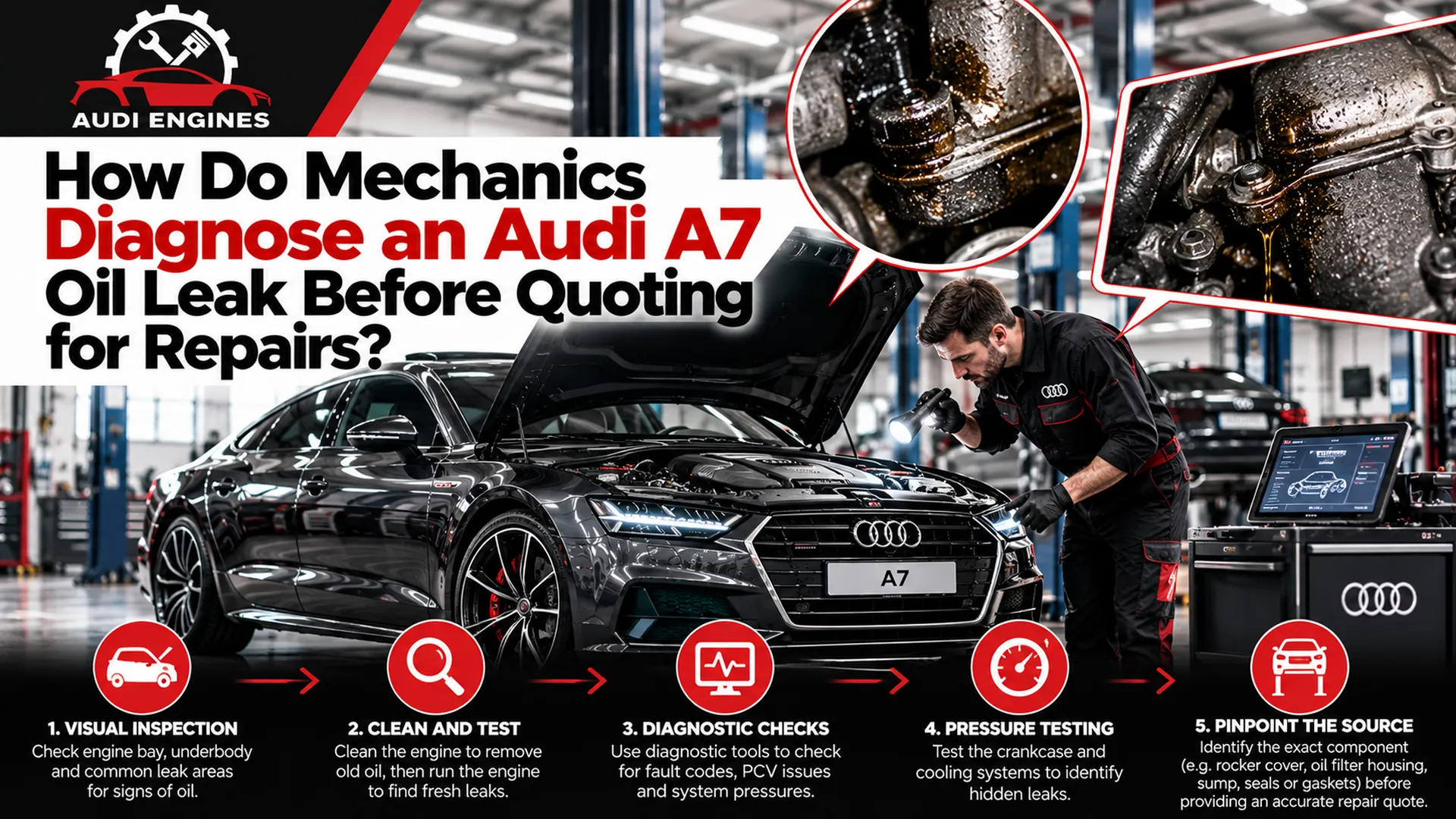
A proper diagnosis identifies the exact source before any parts are ordered. It is also what a diagnostic fee pays for. Skipping it risks replacing the wrong gasket and still leaking afterwards.
What Are the Warning Signs of an Audi A7 Oil Leak, and How Is the Source Confirmed?
Watch for these signs:
- Oil spots under the car on a drive or parking space
- Burning oil smell after driving, often from oil on hot engine parts
- Oil residue on the engine cover or around the filter, timing cover or turbo
- Oil on the undertray, which can hide a leak for a long time
- Engine oil level dropping between services
- Blue exhaust smoke, which can point to oil consumption
- Oil warning light on the dash
These signs overlap. A falling oil level or blue smoke can mean oil is leaking externally, but it can also mean oil is being burned inside the engine. Those are different problems with different repairs. Neither symptom alone proves which one you have.
Mechanics typically work through the following steps:
- Visual inspection. Check the engine, undertray, gearbox bellhousing and surrounding components for fresh oil.
- Clean-down and reinspection. Degrease the area, run the car, then look again. Fresh oil shows where the leak starts.
- UV dye test. For slow or intermittent leaks, dye is added to the oil and a UV lamp reveals the path of the leak.
- Oil level and pressure checks. These confirm whether lubrication is affected.
- Crankcase pressure and PCV checks. Where appropriate, these show whether ventilation faults are pushing oil past seals.
- Written quote naming the source. You should see the leak location, the repair and the cost.
Here is a scenario that shows why this matters. An owner notices oil on the undertray and is told the sump gasket has failed. After a clean-down and a short drive, fresh oil shows at the oil filter housing instead, running down to the sump. Replacing the housing seals fixes it. A sump gasket repair would have cost more and the leak would have remained.
Prevention helps too:
- Check the oil level regularly, especially before long journeys.
- Use the correct oil specification for your exact engine.
- Ask for leak checks at every service, since early seeps cost less than late failures.
- Act on small seeps early instead of waiting for a warning light.
- Check the drain plug washer is replaced at each oil change.
Should You Repair the Oil Leak, or Is It Time to Consider an Engine Replacement?
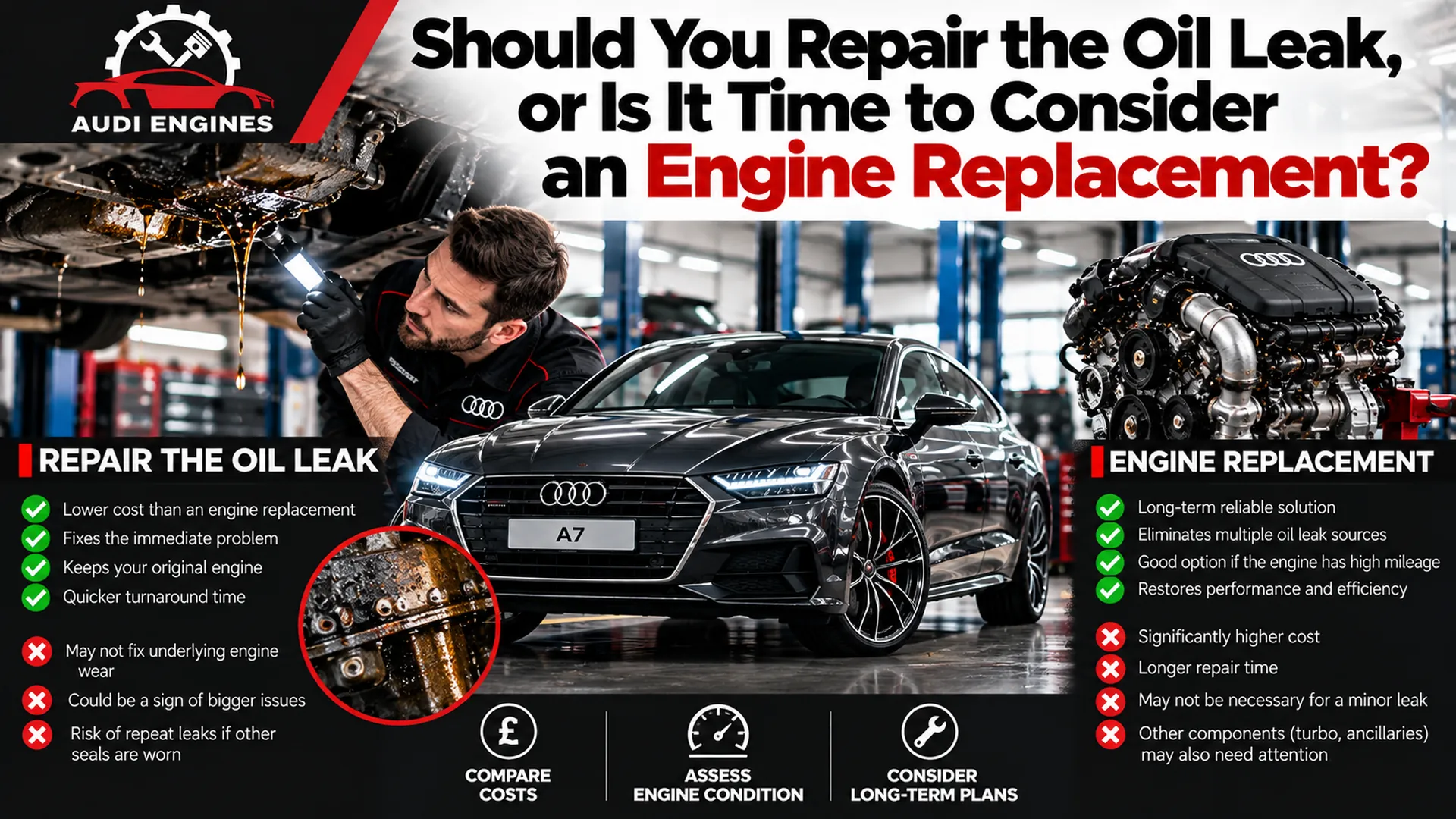
Most oil leaks are repairable, and repair is usually the right answer. But a leak can be a symptom of wider wear, and that changes the decision.
When Is a Gasket or Seal Repair Enough, and When Does a Reconditioned Replacement Engine Make More Sense?
Repair is usually enough when:
- The leak is localised to a gasket, seal, housing or pipe
- Oil pressure and compression are healthy
- There is no sign of bearing noise or heavy oil consumption
- The rest of the car is in good condition
Consider replacement when:
- The leak comes with low oil pressure warnings or bearing damage
- The engine burns oil heavily, which suggests internal wear
- Repeated repairs keep failing
- The bill approaches the value of the car
The table below compares the main routes. Use it as a framework, then ask for real figures on your own car.
Option | Cost basis | Downtime | Warranty | Main risk |
| Gasket or seal repair | Lowest, depends on access | Short | Usually on the repair | Hidden wear elsewhere |
| Component replacement (housing, pipe, cooler) | Mid-range | Moderate | Parts and sometimes labour | Related parts may be worn |
| Reconditioned engine replacement | Highest upfront, supply and fit available | Longer | Written warranty expected | Needs correct engine matching |
Before you approve an expensive repair, take these steps:
- Get a second quote if the first is high or does not name the leak source.
- Ask for the diagnosis in writing, including the test that confirmed it.
- Check what the warranty covers, including parts, labour and the length of cover.
- Ask whether related parts should be renewed while the area is open.
If you are buying a used A7 with a known leak, ask for the service history, get an independent inspection and use the repair cost to negotiate the price. A documented, completed repair is better than a promise to fix it later.
If the diagnosis points towards engine replacement, correct matching matters. You will need your registration, engine code, model year and drivetrain, such as quattro all-wheel drive or front-wheel drive, so the right unit is supplied.
Not sure whether your A7 needs a repair or something bigger? Request a quote or book an inspection with Audi Engines. Send your registration, engine details and a short description of the leak, and we will give you clear, written advice. Warranty terms, delivery and fitting options will be confirmed in your quote.
Frequently Asked Questions About Audi A7 Oil Leak Repair Costs
How much does it cost to repair an oil leak on an Audi A7?
Costs typically range from about for an accessible gasket or seal up to or more for labour-heavy work. The leak source and engine access time decide the price.
Is an Audi A7 oil leak expensive to repair?
It depends on the source. A drain plug washer is cheap. A rear main seal can be expensive because of the labour involved.
How much does it cost to replace an Audi A7 rocker cover gasket?
Many UK garages price this somewhere between about, depending on the engine and what must be removed. Ask for a written quote.
How much does an Audi A7 rear main seal replacement cost?
Often more, because the gearbox may need to be removed for access. Always confirm the source before approving this repair.
How much does an Audi A7 oil leak diagnostic inspection cost?
Fees vary by garage. Some include diagnosis in the repair price and others charge separately and credit it. Ask before booking.
Are Audi main dealer oil leak repairs more expensive than independent garages?
Often yes, because dealer labour rates are usually higher. A qualified independent Audi specialist can be a good-value alternative.
How long does an Audi A7 oil leak repair take?
A simple gasket may take a few hours. Crankshaft seals and turbo-area repairs can take a day or more. Parts availability and workshop booking also affect timing.
Can an Audi A7 leak oil without leaving a puddle?
Yes. Oil can burn off on hot parts, collect on the undertray or run along the engine, so there may be no visible puddle.
Is it safe to drive an Audi A7 with an oil leak?
A slow seep may be manageable short-term with regular level checks. Stop immediately if the oil pressure warning appears or you see smoke.
Will an oil leak cause an MOT failure?
It can. A leak that is excessive or dripping can lead to an advisory or a fail. Have it inspected before the test.
Is it worth repairing an oil leak on a high-mileage Audi A7?
Usually yes, if the leak is localised and oil pressure and compression are healthy. If tests show internal wear, discuss replacement options.
When does an oil leak indicate a more serious engine problem?
Warning signs include low oil pressure, heavy oil consumption, knocking noises and repeated leaks after repairs. These need professional testing.
Final Word: Find the Source Before You Pay for the Repair
The Audi A7 engine oil leak repair cost comes down to the leak source, the labour needed to reach it and the quality of the diagnosis behind the quote. A confirmed source, a written estimate and clear warranty terms protect you from paying twice.
Check your oil level, act on small seeps early and never ignore an oil pressure warning. Most leaks are repairable. When the diagnosis shows wider engine wear, a correctly matched, warranted reconditioned engine can be a sensible alternative.
If you are weighing up your options, contact Audi Engines today to request a quote or arrange an inspection. Send your registration and a short description, and we will help you decide the right next step.