
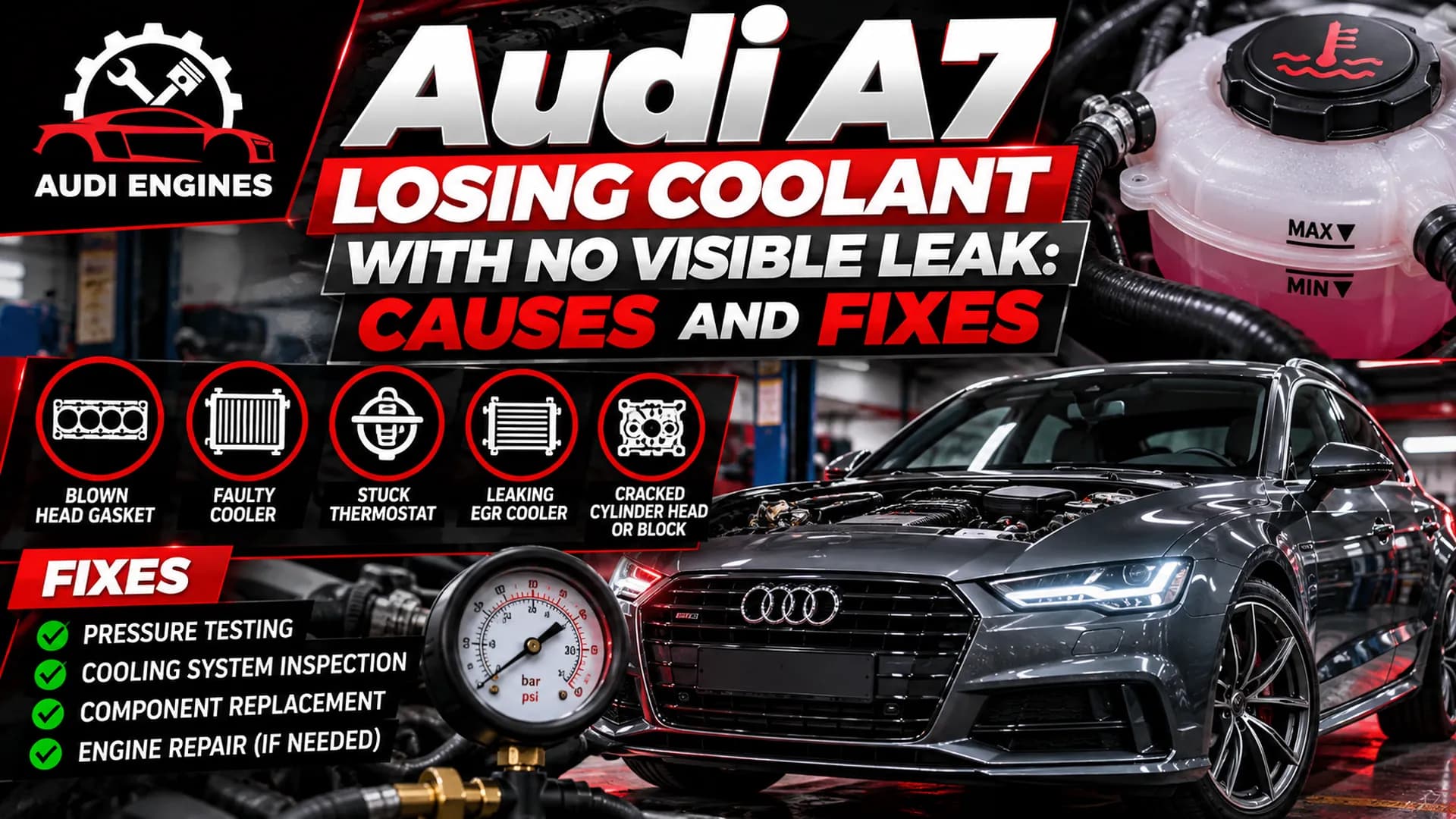
Audi A7 Losing Coolant With No Visible Leak: Causes and Fixes
You top up the expansion tank, and a few weeks later it's low again. You check the driveway and there's nothing. No puddle, no drips, no obvious stain. Meanwhile you're wondering whether this is a cheap seal or the start of a damaged engine. That uncertainty is exactly why this problem is so frustrating.
You top up the expansion tank, and a few weeks later it's low again. You check the driveway and there's nothing. No puddle, no drips, no obvious stain. Meanwhile you're wondering whether this is a cheap seal or the start of a damaged engine.
That uncertainty is exactly why this problem is so frustrating. When an Audi A7 is losing coolant with no visible leak, the cause usually falls into one of three groups: a hidden external leak (the water pump, thermostat housing or coolant pipes), a pressure-related fault such as a worn expansion tank cap, or an internal leak such as a head gasket fault. The symptom alone can't tell you which. Only testing can.
This guide explains where the coolant can go, how mechanics find it, what is safe to do in the meantime, and when the engine itself is at risk. Use this urgency key as you read:
- Stop driving: temperature warning, steam from the engine bay, a critically low coolant warning, milky oil or persistent white smoke.
- Inspect soon: the level keeps dropping, you smell coolant after driving, or the cabin smells sweet or the carpet is damp.
- Monitor and investigate: a very slow drop with a normal gauge and no other symptoms. Don't ignore it for long.
A safety note before anything else: never open the expansion tank cap on a hot engine. The system is pressurised, and scalding coolant can spray out.
Want a second opinion on your A7? Describe your symptoms and we'll point you towards the most likely causes and the tests worth doing first.
Why Is Your Audi A7 Losing Coolant With No Visible Leak?
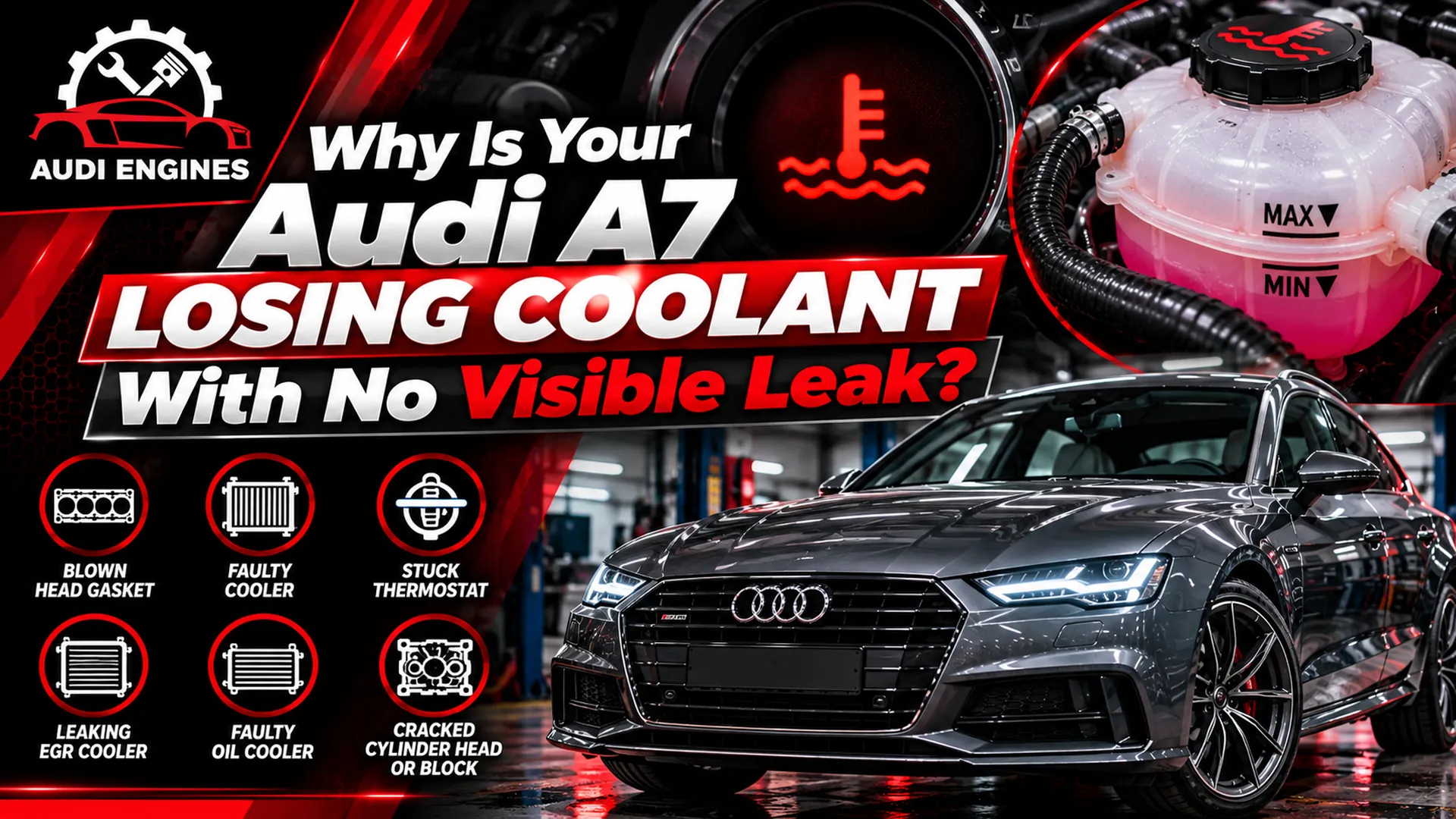
Coolant doesn't vanish. It leaves the system one of two ways: it escapes outside the engine, or it's lost inside it. The reason you can't see a puddle depends on which.
Three things commonly hide an external leak:
- Evaporation on hot components. A small leak that drips onto a hot engine part can boil off before it ever reaches the ground. All that's left may be a faint dried deposit.
- Coolant trapped by the undertray. The shield beneath the engine can catch coolant and hold it, or channel it away from the actual source, so the ground stays dry.
- Leaks that only open under pressure. Some leaks seal when the engine is cold and only weep once the system is hot and pressurised. By the time you check, the engine has cooled and the evidence has dried.
On many cars, an engine that's sealed tightly under the bonnet can also hide a leak behind other components. On some A7 engines, certain coolant connections sit beneath other parts, which makes them hard to see without dismantling.
A quick note on variants. The A7 has been sold in two generations (C7 and C8) with several petrol and diesel engines. Cooling layouts differ between them, so a fault that is well known on one engine isn't automatically a fault on every A7. We'll flag where a point applies only to some engines.
Can Water Pump, Thermostat Housing and Coolant Pipe Leaks Disappear Without a Puddle?
Yes, and they are among the most common explanations. Owner discussions about A7 coolant loss often mention these parts, though forum reports are individual experiences and not proof that every car has the same weakness.
Water pump. The pump circulates coolant through the engine. When its seal begins to fail, it can seep slowly. The tell-tale sign is dried coolant residue, often crusty and coloured (pink, purple or white deposits depending on the coolant type) around the pump. Because the leak may be small and intermittent, the level drops gradually.
Thermostat housing. On many modern engines this housing is made of plastic. Over time, heat cycles can cause cracks or let seals deteriorate. The leak may show only when hot and pressurised, and the coolant can evaporate on nearby components.
Coolant pipes and crossover pipe. Pipes, O-rings and quick-connect fittings can weaken with age. A slow leak at a joint may be tucked away behind other parts, so it's easy to miss during a quick visual check.
Other parts to know about on applicable engines:
- Coolant shut-off valve. Some engines use one to control flow. If it leaks or fails, it can cause coolant loss.
- Expansion tank cap. The cap holds the system at the right pressure. A weak cap can let coolant escape as pressure and temperature rise, sometimes without an obvious leak.
- Heater matrix. If it leaks, the coolant may end up inside the cabin instead of outside. Watch for a damp passenger footwell, a sweet smell or a misted windscreen that won't clear.
Here's how these suspects compare:
Component | Typical sign | How it's usually confirmed |
| Water pump | Dried coolant residue near the pump, gradual loss | Visual inspection, pressure test, UV dye |
| Thermostat housing | Weeping at joints, loss when hot | Pressure test, inspection with the undertray off |
| Coolant pipes and crossover pipe | Residue at joints, slow level drop | Pressure test, UV dye |
| Shut-off valve (on applicable engines) | Unexplained loss with no obvious source | Component inspection, pressure test |
| Expansion tank cap | Loss as the system heats, pressure issues | Cap pressure test |
| Heater matrix | Damp footwell, sweet smell, misted glass | Cabin inspection, pressure test |
A real-world scenario. An owner notices the coolant warning twice in a month. The driveway is dry, and the radiator and hoses look fine. A workshop pressure-tests the system and finds a weep at the thermostat housing, hidden behind another component. The coolant had been evaporating off hot metal and leaving only a faint residue. The fix was inexpensive compared with what a long-ignored loss could have caused. This is an illustrative example of how these cases typically unfold, not a record of a specific customer.
Can a Head Gasket, Oil Cooler or EGR Cooler Leak Coolant Without White Smoke?
Yes. If you can't find any external leak, the coolant may be going inside the engine.
An internal coolant leak means coolant escapes into the combustion chamber, the engine oil or the exhaust system instead of out of the car. Possible sources include:
- Cylinder head gasket, which seals the combustion chambers and the coolant and oil passages
- Engine oil cooler, on engines where it shares a coolant path with the oil
- EGR cooler, on applicable diesel engines
- A cracked cylinder head or block, usually after overheating
Warning signs worth watching for:
- Milky or creamy engine oil, or a milky film under the oil filler cap
- Bubbles in the expansion tank, or a tank that pressurises quickly
- Persistent white exhaust smoke, especially with a sweet smell
- Overheating that comes and goes
- A rough or misfiring engine on a cold start
A common myth is that you'd always see white smoke if the head gasket had failed. You wouldn't. The failure can be small, or coolant can leak into the oil or into the cooling system under pressure without appearing at the exhaust. The opposite error is just as costly. Coolant loss alone doesn't prove a head gasket fault. Many cars get an expensive head gasket repair that wasn't needed, when the real cause was a thermostat housing or pipe.
A combustion-gas test (sometimes called a block test) can check whether exhaust gases are entering the coolant. A pressure test, plus a check of the oil and coolant condition, helps build the full picture.
Worried about internal damage? Tell us what your A7 is doing and we'll explain which tests matter before you spend on repairs.
How Do You Diagnose a Hidden Audi A7 Coolant Leak Before Paying for Parts?
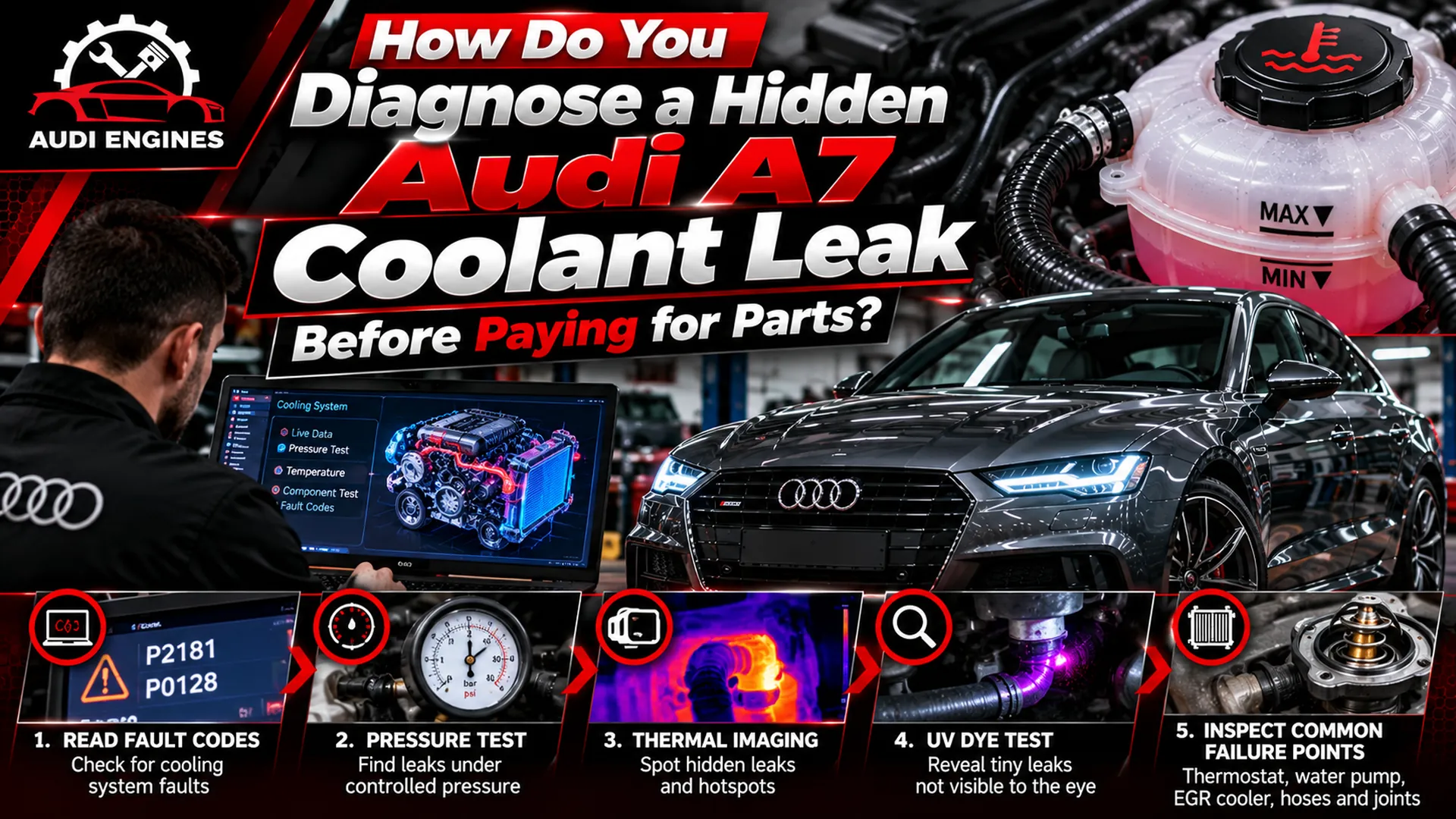
Replacing parts on a guess is the fastest way to waste money. A good diagnosis follows a sequence, starting with the cheapest and simplest checks.
What Steps Do Mechanics Follow to Find Where the Coolant Is Going?
- Check the level cold and record it. Note the exact level so that future drops are measurable. Never open the cap on a hot engine.
- Inspect hoses, connections and dried residue. Look for crusty deposits, damp patches, perished hoses and loose clamps. Dried coolant often shows where the leak has been, even when it isn't leaking now.
- Remove the undertray. Coolant can collect there, hiding the true source. A full inspection from below is often the step that finds the problem.
- Pressure test the system and the cap. A pressure tester raises the system to its operating pressure so leaks that stay hidden when cold start to show. The cap should be tested separately.
- Use UV dye for intermittent leaks. Dye added to the coolant glows under a UV lamp, which helps locate small or slow leaks after the car has been driven.
- Run a combustion-gas test where indicated. If there's no external leak, this helps check for internal leakage.
- Verify the repair and recheck the level. After any repair, the system must be bled correctly and rechecked, because trapped air can cause fluctuating readings and false alarms.
Why a pressure test sometimes comes back clean. A cold pressure test can miss a leak that only opens when the engine is hot, or one that depends on vibration or flow. If the loss continues despite a clean test, the next steps are a hot inspection, UV dye over several drives, and internal-leak testing. Persistence matters here. A clean result doesn't mean the leak isn't real.
Coolant loss after a previous repair. If the coolant is still dropping after a water pump or thermostat job, don't assume the work was wrong or that something new has failed. A second leak may have been present all along. A disturbed seal, a poorly seated hose or incomplete bleeding can also be responsible. Go back to the diagnostic sequence rather than topping up and hoping.
Why Does an Audi A7 Lose Coolant but Not Overheat, and Is It Safe to Keep Driving?
A normal temperature gauge doesn't mean the system is healthy. The engine can run at its usual temperature as long as enough coolant remains to circulate. The level only becomes critical once it drops far enough for the system to run short, and by then overheating can come on quickly.
That's the danger of a slow loss. Overheating can warp the cylinder head, damage the gasket and cause consequential engine damage, which turns a minor repair into a major one.
So is it safe to keep driving?
- A short, careful trip to a garage with the level checked and topped up beforehand is usually reasonable if there's no warning light and the gauge is normal.
- Regular driving while topping up is not safe. Each top-up hides a problem that's still developing.
- Stop immediately if the temperature rises, steam appears, a red warning shows or you notice a coolant smell with white smoke.
What about stop-leak additives? We'd advise against them as a long-term answer. They don't identify the cause, and they can partially block narrow passages in the cooling system and heater matrix. Diagnosis first, repair second.
Use the right coolant when topping up. The correct specification for your A7 matters, because mixing incompatible coolants can reduce protection and cause deposits.
Should You Repair, Rebuild or Replace the Engine After Coolant Loss?

Most coolant leaks end in a straightforward repair. A pipe, housing, pump or cap is replaced, the system is bled and the car goes back to normal. But when coolant loss has been ignored, or the engine has overheated, the question changes from "what's leaking?" to "what's been damaged?"
How Much Does an Audi A7 Coolant Leak Repair Cost in the UK?
We'd rather be straight with you than quote a figure that doesn't fit your car. Costs vary a lot, and a headline number can mislead. What actually moves the price:
- The confirmed fault. A cap or hose is a very different job from a water pump, and different again from a head gasket.
- Engine variant and generation. Layouts differ between engines, and so does the time needed to reach parts.
- Access and labour time. On some engines, components are buried under other parts, so labour can outweigh the cost of the part.
- Parts quality. Genuine, OE-quality and aftermarket parts differ in price and durability.
- Diagnostic time. Finding an intermittent leak takes time, but it's usually cheaper than replacing parts blindly.
Here's a rough guide to how repair types compare in scope:
Repair type | Typical scope | Cost tendency |
| Cap, hose or small seal | Quick access, minimal parts | Lower |
| Water pump or thermostat housing | More labour, often replaced together | Medium |
| Coolant pipes, shut-off valve | Depends heavily on access | Medium to higher |
| Head gasket or internal repair | Major dismantling and machining | Higher |
| Engine rebuild or replacement | Full engine work or supply and fit | Highest |
Ask for an itemised written quote that separates diagnosis, parts, labour, fluids and VAT. Compare totals, not just part prices. And if a garage recommends replacing parts without testing first, ask what test supports the diagnosis.
When Is the Engine Beyond Repair, and What Should You Check Before Replacing It?
Sometimes the cooling fault is only the beginning. Signs the engine itself may have suffered lasting damage include:
- Repeated overheating, especially if it happened before the leak was found
- A warped or cracked cylinder head, which a workshop can confirm by measurement
- Coolant in the oil, or oil in the coolant
- Low compression on one or more cylinders, shown by a compression test
- Persistent misfire or white smoke after the cooling system has been repaired
When the damage is extensive, you have options:
Option | Best when | Watch out for |
| Component repair | Fault is isolated, rest of the engine is sound | Treating the symptom and missing the cause |
| Engine rebuild | The block and head are worth saving | Cost, downtime, machining quality |
| Reconditioned engine | Significant damage, and you want documented work | Confirm what was replaced and the warranty |
| Used engine | Tight budget and modest car value | Unknown internal wear and donor history |
Weigh the diagnosis, repair quote, mileage, the condition of the rest of the engine, downtime and the car's value. For more on the two replacement routes, read our guide to the used vs reconditioned engine choice.
The most important rule. Before any replacement engine is fitted, the original cause must be found and fixed. If the car overheated because of a leaking pipe, a failed pump or a faulty cap and that fault remains, a new engine can fail the same way. It's the most expensive mistake an owner can make.
How Do You Match the Right Replacement Engine and Prevent Future Coolant Problems?
If replacement is the right call, getting an exact match matters. Before you buy, confirm:
- The engine code, not just the model name
- Your VIN, so the supplier can verify fitment
- Generation and fuel type, as C7 and C8 cars and petrol and diesel variants differ
- What's included, such as the water pump, thermostat housing, sensors and ancillaries, or whether they must transfer from your old engine
- Warranty terms, including duration, whether labour is covered, exclusions and claim steps
We verify every engine against the vehicle's details instead of relying on a general list, since parts and compatibility vary by variant.
Protect your cooling system afterwards. A few habits go a long way:
- Use the correct coolant specification for your A7
- Make sure the system is bled properly after any work
- Check the level every few weeks, cold, and note any drop
- Have the cooling system inspected at services, including hoses, pipes, the cap and the pump
- Don't ignore a low-coolant warning, a sweet smell or a damp footwell
Buying a used A7? Check the coolant level and condition, look for dried residue and ask about previous cooling-system repairs. A short pressure test during a pre-purchase inspection can save a lot of trouble.
Ready for a straight answer? Send us your registration and engine details for a free quote on a compatible replacement engine, or call us to talk through repair versus replacement.
Frequently Asked Questions About Audi A7 Coolant Loss
Why is my Audi A7 losing coolant with no visible leak?
The coolant may be escaping from a hidden external leak that evaporates on hot parts or collects under the undertray, from a pressure-related fault such as a worn cap, or into the engine through an internal leak. Testing is needed to confirm which.
Can a faulty water pump cause coolant loss without a puddle?
Yes. A failing pump seal can weep slowly and leave only dried residue near the pump. The leak may appear mainly when the engine is hot and pressurised.
Can a head gasket leak coolant without white smoke?
Yes. Internal leaks can be small, or coolant can enter the oil or cooling system without visible smoke. A combustion-gas test and a pressure test help confirm it. Coolant loss alone doesn't prove a head gasket fault.
How do mechanics diagnose a hidden coolant leak?
They check the level cold, inspect for dried residue, remove the undertray, pressure-test the system and cap, use UV dye for intermittent leaks and run a combustion-gas test where indicated.
Is it safe to drive an Audi A7 when the coolant level keeps dropping?
A short trip to a garage may be acceptable if there's no warning and the gauge is normal. Regular driving with repeated top-ups isn't safe, because overheating can follow quickly. Stop if the temperature rises or steam appears.
Why does my Audi A7 need coolant every few weeks?
A steady loss means the coolant is going somewhere. Common causes include a slow external leak, a weak cap or an internal leak. Repeated top-ups mask the cause, so get it tested.
Can coolant disappear without a puddle?
Yes. It can evaporate on hot components, collect under the undertray or leak only under pressure.
Can a pressure test miss a small leak?
It can. A cold test may not reveal a leak that opens only when hot. UV dye, a hot inspection and internal-leak testing can follow.
Can I drive with a low coolant warning?
Treat it as urgent. Check the level only when the engine is cold, top up with the correct coolant and arrange an inspection. If the warning returns or the temperature climbs, stop.
Should I visit an Audi specialist?
It helps. A specialist who knows A7 cooling layouts can reach hidden components faster and test properly instead of replacing parts on a guess.
Final Thoughts
When an Audi A7 loses coolant with nothing to show for it, the answer is rarely "nothing is wrong." The coolant is either escaping somewhere you can't see or being lost inside the engine, and the sooner you find where, the cheaper the fix tends to be.
Keep three habits in mind: diagnose before replacing parts, never rely on repeated top-ups, and treat a rising temperature or milky oil as a stop-driving warning. If the engine has already been damaged, check the cause, the engine code and the warranty before you commit to a replacement.
Get your free quote. Send us your registration and a short description of what your A7 is doing, and we'll help you decide between repair, rebuild and replacement. Call us or request your quote at audiengines.co.uk.