
Audi A7 Rough Idle on Cold Start Causes: What Is Behind the Shake, How to Diagnose It and What to Do Next
You turn the key on a cold morning and the Audi A7 shakes, stumbles or hunts for a steady idle. Thirty seconds later it smooths out and drives as if nothing happened. It is easy to shrug off, and just as easy to worry about. The Audi A7 rough idle on cold start causes usually come down to a short list.
You turn the key on a cold morning and the Audi A7 shakes, stumbles or hunts for a steady idle. Thirty seconds later it smooths out and drives as if nothing happened. It is easy to shrug off, and just as easy to worry about.
The Audi A7 rough idle on cold start causes usually come down to a short list: ignition faults, carbon build-up on the intake valves, crankcase ventilation faults or air leaks, fuelling and sensor problems, and glow plug or injection faults on diesels. Which one applies to your car is a diagnosis question, not a guess. This guide explains how to tell them apart, when the shake is a warning sign, and when to bring in a specialist.
Written by the Audiengines.co.uk workshop team.
In this guide: the most common causes, petrol and diesel differences, how mechanics diagnose a cold-start misfire, fault codes, when to stop driving, UK repair cost factors, prevention, and FAQs.
Why Does an Audi A7 Idle Rough on a Cold Start, and What Are the Most Common Causes?
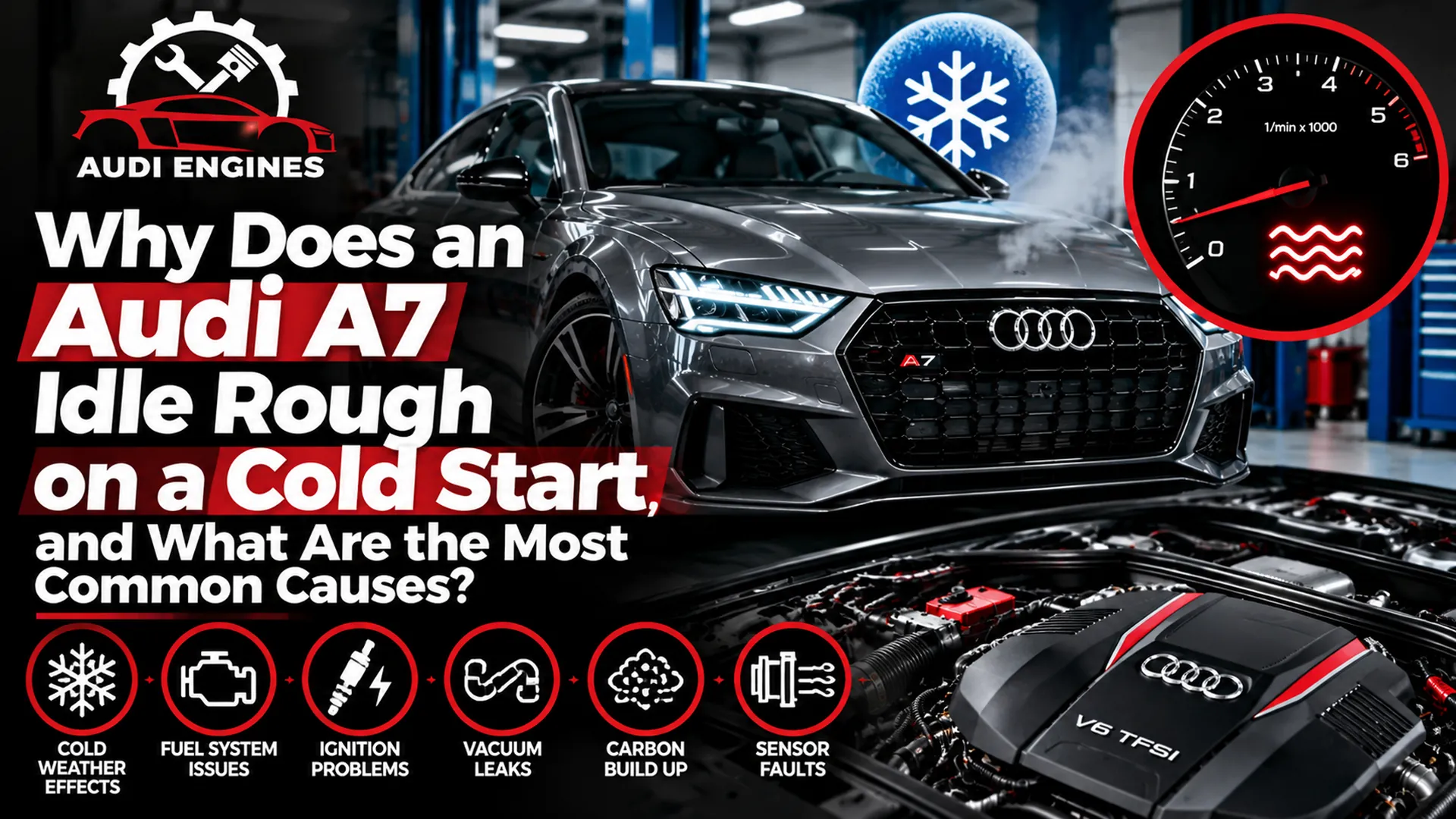
A cold engine is far more sensitive to small faults than a warm one. On a cold start, the engine control unit (ECU) enriches the fuel mixture, raises the idle speed and relies heavily on temperature sensor readings. Condensation in the intake and thicker oil add to the load. A component that is marginal when warm, such as a tired coil, a leaking hose or an injector with a poor spray pattern, often shows itself first thing in the morning.
That is why the Audi A7 rough idle when cold is so often temporary. The fault is still there once the engine warms up. It has simply stopped being noticeable.
The most common causes are:
- Worn spark plugs or failing ignition coils (petrol models), causing cylinder misfires.
- Carbon build-up on the intake valves on direct-injection petrol engines.
- PCV valve and crankcase ventilation faults, which let unmetered air or pressure disturb the mixture.
- Vacuum leaks and intake manifold leaks, which lean out the mixture.
- Faulty fuel injectors or low fuel pressure.
- Coolant temperature sensor faults, which give the ECU the wrong cold-start data.
- Glow plug, injector or EGR problems on diesel models.
- Low compression or other mechanical wear, which is the least common but most serious cause.
Which Symptoms Point to Which Cause?
Use this table as a set of clues. It does not confirm a fault, because several causes can produce the same symptom.
What you notice | What it suggests | What to test first |
| One cylinder misfires repeatedly | Spark plug, ignition coil, injector or a mechanical fault in that cylinder | Misfire counters, then swap-testing coils and inspecting plugs |
| Several cylinders misfire together | A shared problem: air leak, fuelling, carbon deposits or ventilation fault | Fuel trims, intake and PCV inspection, smoke test |
| Lean-mixture code at idle | PCV system, vacuum leak or unmetered air | Smoke test and hose inspection |
| Rough only when cold | Temperature-sensitive fuelling, ignition, deposits or diesel cold-start systems | Live data on coolant temperature, injector and glow plug checks |
| Rough both cold and warm | A persistent air, ignition, fuel or mechanical fault | Full fault scan, fuel pressure and compression checks |
| Rough idle and no warning light | An intermittent or early-stage fault that has not yet set a code | Pending codes, live data and misfire counters |
Why Does the Audi A7 Run Rough When Cold but Smooth Out When Warm?
As the engine heats up, the ECU leans off the mixture, the oil thins, intake condensation clears and metal parts expand to their working clearances. A marginal component then has less to fight against.
Do not treat smoothing out as a clean bill of health. A misfire that appears for the first minute only is still a misfire. It can still wear the catalytic converter, foul plugs and point to a fault that gets worse.
Can Spark Plugs, Ignition Coils, Carbon Buildup, a PCV Fault or a Vacuum Leak Cause Rough Idle on a 3.0 TFSI?
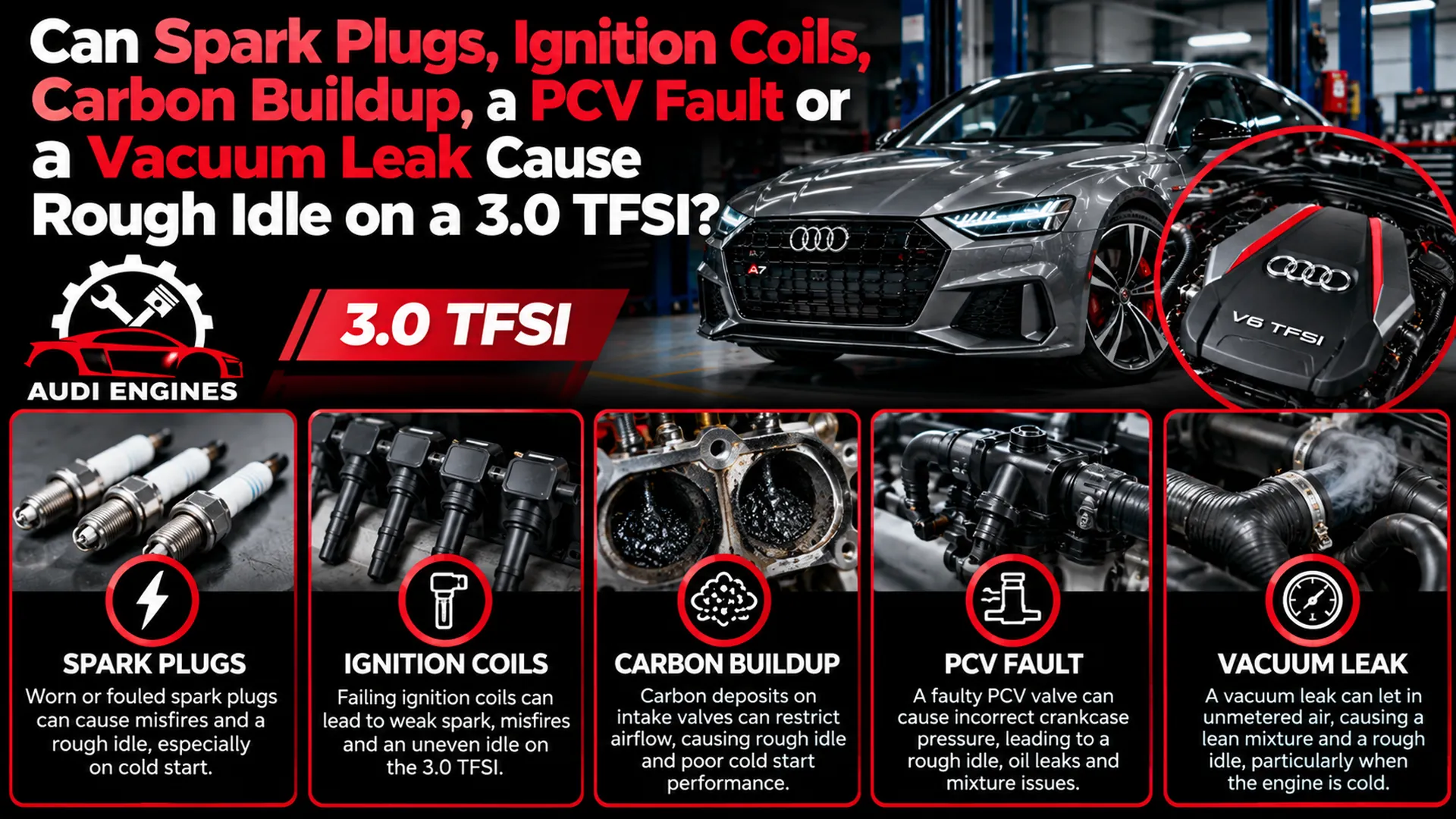
Yes, all five can. The 3.0 TFSI is a supercharged, direct-injection V6 petrol, and that design shapes its typical cold-start faults. Confirm your engine code and generation (C7 or C8) before assuming a known fault applies to your car.
Spark plugs and ignition coils. Worn plugs widen the electrode gap and weaken the spark. Failing coils deliver an inconsistent spark. The classic sign is a misfire on one cylinder, often logged as a P0301-series code. Cold, damp starts expose these faults first.
Carbon build-up on the intake valves. On direct-injection engines, fuel is sprayed into the cylinder and not over the back of the intake valves. Oil vapour from the crankcase ventilation system can bake onto the valves as carbon. Heavy deposits disturb airflow and can cause rough running, especially when cold. Carbon is not the cause of every cold-start misfire. Have the valves inspected before paying for a clean.
PCV and breather faults. A failed PCV valve or split breather hose disturbs crankcase pressure and lets unmetered air into the intake. Symptoms include unstable idle, whistling or hissing, oil consumption and lean-mixture codes.
Vacuum and intake manifold leaks. Cracked hoses, perished seals and leaking manifold gaskets all let in extra air. The ECU cannot compensate perfectly when cold, so the idle hunts or stumbles. A smoke test finds these quickly.
Injectors and fuel pressure. A leaking or poorly spraying injector, or a weak high-pressure fuel pump, can cause rough starts. These are usually confirmed with fuel pressure testing and injector checks, not guesswork.
A realistic scenario: an owner replaces all six coils on a forum suggestion, and the shake stays. A smoke test then finds a split breather hose. The coils were fine. That is why diagnosis comes before parts.
Can Glow Plugs, Injectors or an EGR Fault Cause a 3.0 TDI or BiTDI to Judder on a Cold Start?
Yes. Diesels have no spark plugs, so the cold-start causes differ from the petrol list.
- Glow plugs: these heat the combustion chambers to help a cold diesel fire evenly. Weak or failed plugs cause hard starting, white smoke, rough running and judder until the engine warms.
- Injectors and fuel delivery: worn or leaking injectors, or low fuel pressure, upset combustion on a cold start.
- EGR valve and air-management faults: a sticking EGR valve or restricted air path can make the idle uneven.
- Coolant temperature sensor: a wrong reading leads the ECU to supply the wrong amount of cold-start fuel.
- Mechanical condition: low compression on one or more cylinders makes a diesel hard to start and rough when cold.
On the Audi A7 BiTDI, owners often describe cold-start judder that fades as the car warms up. Do not assume one cause. The same symptom can come from glow plugs, injectors or air management, and only testing separates them.
How Do Mechanics Diagnose an Audi A7 Rough Idle, and Is It Safe to Keep Driving?
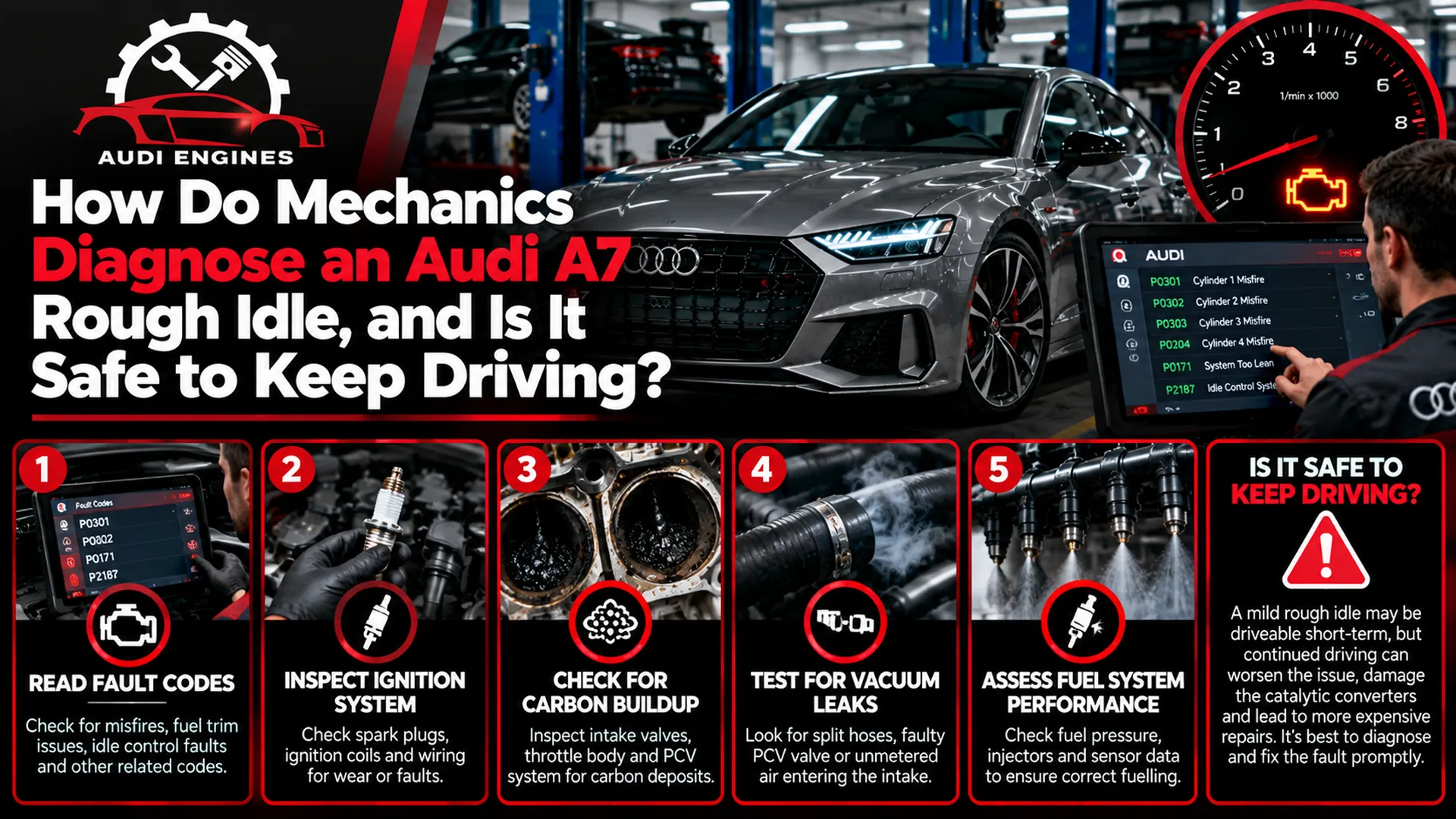
The principle is simple: diagnose first, replace parts second. Swapping plugs, coils or injectors on a hunch is how owners spend hundreds of pounds and still have the same problem.
What Is the Correct Order for Diagnosing a Cold-Start Misfire, and What Do P0300, P0301 and P0171 Mean?
A sensible order looks like this:
- Record the symptoms. Note engine temperature, how long the rough running lasts, the weather and any warning lights.
- Scan stored and pending fault codes before clearing anything. Clearing codes first destroys evidence.
- Check misfire counters and freeze-frame data to see which cylinders are affected and under what conditions.
- Inspect ignition, PCV and intake hoses for wear, splits and leaks.
- Review fuel trims and sensor data, including coolant temperature, airflow and lambda readings.
- Test fuel pressure and injector operation if the data points there.
- Inspect the intake valves for carbon deposits where the symptoms fit.
- Carry out compression or cylinder leakage testing if a mechanical fault is suspected.
A code is evidence to investigate. It is not proof that a particular part has failed. Here are the common ones:
Code | General meaning | Typical direction |
| P0300 | Random or multiple-cylinder misfire | Shared cause: air, fuelling, ignition or deposits |
| P0301 onward | Misfire on a specific cylinder (P0301 is cylinder 1) | Plug, coil, injector or mechanical fault in that cylinder |
| P0171 / P0174 | System too lean, bank 1 or bank 2 | Vacuum leak, PCV fault, MAF fault or fuel delivery |
| P0101 | Mass airflow sensor range or performance | MAF sensor, intake leak or restriction |
| P0116 | Coolant temperature range or performance | Temperature sensor or cooling issue |
| P0087 | Fuel rail or system pressure too low | Fuel pump, supply or pressure regulation |
Exact meaning depends on the engine and the scan tool data.
What if there is no warning light? An intermittent or early fault may not trigger the dashboard light straight away. A pending code, a misfire counter or a live data reading can still show the problem. A basic generic scanner may miss these. A VAG-compatible diagnostic tool reads manufacturer-specific data and gives a much clearer picture.
When Should You Stop Driving an Audi A7 With a Rough Idle?
Stop safely and arrange assessment promptly if you see any of the following:
- A flashing check engine light. This usually signals an active misfire that can damage the catalytic converter.
- Severe shaking or loss of power.
- An oil pressure warning, which means stop immediately.
- Overheating or rising coolant temperature.
- Heavy knocking from the engine.
A mild shake that clears within seconds is less urgent, but it should still be checked. Repeated misfires can wash oil from the cylinder walls, foul plugs and overload the catalytic converter.
Rough running that persists when the engine is warm, together with metal in the oil, low compression or a knock from the bottom of the engine, can point to internal wear. At that point the question is no longer a tune-up. If that sounds like your car, read our guide to Audi A7 engine rebuild cost UK and our page on reconditioned Audi engines.
How Much Does It Cost to Fix Audi A7 Rough Idle in the UK, and When Should You Call an Audi Engine Specialist?
There is no single price for fixing a rough idle, because the cause decides the bill. A loose hose and a worn injector are very different jobs. We do not publish one universal figure, because it would mislead more owners than it would help. What we can do is show you what drives the cost.
Costs depend on:
- Diagnostic time, since intermittent faults take longer to trace.
- Engine variant and code, including 3.0 TFSI, 3.0 TDI, BiTDI and generation.
- Parts versus labour, and whether genuine or aftermarket parts are used.
- Access, as some components sit under the intake manifold.
- VAT, which should always be stated on the estimate.
- Extra faults found during inspection.
Repair route | What it involves | What moves the price |
| Diagnostic scan and inspection | Code reading, live data, misfire counters, visual checks | Time needed, depth of testing |
| Spark plug and ignition coil replacement | Replacing worn plugs or failed coils | Number of cylinders, part quality |
| PCV valve and vacuum leak repair | Replacing the valve, hoses or seals found leaking | Access and parts needed |
| Fuel injector testing or replacement | Testing spray and leakage, replacing faulty units | Number of injectors, coding requirements |
| Intake valve carbon cleaning | Removing deposits from the valves | Method used and access |
| Glow plug and diesel fuel-system repair | Testing and replacing plugs, injectors or pumps | Engine type and parts |
Why specialist diagnosis pays for itself
At Audiengines.co.uk we specialise in Audi engines. We diagnose before recommending parts, and we explain what we find in plain English, so you know what is wrong and why. Our estimates are written and itemised, with VAT stated.
How Can You Prevent Recurring Cold-Start Problems, and What Should You Send for an Accurate Estimate?
You can reduce the chance of a repeat by doing the basics well:
- Follow the correct engine-specific service schedule.
- Use the specified oil and good-quality fuel.
- Investigate repeated misfires promptly, before they damage other parts.
- Keep records of fault codes, repairs and previous diagnostic reports.
To get an accurate estimate, send us:
- Your registration and engine code, if you have it.
- Whether the car is petrol or diesel.
- When the fault happens (cold only, warm only, always).
- Any warning lights, noises or smoke.
- Any previous diagnostic reports or recent repairs.
Is It Worth Having a Specialist Diagnose It Before Replacing Parts?
Yes. Several different faults can produce the same cold-start shake, so replacing parts without testing often fixes nothing and costs more. A proper diagnosis identifies the real cause once, whether that is a hose, a coil, an injector or something deeper in the engine.
Audi A7 Rough Idle on Cold Start: Frequently Asked Questions
Why does my Audi A7 shake in the morning but run fine when warm?
A cold engine is more sensitive to marginal faults such as weak ignition, small air leaks or poor injector spray. When it warms up, the ECU leans out the mixture and the symptom fades, but the fault remains.
Can bad spark plugs cause a rough cold start?
Yes, on petrol models. Worn plugs struggle to ignite a cold, enriched mixture, causing misfires and an uneven idle.
Can a faulty PCV valve cause rough idle?
Yes. A failed PCV valve or split breather hose lets unmetered air in and disturbs crankcase pressure, causing an unstable idle and sometimes lean-mixture codes.
Can carbon buildup cause an Audi engine to misfire?
It can use direct-injection petrol engines, especially when deposits are heavy. It is not the cause of every misfire, so inspect the valves before paying for cleaning.
Can carbon cleaning fix a cold-start misfire?
Only if carbon is the actual cause. If the problem is ignition, an air leak or an injector, cleaning will not cure it.
Can a fuel injector cause rough idle only when cold?
Yes. A leaking or poorly spraying injector can upset the cold mixture, then become less noticeable as the engine warms.
Why does my Audi A7 have a rough idle but no warning light?
An intermittent or early fault may not set a visible warning. Pending codes and live data can still show the problem.
Can a coolant temperature sensor cause cold-start problems?
Yes. If the ECU reads the wrong temperature, it supplies the wrong cold-start fuel, which can make the engine run rough.
Can a vacuum leak cause rough idle in an Audi A7?
Yes. Extra air leans the mixture and unsettles the idle. A smoke test is the usual way to find it.
Can faulty glow plugs cause rough idle on an Audi A7 TDI?
Yes. Weak glow plugs cause hard starting, white smoke and judder on a cold diesel.
What does a P0300 code mean on an Audi?
It means random or multiple-cylinder misfires were detected. It does not name the cause, so further testing is needed.
What does a P0171 code mean?
It means the system is running too lean on bank 1, which often points to an air leak, PCV fault or fuel delivery issue.
Is it safe to drive an Audi A7 with a rough idle?
A mild, brief shake is less urgent, but a flashing check engine light, severe shaking, an oil pressure warning, overheating or knocking means stop safely and get it assessed.
Should I replace ignition coils before diagnosing the fault?
No. Replacing coils on a guess is a common way to spend money without fixing the problem.
How much does it cost to fix rough idle on an Audi A7?
It depends on the cause, engine variant, parts, labour and VAT. A diagnosis gives you a real figure, and we provide written estimates.
Still Experiencing a Rough Idle on Your Audi A7? Get It Diagnosed Properly
A cold-start shake is your car telling you something. Sometimes the message is small, such as a worn plug or a split hose. Sometimes it is an early notice of something bigger. Either way, the right answer comes from testing, not guessing.
Record when the fault happens, keep any warning light details, and do not clear codes before they are read. Diagnose first, repair second, and the bill stays as small as it can be.
At Audiengines.co.uk we specialise in Audi engines, from diagnosis to repair, rebuild and replacement.
Arrange a diagnostic inspection with an Audi engine specialist. Send us your registration, engine code and a description of the symptoms, call us or use our quote form. We will tell you what we find, what it needs and what it costs in writing before any work begins.