
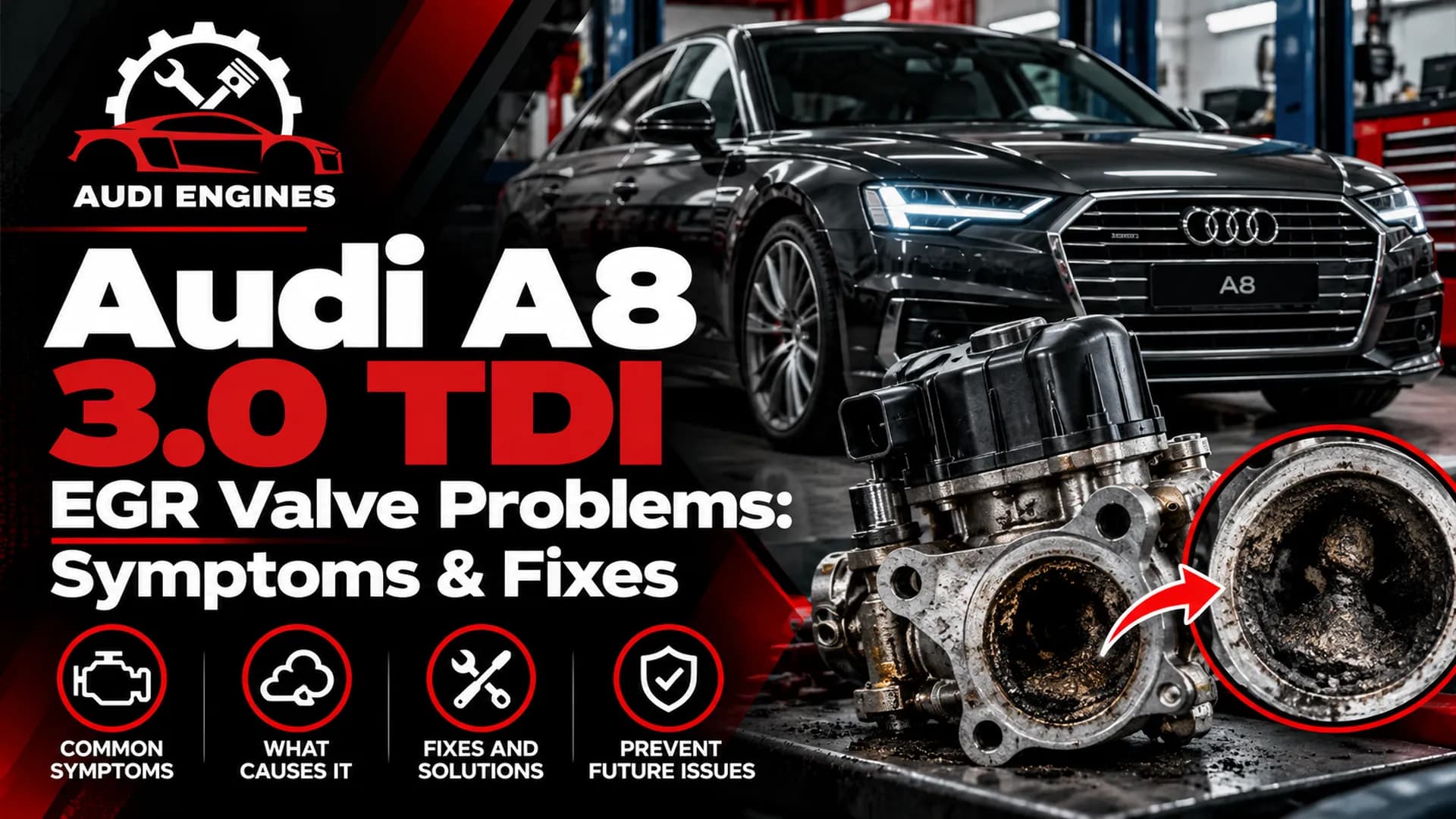
Audi A8 3.0 TDI EGR Valve Problems: Symptoms & Fixes
The engine management light came on last week. Now the car idles roughly, hesitates when you pull away, and every so often drops into limp mode just when you need it to behave. Someone has told you it is "probably the EGR valve," and you are wondering whether that means a quick clean or a very expensive afternoon.
The engine management light came on last week. Now the car idles roughly, hesitates when you pull away, and every so often drops into limp mode just when you need it to behave. Someone has told you it is "probably the EGR valve," and you are wondering whether that means a quick clean or a very expensive afternoon.
Audi A8 3.0 TDI EGR valve problems are common enough to be worth understanding properly. But here is the part that saves owners money: a fault code alone does not prove the valve has failed. Blocked passages, a wiring fault, a sensor error or a leaking EGR cooler can all produce the same warning. Replacing parts without confirming the cause is how the same fault ends up coming back.
The exact A8 generation (D3, D4 or D5), the model year and the engine code all affect the diagnosis and the parts. At Audi Engines, we confirm your engine first, diagnose before we replace anything, and give you an itemised written quote before work begins.
This guide covers the symptoms, causes, fault codes, diagnosis, cleaning versus replacement, and what the repair costs in the UK.
What Are the Symptoms and Causes of Audi A8 3.0 TDI EGR Valve Problems?
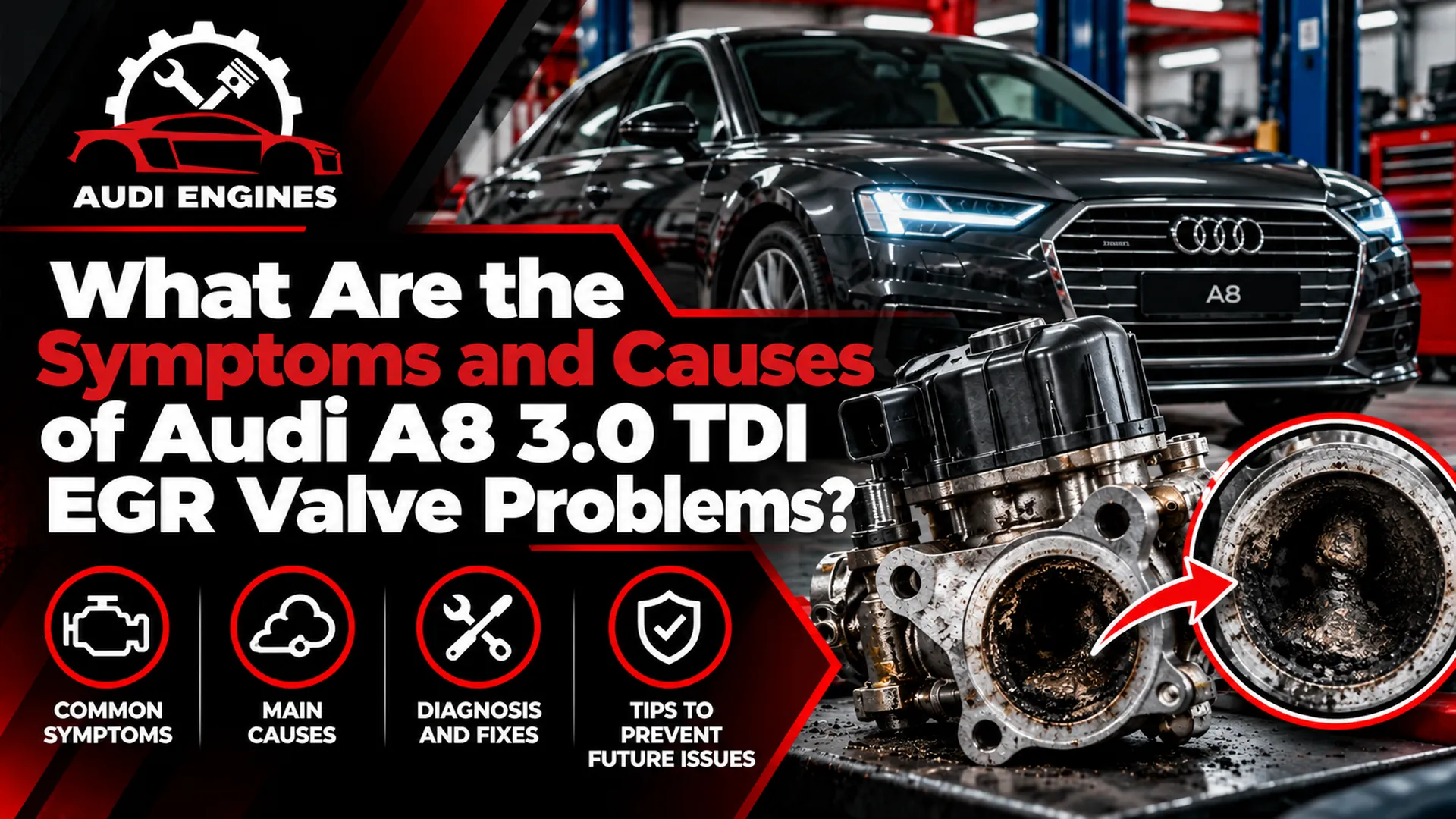
The EGR (exhaust gas recirculation) valve sends a controlled amount of exhaust gas back into the intake to lower combustion temperatures and reduce nitrogen oxide (NOx) emissions. The engine control unit (ECU) commands the valve, reads its position and checks the result against airflow data. When the valve sticks, clogs or fails electrically, that balance goes wrong, and the engine tells you.
Common symptoms of an EGR fault on an Audi A8 3.0 TDI:
- Engine management light: Often the first sign, usually with a stored fault code
- Rough idle: The engine shakes or hunts at a standstill, especially when warm
- Loss of power and poor acceleration: The car feels flat or hesitant under load
- Limp mode: The ECU limits performance to protect the engine
- Black smoke: Excess fuel or poor combustion, particularly under acceleration
- Higher fuel consumption: Combustion efficiency drops when exhaust gas flow is wrong
- Stalling: Most likely when the valve is stuck open at low revs
None of these symptoms point exclusively to the EGR system. A failing mass air flow (MAF) sensor, an intake leak, a turbocharger fault or a blocked diesel particulate filter (DPF) can feel almost identical. That is why a proper diagnosis matters more than a guess.
What usually causes EGR problems:
- Carbon and soot build-up: Diesel exhaust gas is dirty, and deposits collect on the valve and in the passages and intake manifold
- A valve stuck open or closed: Soot can jam the valve in either position
- Actuator or wiring faults: The electronic actuator, its position sensor, the connector or the wiring harness can fail
- Restricted EGR passages: Deposits narrow the flow path until the ECU cannot reach its target
- EGR cooler faults: Where fitted, a clogged or leaking cooler affects flow and can cause coolant loss
- Repeated short journeys: The engine rarely reaches full operating temperature, so deposits build faster
Service history matters too. Diesel engines that spend most of their time on short trips, or that have missed oil changes, tend to carry more deposits.
Can an Audi A8 3.0 TDI EGR Fault Cause Limp Mode or Loss of Power?
Yes. An EGR fault is one of several reasons an A8 3.0 TDI can lose power or enter limp mode. The ECU compares what it expects the EGR system to do with what the sensors report. If the two disagree for long enough, it can cut power to protect the engine and emissions system.
The two failure modes feel different:
Valve stuck open | Valve stuck closed | |
| What happens | Too much exhaust gas enters the intake | Little or no exhaust gas is recirculated |
| Typical feel | Rough idle, stalling, weak low-speed power | Often runs fairly normally, but NOx rises and a code is stored |
| Smoke | Can produce black smoke under load | Usually less noticeable |
| Likely fault code | P0402 (excessive flow) | P0401 (insufficient flow) |
| Risk if ignored | Poor combustion, deposits and drivability worsening | Emissions failure, with deposits continuing to build |
Treat that table as a guide, not a diagnosis. Other faults can mimic either pattern.
Is it safe to keep driving? Short, careful trips are sometimes possible with a mild fault, but we don't recommend carrying on. A persistent EGR problem can drive soot into the intake, stress the DPF and turn a manageable repair into a larger one. If the car is stalling, losing power suddenly or running very roughly, stop driving it and get it checked.
One more point: the A8's generation and engine code matter here. D3, D4 and D5 cars are not the same job, and EGR layout, access and parts vary. Never assume one repair procedure fits every A8 3.0 TDI.
A short scenario: an owner replaces the EGR valve after reading a P0401 code online. The light returns within weeks. The real cause was a restricted passage and a sticky intake component, neither of which a new valve could cure. A proper diagnosis would have found it first.
Send us your registration and we will confirm the engine code before we advise on anything else.
Send Your Reg for an Engine Code Check
How Do You Diagnose and Fix an Audi A8 3.0 TDI EGR Fault?
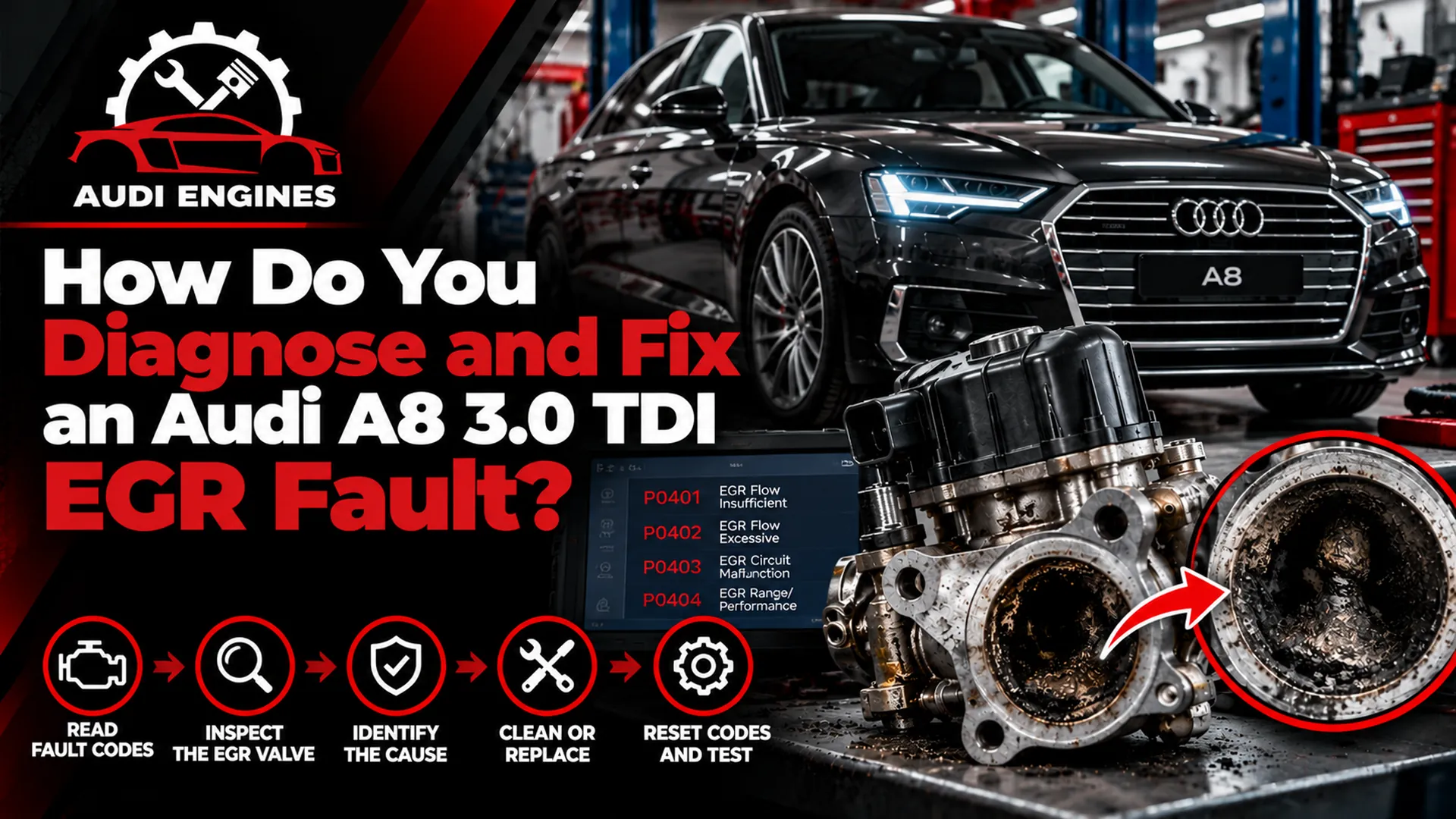
Diagnosis comes before replacement. Swapping the valve without confirming the cause often fails to cure the fault, and you pay for parts that were never the problem.
Here is the sequence a specialist works through:
- Fault-code scan and freeze-frame data: Read every stored code, not only the EGR ones, and note the conditions when the fault was logged
- Commanded versus actual EGR position: Check whether the valve moves where the ECU tells it to
- Wiring and connector inspection: Look for damaged wiring, corrosion and poor connections at the actuator
- Sensor checks: Test the MAF sensor, boost and manifold pressure sensors and coolant temperature input, because the ECU relies on them to judge EGR flow
- Flow and restriction testing: Confirm whether the passages and intake are carrying deposits
- EGR cooler inspection: Check for blockage and for any sign of coolant leaking into the exhaust path
- Repair and post-repair verification: Fix the confirmed fault, then clear codes, check live data and road test to confirm the system performs correctly
Where the engine and ECU support it, replacement of the valve may also need adaptation or basic settings so the ECU learns the new component's range. A specialist with the right diagnostic software handles this as part of the job.
Does a P0401 or P0402 Code Mean the EGR Valve Is Faulty?
Not on its own. A diagnostic trouble code reports a condition the ECU has detected, not a failed part.
The main EGR-related codes:
- P0401: Insufficient EGR flow. The ECU expected more exhaust gas flow than it measured
- P0402: Excessive EGR flow. More flow than expected, often linked to a valve stuck open
- P0403: EGR control circuit malfunction, pointing towards the electrical side
- P0404: EGR control range or performance problem
- P0407 and P0408: EGR sensor signal low or high
- P3131: EGR regulation range not reached on some VAG systems
Codes must always be interpreted against your car's ECU, engine code and the diagnostic software in use. A P0401 might come from a clogged passage, a sticky valve, a failing actuator, a sensor reading wrongly or a restricted cooler. A P0403 may be a simple wiring or connector fault, in which case a new valve is not needed at all.
This is also why EGR faults often return after cleaning or replacement. If the underlying restriction, sensor problem or wiring fault stays in place, the code comes back.
Should I Clean or Replace the EGR Valve on My Audi A8 3.0 TDI?
It depends on what the diagnosis finds. Cleaning can work when the valve is mechanically sound and only coated with soot. Replacement is justified when the valve is seized, damaged or the actuator has failed.
EGR valve cleaning | EGR valve replacement | EGR cooler repair or replacement | |
| Best when | The valve moves but is coated with deposits | The valve is seized, damaged or the actuator has failed | The cooler is blocked or leaking |
| What it involves | Removal, cleaning of the valve and the accessible passages, refit and test | New valve, gasket and adaptation where required | Cooler removal and renewal, with gaskets and a coolant check |
| Main risk | Can be a short-term fix if the root cause remains | Wasted if the real cause is elsewhere | Missed if only the valve is checked |
| Warranty | Terms confirmed in writing | Terms confirmed in writing | Terms confirmed in writing |
On parts, genuine and OEM-equivalent options exist. We explain the choice and what it means for price and warranty before you approve the work.
A word on EGR "delete" or blanking kits. Removing or disabling emissions equipment can cause an MOT emissions failure and legal problems, and it can trigger further fault codes. We never offer it as a fix. The correct repair restores the system to proper working order.
How Can I Tell an EGR Valve Fault From an EGR Cooler Fault?
Valve and cooler faults share some symptoms, but the cooler brings its own warning signs.
Signs that point towards the cooler:
- Unexplained coolant loss with no visible leak
- White smoke from the exhaust, particularly after start-up
- Overheating or coolant-pressure problems
- A sweet smell from the exhaust
A cooler can leak coolant into the exhaust path without leaving a puddle on the drive, which is why owners often miss it. Pressure testing the cooling system and inspecting the cooler separates a cooler fault from a valve, wiring or passage fault.
We recommend checking the cooler whenever the valve is replaced. Fitting a new valve onto a system with a failing cooler is a good way to repeat the job.
Request a Diagnostic Assessment
How Much Does Audi A8 3.0 TDI EGR Valve Repair Cost in the UK, and How Do I Get a Quote?
The price depends on your engine variant, how easy the components are to reach, how much labour the job takes, whether the cooler is involved, the parts you choose and the workshop's rates. No honest garage can name an exact figure without knowing your car and the diagnosis.
You will see general UK guides quoting an average for Audi EGR valve replacement. Those are broad, manufacturer-level figures, not quotes for an A8 3.0 TDI, so use them as a rough starting point only.
What makes up the price of an EGR repair:
- Diagnostic scan and inspection: The time spent confirming the fault and its cause
- EGR valve cleaning: Labour for removal, cleaning, refitting and testing
- Replacement valve and gaskets: The part, the seals and any related components
- EGR cooler repair or replacement: Needed only if testing shows a cooler fault
- Labour: Driven by engine layout and access
- Related work: Sensors, wiring repairs or intake cleaning where diagnosis shows they are needed
- VAT: Check whether any quote you compare includes it
- Post-repair testing and adaptation: Verifying the fix and, where required, coding the new valve
A cheap quote that skips the diagnosis, the cooler check or the testing often costs more once the fault returns. Ask exactly what is included.
What Should I Check Before Approving an Audi EGR Repair Quote?
Before you say yes, make sure the quote answers these questions:
- Does it include diagnosis, parts, labour, VAT and post-repair testing?
- Does it cover the cooler, gaskets and any related sensors, or only the valve?
- How long is the warranty, does it cover parts and labour, and what conditions apply?
- Is the part genuine or OEM-equivalent?
- What happens if extra work is found once the car is opened up?
We confirm warranty duration, cover and conditions in writing before work starts, and we tell you before we carry on if the job grows.
To get an accurate quote, send us:
- Your registration number or VIN
- Current mileage and service history
- The symptoms and when they occur: cold start, under load or at idle
- Any fault codes already read from the car
- Whether the engine management light, DPF warning or limp mode has appeared
Timescales depend on the diagnosis, parts availability and workshop capacity. We give you a realistic estimate with your quote and never a date we cannot promise.
Request Your Audi A8 EGR Repair Quote
Quick Reference: Symptoms, Likely Causes and What a Specialist Checks Next
Symptom | Possible cause | What we check next |
| Engine management light | Stored EGR flow or circuit fault | Full code scan and freeze-frame data |
| Rough idle or stalling | Valve stuck open, intake leak, sensor fault | EGR position, MAF and pressure readings |
| Loss of power or limp mode | Restricted flow, turbo or DPF issue | Live data, boost readings and exhaust back pressure |
| Black smoke | Poor combustion, stuck valve, injector or air-flow issue | EGR operation, air-flow data and fuel system checks |
| Coolant loss or white smoke | EGR cooler leak | Cooling system pressure test and cooler inspection |
| Fault returns after cleaning | Underlying restriction, wiring or sensor fault | Passage and intake inspection, wiring and sensor tests |
Frequently Asked Questions About Audi A8 EGR Problems
What are the common Audi A8 3.0 TDI EGR valve problems?
Soot build-up, a valve stuck open or closed, actuator and wiring faults, restricted passages and EGR cooler issues. Symptoms include a warning light, rough idle, power loss and limp mode.
Can a faulty EGR valve cause loss of power?
Yes. If the ECU sees an EGR fault or abnormal readings, it can reduce power or enter limp mode to protect the engine.
Can an EGR valve cause rough idling on a diesel Audi?
Yes, particularly when the valve sticks open and lets too much exhaust gas into the intake at low revs.
Can EGR failure cause black smoke?
It can. Poor combustion from incorrect EGR flow can produce black smoke, although injectors, airflow faults and the turbo can cause it too.
Can an EGR valve fault put an Audi A8 into limp mode?
Yes. Persistent flow or control faults can trigger it.
Can a faulty EGR valve increase fuel consumption?
Yes. Wrong exhaust gas flow reduces combustion efficiency.
Can an EGR fault cause a diesel engine to stall?
Yes, especially when the valve is stuck open at idle or low speed.
How do I know whether my Audi A8 EGR valve is stuck open?
Rough idle, stalling and weak low-speed response are typical signs, often with a P0402 code. Confirmation needs a diagnostic check of commanded and actual valve position.
How do you diagnose EGR valve problems on an Audi A8 3.0 TDI?
We read all codes and freeze-frame data, compare commanded and actual position, inspect wiring, test the related sensors, check flow and restriction, and inspect the cooler.
What does P0401 mean on an Audi A8 3.0 TDI?
Insufficient EGR flow. It can come from a clogged passage, a sticky valve, an actuator fault, a sensor error or a restricted cooler.
What does P0402 mean on an Audi A8 3.0 TDI?
Excessive EGR flow, often linked to a valve stuck open, though it also needs diagnosis to confirm.
Does an EGR fault code always mean the valve is faulty?
No. Codes point to a condition, not a failed component.
Can a faulty MAF sensor cause an EGR fault code?
Yes. The ECU uses MAF data to judge EGR flow, so a faulty sensor can produce misleading EGR codes.
Can blocked EGR passages cause insufficient flow?
Yes, and it is one of the most common reasons for a P0401-type fault.
Why does the EGR fault return after cleaning?
Because the underlying cause, such as a restricted passage, a failing sensor, a wiring fault or a cooler problem, is still there.
Can an EGR fault cause DPF problems?
It can contribute. Poor combustion and extra soot place more load on the DPF.
Can an Audi A8 3.0 TDI EGR valve be cleaned?
Often, if the valve is mechanically sound. If it is seized, damaged or has a failed actuator, replacement is the better route.
Is EGR valve cleaning better than replacement?
Neither wins by default. Diagnosis decides, and cleaning a failing valve is only a short-term fix.
How much does Audi A8 EGR valve replacement cost in the UK?
It depends on the engine variant, access, parts, cooler involvement and labour rates. We give an itemised written quote after diagnosis.
How long does EGR valve replacement take?
It varies with the engine and the access involved. We give a realistic estimate with your quote.
Does replacing an EGR valve require ECU adaptation?
Often, depending on the engine and ECU. We confirm this as part of the job.
Is it safe to drive with an EGR fault?
We advise against it. A persistent fault can worsen deposits, strain the DPF and cause drivability problems.
What happens if an EGR valve problem is ignored?
Deposits build, performance drops, fuel use rises and the repair often grows bigger and costlier.
Will an EGR fault fail an MOT emissions test?
It can. A warning light or poor emissions can lead to a failure, and removing or disabling the system is not a legal fix.
How can I prevent recurring EGR carbon build-up?
Use the correct oil specification, keep to service intervals, avoid constant short journeys where possible and get early faults diagnosed.
Should the EGR cooler be checked when replacing the valve?
Yes. A failing cooler can cause a repeat fault.
Is an EGR repair worthwhile on a high-mileage Audi A8?
Usually, if the rest of the car is sound. Weigh the repair against the car's value and condition, and we will give you a straight opinion.
Get the Right Fix for Your Audi A8
EGR problems on the Audi A8 3.0 TDI are rarely as simple as "replace the valve." The right fix depends on your exact engine, a confirmed diagnosis and an honest look at the valve, the passages, the wiring, the sensors and the cooler.
At Audi Engines, you get a specialist assessment, a diagnosis before any parts are replaced, an itemised written quote and warranty terms confirmed before work starts. If a repair is not the right answer, we will tell you.
Send us your registration number and a description of what the car is doing, and we will take it from there. Book an Audi EGR Diagnostic