
Audi A8 4.0 TFSI Oil Consumption: Causes, Symptoms and Diagnosis
The low oil level warning has appeared again, and you topped it up only a few weeks ago. You have checked the drive and the garage floor, and there is no puddle. So where is the oil going? The main Audi A8 4.0 TFSI oil consumption causes are piston ring or oil control ring problems, a faulty PCV or breather system, turbocharger oil leakage, worn valve stem seals.
The low oil level warning has appeared again, and you topped it up only a few weeks ago. You have checked the drive and the garage floor, and there is no puddle. So where is the oil going?
The main Audi A8 4.0 TFSI oil consumption causes are piston ring or oil control ring problems, a faulty PCV or breather system, turbocharger oil leakage, worn valve stem seals, external leaks, and incorrect oil or maintenance. A single symptom never proves which one applies. That is why testing matters more than guessing.
Audi has also published a technical service bulletin on excessive oil consumption covering certain 2019 to 2024 A8 models with the 4.0-litre engine. It points to a piston ring geometry change and updated rings. That does not mean every A8 4.0 TFSI has this fault, and this guide explains how to check whether it applies to your car.
Want to know where your oil is going? Audi Engines can test it and explain your options.
What Causes Oil Consumption in the Audi A8 4.0 TFSI?
The 4.0 TFSI is a turbocharged petrol V8 with direct fuel injection. Oil can leave the lubrication system in several ways. It can burn inside the combustion chamber, be drawn in through the crankcase ventilation system, pass through the turbochargers, or leak out of the engine. Each route points to a different repair.
Can Piston Rings, a Faulty PCV Valve, Turbo Leaks or Valve Seals Make an Audi A8 Burn Oil?
Yes, all four can. So can an ordinary external leak. The difference is cost and complexity, and the table below shows how the causes compare. These are diagnostic associations, not one-to-one matches.
Possible cause | Typical clues | Diagnostic direction | May need major work? |
| Piston ring or oil control ring issue | Persistent oil loss, often with no visible leak | Manufacturer procedure, oil consumption test, internal engine assessment | Often, because the engine must be opened |
| Faulty PCV valve or oil separator | Oil in the intake, abnormal crankcase pressure or vacuum | Inspect ventilation parts, measure pressure or vacuum | Usually less invasive |
| Turbocharger oil leakage | Oil residue in the intake or exhaust, smoke, possible turbo symptoms | Check oil supply and return lines, turbo condition | Depends on the findings |
| Valve stem seal wear | Smoke at certain times, such as after idling | Plug inspection, combustion evidence, specialist assessment | Often a cylinder head job |
| External oil leak | Oil residue on the engine, undertray or ground | Clean, inspect and trace the source | Usually not |
| Wrong oil or maintenance issue | Level changes after a service | Verify specification, quantity and records | No |
Piston rings and oil control rings. Oil control rings scrape excess oil from the cylinder walls. When they wear, stick or are not up to the job, oil reaches the combustion chamber and burns. Audi's bulletin ties the concern on certain 2019 to 2024 models to piston ring geometry, with updated rings as part of the production solution. Ring problems are also a classic cause of oil loss with no visible leak.
PCV valve and oil separator. The crankcase ventilation system manages pressure inside the engine. If the PCV valve or oil separator fails, oil vapour and liquid oil can be drawn into the intake and burned. Owners on AudiWorld and other forums describe PCV faults on earlier D4-generation 4.0T cars. Treat those reports as useful leads, not proof of a pattern across every car.
Turbocharger oil leakage. Turbos depend on oil feed and return lines. A leaking seal, a restricted oil supply or a damaged line can let oil escape into the intake or exhaust. Forum owners also discuss turbo oil screens as a check point. Again, these are diagnostic leads, not established failure rates.
Valve stem seals and valve guides. Worn seals let small amounts of oil past the valves, often showing as blue smoke after the car has idled or on first start.
External leaks. Gaskets, seals and oil lines can all weep. Some owners assume an engine is burning oil when it is actually leaking, so this check comes first.
Oil specification and maintenance. Using the wrong oil, overfilling, underfilling or extending service intervals can all change what you see on the dipstick or display.
A few points are worth keeping in mind:
- Oil in the intake does not, by itself, prove a faulty turbo. A PCV fault can put oil there too.
- A PCV fault and an external leak can exist together. Fixing one may not stop the loss.
- A normal compression test does not necessarily rule out oil control ring problems. Rings can pass oil without losing much compression.
Why Is My Audi A8 Losing Oil Without a Visible Leak, and What Are the Symptoms?
If there is no puddle, the oil is probably leaving through the engine's internal paths, such as burning in the cylinders or passing through the ventilation system. Watch for these signs:
- Frequent top-ups. You add oil between services more often than expected.
- Low oil level warnings. These can appear after long motorway runs, when oil consumption tends to be higher.
- Blue or grey exhaust smoke. It may be intermittent and hard to see, especially on acceleration or after idling.
- A burning oil smell while driving or after the engine is switched off.
- Oil residue in the intake or charge-air pipework, which a technician can spot during inspection.
- Spark plug deposits, misfires or rough idle, which can develop when oil fouls the combustion chamber.
Do not ignore a low oil level just because the engine still seems fine. An engine can run normally until oil gets low enough to threaten the turbos, bearings and pistons.
How Do You Test Audi A8 4.0 TFSI Oil Consumption and Find the Real Fault?
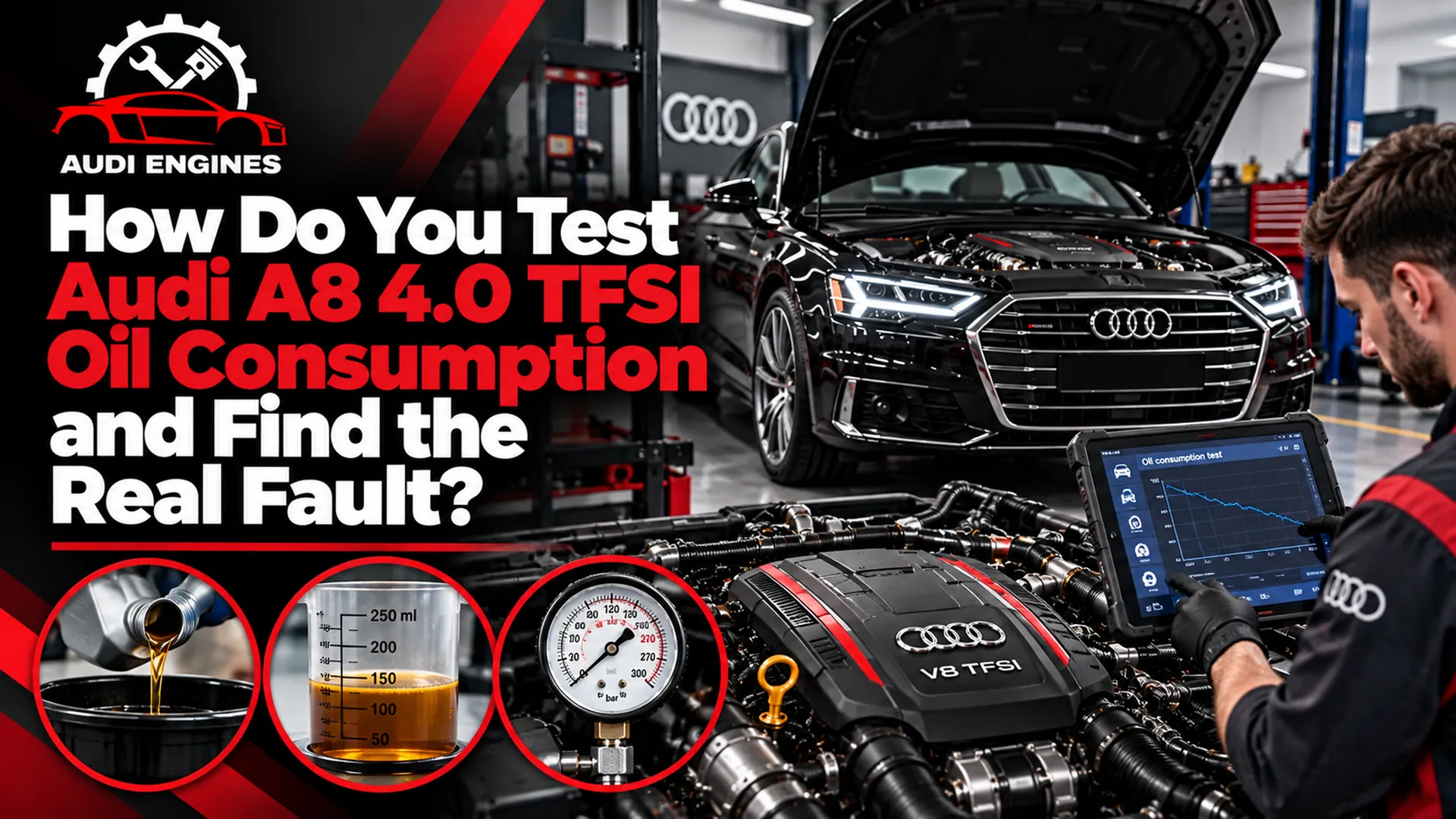
Replacing a PCV valve, a turbo or even an engine on a hunch is a gamble. A measured test shows what is actually happening, and it should come before any major repair.
How Is Audi A8 4.0 TFSI Oil Consumption Measured and Diagnosed?
You can start at home with a simple record. It gives a specialist hard evidence instead of impressions.
- Check the oil level on level ground with the engine at normal temperature, following the manual's procedure.
- Write down the odometer reading and date.
- Note any oil you add, with the quantity and the specification.
- Check again regularly, recording distance travelled and the level each time.
- Note driving conditions, such as long motorway runs, short trips or hard acceleration.
We have not quoted a universal "normal" consumption figure here. The acceptable limit depends on Audi's own guidance for your specific vehicle, and a specialist can confirm it from the correct documentation.
A workshop will normally work through the following:
- External leak inspection. Clean the engine and undertray, then trace any oil to its source.
- Service history and oil specification check. Confirm the right oil was used and the right amount fitted.
- PCV and breather system tests. Inspect the components and measure crankcase pressure or vacuum.
- Turbocharger oil supply and return inspection. Check lines, connections and the condition of the turbos.
- Compression and leak-down tests. These show whether the cylinders are sealing properly.
- Borescope inspection. A small camera can reveal cylinder wall condition and deposits.
- Fault code scan. Audi diagnostic equipment, including ODIS, can read stored codes and run guided tests.
Every test has limits. A compression test can look normal while oil control rings are still passing oil. A fault code scan may show nothing if the problem is purely mechanical. That is why a competent diagnosis combines several tests with measured consumption.
A word on additives: oil additives and flush products are sometimes promoted as fixes. They should not be presented as a guaranteed repair for worn or stuck rings.
If you would rather have the car tested properly, book an Audi A8 oil consumption test with Audi Engines. We will measure, inspect and tell you what the evidence points to.
Does Audi Have a Technical Bulletin for 4.0 TFSI Oil Consumption, and Does It Cover My Car?
Yes. Audi has published a technical service bulletin covering excessive oil consumption on certain 2019 to 2024 Audi A8 models with the 4.0-litre engine. It describes a piston ring geometry change and updated piston rings as part of the technical background and production solution. Later revisions refer to production VIN boundaries.
Two points matter here:
- The bulletin is not proof that every A8 4.0 TFSI has this fault. It applies to specific vehicles.
- Eligibility depends on your exact VIN and the bulletin revision. Model year alone may not decide it.
To check your car, give your VIN to an Audi dealer or a specialist who has access to the relevant bulletin. A good workshop will verify the VIN, the bulletin revision and your service history before recommending any repair.
Can an Audi A8 4.0 TFSI Be Repaired, or Does It Need a Rebuild or Replacement Engine?

It depends on the cause. A ventilation fault may be a straightforward repair, while worn piston rings mean opening up the engine. The honest first step is always diagnosis.
How Much Does Audi A8 4.0 TFSI Oil Consumption Repair Cost in the UK?
The cost depends on what is causing the oil loss, so diagnosis comes before any parts. Quoting a single price without testing the car would not serve you.
Repair route | When it suits | Main cost drivers | Warranty questions |
| PCV and breather repair | Ventilation fault confirmed by testing | Parts, access, labour | Parts and labour cover, and whether oil loss is rechecked afterwards |
| Turbo inspection or repair | Oil leakage traced to a turbo or its oil lines | Turbo condition, parts, access, labour | What the repair covers and for how long |
| Valve stem seal repair | Seals confirmed as the source | Labour-intensive, cylinder head access | Whether related wear is checked |
| Piston ring replacement | Internal oil burning traced to rings | Engine access, machining, parts, labour | Written terms and whether the bulletin applies |
| Engine rebuild | Wider internal damage or wear | Strip-down findings, parts, machining, labour | Parts and labour terms in writing |
| Reconditioned or replacement engine | Damage beyond sensible repair | Engine price, fitting, ancillary parts | Duration, mileage limits and exclusions |
Several factors shape the final bill:
- Access and labour. The 4.0 TFSI is a tightly packaged V8, and some jobs need major dismantling.
- Parts. Genuine, OEM-equivalent and reconditioned parts carry different prices and warranty terms.
- Engine generation and condition. Different model years and mileages can affect what is needed.
- Extent of damage. Low oil can harm other components, which adds to the work.
- Additional faults found. Strip-down or inspection can reveal more than the initial test.
- Vehicle value. Compare the total cost against what the car is worth and how long you plan to keep it.
We have not published exact prices because they would not be reliable without a diagnosis. Current UK ranges for add recent quotation ranges and review dates supplied by your workshop can be added here once confirmed.
Is it safe to drive? If the oil level is dropping slowly and no warning is showing, topping up and booking a test is usually sensible. Stop driving and seek help if you see an oil pressure warning, hear knocking, notice heavy smoke or find the level near the minimum mark. Running an engine low on oil can cause serious damage.
If you want to discuss options, request an Audi A8 engine repair or rebuild quote from Audi Engines. Tell us your VIN, mileage and symptoms and we will advise on the next step.
When Should You Contact an Audi Engine Specialist, and What Should You Ask Before Approving Work?
Contact a specialist when oil use is regular, when it is getting worse, when warning lights appear, or when someone recommends a major repair without showing evidence. A second opinion can save a lot of money.
What Should You Check Before Approving a PCV, Turbo, Piston Ring or Engine Rebuild Job?
Use this checklist before you say yes to any significant work:
- A written diagnosis with evidence. What tests were done, and what did they show?
- Bulletin and VIN check. Has the workshop checked whether the technical bulletin applies?
- Itemised parts and labour. Lines for each stage, not a single total.
- Extra-fault policy. What happens if more problems are found, and will you be contacted first?
- Warranty terms. Does it cover parts and labour, how long does it last, and what voids it?
- Genuine experience. Ask whether the specialist has worked on the A8 4.0 TFSI and similar Audi V8 engines.
A few simple habits help prevent further trouble:
- Use the correct oil specification and change it on schedule.
- Check the oil level regularly, not just at service time.
- Record every top-up with the distance travelled.
- Investigate any new smoke, smell or warning promptly.
Frequently Asked Questions About Audi A8 4.0 TFSI Oil Consumption
Is oil consumption normal on an Audi A8 4.0 TFSI?
Some oil use can be normal on a turbocharged engine, but there are limits. The acceptable amount depends on Audi's guidance for your vehicle. A record of top-ups and distance helps a specialist judge it.
Can a faulty PCV valve make an Audi A8 burn oil?
Yes. If the crankcase ventilation system fails, oil can be drawn into the intake and burned. Testing the PCV and measuring crankcase pressure helps confirm it.
Can a turbo cause oil loss?
Yes. A leaking turbo seal or a problem with the oil supply or return lines can cause oil loss. Oil in the intake does not prove the turbo is at fault, because a PCV problem can cause it too.
Can worn piston rings cause high oil consumption?
Yes. Worn, stuck or unsuitable oil control rings can let oil reach the combustion chamber and burn. This is one reason the bulletin on certain 2019 to 2024 models is relevant.
Does a compression test find worn rings?
Not always. A compression test can look normal while oil control rings are still passing oil. Leak-down testing, measured consumption and inspection give a fuller picture.
Can worn valve stem seals cause blue smoke?
Yes. Worn seals can let oil past the valves, which often shows as blue smoke after idling or on start-up.
Why is my Audi A8 losing oil without a visible leak?
The oil is probably burning in the engine or being drawn through the ventilation system. Piston rings, the PCV system, the turbos and valve seals are the usual places to look.
Is it safe to drive with high oil consumption?
It depends on the level and the symptoms. Keep the level topped up and book a test. Stop driving if you see an oil pressure warning, hear knocking or find the level very low.
How can I check whether the bulletin applies to my VIN?
Ask an Audi dealer or a specialist with bulletin access to check your VIN against the current revision. Model year alone is not enough to decide.
Can the engine be repaired instead of replaced?
Often, yes. Many faults, such as PCV, turbo or valve seal issues, can be repaired. Replacement or a rebuild is usually considered when internal damage is extensive.
How much does Audi A8 4.0 TFSI oil consumption repair cost?
It depends on the cause, the labour involved and the parts used. Ask for a written, itemised quote after diagnosis.
Find Out Where Your Oil Is Going Before It Costs You an Engine
Audi A8 4.0 TFSI oil consumption has several possible causes, from a simple ventilation fault to piston ring problems that need engine work. The key is evidence. Measure the consumption, rule out external leaks, test the PCV and turbo systems and check whether Audi's bulletin applies to your VIN.
Once the cause is known, you can choose between repair, rebuild or replacement with confidence, rather than paying for parts that may not solve the problem.
Book an Audi A8 4.0 TFSI oil consumption test with Audi Engines. Send us your VIN, mileage and symptoms, and we will explain what the evidence shows and what your options are.