
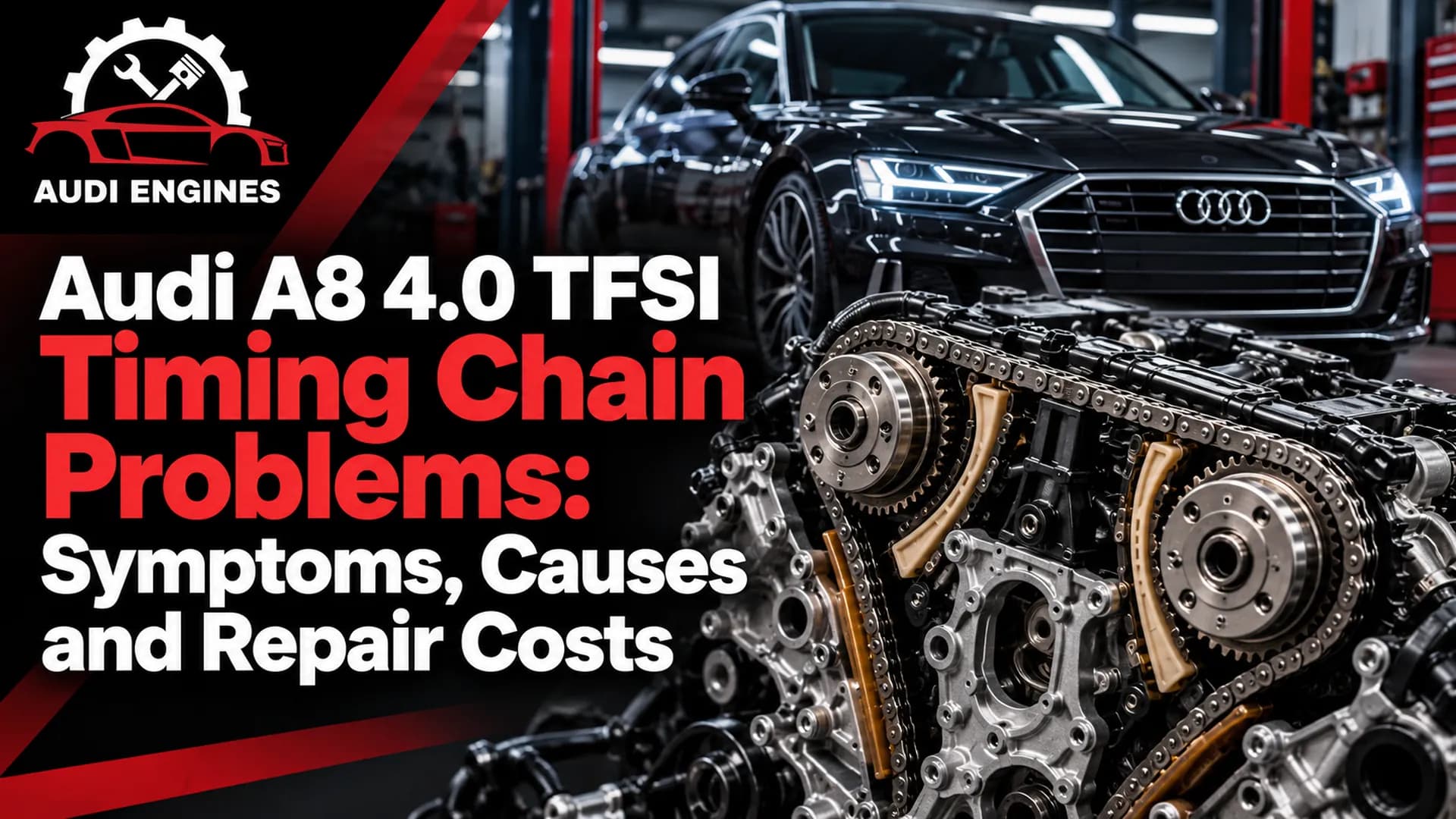
Audi A8 4.0 TFSI Timing Chain Problems: Symptoms, Causes and Repair Costs
You start the engine on a cold morning and hear it: a brief, metallic rattle from the front of the V8 that fades after a second or two. Most days you ignore it. Then one morning it lasts a little longer, and the worry sets in. Is this the start of an expensive timing chain repair. Audi A8 4.0 TFSI timing chain problems do exist, and they are worth taking seriously.
You start the engine on a cold morning and hear it: a brief, metallic rattle from the front of the V8 that fades after a second or two. Most days you ignore it. Then one morning it lasts a little longer, and the worry sets in. Is this the start of an expensive timing chain repair?
Audi A8 4.0 TFSI timing chain problems do exist, and they are worth taking seriously. Chain wear, tensioner faults and guide deterioration can all affect this engine. But a rattle alone is not a diagnosis. The sooner it is properly inspected, the more likely the repair stays limited to the timing system and does not spread into the engine itself.
This guide explains the symptoms, the causes, how the fault is diagnosed, what drives the repair cost in the UK, and how to decide between repair and replacement. One accuracy note first: the 4.0 TFSI V8 is also used in the S8, RS6 and RS7, and engine versions differ by model year. Always verify your engine code and VIN before applying any advice here to your own car. If you are hearing a rattle on your A8, Audi Engines can talk you through your options before it gets worse.
What Are the Symptoms of Audi A8 4.0 TFSI Timing Chain Failure, and Is a Cold-Start Rattle Serious?
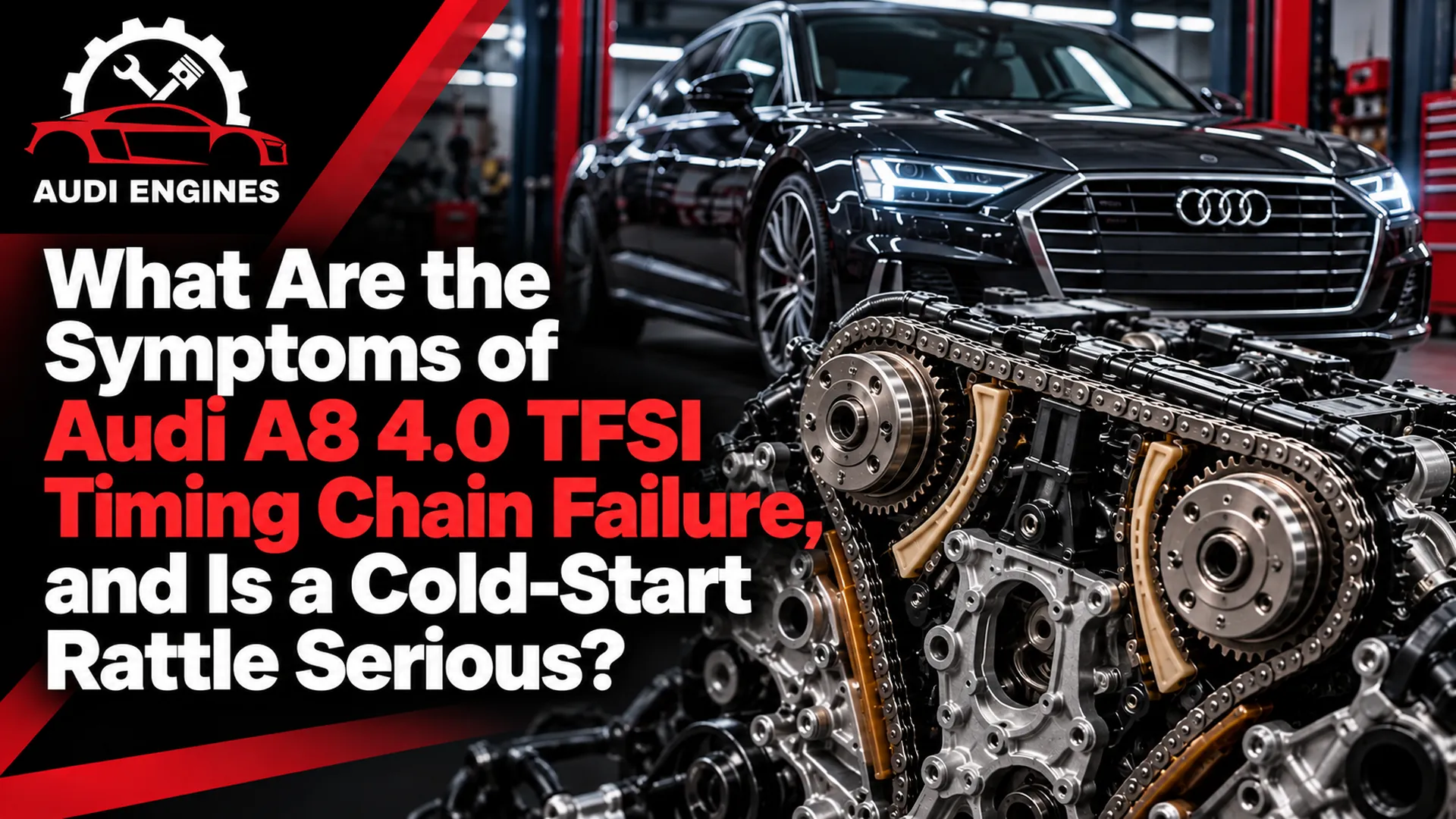
A brief rattle that fades quickly can have several causes, but a rattle that lasts longer, repeats on every cold start or arrives with warning lights needs prompt inspection. Sound alone does not prove a chain fault, yet it is often the first sign owners notice, so it should never be ignored.
The timing chain keeps the crankshaft and camshafts synchronised, so the valves open and close at exactly the right moment. When the chain, tensioner or guides wear, that synchronisation can drift. Here are the symptoms to watch for, and what each one can mean:
- Cold-start timing chain rattle. A metallic clatter for a second or two after a cold start can point to a hydraulic tensioner that is slow to build pressure, or to chain slack. Pay attention to how long it lasts and whether it is getting worse.
- Persistent metallic noise. A rattle or ticking that continues once the engine is running suggests a more advanced problem and needs inspection soon.
- Rough idle and engine misfires. If valve timing has drifted, combustion suffers. The engine may idle unevenly, hesitate or vibrate.
- Difficult starting. Extended cranking can accompany timing deviation, although many other faults cause the same symptom.
- Engine warning light and fault codes. Camshaft and crankshaft correlation codes are a strong prompt to investigate, because they suggest the engine control unit has detected a timing mismatch.
- Reduced performance. The car may feel flat or less responsive than usual, particularly under load.
Not every symptom means the chain is failing. Treat each one as a reason to investigate, not a conclusion.
When Should You Stop Driving an Audi A8 With a Timing Chain Rattle?
Some symptoms mean the car should stay parked until a specialist has looked at it. Stop driving if you notice any of these:
- A rattle that continues once the engine is warm.
- A flashing engine warning light or a sudden loss of power.
- Misfires combined with timing or camshaft correlation fault codes.
- Metallic debris on the oil filter or in the oil.
- A rattle that is clearly getting louder or lasting longer from week to week.
Driving on a worsening timing fault can turn a limited repair into serious internal damage. If in doubt, a short recovery journey costs far less than a rebuilt engine.
What Causes Timing Chain Tensioner and Guide Problems on the Audi 4.0 TFSI?
Several mechanisms can contribute to timing system problems, and they often interact. Chain wear and elongation, hydraulic tensioner pressure loss, guide rail deterioration and lubrication issues are the main ones to understand. The table below summarises how each component works and what its failure can sound or feel like.
Component | What it does | What a fault can sound or feel like |
| Timing chain | Links the crankshaft to the camshafts | Slack or elongation causing rattle, timing deviation and correlation codes |
| Hydraulic tensioner | Keeps the chain at the correct tension using oil pressure | Cold-start rattle if pressure builds slowly or the tensioner is worn |
| Guide rails | Support and direct the chain as it moves | Rattling or debris if the rails wear or break |
| Sprockets | Transfer rotation between chain and shafts | Wear that adds slack and noise |
| Camshaft adjusters | Vary valve timing under ECU control | Rough running and codes if they respond incorrectly |
| Oil pump and lubrication system | Supplies pressure to the tensioners and chain | Poor tension, accelerated wear and noise if oil pressure or condition is poor |
Oil matters more than many owners realise. Hydraulic tensioners depend on clean oil at the correct pressure, and old or incorrect oil can speed up wear throughout the timing drive. Use the oil specification Audi lists for your exact engine code, and consider shorter service intervals than the maximum if the car does mostly short journeys.
Finally, remember that engine-specific revisions exist. A fault documented on one 4.0 TFSI engine code should not be assumed for another, which is why a proper identification step comes before any repair.
How Are Audi A8 4.0 TFSI Timing Chain Problems Diagnosed, and What Else Can Sound Like a Rattle?
A reliable diagnosis follows a sequence rather than a guess. A specialist will typically work through these steps:
- Confirm the engine code, model year and service history, so the correct procedure and parts are used.
- Listen to a true cold start, noting the duration, the pitch and whether the noise changes as the engine warms.
- Scan for diagnostic trouble codes, including camshaft and crankshaft correlation faults and stored misfire data.
- Check camshaft and crankshaft timing data using live readings, where the equipment supports it.
- Verify mechanical timing and inspect components when the evidence points that way, including looking for debris or wear.
- Rule out other sources of noise, before any repair is authorised.
That last step is vital, because other components can make similar sounds. The auxiliary drive chain, ancillary belt components, heat shields, a failing alternator or water pump bearing, and turbocharger-related parts can all produce noises on startup. A timing chain rattle is a possible cause, not the only one. Paying for a repair on sound alone, without testing, risks fixing the wrong thing.
What Happens If the Audi 4.0 TFSI Timing Chain Fails or Jumps?
The 4.0 TFSI is generally treated as an engine where timing errors can allow valve and piston contact, so a serious timing failure can be costly. The usual sequence runs like this: a rattle appears, wear or tensioner loss lets the chain slacken, timing begins to deviate, misfires and fault codes follow, and in the worst case the timing slips far enough for internal contact to damage valves, pistons or the cylinder head.
Not every rattle leads to failure. Many are caught and corrected in time. But ignoring a worsening noise raises the risk considerably, and that is why early inspection matters so much on an engine this complex and expensive.
Consider a typical scenario. An owner notices a two-second rattle on cold mornings and decides to wait for the next service. Over several weeks it lengthens, and a camshaft correlation code appears. A diagnostic check finds a worn tensioner and elongated chain, and the repair stays within the timing system. A second owner, hearing the same noise, keeps driving for months. The chain slips, the engine misfires and internal damage turns a timing repair into an engine-level job. The noise was the same. The outcome was not.
How Much Does Audi A8 4.0 TFSI Timing Chain Replacement Cost in the UK?

The cost depends on what needs replacing, the labour involved in reaching the timing drive on a V8, and whether the chain has already caused further damage. I have deliberately avoided quoting fixed prices, because UK labour rates, parts choices and engine versions vary widely. Always ask for a written, itemised estimate for your own car.
This table explains what drives each part of the bill.
Cost element | What it covers | What affects the price |
| Diagnosis | Fault-code scan, cold-start assessment, timing checks | Time needed and equipment used |
| Chain, tensioner and guide parts | Timing chain kit, tensioners, guide rails and related items | OEM or alternative parts, how much is replaced |
| Specialist labour | Access, removal of components, installation and timing setting | V8 layout, engine access and the technician's rate |
| Related components | Gaskets, seals, fasteners, oil and filter | Condition of surrounding parts |
| Consequential damage | Valves, pistons, cylinder head or bearings, if the chain has slipped | Extent of internal damage |
| Post-repair checks | Timing verification, fault-code clearing, road test | Workshop procedure |
Access is the main reason the job is expensive. On the 4.0 TFSI, the timing components sit in a tightly packaged V8, and reaching them can involve substantial dismantling. Because that labour is already being done, replacing the chain, tensioners and guides together is usually more sensible than replacing one part and revisiting the job later. Ask any garage whether the quote covers the full set, and why.
It is also worth asking whether the repair is being carried out by an independent Audi specialist or a main dealer. The comparison below covers the usual differences.
Factor | Independent Audi specialist | Main dealer |
| Labour rate | Often lower | Often higher |
| Parts choice | May offer OEM or alternative options | Usually genuine parts only |
| Flexibility | May advise on repair versus replacement | Often follows a fixed process |
| Warranty | Varies, so ask for written terms | Usually clearly defined |
| Experience with older cars | Can be extensive | Varies by site |
Neither route is automatically better. What matters is documented experience with this engine, a clear itemised quote and a written warranty.
Does Audi 4.0 TFSI Timing Chain Replacement Require Engine Removal?
It depends on the engine version, the exact job and the workshop's method. Some procedures can be completed with the engine in the car, while others require extensive dismantling or removing the engine to reach the timing drive properly. Ask the garage which approach applies to your car and why. A clear explanation is a good sign.
Should I Repair the Timing Chain or Replace the Engine on My Audi A8?
When the problem is caught early and the engine is otherwise sound, repairing the timing system is usually the sensible route. When internal damage has occurred, the maths changes. The decision depends on three things: the extent of the damage, the condition of the rest of the car, and how the repair estimate compares with the cost of replacing the engine.
Use these as a framework:
- Repair may be sufficient when the fault is limited to the chain, tensioner and guides, with no evidence of valve or piston contact.
- Replacement deserves serious consideration when the chain has slipped, the engine has suffered internal damage, or repair costs approach the value of a replacement unit.
- Compare like with like. Weigh the full repair estimate, including consequential damage, against a reconditioned engine supplied and fitted, with warranty terms on each.
Before approving any work, ask the garage these questions:
- What exactly is included? Chain, tensioners, guides, sprockets, seals and fluids?
- Which parts are being used? OEM or alternative, and from which supplier?
- How will the timing be verified afterwards?
- What happens if internal damage is found part-way through?
- What warranty applies, and does it cover labour?
Audi Engines can help with exactly this decision. We assess the fault, explain the options in plain terms and can quote for timing system repair or a replacement engine where that is the better route. Please confirm the exact scope of diagnosis, repair, reconditioned engine supply, fitting and warranty when you enquire, so your quote reflects your engine and its condition.
Request a timing chain inspection or engine replacement quote from Audi Engines.
Is the Audi A8 4.0 TFSI Reliable at High Mileage, and What Should You Check Before Buying One?

There is no fixed timing chain lifespan, and the answer to how long an Audi 4.0 TFSI timing chain lasts depends on how the car has been maintained and driven. Condition and service history matter more than mileage alone. A well-documented high-mileage A8 can be a safer buy than a lower-mileage car with gaps in its records.
The A8 D4 is a refined, powerful luxury saloon, but it is also a complex and expensive car to repair. That makes careful inspection before purchase essential, especially for the timing system.
How Can You Check for Timing Chain Problems Before Buying a Used Audi A8 4.0 TFSI?
Work through this checklist, and do not skip steps because the car looks immaculate:
- Verify the engine code and model year. This confirms which timing system and which known issues apply to the car in front of you.
- Insist on a cold start. Ask the seller not to run the engine before you arrive. A warm engine hides the very noise you are listening for.
- Listen carefully. Note how long any rattle lasts and whether it repeats.
- Scan for fault codes. Stored timing, misfire or correlation faults can appear even when no warning light is showing.
- Review oil change records. Regular, correctly specified oil changes protect the tensioners and chain.
- Look for evidence of previous timing or engine repairs. Invoices should show what was done, by whom and with which parts.
- Check MOT history. Look for consistent mileage and patterns of advisories.
- Arrange an independent pre-purchase inspection by an Audi specialist.
When Should You Walk Away From a Used Audi A8 4.0 TFSI?
Some warning signs deserve a firm no, especially in combination:
- An unexplained rattle on a cold start.
- Missing or inconsistent service history.
- Engine warning lights on the dashboard.
- Repairs the seller cannot document.
- A seller who will not allow a cold-start inspection or independent check.
How Can You Prevent Premature Timing Chain Wear?
Good maintenance reduces risk, but it cannot guarantee that a chain will never need work. These habits give the timing system the best chance:
- Use the correct oil specification for your exact engine code, and change it on time. Consider shorter intervals for short-journey use.
- Let the engine reach temperature during regular drives, rather than relying only on short, cold trips.
- Investigate new noises promptly, rather than waiting for the next service.
- Keep records. Service invoices protect resale value and help a specialist diagnose problems faster.
- Check timing data periodically as part of a specialist health check, particularly on higher-mileage cars.
Frequently Asked Questions About Audi A8 Timing Chain Problems
Does the Audi A8 4.0 TFSI have known timing chain problems?
Timing chain wear, tensioner faults and guide deterioration are reported on Audi V8 engines, and owners and specialists discuss them regularly. Experiences vary by engine code and model year, so check the specific car rather than assuming every example is affected.
How long should an Audi 4.0 TFSI timing chain last?
There is no guaranteed figure. Lifespan depends on oil quality, service intervals, driving pattern and component condition. A documented service history is a better guide than mileage alone.
Is a brief cold-start rattle always a timing chain fault?
No. A short noise can come from several sources, including the tensioner, ancillaries or other components. But a rattle that lengthens, repeats or arrives with warning lights should be inspected promptly.
Can you drive an Audi A8 with a rattling timing chain?
It is a risk. If the rattle lasts beyond start-up, the engine misfires or a warning light flashes, stop driving and arrange inspection. Continuing can turn a timing repair into serious engine damage.
What are the symptoms of a failing Audi timing chain?
Common signs include cold-start rattle, persistent metallic noise, rough idle, misfires, difficult starting, warning lights and camshaft correlation codes. None proves a fault alone, so diagnosis matters.
How much does Audi A8 timing chain replacement cost in the UK?
It depends on the parts replaced, the labour required and whether the chain has caused damage. Ask for a written, itemised estimate that separates diagnosis, parts, labour and any additional work.
Can timing chain failure destroy an Audi V8 engine?
Yes, in severe cases. If timing slips far enough, valves and pistons can make contact and cause internal damage. Early inspection greatly reduces this risk.
Can an oil change fix a timing chain rattle?
Sometimes fresh, correctly specified oil improves tensioner behaviour, but it will not repair worn components. If a rattle persists after an oil change, have it inspected.
Can a diagnostic scan confirm timing chain failure?
A scan can reveal camshaft correlation faults and misfire data that point towards a timing problem, but it does not give the whole picture. Mechanical inspection and live data are often needed to confirm the cause.
Should I buy an Audi A8 with a timing chain rattle?
Only with great caution. Without a documented diagnosis and repair estimate, the financial risk is high. Negotiate on the basis of a specialist inspection, or walk away.
Is timing chain replacement cheaper than replacing the engine?
When damage is limited to the timing system, repair is usually cheaper. If the chain has slipped and caused internal damage, a reconditioned replacement engine can become the more sensible option.
Need Expert Help With Your Audi A8 4.0 TFSI?
A rattle on a cold start does not always mean disaster, but it is never worth ignoring. Identify the engine code, get a proper diagnosis, ask for an itemised quote and act early. That sequence gives you the best chance of keeping a timing repair.
If you are hearing a noise, weighing repair against replacement, or inspecting an A8 before you buy, Audi Engines can help. Send us your registration number and a description of the noise, and we will talk you through your options.