
Audi A8 DPF Regeneration Problems: Causes, Fixes and UK Repair Costs
The DPF light comes on again. You have already driven the A8 down the motorway, the light is still there, and now the car feels flat when you push the pedal. A garage has hinted that the filter may need replacing, and the number mentioned would make anyone wince.
The DPF light comes on again. You have already driven the A8 down the motorway, the light is still there, and now the car feels flat when you push the pedal. A garage has hinted that the filter may need replacing, and the number mentioned would make anyone wince.
Before you agree to that, consider this: Audi A8 DPF regeneration problems are usually caused by something around the filter, not the filter itself. Short journeys, a faulty differential pressure sensor, an exhaust temperature sensor reading wrongly, a cold-running engine or a fault producing excess soot can each stop a regeneration cycle. A genuinely failed filter is the less common cause.
This guide explains why an Audi A8 DPF stops regenerating, how mechanics separate a blocked filter from a sensor or engine fault, what fault codes such as P2458, P2459 and P2463 point to, and what repairs cost in the UK. If you want a second opinion on your car, the team at audiengines.co.uk can talk through your symptoms and recommend the right next step.
All prices and timings in this article are indicative UK market ranges, not quotes. Price information last checked: the date of publication.
Why Is Your Audi A8 DPF Not Regenerating, and What Are the Warning Signs?
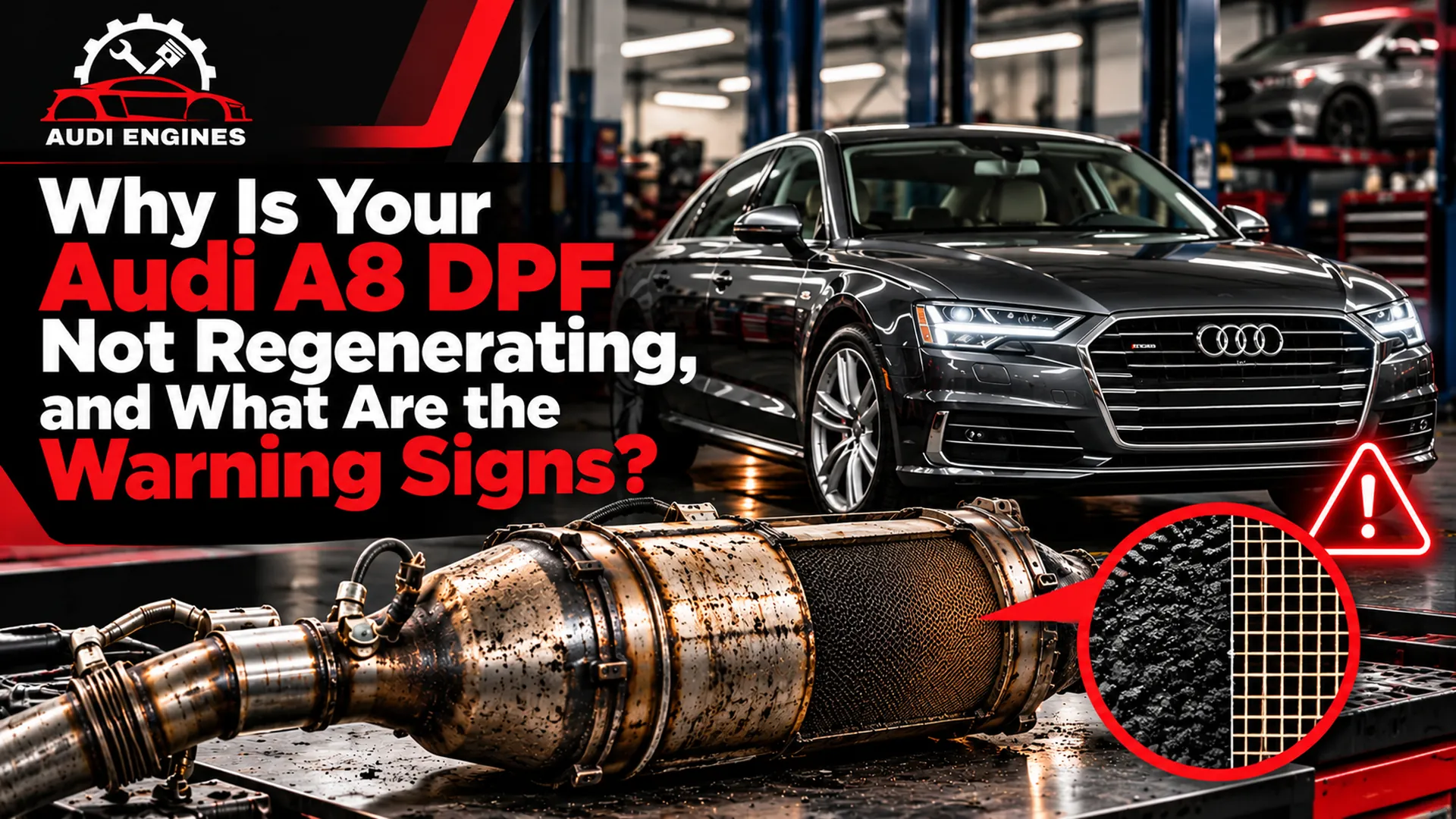
A diesel particulate filter traps soot from the exhaust. When enough builds up, the engine control unit raises the exhaust temperature to burn it off. That process is regeneration, and on a diesel A8 it normally happens without you noticing.
It only works when several conditions are met. The engine must be at operating temperature, the sensors must report believable readings, the soot load must be within limits, and the car must run long enough to finish the cycle. If any condition fails, the ECU delays, interrupts or blocks regeneration. Soot keeps accumulating, and the warnings begin.
A note on models: the A8 has been sold with different diesel engines, including the 3.0 TDI and, in some generations, the 4.2 TDI. Sensor layouts, fault code definitions and regeneration procedures vary by generation, engine and model year. Treat everything below as a guide to the likely cause, not a verdict on your specific car.
What Causes Audi A8 DPF Regeneration Problems and How Do You Spot Them?
Most Audi A8 DPF regeneration problems come from driving patterns, temperature or sensor faults, or an engine fault creating excess soot. Warning signs include a DPF light that stays on or returns, reduced power, higher fuel use and frequent regeneration attempts.
Here are the main causes in more detail.
Short journeys and stop-start driving. Regeneration needs sustained heat. If you switch off ten minutes into a cycle, it is abandoned. Repeat that across weeks of school runs and town driving, and the soot load climbs. Cold starts make it worse.
The engine not reaching operating temperature. Regeneration is normally inhibited until coolant temperature is correct. A thermostat stuck open keeps the engine cooler than it should be, so the ECU holds off. A faulty coolant temperature sensor can cause the same result. The thermostat is only a suspect until the live data confirms it, so a technician checks actual operating values rather than assuming.
A faulty differential pressure sensor or blocked pressure hoses. This sensor measures the pressure difference across the filter and tells the ECU how clogged it is. If it, or the small hoses feeding it, give false readings, the car may trigger regeneration at the wrong time, refuse it, or display a blockage that is not there.
A defective exhaust gas temperature sensor. The ECU relies on these sensors to control and monitor the burn. Implausible readings can interrupt a cycle or prevent one starting.
EGR, MAF and fuel injection problems. A sticking EGR valve, a failing mass airflow sensor, injectors delivering fuel poorly, low fuel rail pressure, a turbocharger fault, intake air restriction or faulty glow plugs all produce incomplete combustion. More soot reaches the filter than the car can burn off, however carefully you drive.
Excess soot or ash. Soot is combustible and regeneration burns it away. Ash is the non-combustible residue left by engine oil additives and fuel, and it builds slowly over the life of the filter. Regeneration cannot remove ash. That is why a filter can stay restricted even after a successful cycle, and why high-mileage cars sometimes need professional cleaning or replacement.
Active engine faults. If the ECU holds a relevant fault, it may block regeneration entirely until the fault is fixed. Pressing on with repeated attempts achieves nothing.
Here is how the symptoms usually appear:
- DPF warning light that stays on or keeps returning after you drive
- Engine management light appearing alongside it
- Reduced power or limp mode, where the ECU protects the engine from exhaust restriction
- Higher fuel consumption, because extra fuel is used during regeneration
- Frequent regeneration attempts, shown by a cooling fan running after shutdown, a raised idle speed or a hot exhaust smell
- A rising engine oil level, which can signal fuel dilution after repeated interrupted regenerations
- A glow plug warning light on some cars, which can accompany emissions faults
One or two of these on their own do not confirm a failed filter. A pattern of them points to a regeneration problem that needs proper investigation. If you are unsure how a technician connects these symptoms, our page on Audi engine diagnostics explains the process.
Why the oil level matters. During active regeneration, extra fuel is injected to raise exhaust temperature. Some of it can pass into the sump. When regenerations are repeatedly interrupted, that diesel builds up in the oil, thinning it and reducing lubrication. A dipstick reading that climbs instead of dropping, especially with a fuel smell, needs prompt attention. Left alone, it can turn a DPF problem into an engine problem.
What Do Audi A8 Fault Codes P2458, P2459, P2463 and P2452 to P2454 Mean?
Fault codes tell a technician where to start. They do not prove the filter has failed. Here is how these codes are generally described:
Code | Commonly described as | Likely causes | Sensible next check |
| P2458 | DPF regeneration duration | Interrupted or overlong cycles, low temperature, sensor faults, excess soot | Review regeneration history and exhaust temperature data |
| P2459 | DPF regeneration frequency | Excess soot production, restricted filter, pressure sensor fault | Compare differential pressure with engine load and speed |
| P2463 | DPF soot accumulation | Failed regenerations, EGR or injector faults, heavily loaded filter | Check measured and calculated soot mass, then find the source of the soot |
| P2452 to P2454 | DPF pressure sensor circuit faults | Sensor failure, wiring fault, damaged or blocked hoses | Test the sensor circuit and inspect the pressure hoses |
| Exhaust temperature sensor codes | Sensor circuit or plausibility faults | Failed sensor, wiring or connector fault | Test sensor readings against actual exhaust temperature |
Exact definitions, trigger conditions and test procedures vary by A8 generation, engine and software version, so treat this table as a diagnostic guide, not a definitive diagnosis. Have the codes read before anyone clears them. Clearing a code erases freeze-frame data a technician needs, and the light usually returns.
How Do You Diagnose and Fix Audi A8 DPF Regeneration Problems?
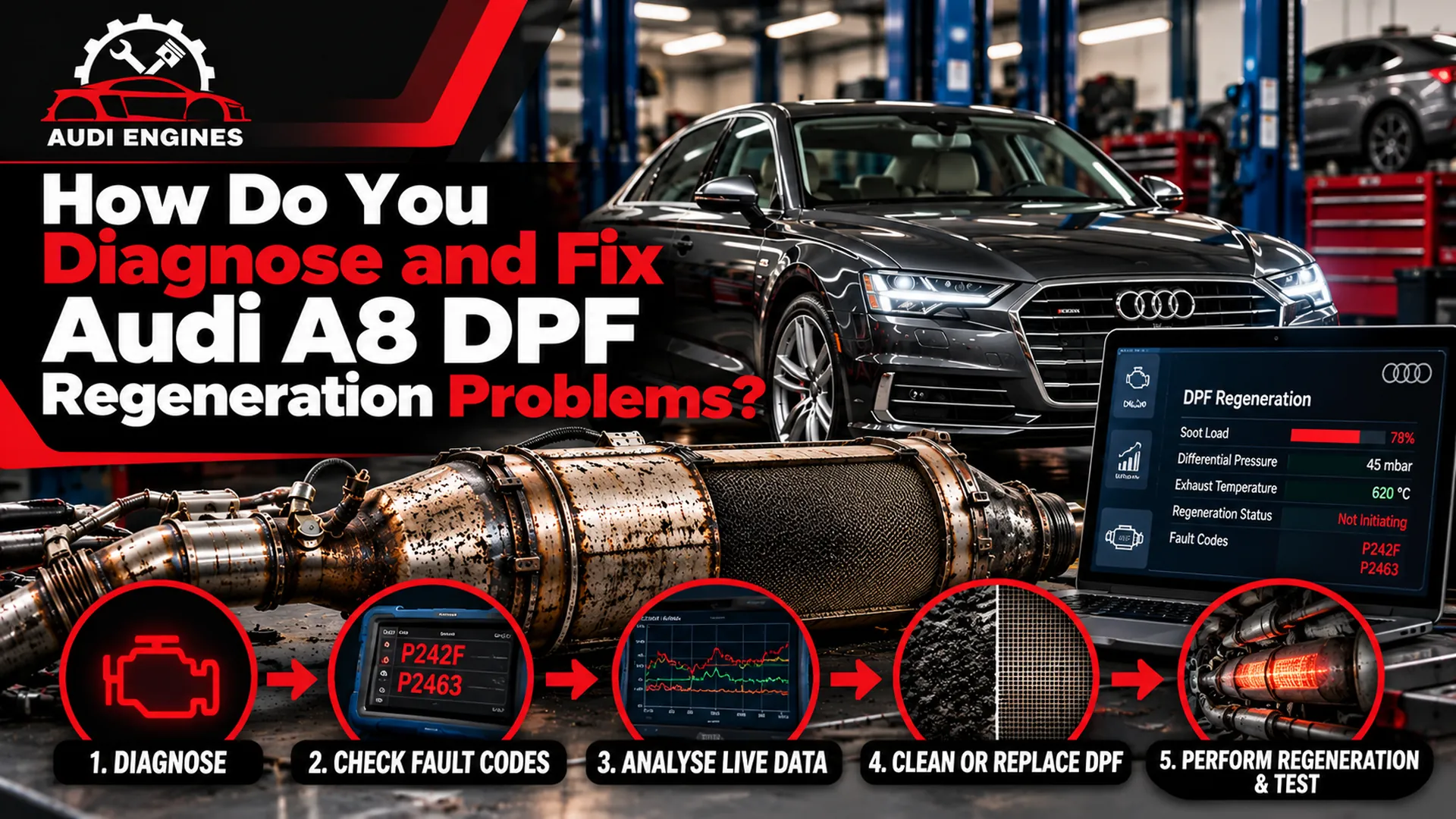
The expensive mistake is starting with the most costly answer: replace the filter. A proper diagnosis works in the opposite direction. It starts with the cheapest and most likely causes and works towards the most expensive.
How Do Mechanics Tell a Blocked Filter From a Sensor Fault or Engine Fault?
A methodical technician using Audi-compatible diagnostic equipment will usually follow a path like this:
- Read the Audi-specific diagnostic trouble codes before clearing anything, and record the freeze-frame data.
- Compare measured and calculated soot mass. If the two figures disagree sharply, the sensor or its hoses are suspect.
- Check differential pressure at idle and under load. A restricted filter and a faulty sensor produce different patterns.
- Verify exhaust temperature sensor readings. Implausible or slow-responding values can stop or ruin a cycle.
- Test coolant temperature and thermostat operation. The engine should reach and hold normal temperature.
- Inspect the EGR valve, MAF sensor, fuel injection and boost system. These are the usual sources of excess soot.
- Determine whether regeneration is currently permitted. The ECU may be blocking it because of a fault, a temperature condition or a soot load above its threshold.
- Verify the result after repair. A fix is only confirmed when regeneration completes and the original fault stays cleared.
A practical example. Picture an A8 3.0 TDI that shows a DPF light every few weeks. The owner has been told the filter is finished. Diagnostics reveal that measured differential pressure does not match the calculated soot load, and one of the pressure hoses is partly blocked. The sensor also reads inconsistently. The repair is new hoses, a replacement sensor, a verified regeneration and a final scan. The cost is a fraction of a new filter, and the filter was never the problem. Cases like this are why testing comes before replacement.
Can you keep driving? If the only sign is a steady DPF light and the car drives normally, a gentle trip to a garage is generally reasonable. Stop and seek help if the car enters limp mode, the warning light flashes, you smell fuel, the oil level is rising or smoke is excessive. Driving on with a heavily loaded filter risks serious and costly damage.
What a good garage gives you. After diagnosis you should receive a clear explanation of what was found, which tests support it, what repair is recommended and what it costs. Nothing beyond the quote should be done without your approval.
Is Forced Regeneration Enough, or Does Your Audi A8 Need DPF Cleaning or Replacement?
Forced regeneration is a workshop procedure where a technician commands the cycle with diagnostic equipment while the car is stationary and monitored. It is not a universal fix. It works when the soot load is high but within permitted limits and no underlying fault exists.
The ECU may refuse it, or it may fail, if the soot load is too high, a sensor gives implausible readings, coolant is too cold, fuel level is low, or an active engine fault is present. Repeating forced regeneration without diagnosis wastes money and strains the system.
Here is how the main options compare:
Option | When it applies | Likely outcome |
| Normal driving regeneration | Light soot loading, no faults, sensors healthy | Cycle completes on a sustained drive |
| Controlled workshop regeneration | Soot load high but within limits, no underlying fault | Soot burned off under monitored conditions |
| Sensor, hose or engine repair | Readings implausible or excess soot source found | Restores correct regeneration control |
| Off-car professional cleaning | Heavy soot or ash loading, filter intact | Often restores flow without replacement |
| DPF replacement | Cracked, melted or unrecoverable filter | New filter, plus repair of the original cause |
Two points deserve emphasis. First, a filter can block again after cleaning or replacement if the root cause is unresolved. A new filter fitted over a failing EGR valve, a leaking injector or a faulty thermostat will not last. Second, after some repairs, learned values in the ECU need resetting so the car calculates soot load correctly. A garage should reset them to match the work performed and confirm the result with a verification scan.
If your A8 keeps returning with the same warning, or a forced regeneration has failed, book an Audi A8 DPF diagnostic assessment through audiengines.co.uk. Finding the true cause once is cheaper than paying for repeat attempts.
How Much Does Audi A8 DPF Repair Cost in the UK, and How Do You Prevent It Happening Again?

Costs depend on the engine, model year, region and how far the problem has progressed, so treat these figures as typical UK market ranges, not quotes. The only reliable number is one given after diagnosis. Always ask for a written quote that separates diagnosis, parts and labour.
What Do Audi A8 Forced Regeneration, DPF Cleaning and Replacement Cost, and What Should a Quote Include?
Premium models like the A8 usually sit toward the upper end of general market ranges because of parts cost and system complexity. Your final quote will depend on the garage, the engine and the work needed.
What a good quote should show:
- An itemised diagnosis, with the codes found and the tests that support the recommendation
- Separate lines for parts and labour, so you can compare garages fairly
- The warranty on parts and workmanship, in writing
- A promise that extra work needs your approval before it begins
- A post-repair verification scan, confirming regeneration completes and the fault stays cleared
That last point matters. A repair is only a repair if the fault is confirmed gone.
Is DPF removal an option? No. Removing the filter is not a legitimate road-use repair in the UK. A car without its DPF will fail an MOT, and it can bring fines and problems with insurance and resale. Be wary of anyone who suggests it.
When is engine repair or replacement the answer? In most cases it is not. The majority of DPF regeneration faults are resolved with sensors, hoses, a thermostat, an EGR repair or a clean. It becomes a genuine conversation only after long-term fuel dilution has damaged bearings, or turbo or injector failures have gone unchecked. If your diagnosis points that way, audiengines.co.uk can explain your options openly, including whether repairing your engine makes more sense than replacing it.
How to prevent repeat blockages:
- Give the car a sustained drive. Steady-speed driving on a motorway or dual carriageway helps complete a cycle. Follow the guidance for your specific model.
- Do not interrupt regeneration. If you notice the cooling fan running after shutdown, a raised idle or a hot exhaust smell, let the cycle finish where it is safe to do so.
- Use the correct engine oil. The right low-ash specification for your TDI protects the filter and slows ash build-up.
- Act on warning lights early. A sensor fault caught early is cheap. A neglected one is not.
- Keep to the service schedule. Healthy injectors, EGR, thermostat and air intake mean less soot to begin with.
Ready to find out what is wrong with your A8? Contact audiengines.co.uk with your model year, engine and symptoms. We will explain what testing is likely to involve and give you a clear next step before any work begins.
Frequently Asked Questions About Audi A8 DPF Problems
Can I drive my Audi A8 with the DPF light on?
For a short, gentle trip to a garage, usually yes, provided the car is not in limp mode, the light is not flashing and there is no fuel smell or rising oil level. Do not carry on as normal for weeks, because a heavily loaded filter can become too blocked to regenerate.
How long does Audi A8 DPF regeneration take?
A typical regeneration can last somewhere in the region of 10 to 20 minutes of sustained driving, though it varies with the engine, conditions and soot load. A cycle that regularly takes much longer, or never finishes, suggests a problem.
How often should an Audi A8 DPF regenerate?
It varies with driving style and soot production. Many diesels regenerate every few hundred miles. A sudden increase in frequency is a warning sign and links to code P2459, so it is worth investigating.
Can a faulty thermostat or EGR fault stop regeneration?
Yes. A thermostat stuck open keeps the engine too cool for regeneration, and a sticking EGR valve increases soot production. Both are cheaper to fix than a filter, but live data should confirm them before parts are replaced.
Can a DPF pressure sensor cause limp mode?
It can. If the sensor reports a severe restriction, the ECU may reduce power to protect the engine and filter, even when the filter is not truly blocked. Testing the sensor and hoses is a sensible early step.
Can an Audi A8 DPF be cleaned instead of replaced?
Often, yes. If the substrate is intact and the problem is soot or ash, professional off-car cleaning can restore flow. Replacement is for filters that are cracked, melted or beyond recovery.
Is frequent regeneration normal?
Some regeneration is normal. Unusually frequent cycles are not. They often point to excess soot production from an EGR, injector or air intake fault, or to a misleading pressure sensor.
Why does the DPF warning light keep returning?
Usually because the cause has not been fixed. Driving it off or clearing the code treats the symptom. The light returns until the underlying sensor, temperature or engine fault is found and repaired.
Is a diagnostic scan necessary before forced regeneration?
Yes. A scan shows whether the ECU will permit regeneration and reveals faults that would make it fail or cause harm.
Can I fix an Audi A8 DPF fault myself?
You can take sensible steps, such as a sustained drive and checking the oil level. Anything beyond that, including forced regeneration, needs Audi-compatible diagnostic equipment and the right procedure.
What should an Audi DPF repair quote include?
Itemised diagnosis, parts, labour, warranty terms, a note on approval for extra work and a post-repair verification scan.
How can I find an Audi DPF specialist near me?
Look for a garage that explains its diagnostic process, uses Audi-compatible equipment, gives written itemised quotes and offers a warranty. Ask what they test before recommending a replacement filter.
Final Thoughts: Fix the Cause, Not Just the Warning Light
An Audi A8 DPF that will not regenerate is sending a message. Sometimes it is simple: drive further, or replace a sensor. Sometimes it points to a thermostat, an EGR valve, an injector or an oil problem. Rarely does it mean the filter is beyond saving.
A sound repair follows a clear pattern. Read the codes before clearing them. Test the sensors and hoses. Find the source of the soot. Choose between regeneration, cleaning and replacement only after that. Skip those steps and you pay twice.
If your A8 has a DPF warning light, is losing power or is showing a rising oil level, speak to the team at audiengines.co.uk. Tell us your model year, engine and symptoms, and we will help you find the real cause and the most sensible fix.