Audi A8 Engine Management Light Common Causes: What They Mean and What to Do Next
The light has just come on. Your Audi A8 feels fine, or maybe it doesn't, and you are trying to decide whether to keep driving or pull over. It is a fair worry. The A8 is a complex car, and a glowing amber engine symbol can mean anything from a minor sensor fault to a problem that needs attention today.
The light has just come on. Your Audi A8 feels fine, or maybe it doesn't, and you are trying to decide whether to keep driving or pull over. It is a fair worry. The A8 is a complex car, and a glowing amber engine symbol can mean anything from a minor sensor fault to a problem that needs attention today.
Here is the short answer. A steady Audi A8 engine management light usually means the engine control unit has stored a fault that needs checking soon. A flashing light, or a light with a sudden loss of power, means stop safely and get help. The most common causes sit in a handful of systems: sensors, ignition, fuel delivery, air intake, turbo and boost control, and emissions equipment.
One point is missing from most guides. A fault code tells you where the car has detected a problem. It does not prove which part has failed. Replacing parts from a code alone is the quickest way to spend money without fixing anything.
Causes also differ between petrol and diesel A8s, and between generations. We treat those separately below. If you want the cause found before you spend anything on parts, book an Audi A8 diagnostic scan with us and we will read the codes and test the system properly.
What Does the Audi A8 Engine Management Light Mean, and Is It Safe to Drive?
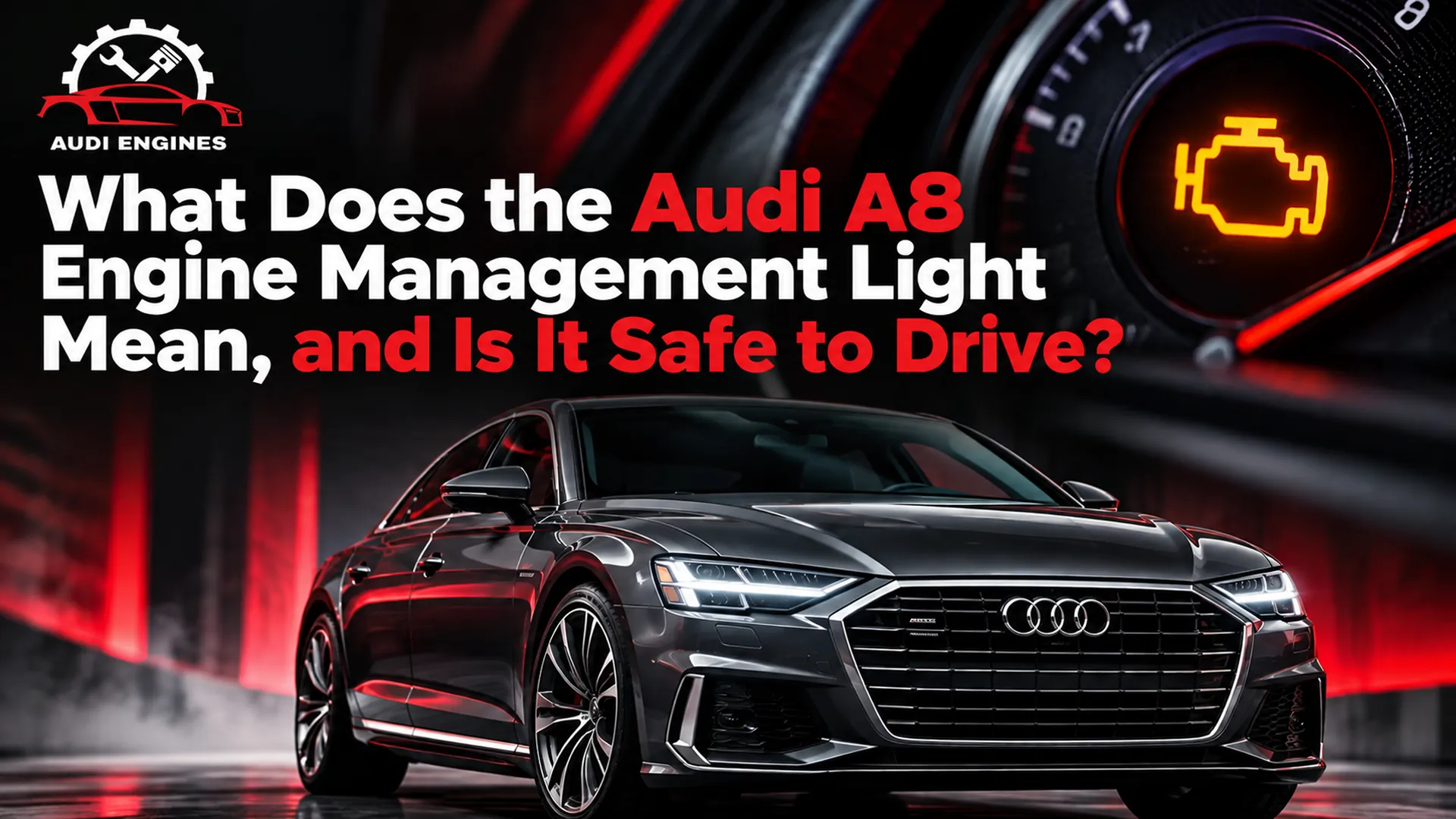
The engine management light, also called the check engine light or malfunction indicator lamp (MIL), is the warning your car's engine control unit (ECU) raises when it detects a fault in the engine or emissions system. The ECU monitors sensor signals constantly, compares them with what it expects, and stores a diagnostic trouble code (DTC) when something falls outside the limits.
The light can come on for reasons that affect how the engine runs, how much it pollutes, or both. That is why an A8 can show the warning while still driving normally. The car has noticed a problem, even if you haven't.
What Is the Difference Between a Steady and a Flashing Audi A8 Engine Light?
A steady light means a fault has been detected and stored. A flashing light means the fault is active and may be damaging the engine or exhaust. Treat the two very differently.
Warning | What it usually signals | How urgent | What to do |
| Steady engine management light | A stored fault, often a sensor, ignition, fuel, air intake or emissions issue | Moderate. Book a diagnosis soon | Drive gently, avoid long trips, arrange a diagnostic scan |
| Flashing engine management light | An active fault, commonly a misfire that can overheat the catalytic converter | High. Act now | Stop safely, switch off, call for help |
| EPC light | A fault in the electronic power control system, such as throttle or accelerator signals | Moderate to high, especially with reduced power | Have it scanned promptly |
| Light with limp mode | The ECU has reduced engine output to protect the engine | High | Stop when safe and arrange recovery or inspection |
The EPC light and the engine management light are related but not identical. The EPC light points to the electronic throttle and power control side. The engine management light covers a wider range of engine and emissions faults. Either can appear alone, or together.
Can You Drive an Audi A8 With the Engine Management Light On?
With a steady light and no other symptoms, you can usually drive to get the car checked, but don't leave it for weeks. A minor fault can become a bigger one if ignored.
Stop driving if you see any of these:
- A flashing engine light. This often points to a misfire, which sends unburnt fuel into the exhaust.
- Sudden loss of power or limp mode. The ECU is protecting the engine.
- Rough running, vibration or heavy shaking. Something is badly wrong with combustion.
- A red oil pressure or coolant warning alongside the engine light. Switch off straight away.
- Smoke, burning smells or a strong fuel smell. Treat these as urgent.
If the light flashes or the car loses power, stop safely, switch the engine off and arrange recovery. Driving on can damage the catalytic converter, and that repair costs far more than the fault that started it.
Consider a typical case. An owner sees a steady light after a cold start, but the car drives well, so they carry on for a few weeks. The cause is a failing ignition coil causing an occasional misfire. Eventually the light begins to flash, the misfire worsens and the catalytic converter overheats. A coil replacement would have been the fix. Instead the owner faces coil, spark plug and exhaust work together.
Waiting is not always that dramatic. Many steady lights turn out to be minor. The point is that you cannot know without reading the codes, so don't guess.
What Are the Most Common Causes of an Audi A8 Engine Management Light?
Most engine management faults fall into a few groups. Understanding them helps you describe your symptoms accurately and ask better questions of any garage.
Two cautions first. Causes vary by generation (the D3, D4 and D5 A8 all differ), by engine (petrol or diesel, V6, V8 or W12) and by model year. We do not claim any particular engine fails more often, because we haven't got verified failure data and you shouldn't trust anyone who says otherwise. The exact engine, year and fault code decide the diagnosis.
Which Sensor, Ignition and Fuel Faults Trigger the Audi A8 Engine Warning Light?
Sensors are the most common starting point, because the ECU depends on them to manage the air-fuel mixture. A sensor can fail, but it can also be fine and report a problem elsewhere.
Common sensor and engine faults
- Lambda (oxygen) sensors. These measure oxygen in the exhaust so the ECU can adjust the air-fuel mixture. A faulty sensor can affect fuel economy and emissions, and trigger the light.
- Mass airflow (MAF) sensor. It measures air entering the engine. A fault can cause hesitation, rough idle or poor fuel economy.
- Manifold absolute pressure (MAP) sensor. It measures pressure in the intake. A fault can cause performance problems and stored codes such as P0106.
- Ignition coils and spark plugs. Worn parts cause misfires. This is one of the most common reasons for a flashing light.
- Fuel injectors and fuel pressure. A clogged or faulty injector, or a pressure fault, can cause a lean or rich mixture, poor running or a misfire.
- Intake air and vacuum leaks. Unmetered air entering the engine leads to a lean mixture and codes such as P0171 or P2279.
- Wiring and connectors. Corroded connectors and damaged wiring can mimic a failed sensor. This is why testing the circuit matters.
These faults overlap. A cracked intake hose, a dirty MAF sensor and a failing injector can all produce similar symptoms. That is why testing beats guessing.
Match your symptoms to the likely causes with this table:
Symptom with the light on | Likely areas to investigate |
| Rough idle | Ignition coils, spark plugs, intake leaks, injectors, MAF sensor |
| Loss of power or poor acceleration | MAF or MAP sensor, fuel delivery, turbo or boost faults, blocked exhaust components |
| Poor fuel economy | Lambda sensors, air leaks, thermostat, injectors |
| Black smoke or strong exhaust smell | Rich mixture, injector faults, catalytic converter or DPF issues |
| Engine vibration | Misfire, worn ignition parts, mechanical issues |
| Difficult starting | Fuel pressure, crankshaft or camshaft sensors, battery or charging faults |
| No symptoms at all | Emissions monitoring faults, stored intermittent codes, minor sensor plausibility faults |
Low battery voltage can also cause odd faults. Modern cars rely on stable power, and a weak battery or charging fault can trigger codes such as P0562 across several systems. A battery and charging check belongs in any thorough diagnosis.
Codes are clues, not verdicts. A few common examples:
- P0101 points to the airflow signal being out of range.
- P0106 relates to manifold or barometric pressure plausibility.
- P0171 means the mixture is too lean on bank 1.
- P0300 indicates random or multiple misfires.
Each one tells you where to start looking. None tells you which part to buy.
A useful real example comes from Audi's own technical information. A service bulletin describes certain 2010 A8 4.2 FSI vehicles storing code P010600, a manifold pressure plausibility fault, under specific cold-weather conditions. The documented remedy was an engine control module software update where applicable. That is a software and signal issue, not a failed part. It is also not a fault that every A8 has. We include it to show why a light can come on without a broken component, and why checking the exact vehicle matters.
Can EGR, DPF, Turbo or Catalytic Converter Problems Cause the Light on a Petrol or Diesel A8?
Yes. The split between petrol and diesel matters here, so keep the two apart.
Petrol A8 (TFSI and FSI engines) is more likely to show faults tied to ignition, direct fuel injection, intake air and catalytic converter efficiency. Misfires and lean mixture codes feature heavily. A misfire left alone can overheat and damage the catalytic converter, which can then trigger a code such as P0420.
Diesel A8 (TDI engines) adds emissions equipment that petrol cars don't carry in the same way. You may see faults relating to:
- Exhaust gas recirculation (EGR). A sticking or clogged valve can cause poor acceleration, rough running and a stored code such as P0401.
- Diesel particulate filter (DPF). A blocked filter can trigger a warning and reduced power. Short trips can stop the filter regenerating properly, so driving pattern matters.
- NOx sensors and the AdBlue (SCR) system. Faults here can trigger warnings and, in some cases, restrict starting after a set distance.
- Exhaust temperature and differential pressure sensors. These monitor the DPF, and a faulty reading can raise a warning even if the filter is fine.
Turbo and boost faults can affect both petrol and diesel engines. A boost leak, a faulty boost control component or a turbo fault can cause an underboost code such as P0299, with noticeably flat acceleration. A split hose is far cheaper than a turbocharger, so confirm the cause before assuming the worst.
We make no claims about which generation or engine suffers each fault most. The D3, D4 and D5 use different engines and electronics, so diagnosis follows the car in front of us, not a general rule.
How Is an Audi A8 Engine Management Fault Diagnosed, and What Does It Cost?
Most of the cost in an engine light repair comes from guessing wrong. A correct diagnosis can save you from buying parts you didn't need, so it is the best money you will spend on the problem.
Why Does a Fault Code Not Prove a Part Has Failed, and How Do Specialists Find the Real Cause?
A code describes a condition the ECU detected, such as a signal out of range or a mixture that is too lean. It doesn't say why. A lean code, for example, might come from a failed sensor, an intake leak, a weak fuel pump or a software issue.
A proper diagnosis follows a sequence:
- Scan the fault memory. We read stored codes from the engine control unit and other modules.
- Check live data. We watch sensor readings and fuel trims while the engine runs, to see which values look wrong.
- Review freeze-frame data. This records conditions when the fault occurred, such as engine temperature and speed.
- Test the circuits and components. That includes wiring, connectors and electrical continuity, not just the part named by the code.
- Check for physical faults. A smoke test can reveal intake leaks that a scan won't show.
- Repair the confirmed cause. We fix what the tests prove, and nothing more.
- Verify the repair. We clear the codes, run the car through a drive cycle and check that the fault does not return.
Equipment matters. A basic generic OBD scanner reads standard emissions codes, which is useful but limited. Audi-specific diagnostic equipment can read manufacturer codes, access more modules and show deeper live data. That extra detail often separates a quick fix from a repeat visit.
Don't clear the light before diagnosis. It is tempting to reset the light and hope. Clearing codes can erase the freeze-frame data a technician needs, and the light will usually return if the fault remains. Get the car scanned first.
How Much Does Audi A8 Engine Light Diagnosis and Repair Cost in the UK?
We will not print a headline price. The cost depends on the fault, the engine and what the diagnosis finds, and any page quoting a single figure for all A8s is guessing. What we can do is explain what shapes the bill, so you can judge any quote.
What affects the final cost:
- Diagnostic time. Intermittent faults and wiring problems take longer to trace.
- The part itself. A sensor, coil or hose costs far less than a turbocharger or catalytic converter.
- Labour. Access on the A8 varies by engine and generation. Some parts are easy to reach, others need components removed first.
- Extra faults found. One fault can hide another, and a good garage tells you before doing extra work.
- Genuine or equivalent parts. Ask what is being fitted and why.
- Dealer or independent specialist. A main dealer offers manufacturer backing and often charges more. An independent Audi specialist can offer flexibility and detailed explanations. Compare the scope of each quote, not only the price.
Questions to ask before approving any repair:
- Which fault codes were found, and what tests confirmed the cause?
- Was the diagnosis done with Audi-specific equipment?
- What is the total cost for parts and labour?
- Who approves extra work if more faults appear?
- Will the repair be verified with a post-repair scan and test drive?
- What warranty covers parts and labour, and is it in writing?
Repair or replacement is not always an either-or decision. A dirty MAF sensor may only need cleaning, while a failed lambda sensor needs replacing. A DPF may respond to cleaning or forced regeneration before replacement is considered. Ask whether a cheaper, effective option exists.
Will an Audi A8 Pass Its MOT With the Engine Management Light On?
Usually not. In the UK, an engine management light that stays on is generally treated as a defect during the MOT, because it signals a fault in the engine or emissions system. How serious that defect is rated can depend on the current testing rules, so check the latest guidance on the official GOV.UK site or ask your MOT tester before you book.
Emissions faults can also affect the emissions test itself. Fixing the cause before the MOT is almost always cheaper than finding out at the test.
Ready to find the cause? Book an Audi A8 diagnostic scan with us. We read the codes, test the system, explain what we find in plain English and give you a clear written quote before any repair work starts.
Frequently Asked Questions About Audi A8 Engine Warning Lights
What causes the engine management light on an Audi A8?
The most common causes are faulty sensors (lambda, MAF or MAP), ignition coil or spark plug faults, fuel delivery problems, intake air leaks, turbo or boost faults, and emissions issues such as EGR, DPF or catalytic converter faults. A diagnostic scan is the only reliable way to find which applies.
Why is my Audi A8 engine light on but the car runs fine?
The ECU can detect a fault before you feel it. Emissions monitoring faults, intermittent sensor problems and minor plausibility faults often produce no noticeable symptoms. Get it scanned before it develops into something larger.
Can I drive my Audi A8 with the engine management light on?
With a steady light and no other symptoms, you can usually drive carefully to a garage. If the light flashes, the car loses power or you see other warnings, stop safely and arrange recovery.
Is a flashing engine management light serious?
Yes. It commonly indicates an active misfire that can overheat the catalytic converter. Stop driving as soon as it is safe.
Can the engine management light turn itself off?
It can, if the ECU no longer detects the fault after several drive cycles. The code usually stays in memory, though, and the problem may return. Have it scanned regardless.
Should I reset the light before diagnosis?
No. Clearing codes can remove useful freeze-frame data, and the light will usually come back if the fault remains.
What is the difference between the EPC light and the engine management light?
The EPC light points to the electronic throttle and power control system. The engine management light covers a broader range of engine and emissions faults.
Can a faulty oxygen sensor cause the engine management light?
Yes. A failing lambda sensor can upset the air-fuel mixture, affect fuel economy and emissions, and trigger the light.
Can a faulty MAF sensor trigger an engine warning?
Yes. A faulty or dirty MAF sensor can cause hesitation, rough idle and stored fault codes.
Can a DPF problem cause the light on a diesel Audi A8?
Yes. A blocked or poorly regenerating DPF can trigger a warning and reduce power. Regular short trips can contribute.
Can a low battery trigger an Audi A8 engine warning?
It can. Low voltage can cause odd faults in several modules, so battery and charging checks belong in a thorough diagnosis.
Why does the light return after a repair?
The original fault may not have been fully fixed, a related fault may remain, or the cause may have been misdiagnosed. A post-repair scan and test drive help catch this.
Should I use a generic OBD scanner or Audi-specific equipment?
A generic scanner is a useful first look. Audi-specific equipment reads more modules, manufacturer codes and deeper live data, which gives a more accurate picture.
Does the Audi A8 model year affect the likely cause?
Yes. Engines, electronics and emissions systems differ between generations, so the right diagnosis depends on your exact car.
What happens if I ignore the engine warning light?
A minor fault can become a larger one. Misfires can damage the catalytic converter, and a boost or emissions fault can cause further wear. Early diagnosis usually costs less.
Conclusion: Find the Cause First, Then Decide on the Repair
The Audi A8 engine management light has a short list of common causes: sensors, ignition, fuel, intake air, turbo and boost, and emissions equipment. What separates a cheap fix from an expensive one is rarely the fault itself. It is how quickly it is found and how accurately it is diagnosed.
If the light is steady, book a scan soon. If it flashes, or the car loses power, stop safely and get help. Don't reset the light first, and don't replace parts from a code alone.
If you want a specialist to take the guesswork out, we can help. We read your A8's fault codes, test the system and explain the cause before any repair begins.
Contact Audi Engines today to book an Audi A8 diagnostic scan and get a clear, written quote.