
Audi A8 Turbo Failure Symptoms: Warning Signs, Causes and What to Do Next
Your A8 felt strong yesterday. Today it hesitates when you press the throttle, whines on the slip road, or flashes an engine warning you can't ignore. The question on your mind is simple: is this serious, and can I keep driving. Here is the short answer. The most common signs of Audi A8 turbo failure are loss of power.
Your A8 felt strong yesterday. Today it hesitates when you press the throttle, whines on the slip road, or flashes an engine warning you can't ignore. The question on your mind is simple: is this serious, and can I keep driving?
Here is the short answer. The most common signs of Audi A8 turbo failure are loss of power, a high-pitched whine or whistle, blue exhaust smoke and rising oil consumption. Several of these can also come from a simple boost leak or a faulty sensor, so the cause is not always the turbo itself. And if you hear a siren-like noise or see the oil pressure light, stop driving.
This guide explains each symptom, which ones demand urgent action, what causes turbo problems on the A8, how specialists diagnose them, and what repair involves. If you'd rather get answers on your own car, you can request an Audi A8 turbo diagnostic inspection through audiengines.co.uk.
What Are the Symptoms of Audi A8 Turbo Failure, and Which Ones Mean Stop Driving?
The main symptoms of Audi A8 turbo failure are loss of engine power, poor acceleration, a whining or whistling noise, blue or grey exhaust smoke, increased oil consumption, and an engine warning light or limp mode. Some are early warnings. Others mean you should stop at once.
How Do You Know If Your Audi A8 Turbo Is Failing?
A turbocharger compresses air into the engine so it can make more power. When it weakens, the engine can no longer build the boost pressure the ECU asks for. The signs usually show up in this order of subtlety:
- Loss of power and slow acceleration. The car feels flat, or the push you expect as the turbo spools up never arrives. Overtaking takes longer than it used to.
- Turbo whistle or whine. A faint whistle under load is not always a fault, but a noise that grows louder or higher-pitched over weeks points to worn bearings or a damaged compressor wheel.
- Blue or grey exhaust smoke. Worn turbo seals can let oil pass into the intake or exhaust. Blue smoke on acceleration is a classic sign.
- Rising oil consumption. If you top up between services more than before, and there are no visible leaks, oil may be burning through a failing turbo.
- Engine warning light or limp mode. The ECU cuts power to protect the engine when boost is wrong. Limp mode on an A8 deserves a proper diagnosis, not a reset.
- Rattling or grinding. Metallic noises from the turbo area suggest serious internal wear.
Know the difference between a warning and a red flag.
Sign | What it means | What to do |
| Gradual power loss, light whistle | Early warning | Book a diagnostic inspection soon |
| Blue smoke, rising oil use | Seal or bearing wear likely | Book an inspection this week and monitor the oil level |
| Limp mode, warning light | Boost fault logged | Have fault codes read and tested promptly |
| Siren-like whine, grinding, rattling | Possible severe internal damage | Stop safely and arrange recovery |
| Oil pressure warning light | Lubrication problem | Stop immediately and arrange recovery |
| Sudden stalling | Possible oil supply failure | Stop safely and arrange recovery |
One honest point: a turbo can fail without a warning light. The ECU only reports what its sensors detect. A worn bearing may damage the turbo for weeks before any code appears. That's why noise, smoke and oil use matter as much as dashboard lights.
Here is a scenario we see often. An owner notices their A8 feels a little lazy on the motorway but dismisses it. Weeks later the whine starts. By the time the car arrives at a workshop, the turbo shaft has play and metal debris has reached the intake. Acting at the first sign would have kept the repair smaller.
If any of these symptoms sound familiar, request an Audi A8 turbo diagnostic inspection before the damage spreads.
Is It Turbo Failure or Just a Boost Leak, Sensor Fault or Blocked DPF?
Not every power loss means a bad turbo. Many faults mimic turbo failure, and some are far cheaper to fix. Diagnosing correctly can save you from paying for a turbo you didn't need.
Symptom | Possible turbo cause | Cheaper alternative cause |
| Loss of power | Worn bearings, damaged compressor wheel | Split intercooler hose or boost pipe leak |
| Hissing under boost | Failed housing seal | Loose or cracked charge-air pipe |
| Low boost pressure | Turbo not building pressure | Faulty actuator, wastegate or boost control solenoid |
| Limp mode | Overboost or underboost from turbo fault | Failed MAP or MAF sensor |
| Poor acceleration, smoke | Turbo wear | Blocked DPF or exhaust restriction on diesels |
| Engine warning light | Boost control fault | Intake leak or software fault |
The point is simple. A boost leak can feel identical to turbo failure from the driver's seat. A technician separates them using live data, a pressure test and a physical inspection.
What Causes Turbo Failure in an Audi A8, and Is the 4.0 TFSI Oil Strainer Issue Affecting Yours?
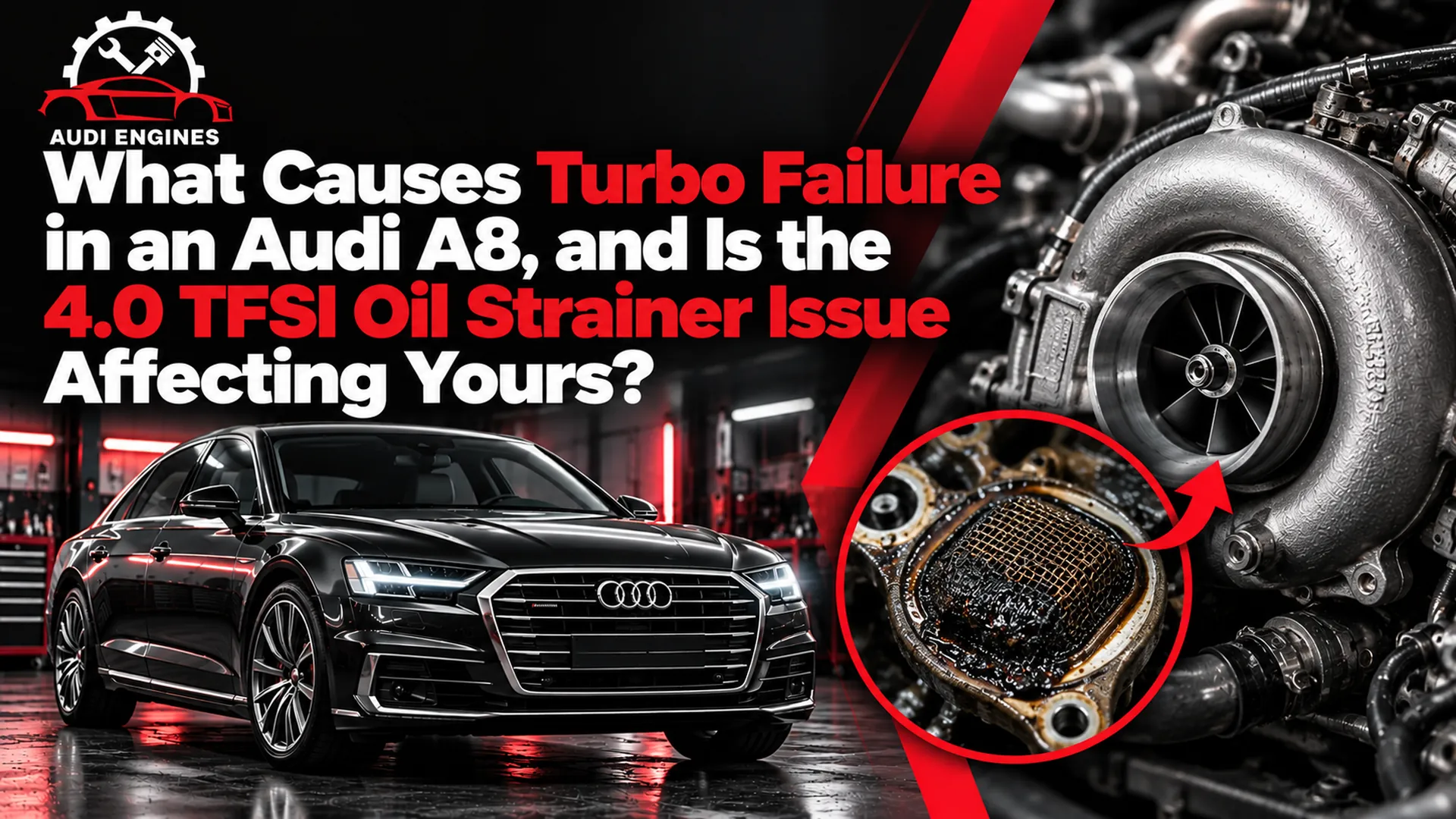
Most turbo failures trace back to lubrication. A turbo shaft spins at extremely high speed on a thin film of engine oil. Interrupt that oil, contaminate it, or overheat it, and the bearings wear out fast.
Why Do Audi A8 Turbos Fail: Oil Starvation, Worn Bearings or Actuator Faults?
These are the causes we look for first, and how each one shows up as a symptom:
- Oil starvation and restricted oil supply. A blocked oil feed pipe or strainer deprives the bearings of lubrication. The result is bearing wear, shaft play and noise.
- Contaminated or old engine oil. Dirty oil carries carbon and debris that scores the bearings. Skipped or stretched oil changes, or the wrong oil specification, shorten turbo life.
- Worn bearings and shaft damage. Journal and thrust bearings wear over time, allowing the shaft to wobble. The compressor and turbine wheels can then touch their housings.
- Failed turbo seals. Worn seals let oil escape, which causes blue smoke and rising oil consumption.
- Faulty actuator or wastegate. A sticking actuator can leave the turbo overboosting or underboosting, triggering limp mode even when the turbo itself is healthy.
- Exhaust restriction and excess heat. A blocked DPF or restricted exhaust raises back pressure and temperatures, stressing the turbine.
- Foreign object damage. Debris entering the intake can chip the compressor wheel.
- Previous incorrect fitting or remapping. A poorly installed turbo, or an aggressive remap, can overspeed the unit and shorten its life.
To reduce the chance of repeat failure, use the correct oil specification, keep to oil service intervals, and have any oil leaks or warning lights investigated early.
Are 4.0 TFSI Audi A8s Affected by the Turbo Oil Strainer Problem?
Some are. This is the one model-specific issue every A8 owner with the 4.0-litre petrol engine should understand.
US safety documentation covers certain 2013 to 2017 Audi A8 vehicles fitted with the 4.0-litre twin-turbo petrol engine. In the affected cars, a blocked turbo oil-supply strainer can restrict lubrication to the turbo bearings. Without enough oil, the bearings wear, the turbo can be damaged, and in some cases the engine may stall.
An important qualification. This does not apply to every A8, and it does not explain every turbo fault. Diesel A8s, including the 3.0 TDI and 4.2 TDI, work differently, and later or earlier cars may not be affected. Applicability depends on your exact engine, model year and market.
How to check your own car:
- Find your VIN. It's on your V5C logbook, at the base of the windscreen and on the door pillar.
- Ask an Audi dealer to check it. They can confirm whether a recall or service campaign applies to your vehicle.
- Read the official documents. The NHTSA recall documentation and Audi's 21H7 recall circular describe the issue and the affected vehicles. We recommend reading them directly instead of relying on summaries.
One rule matters most here. A replacement turbo should never be fitted without finding out why the original failed. If the oil supply problem remains, the new turbo can fail the same way. That's why a proper repair includes checking the oil feed and strainer, not only swapping the unit.
How Is Audi A8 Turbo Failure Diagnosed, and Should You Repair or Replace?
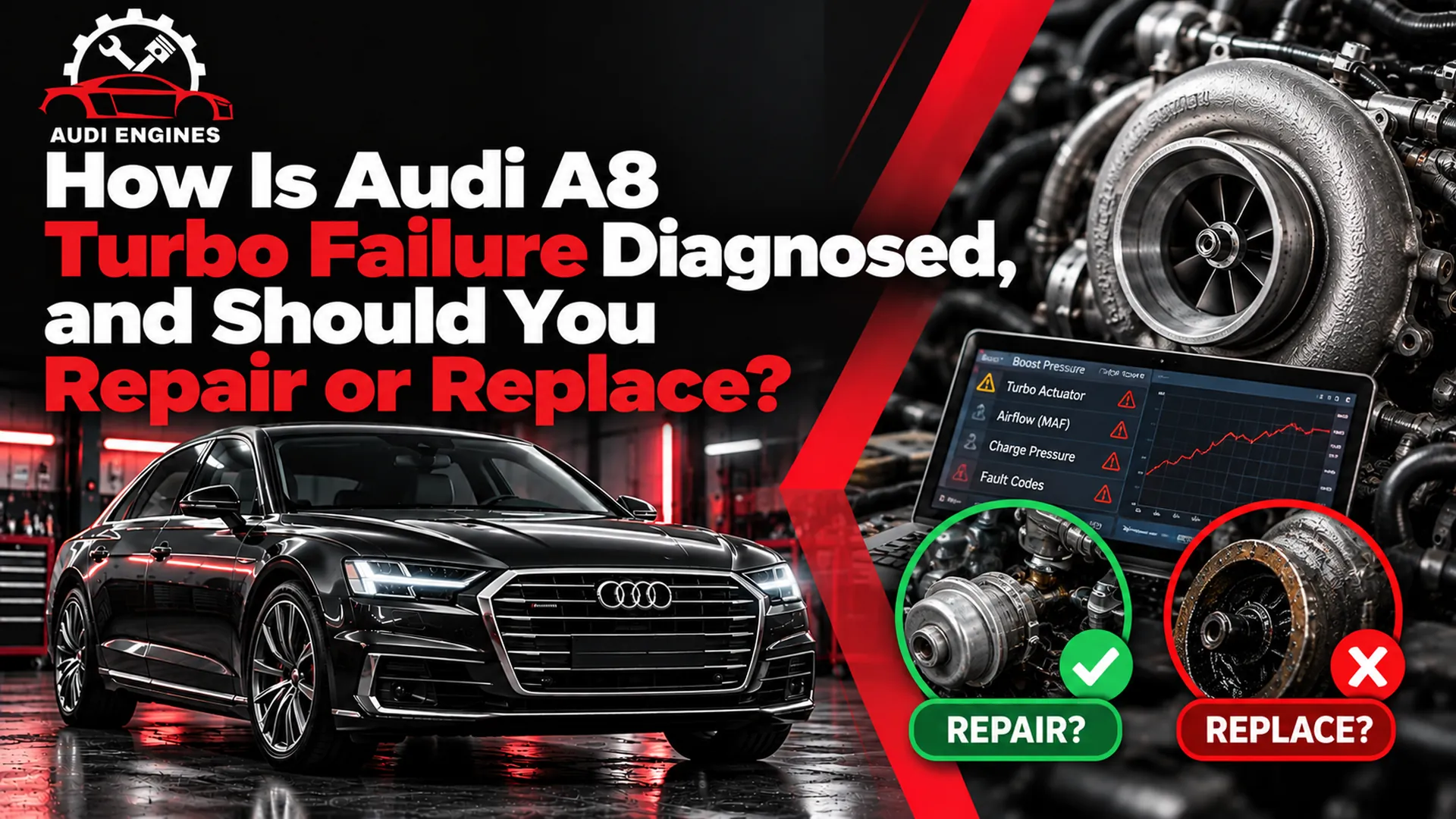
Diagnosis is where the right garage separates itself from the rest. Guessing leads to expensive parts you may not need. A structured approach leads to the real fault.
How Do Specialists Diagnose Audi A8 Turbo Problems?
A thorough diagnosis typically follows this sequence:
- Read fault codes and examine live data. A VAG-compatible scan tool shows stored codes and compares requested boost pressure with actual boost.
- Inspect boost hoses and intercooler connections. Cracked pipes and loose clamps are common and cheap to fix.
- Run a boost leak test. Pressure testing finds leaks the eye can't see.
- Check engine oil pressure and the turbo oil supply. Feed and return pipes and, where relevant, the strainer are inspected for restriction.
- Inspect the turbo itself. Shaft play, compressor wheel condition and signs of oil in the charge-air system are checked.
- Verify after repair. A post-repair test confirms boost pressure and the absence of fault codes.
Fault codes are clues, not proof. These are commonly seen on turbo-related faults, but definitions and relevance vary by engine management system, so each should be verified against vehicle-specific data:
Code | Common description | What it can mean |
| P0299 | Turbocharger underboost | Boost leak, actuator fault or a failing turbo |
| P0234 | Turbocharger overboost | Sticking actuator or wastegate, control fault |
| P2263 | Turbocharger system performance | Wide range, from leaks to turbo wear |
| P2563 | Boost control position sensor range | Sensor or actuator position fault |
A scan alone can't confirm mechanical wear. It tells you what the ECU noticed, not what is physically wrong inside the turbo. That's why physical inspection matters.
Can an Audi A8 Turbo Be Repaired, or Does It Need Replacing?
It depends on the fault. Sometimes a smaller repair solves the problem. Other times replacement is the only sensible route.
Situation | Likely approach | Notes |
| Faulty actuator or sensor | Replace or recalibrate the part | Often cheaper than a full turbo |
| Leaking intercooler pipe or boost hose | Replace the pipe | Frequently mistaken for turbo failure |
| Worn but repairable turbo | Reconditioning | Can offer good value, with warranty varying by supplier |
| Severe bearing or wheel damage | Replacement turbo | Choose between new OEM and aftermarket units |
| Oil supply problem | Fix the cause first, then replace the turbo | Skipping this risks repeat failure |
A proper replacement should include checks of the oil feed and return pipes, fresh oil and filter, new gaskets, and priming the turbo before the first start. Skipping priming can starve a brand-new unit in its first seconds of life.
If the root cause isn't corrected, even a perfect turbo may fail again. That's the most common reason for repeat turbo failure, and one of the strongest arguments for choosing a specialist over a quick fix.
How Much Does Audi A8 Turbo Repair Cost in the UK, and How Do You Get a Quote?
Cost depends on your engine, the part chosen, and what the inspection finds. A single figure would mislead you, so here is what actually moves the price, and how to get a number you can trust.
What Affects Audi A8 Turbo Replacement Cost in the UK?
- Engine variant. A 3.0 TDI, a 4.2 TDI, a 3.0 TFSI and a 4.0 TFSI twin-turbo have different turbo layouts, parts costs and labour time. Twin-turbo cars involve more work.
- New or reconditioned turbo. A new OEM unit costs more than a reconditioned one, and aftermarket units vary widely in quality and warranty.
- Labour. Access on the A8 can be tight, and labour is a major part of the invoice.
- Diagnostic fee. A proper inspection takes time, but it can prevent an unnecessary repair.
- Extras. Oil feed pipes, actuators, gaskets, an intercooler pipe or a DPF issue can add to the bill.
Our current price range for Audi A8 turbo repair: (add your confirmed price range here).
Weigh the planned cost against the alternative. Fixing a turbo at the first symptom is a controlled expense. Driving on until the bearings fail can send metal debris into the engine, and a damaged engine costs far more than a turbo.
What Information Do You Need to Get an Accurate Audi A8 Turbo Repair Quote?
Have these ready before you call:
- Registration number or VIN, so the engine and model year can be confirmed
- Engine and model year, for example 4.0 TFSI D4
- Current mileage
- Symptoms and warning lights, including when they appear
- Service and oil history, plus any previous turbo work or remapping
Warranty length: (add your confirmed term). Turnaround time: (add your confirmed timeframe). Technician credentials: (add your real details). Last technically reviewed: (add date).
Book your Audi A8 turbo diagnostic inspection today. Send your registration through audiengines.co.uk, call us, or use the booking link, and we'll tell you what's wrong and what it takes to fix it.
Frequently Asked Questions About Audi A8 Turbo Failure
Can I drive my Audi A8 with a failing turbo?
For mild power loss, short, gentle journeys to a garage are sometimes possible, but the risk rises with every mile. If you hear a siren-like whine, grinding, see the oil pressure light, or the engine stalls, stop safely and arrange recovery.
Can an Audi A8 turbo fail without a warning light?
Yes. A turbo can wear internally for a while before the ECU sets a code. Noise, smoke and oil consumption are just as important signs as dashboard lights.
What does a failing Audi A8 turbo sound like?
Usually a rising, high-pitched whine or whistle under acceleration, sometimes like a siren. Rattling or grinding suggests serious internal wear.
Can a boost leak feel like turbo failure?
Very much so. A split intercooler hose or loose charge-air pipe causes power loss and hissing that mimic a failing turbo. A pressure test tells them apart.
Can a faulty turbo cause blue smoke and high oil consumption?
Yes. Worn seals allow oil to pass through, producing blue or grey smoke and oil use. Other engine faults can do the same, so a diagnosis is needed.
What does the P0299 code mean on an Audi A8?
It generally indicates turbocharger underboost, meaning actual boost is below what the ECU requested. It can come from a leak, actuator fault or turbo wear, so it isn't proof of a failed turbo.
Does turbo replacement need an oil change?
Yes. Fresh oil and a new filter are part of a proper replacement, since contaminated oil can destroy a new turbo.
How long does Audi A8 turbo replacement take?
It varies with the engine, the number of turbos and what inspection reveals. Be wary of any garage that promises an exact time before seeing the car.
Can an Audi A8 turbo be reconditioned?
Often yes, when damage is limited. Severe wheel or bearing damage usually calls for replacement. Ask about the warranty on either option.
How do I check whether a recall applies to my Audi A8?
Give your VIN to an Audi dealer, or read the official recall documents. Eligibility depends on your engine, model year and market.
How can I prevent turbo failure in my Audi A8?
Use the correct oil specification, keep to service intervals, fix oil leaks early, and investigate any warning light or noise promptly.
Final Word: Act on the First Sign, and Fix the Cause
The most common Audi A8 turbo failure symptoms are power loss, whining, blue smoke, oil consumption and warning lights. Treat the early signs as your chance to keep a small repair small. Treat a siren-like noise, grinding or the oil pressure light as a stop-now warning.
Remember that not every power loss is the turbo, and not every turbo failure has the same cause. A correct diagnosis, a VIN check for the 4.0 TFSI oil strainer issue where relevant, and a repair that fixes the root cause are what protect your engine and your wallet.
Send your registration through audiengines.co.uk to book an Audi A8 turbo diagnostic inspection or request a repair quote today.