

Audi DPF Warning Light What To Do and How to Fix It (For Good)
Your Audi's DPF light just came on, and you're not sure whether to panic, pull over, or just carry on to your next meeting. That split-second decision matters more than most drivers realise, react the wrong way and you could turn a simple regeneration into a costly repair bill.
Your Audi's DPF light just came on, and you're not sure whether to panic, pull over, or just carry on to your next meeting. That split-second decision matters more than most drivers realise, react the wrong way and you could turn a simple regeneration into a costly repair bill.
Here's the short answer: if it's just the amber DPF warning light on its own, and your Audi is otherwise driving normally, a sustained motorway-style drive will usually let the filter regenerate itself. But if the light is joined by other warnings, the car has gone into limp mode, or the light keeps coming back after you've tried to clear it, driving it hard is the wrong move, and could make things worse.
This guide walks through exactly what the Audi DPF warning light means, what to do in each specific scenario, why it keeps returning for some drivers, and how the fault actually gets diagnosed and repaired properly, model by model, cause by cause.
What Does the Audi DPF Warning Light Mean, And What Should You Do Right Now?
What Does the Audi DPF Warning Light Actually Mean?
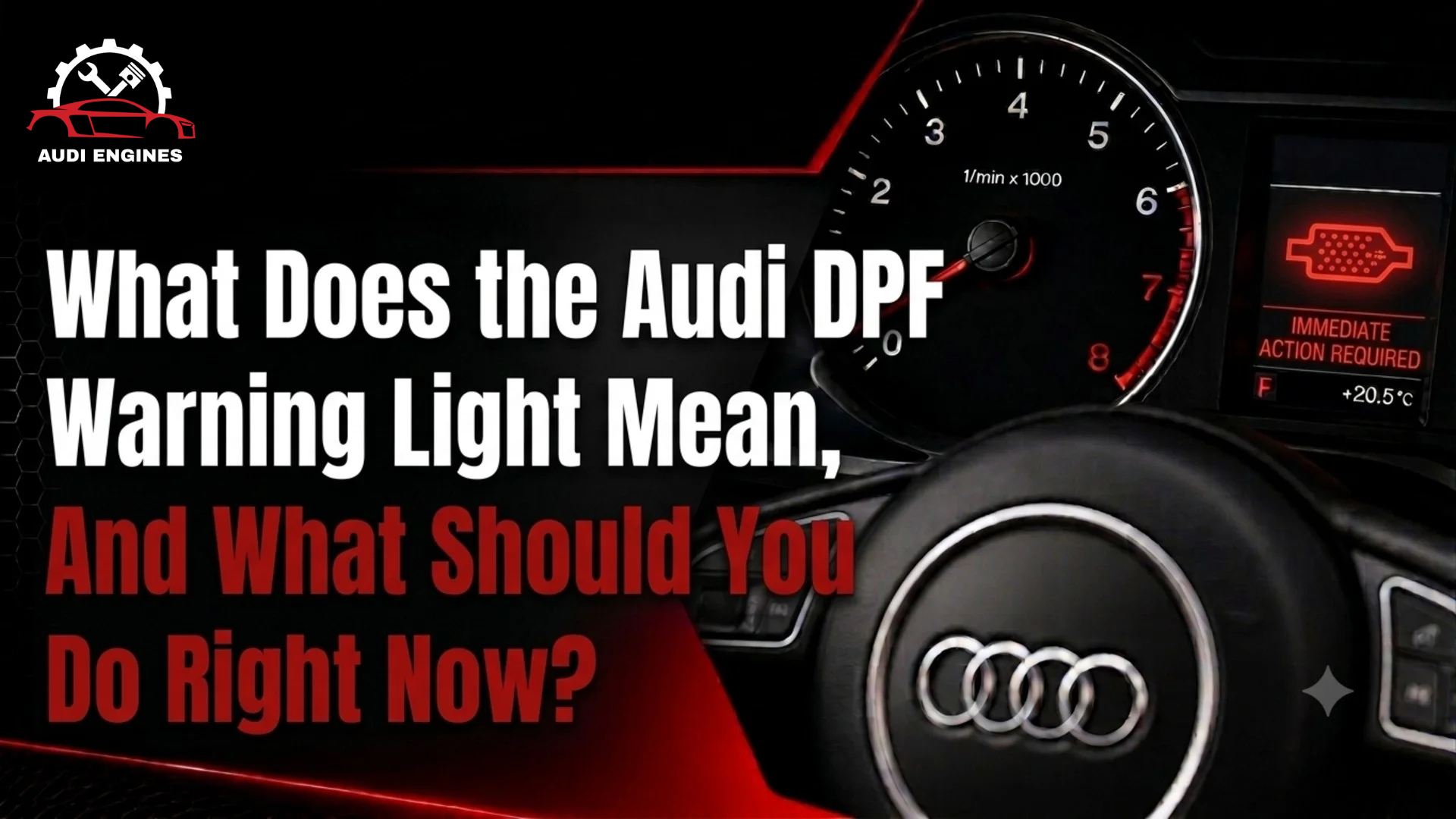
The DPF warning light tells you that your Audi's diesel particulate filter has built up more soot than it can safely burn off during normal driving. The diesel particulate filter (DPF) sits in the exhaust system and traps soot particles produced by the diesel engine before they leave the exhaust pipe. It's a legal requirement on modern diesel vehicles, and it plays a direct role in reducing particulate emissions.
Under normal conditions, the DPF clears itself through a process called regeneration, the engine management system raises exhaust temperature enough to burn the trapped soot into a small amount of ash. This happens automatically and you'd never notice it. The warning light appears when the ECU detects that soot loading has reached a level where passive regeneration alone isn't clearing it fast enough.
Think of it as an early warning, not necessarily a breakdown warning. The car is telling you it needs specific driving conditions to solve the problem itself, but only if you catch it early and respond correctly.
Can You Drive With the Audi DPF Warning Light On?
Generally, yes, but how you drive matters far more than whether you drive at all. This is the point where most drivers either fix the problem in twenty minutes or turn it into a workshop visit, depending on what they do next.
Amber DPF Light Only, Is a Regeneration Drive Safe?
If the DPF light is the only warning showing and the car has full power, this is the ideal moment for a regeneration drive. The engine is asking for sustained higher exhaust temperatures, and a solid motorway run is typically enough to complete active regeneration and clear the light on its own.
DPF Light With Other Warning Lights, Why You Shouldn't Force a Regen
If the DPF light appears alongside the check engine light, glow plug light, or any other dashboard warning, don't just try to "drive it off." A second fault, a sensor, an EGR issue, an injector problem, may be preventing regeneration from completing at all, no matter how far you drive. Forcing the issue in this situation tends to add mileage and stress to a car that already has an underlying fault, without solving anything.
DPF Light and Limp Mode, When to Stop Driving Immediately
If your Audi has entered limp mode, noticeably reduced power, sluggish acceleration, and the engine capping itself at low RPM, this isn't a "drive it out" situation anymore. Limp mode is the ECU protecting the engine from damage, usually because of excessive exhaust back pressure or a fault it can't safely manage on its own. Continuing to drive normally in this state risks turbocharger damage or further contamination. At this point, a professional diagnostic assessment is the right next step, not the motorway.
How to Help Your Audi Complete a DPF Regeneration
When conditions are right for a regeneration drive, a few specifics genuinely make the difference between success and a wasted journey.
- Maintain a sustained road speed ideally 40mph or above, held consistently for 15–20 minutes, rather than stop-start town driving.
- Keep engine RPM in the mid-range generally above 2,000 RPM, since this helps the engine reach and hold the exhaust temperature needed to burn off soot.
- Avoiding interrupting the drive stopping partway through a regeneration cycle (for a red light, a fuel stop, or a school run detour) can reset the process before it finishes.
- Check your fuel level first; some Audi models won't initiate regeneration below a certain fuel threshold, so a near-empty tank can quietly block the whole attempt.
- Looking at the dashboard many Audi models show a specific regeneration message or symbol; if it disappears mid-drive without the DPF light clearing, the cycle is interrupted.
Regeneration Notes by Model (A3, A4, A5, A6, Q3, Q5, Q7 & TDI Engines)
Regeneration behaviour isn't identical across the Audi range. The requirements shift slightly depending on engine size and vehicle weight:
- Audi A3 and A4 (1.6 TDI, 2.0 TDI): Generally the quickest to regenerate due to lower vehicle mass, a consistent 20-minute motorway run is often enough.
- Audi A5, A6 and A7 (2.0 TDI, 3.0 TDI): Larger, heavier vehicles may need slightly longer sustained runs to hit the required exhaust temperature.
- Audi Q3, Q5 and Q7: SUVs carry more weight and often run higher-torque diesel variants, so a Q7 3.0 TDI, for example, may take longer under load compared with a smaller A3 1.6 TDI on the same stretch of motorway.
If you're unsure what applies to your specific model, the owner's manual will confirm the manufacturer-recommended regeneration procedure, always worth checking before assuming one approach fits every Audi.
Why Does the Audi DPF Warning Light Keep Coming Back?
A DPF light that clears once and returns a week later is telling you something different from a first-time warning. Repeated warnings almost always point to an underlying cause that a regeneration drive treats the symptom of, but doesn't actually fix.
Common Causes of a Blocked or Clogged Audi DPF
Short Journeys and Low Exhaust Temperatures
This is by far the most common cause, particularly for Audi owners doing mostly urban driving or short school-run and commute distances. Diesel engines need sustained higher exhaust temperatures to trigger passive regeneration, and short trips simply don't give the system enough time to reach that point. Soot builds up faster than it's burned off, and the warning light becomes a recurring feature rather than a one-off event.
Faulty DPF Pressure or Temperature Sensors
The DPF differential pressure sensor measures the pressure difference before and after the filter to estimate soot loading, while the exhaust gas temperature sensor confirms the filter is hot enough for regeneration to work. When either sensor gives an inaccurate reading, the ECU can trigger the DPF light even when the filter itself isn't seriously blocked, or worse, prevent a genuinely necessary regeneration from starting at all.
EGR, Turbo and Injector Faults That Trigger the DPF Light
A faulty EGR valve or EGR cooler can increase soot production upstream, overloading the DPF faster than normal. Similarly, a turbocharger fault, a MAF sensor issue, or a fuel injector delivering too much fuel can all push more soot into the exhaust system than the filter is designed to handle in normal conditions. In these cases, the DPF light is really a downstream symptom of a different mechanical fault.
Why Is the DPF Light Still On After a Motorway Drive?
If you've done everything right, sustained speed, correct RPM, no interruptions, and the light is still on, it usually means one of two things: either the soot loading was too severe for a single regeneration cycle to clear, or there's a sensor or component fault preventing the ECU from recognising that regeneration succeeded. This is the point where continuing to attempt regeneration drives becomes counterproductive, and a proper fault-code scan is the more useful next step.
DPF Light With Glow Plug or Engine Management Light, What's the Difference?
These combinations tell different stories:
Warning Combination | Likely Meaning |
| DPF light only | Standard soot loading, regeneration drive may resolve it |
| DPF + engine management light | A stored emissions-related fault code, often sensor or EGR-related |
| DPF + glow plug light | Additional engine-management issue, sometimes linked to cold-start or sensor faults |
| DPF + limp mode | Excessive exhaust restriction or a fault serious enough to trigger protective mode |
| Repeated DPF warnings | Root cause hasn't been resolved, diagnosis needed |
| DPF light after motorway drive | Regeneration was unsuccessful, or a sensor/fault is interfering with completion |
The glow plug light on its own usually relates to cold-start performance rather than the DPF directly, but when it appears alongside the DPF light, it's often worth treating as a signal that the engine management system has logged more than one issue, which is exactly what a diagnostic scan is built to untangle.
How Are Audi DPF Problems Diagnosed and Fixed?
How Is an Audi DPF Fault Properly Diagnosed?
A proper diagnosis goes well beyond glancing at the dashboard. It's built around actual data pulled from the car's engine management system.
Reading Fault Codes and Live DPF Data (VCDS/OBD Diagnostics)
Audi and the wider Volkswagen Group (VAG) platform are well supported by VCDS and other VAG-specific diagnostic tools, which go deeper than a generic OBD-II scanner. These tools can pull stored fault codes, but more usefully, they can show live data, actual sensor readings in real time, rather than just a historical code.
Checking Soot Mass, Ash Load and Differential Pressure
A specialist scan tool can show the calculated soot mass, measured soot mass, and ash load stored in the ECU, alongside live differential pressure readings across the DPF. This is where a genuine diagnosis separates from guesswork, it tells a technician whether the filter is genuinely overloaded, whether a sensor is giving an implausible reading, or whether the regeneration history shows repeated failed attempts. This kind of detail simply isn't visible from the driver's seat.
DPF Cleaning vs Forced Regeneration vs Replacement, Which Do You Need?
Not every DPF warning ends in the same fix, and the right one depends entirely on what the diagnostic data shows.
When Professional DPF Cleaning Is Enough
If the filter itself is structurally sound but heavily loaded with soot or ash beyond what a normal drive can clear, professional cleaning is often the most cost-effective option. This typically involves removing the DPF and using specialist equipment to clear soot and ash buildup that driving alone can't reach, a different process entirely from the additive-based "off-car cleaner" products sold for home use, which have mixed results on severely blocked filters.
When Replacement Is the Only Real Fix
If the filter is cracked, physically damaged, or has reached the end of its usable ash capacity (ash doesn't burn off the way soot does, so it accumulates permanently over the vehicle's life), cleaning won't solve the problem. Replacement is also usually the right call when a filter has been running with an unresolved fault for an extended period, since prolonged excessive soot loading can damage the substrate inside the DPF itself.
How Much Does Audi DPF Repair Cost?
Costs vary considerably depending on the model, the extent of the problem, and whether cleaning or replacement is required:
- Diagnostic scan: Typically the starting point, and relatively low cost compared with any repair that follows.
- Professional DPF cleaning: Generally sits well below the cost of a new filter, and is often the first option explored when the filter itself is intact.
- DPF replacement: The most expensive route, with genuine Audi parts costing more than aftermarket or reconditioned alternatives, but replacement is sometimes unavoidable once the filter is damaged.
- Related component repairs: If the root cause is a faulty pressure sensor, EGR valve, or temperature sensor, fixing that component is usually far cheaper than repeatedly cleaning or replacing a DPF that keeps getting overloaded by the same unresolved fault.
Because the range is wide, a proper diagnostic scan before committing to any repair is genuinely the most cost-effective first step, it tells you which of these you actually need, rather than paying for a filter replacement when a £-figure sensor was the real problem all along.
How to Prevent Audi DPF Warning Lights From Coming Back
Driving Habits That Protect Your Audi's DPF
Prevention largely comes down to giving the engine the conditions it needs to regenerate naturally, before the warning light ever appears.
- Predominantly urban or short-trip drivers benefit from building in a longer drive at least once a week, even a 20-minute motorway stretch can make a meaningful difference to soot accumulation.
- High-mileage motorway drivers rarely see DPF issues, since sustained speed naturally supports passive regeneration, but should still watch for repeated warnings as a sign something else is wrong.
- Vehicles used for towing work harder and produce more soot under load, so factoring in occasional unloaded, sustained-speed drives helps offset this.
- Cars with a history of interrupted regenerations are more prone to repeat warnings, if you notice the regeneration message appearing and disappearing frequently without the light clearing, it's worth having this checked rather than waiting for it to escalate.
- Correct engine oil and service intervals matter more than most drivers realise, since unsuccessful regenerations can contribute to oil dilution over time, a good reason to keep an eye on oil level and condition, not just mileage.
When Should You Contact an Audi DPF Specialist?
A few situations are clear signals that it's time to move from self-diagnosis to a proper workshop assessment:
- The DPF light has returned more than once despite completing a full regeneration drive
- The car has entered limp mode or shows noticeably reduced power
- The DPF light appears alongside the engine management or glow plug light
- A regeneration drive hasn't cleared the light after a genuine, uninterrupted attempt
- You're unsure whether your Audi's fuel level, driving conditions, or model-specific requirements were actually met
At this point, an Audi specialist with proper VAG diagnostic equipment can pull the actual fault-code and live-data picture in a way that guesswork never will, saving you from paying for the wrong repair.
Frequently Asked Questions About the Audi DPF Warning Light
What does the Audi DPF warning light mean?
It means the diesel particulate filter has built up more soot than passive regeneration is currently clearing, and the car needs either a sustained drive to trigger active regeneration or, if the light persists, a diagnostic check.
Can I drive with the Audi DPF light on?
In most cases yes, as long as no other warning lights are present and the car isn't in limp mode. A sustained motorway-style drive is usually the recommended next step in this scenario.
How long should I drive to regenerate an Audi DPF?
Around 15–20 minutes of consistent driving above roughly 40mph, ideally without stopping partway through, gives the engine the best chance of completing a full regeneration cycle.
Why does my Audi DPF light keep coming back?
Recurring warnings usually point to an underlying cause, commonly short-journey driving patterns, a faulty pressure or temperature sensor, or an EGR-related fault, rather than the DPF itself being the primary problem each time.
Why has my Audi gone into limp mode with the DPF light on?
Limp mode is triggered when the ECU detects excessive exhaust restriction or a fault it considers a risk to the engine, and it reduces power to protect the vehicle. This calls for diagnosis rather than continued driving.
Can a blocked DPF fail an MOT?
Yes. A DPF that's been removed, is visibly damaged, or is producing excessive emissions can result in an MOT failure, since particulate filters are part of the emissions requirements for diesel vehicles.
Is it illegal to remove a DPF?
Yes, removing a DPF from a vehicle that was fitted with one as standard is illegal for road use in the UK, since it's a legally required emissions control component.
How much does Audi DPF cleaning or replacement cost?
This depends entirely on whether cleaning is sufficient or replacement is needed, along with the specific model. A diagnostic scan is the most reliable way to get an accurate cost picture before committing to either option.
Getting It Right the First Time
A DPF warning light isn't something to ignore, but it's also not automatically a five-figure repair bill. The difference between a twenty-minute fix and a costly repair usually comes down to reading the situation correctly, knowing when a regeneration drive is the right call, and knowing when it's time to stop guessing and get the car properly diagnosed.
If your Audi's DPF light has come back more than once, if the car has lost power, or if you're simply not confident about what's actually happening under the bonnet, a proper diagnostic scan will tell you exactly what you're dealing with, soot, sensor, or something further upstream, before you spend money on the wrong fix.
Get in touch with the team at Audi Engines for a proper DPF diagnostic assessment, and find out exactly what your car needs before committing to cleaning, repair, or replacement.