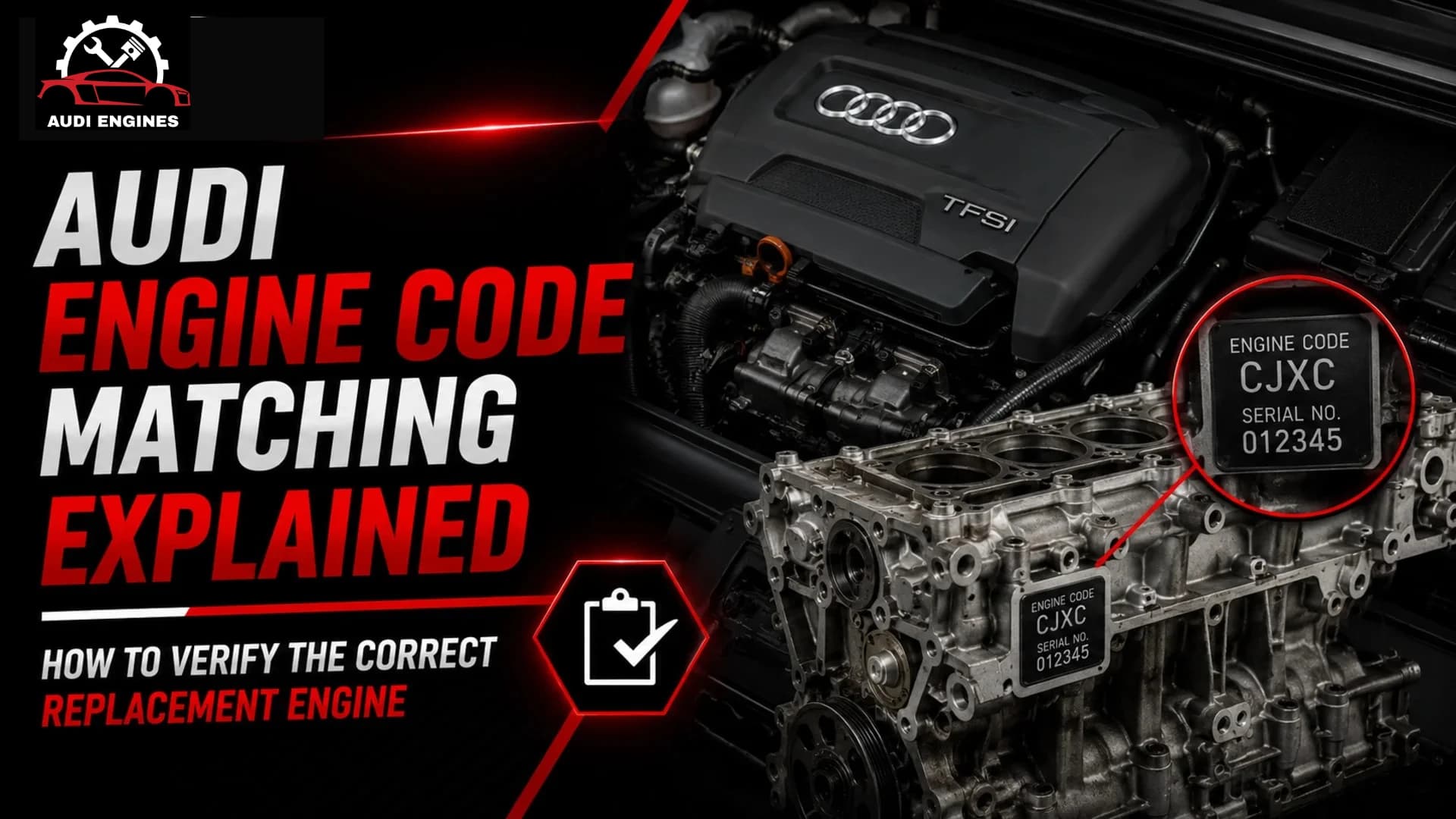
Audi Engine Code Matching Explained How to Verify the Correct Replacement Engine
You've found a replacement engine for your Audi. The engine code looks close enough. Maybe it's the same three letters, maybe it's a slightly different suffix, and now you're staring at two listings wondering if close enough.
You've found a replacement engine for your Audi. The engine code looks close enough. Maybe it's the same three letters, maybe it's a slightly different suffix, and now you're staring at two listings wondering if "close enough" is actually good enough, or if you're about to spend thousands of pounds on an engine that bolts in but never runs properly.
This is one of the most common, and most costly, mistakes we see when Audi owners source a replacement engine themselves. The engine code matters, but it's only the starting point of a much longer compatibility chain. Matching codes doesn't automatically mean matching engines, and getting this wrong can mean a replacement that fits physically but fails electronically, or one that runs but trips emissions faults for months afterward.
This guide walks through exactly how Audi engine code matching works, what the code actually tells you, what it doesn't, and everything else that needs to line up before a replacement engine is genuinely compatible with your car.
What Is an Audi Engine Code and Where Do You Find It?
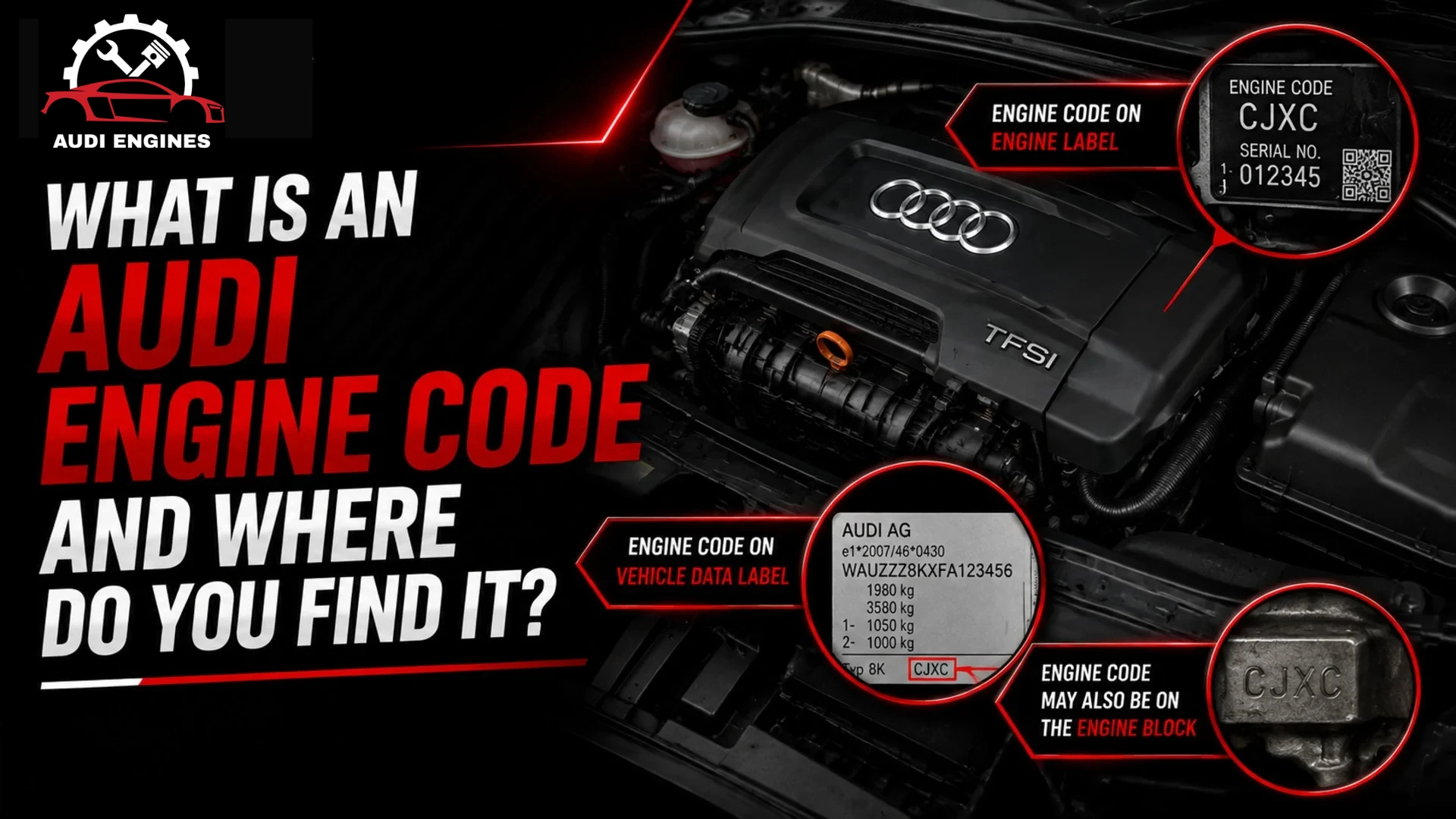
An Audi engine code is a short alphanumeric identifier, typically three or four characters, such as CJSA or CHHB, that identifies the specific engine variant fitted to your vehicle. It's part of the wider Volkswagen Group (VAG) engine identification system, and it tells you far more than just "this is a 2.0 TDI", it pins down the exact specification, generation, and calibration of that particular engine.
Think of it less like a general description and more like a precise part reference. Two Audis can share the same engine size, fuel type, and even the same general family, and still carry different codes because something about their specification differs, power output, emissions equipment, or the vehicle they were built for.
Where Can You Find Your Audi Engine Code?
There are several reliable places to locate your engine code, and it's worth checking more than one if you can, since stickers can fade or go missing over time on older vehicles.
- The vehicle data sticker, usually found in the spare wheel well, boot area, or occasionally the engine bay, this sticker lists the engine code alongside other build specification details
- The service book or maintenance manual, often records the engine code as part of the vehicle's documented specification
- Stamped markings on the engine block itself, physically stamped into the cylinder block, sometimes near the timing belt or timing chain cover
- The V5C registration document, doesn't always show the engine code directly but can help narrow down the engine family alongside the VIN
- An Audi dealer or specialist using VCDS/ETKA, diagnostic tools like Ross-Tech VCDS can pull the exact engine code and specification directly from the ECU
Vehicle Data Sticker, Service Book & Engine Block Markings
If you're checking the data sticker, look for a code labeled specifically as the engine code rather than the paint code or trim code, these often sit close together and get confused. A genuine example: on many A3 and A4 models, the data sticker in the spare wheel well lists several short codes in a block, and the engine code is usually the one that starts with a letter followed by two more letters (not numbers), positioned near a line marked "Motor" or similar. If you're not confident reading the sticker, a quick photo sent to a specialist is often faster than guessing.
Audi Engine Code vs VIN: What's the Difference?
This trips up a lot of owners, understandably, both look like strings of letters and numbers, and both relate to identifying your vehicle. But they serve different purposes entirely.
The VIN (Vehicle Identification Number) identifies your specific vehicle as a whole, chassis, build date, factory, and full specification history. The engine code identifies the engine variant specifically, independent of which particular car it happens to be sitting in. A VIN can tell you which engine code your car left the factory with, but it doesn't tell you everything about that engine's individual build history the way an engine serial number would.
Engine Code, Engine Number, VIN & PR Code Compared
Identifier | What It Identifies |
| VIN | The specific vehicle, chassis, build spec, history |
| Engine code | The engine variant/specification (e.g., CJSA) |
| Engine serial number | The individual physical engine unit |
| Part number | A specific component or assembly |
| PR code | The vehicle's factory-fitted equipment and specification package |
Knowing the difference matters most when you're buying a replacement engine: a supplier needs your engine code to identify the right variant, but your VIN helps confirm that variant is actually correct for your specific vehicle's build, since production changes mid-model-run aren't unheard of.
What Do the Letters in an Audi Engine Code Mean?
Audi and the wider VAG group don't publish a single universal decoder for what each letter means, the system has evolved and been reused across decades of engines, but there are patterns worth understanding.
Three-Letter Core Code vs Fourth-Letter Suffix
Many Audi engines are identified by a three-letter core code (like CJS), which represents the base engine specification, displacement, general architecture, and core calibration. In some contexts, you'll also see a fourth character added, which can represent a more specific version, tune, or vehicle application of that same base engine.
This distinction matters enormously for compatibility. The core three letters tell you the engine family and base spec. The fourth character, where present, can indicate a variation significant enough to affect whether a "matching" engine is actually a direct replacement or just a close relative. Treating the fourth character as optional detail, rather than a meaningful distinction, is one of the most common mistakes in DIY engine sourcing.
Does an Audi Replacement Engine Need to Match Exactly?
This is the question that actually matters most, and the honest answer is: it depends on how much risk you're willing to accept, and what "match" really means.
Does the Engine Code Have to Match, or Just the Engine Family?
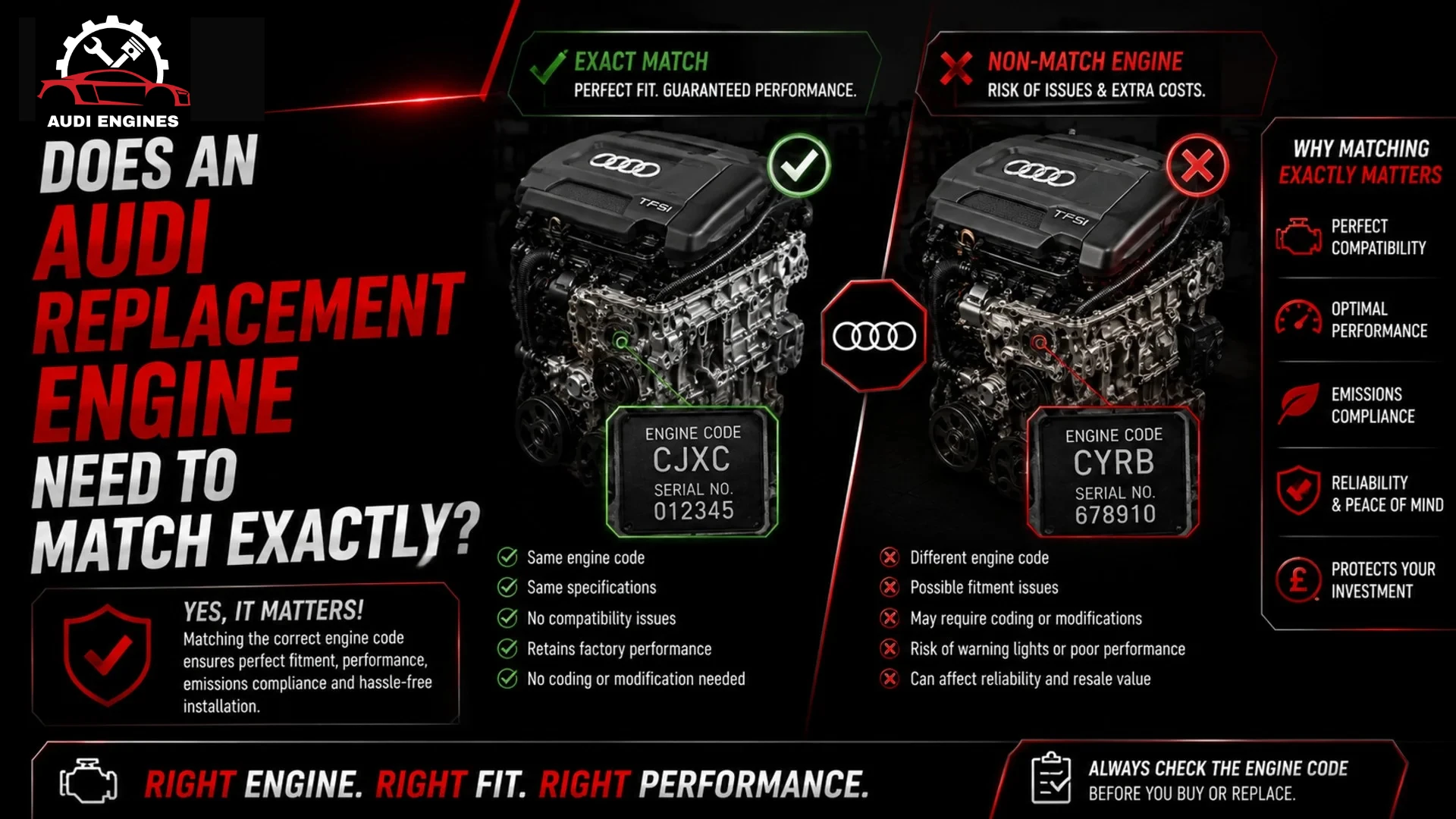
For a genuinely straightforward, low-risk replacement, matching the exact engine code is the gold standard. It gives you the highest confidence that power output, emissions specification, physical layout, and electronic calibration will all align with what your car expects.
That said, engines from the same family with a different code can sometimes work, but only once you've verified the specific differences between the two codes, not just assumed they're interchangeable because they share the same displacement and general description.
Same Engine Family vs Same Exact Engine Code
This is one of the most misunderstood areas in Audi engine replacement, so it's worth being direct about it: same engine family does not automatically mean direct replacement.
Take the EA888 family as a real-world example. It's been used across a huge range of Audi and VAG models over multiple generations, but engines within that family can differ in genuinely significant ways, mounting orientation, ancillary layout, wiring, emissions hardware, and ECU calibration. An EA888 engine pulled from a transverse-mounted application isn't a straightforward swap into a vehicle expecting a longitudinally-mounted version of the same family, even though both are technically "EA888 engines."
The safer mental model is: family tells you the broad category, code tells you the specific variant, and only checking both together tells you whether it's actually a viable replacement.
Can Two Different Audi Engine Codes Be Compatible?
Sometimes, yes, but this needs proper verification rather than assumption. Two different codes might represent the same core engine with only a minor calibration or regional-market difference, in which case compatibility is often achievable, sometimes with an ECU reflash or adaptation. In other cases, two different codes represent genuinely different hardware, different turbo sizing, different emissions equipment, different injection systems, where physical fitment might technically be possible but the engine won't run correctly, or at all, without extensive rework.
Longitudinal vs Transverse Engine Orientation
One of the most overlooked compatibility factors is engine orientation. Audi uses both longitudinal engine mounting (common in A4, A6, and Quattro-based models) and transverse mounting (common in A3 and Q3-based platforms). Even within the same engine family, a longitudinally-mounted variant and a transversely-mounted variant will differ in mounting points, ancillary positioning, and often the accessory drive layout, meaning they are not interchangeable regardless of how similar their engine codes appear.
If you're unsure whether your vehicle uses a longitudinal or transverse layout, this is something worth confirming before you even start comparing engine codes, since it immediately rules out a large chunk of "similar" listings that would never have fitted anyway.
What Else Needs to Match Beyond the Engine Code?
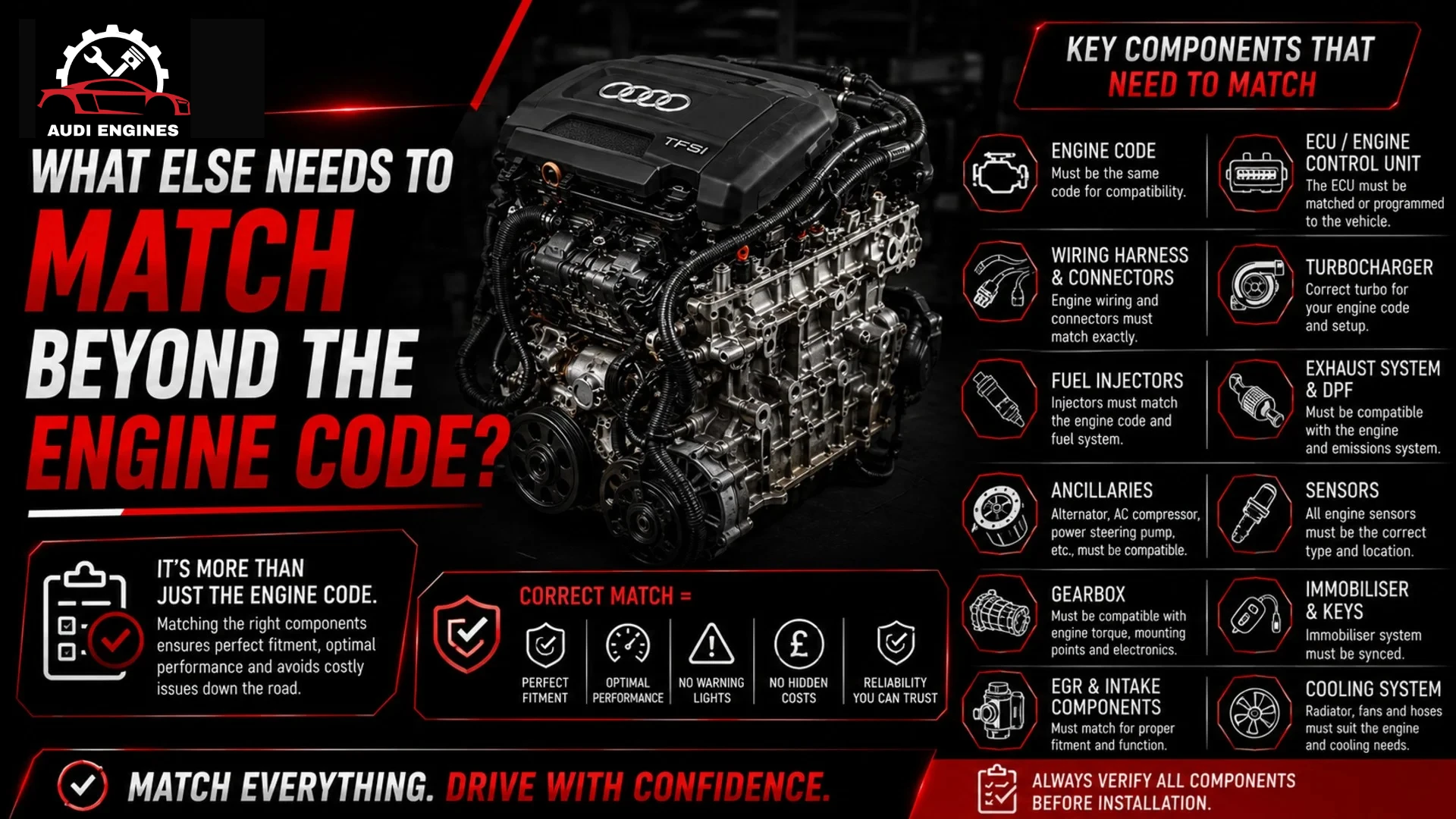
Even with a confirmed, correct engine code, physical fitment is only half the story. A genuinely successful replacement depends on several other systems lining up too.
Does the ECU Need to Match the Engine Code?
Physical compatibility and electronic compatibility are two separate questions, and it's entirely possible for an engine to bolt in perfectly while remaining completely unable to run because the ECU doesn't recognise or correctly control it.
ECU, Immobiliser & Wiring Harness Compatibility
The engine control unit (ECU) manages fuel injection, ignition timing, turbo boost, and emissions control, and it's calibrated specifically for a given engine code. Swap in a different variant without addressing the ECU, and you can end up with anything from a warning light to an engine that simply won't start.
The immobiliser adds another layer: many Audi and VAG vehicles link the ECU, immobiliser, and key together electronically. A replacement engine coming with its own ECU may need to be re-coded or adapted to work with your vehicle's existing immobiliser system, a job that typically requires specialist diagnostic equipment, not just a socket set.
Wiring harness compatibility matters too. Even engines from the same family can have different connector layouts or sensor counts between model years, meaning a harness built for one variant may not plug directly into another without modification.
Do Turbochargers, Injectors & Sensors Need to Match?
These components are often specific to the exact engine code, not just the family:
- Turbocharger, sizing and boost characteristics are tuned to a specific engine's power output and emissions targets; fitting a mismatched turbo can affect performance and trigger fault codes
- Injectors, fuel injector flow rates are calibrated for the engine's intended power and emissions specification
- Sensors, oxygen sensors, MAP/MAF sensors, and temperature sensors are often engine-code specific, particularly on newer, more tightly-controlled emissions systems
A genuinely useful approach here: when comparing two potential replacement engines, ask the supplier directly whether the turbo, injectors, and sensor set match your original engine code, not just whether the "engine" matches. A reputable Audi engine specialist will be able to confirm this from the code alone.
Do Engine Mounts, Manifolds & Ancillaries Affect Fitment?
Yes, and this is where a "compatible" engine on paper can turn into a frustrating parts-chasing exercise in practice. Components that commonly differ between otherwise-similar engine variants include:
- Engine mounts, bracket positions can shift between model years or applications
- Intake and exhaust manifolds, shape and connection points often vary by vehicle platform
- Oil pan (sump), shape sometimes differs to clear different subframes or steering components
- Accessory brackets, alternator, power steering, and air conditioning compressor mounting points
- Starter motor and alternator, sometimes interchangeable, sometimes not, depending on electrical system differences
A well-sourced replacement engine should ideally come complete with the ancillaries that were actually tested and confirmed with that specific engine code, reducing the risk of a mismatched bracket or manifold holding up the whole job.
Does the Transmission Affect Engine Compatibility?
Indirectly, yes. The transmission (gearbox) needs to physically bolt to the engine via a compatible bellhousing pattern, and the flywheel or torque converter needs to suit both the engine and the transmission. Beyond the physical connection, many modern Audis also have electronic communication between the engine ECU and transmission control module, meaning a mismatched pairing can cause shifting problems or fault codes even if the physical bolt-up works fine.
If you're sourcing a used or reconditioned engine independently of your existing transmission, it's worth confirming gearbox compatibility as part of the same conversation, not as an afterthought once the engine's already on order.
How to Verify and Buy the Correct Audi Replacement Engine
How to Check an Audi Replacement Engine Before Buying
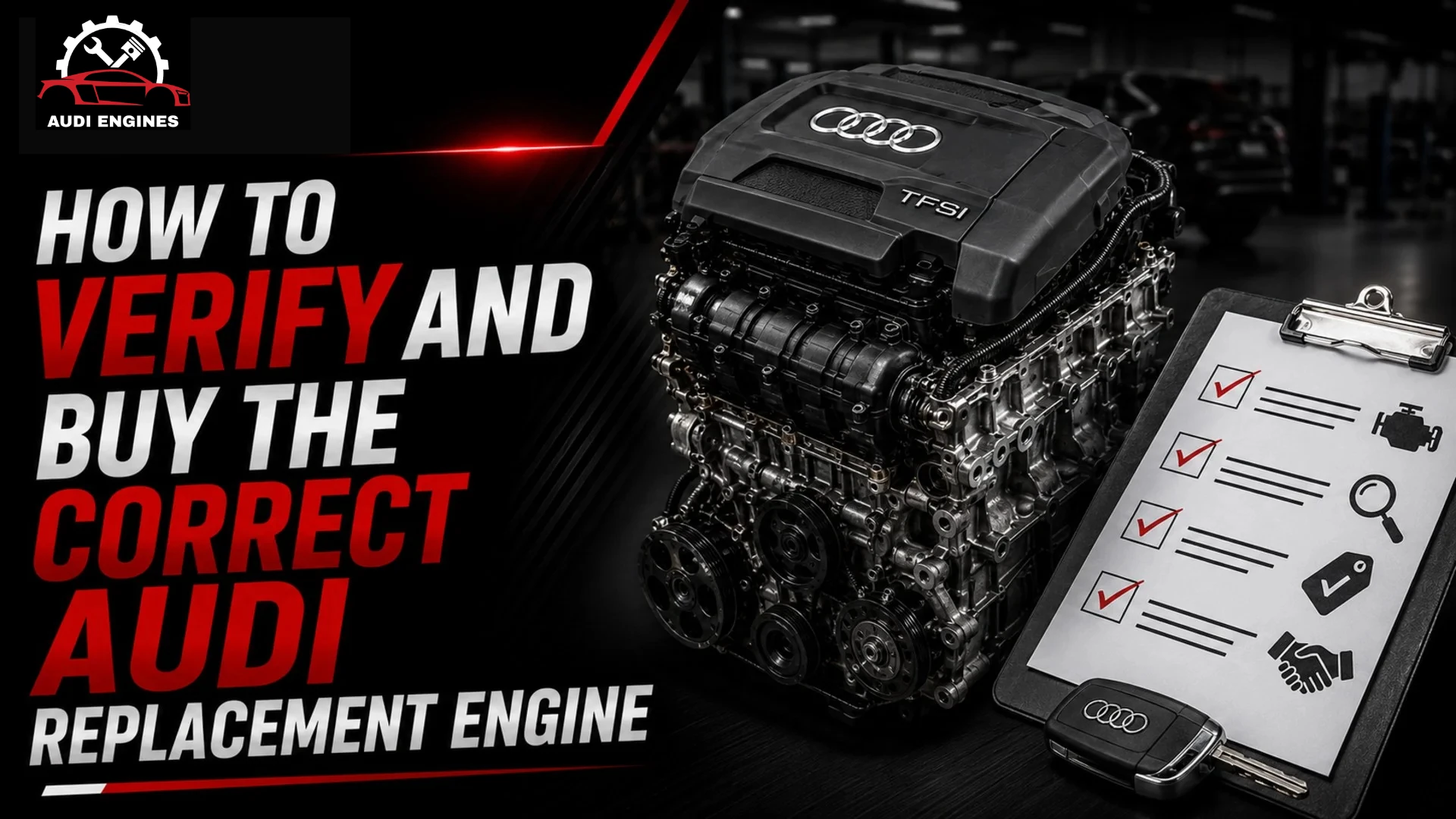
Before committing to any replacement engine, it's worth working through a short verification checklist rather than relying on the listing description alone:
- Verify the exact engine code against your vehicle's documentation or physical markings
- Verify the VIN of the donor vehicle where possible, to confirm the engine's original application
- Verify the model year, since specifications can change even within the same generation
- Verify the engine generation (particularly important for long-running families like EA888)
- Verify the drivetrain configuration, longitudinal vs transverse, and whether quattro-specific components are involved
- Verify the emissions standard the engine was built to meet
- Confirm which ancillaries are included, turbo, injectors, manifolds, sensors, wiring, ECU
Going through this list with a supplier before purchase takes a few extra minutes but can save weeks of delay and significant additional cost if a mismatch only becomes apparent after the engine's already been fitted.
What Information Should You Give an Audi Engine Supplier?
The more specific information you can provide upfront, the more accurately a supplier can confirm real compatibility rather than a rough approximation. At minimum, it's worth having:
- Your full VIN
- The engine code as it appears on your vehicle's data sticker or documentation
- Your vehicle registration, which can help cross-reference build specification
- Any known service history details, particularly if the engine has previously been replaced or modified
- Photos of the data sticker and any visible engine markings, if you're able to access them
A genuine Audi engine specialist should be able to take this information and confirm, quickly and specifically, whether a given replacement engine is a direct match, a compatible variant requiring some adaptation, or not suitable at all. That verification step is exactly where a specialist earns their value over simply matching listings by eye.
Audi Engine Code Matching FAQs
What is an Audi engine code?
It's a short alphanumeric identifier, usually three or four characters, that identifies the specific engine variant fitted to your Audi, covering its displacement, general architecture, and calibration specification.
Where can I find my Audi engine code?
Most commonly on the vehicle data sticker (often in the spare wheel well or boot), in the service book, or stamped directly onto the engine block. A specialist can also pull it via diagnostic tools using your VIN.
Does the Audi engine code have to match exactly for a replacement?
For the highest confidence and lowest risk, yes, an exact code match is the safest option. A different code can sometimes work, but only after checking the specific differences in ECU calibration, ancillaries, and physical layout.
Can Audi engines with different codes be interchangeable?
Sometimes, if the difference is a minor calibration or market variation. Often not, if the codes represent different hardware, different turbo sizing, injectors, or emissions equipment. This needs verification on a case-by-case basis rather than assumption.
Does engine code affect ECU compatibility?
Yes. The ECU is calibrated specifically for a given engine code, and mismatched pairings can prevent the engine from starting or running correctly without recoding or adaptation.
Can the same engine family fit different Audi models?
Not automatically. Engine families like EA888 span many models and generations, but individual variants within that family can differ significantly in mounting orientation, wiring, and ancillary layout, meaning family membership alone doesn't guarantee fitment.
What's the difference between engine code and engine number?
The engine code identifies the engine variant/specification (shared across all engines built to that spec), while the engine number (or serial number) identifies one individual physical engine unit.
Matching an Audi engine code correctly is the first step toward a successful replacement, but as this guide shows, it's rarely the whole picture. Engine family, generation, orientation, ECU calibration, and ancillary compatibility all need to line up before a "matching" engine is genuinely the right one for your car.
If you're weighing up a replacement engine and want certainty before you commit, get your VIN and engine code checked against the listing by a specialist who works with Audi engines every day. A proper verification takes minutes and can save you from a costly mismatch, get in touch with our team for a straightforward compatibility check before you buy.