
Audi Engine Light On Meaning: Causes, Warning Colours and What to Do Next
The amber engine symbol has just lit up on your dashboard. The car feels fine, or maybe it doesn't. Now you're wondering whether to keep driving, pull over or ring someone. Here is the short answer. The Audi engine warning light, also called the Audi engine management light or Audi check engine light.
The amber engine symbol has just lit up on your dashboard. The car feels fine, or maybe it doesn't. Now you're wondering whether to keep driving, pull over or ring someone.
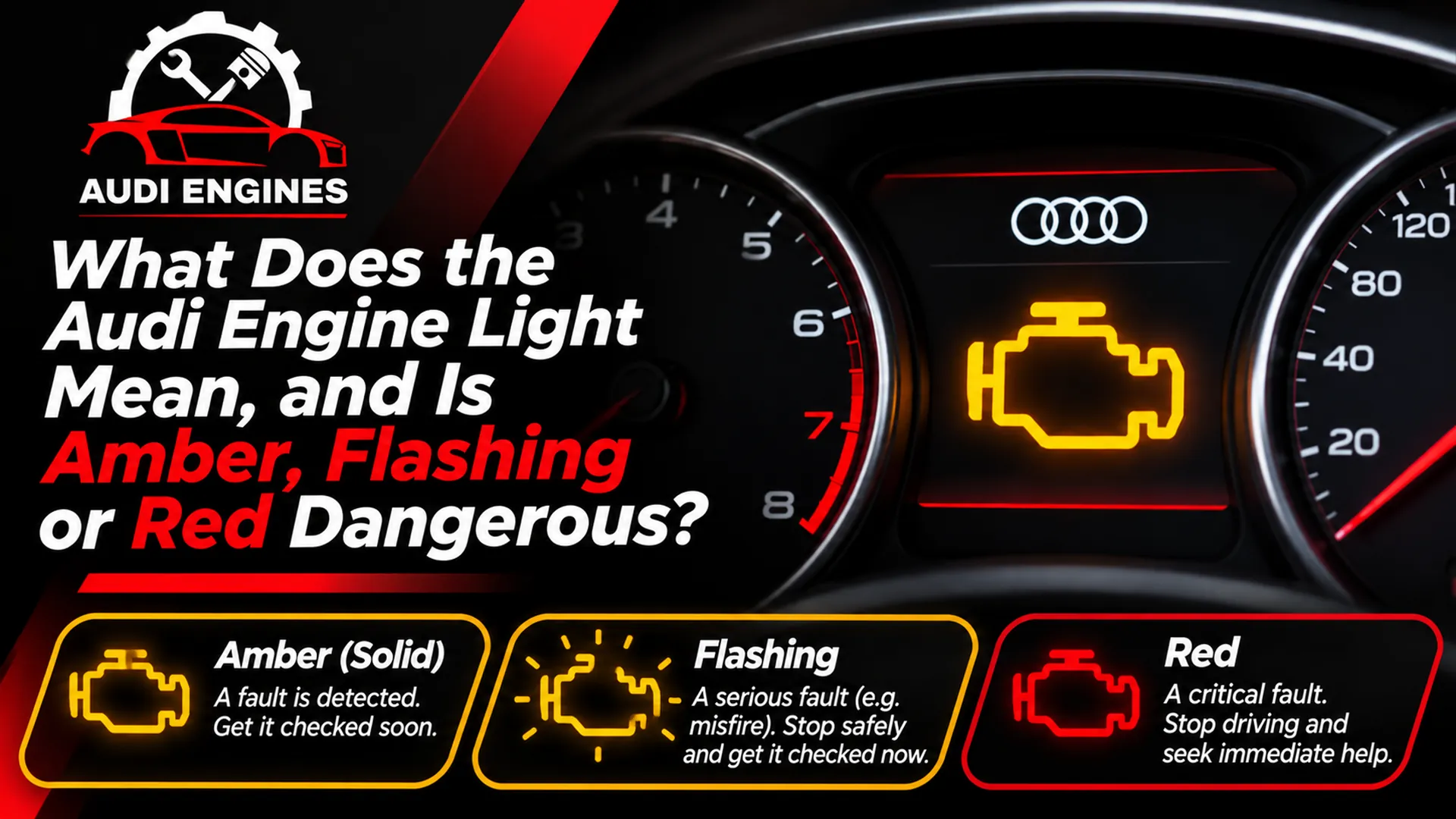
Here is the short answer. The Audi engine warning light, also called the Audi engine management light or Audi check engine light, means the engine control unit has detected a fault in the engine management or emissions system. How urgent it is depends on the colour and behaviour of the light. A steady amber light needs checking soon. A flashing amber light needs action now. A red warning means stop.
This guide explains what the light means, why it appears, what the common causes are, how specialists diagnose it, and what the UK MOT says about it. If your light is already on, you can book an Audi engine diagnostic with audiengines.co.uk and have the fault properly investigated.
What Does the Audi Engine Light Mean, and Is Amber, Flashing or Red Dangerous?
Your Audi runs on a network of sensors that constantly report to the engine control unit, or ECU. The ECU is the car's engine management computer. It checks that air, fuel, ignition, exhaust and emissions systems are working within expected limits.
When a reading falls outside those limits for long enough, the ECU stores a diagnostic trouble code in its fault memory. It then switches on the malfunction indicator lamp, known as the MIL. That lamp is the engine light you see on the dashboard.
In plain terms, the light is a message that says something has been detected and needs investigation. It does not tell you what the fault is, and it does not always mean the engine is failing.
Owners also search for this symbol under several names, including the Audi engine warning symbol, the orange engine symbol and the Audi engine malfunction light. They all refer to the same lamp.
Can You Drive With the Audi Engine Management Light On?
Sometimes, but only if you read the light correctly. Here is how the three situations compare.
Light type | What it usually means | What to do | Urgency |
| Steady amber | The ECU has stored a fault, often in a sensor, the emissions system or the ignition system | Drive gently, avoid hard acceleration and book a diagnostic check soon | Moderate |
| Flashing amber | An active fault such as a misfire that can damage the catalytic converter | Reduce speed, stop somewhere safe and arrange assistance | High |
| Red warning | A serious problem such as oil pressure loss or overheating | Stop as soon as it is safe, switch off and call for recovery | Immediate |
A steady amber light usually gives you time. If the car drives normally, you can generally continue to a garage, but do not ignore it for weeks. A small fault left alone can grow into a larger one.
A flashing amber light is a different matter. It often signals a misfire, meaning one or more cylinders are not burning fuel properly. Unburnt fuel can pass into the exhaust and overheat the catalytic converter. If the flashing comes with juddering, severe vibration or a sudden loss of power, pull over safely and get help.
A red warning should never be driven on. Red lights relating to oil pressure or coolant temperature can destroy an engine within minutes.
It also helps to know what the engine light is not. These are separate warnings:
- The EPC light. EPC stands for electronic power control. It relates to the throttle and related electronics, and it can put the car into limp mode with reduced power.
- The service reminder. The spanner symbol or service message is a scheduled maintenance prompt. It is not a fault warning.
- The DPF warning light. This is specific to diesel Audis and relates to the diesel particulate filter.
- The oil pressure warning. This is red and serious, and it is not the same as the amber engine light.
Always check your owner's manual for the exact symbols on your model, because layouts and wording vary between the A3, A4, A6, Q5, Q7 and other Audis.
Why Is My Audi Engine Light On? Common Causes and Symptoms
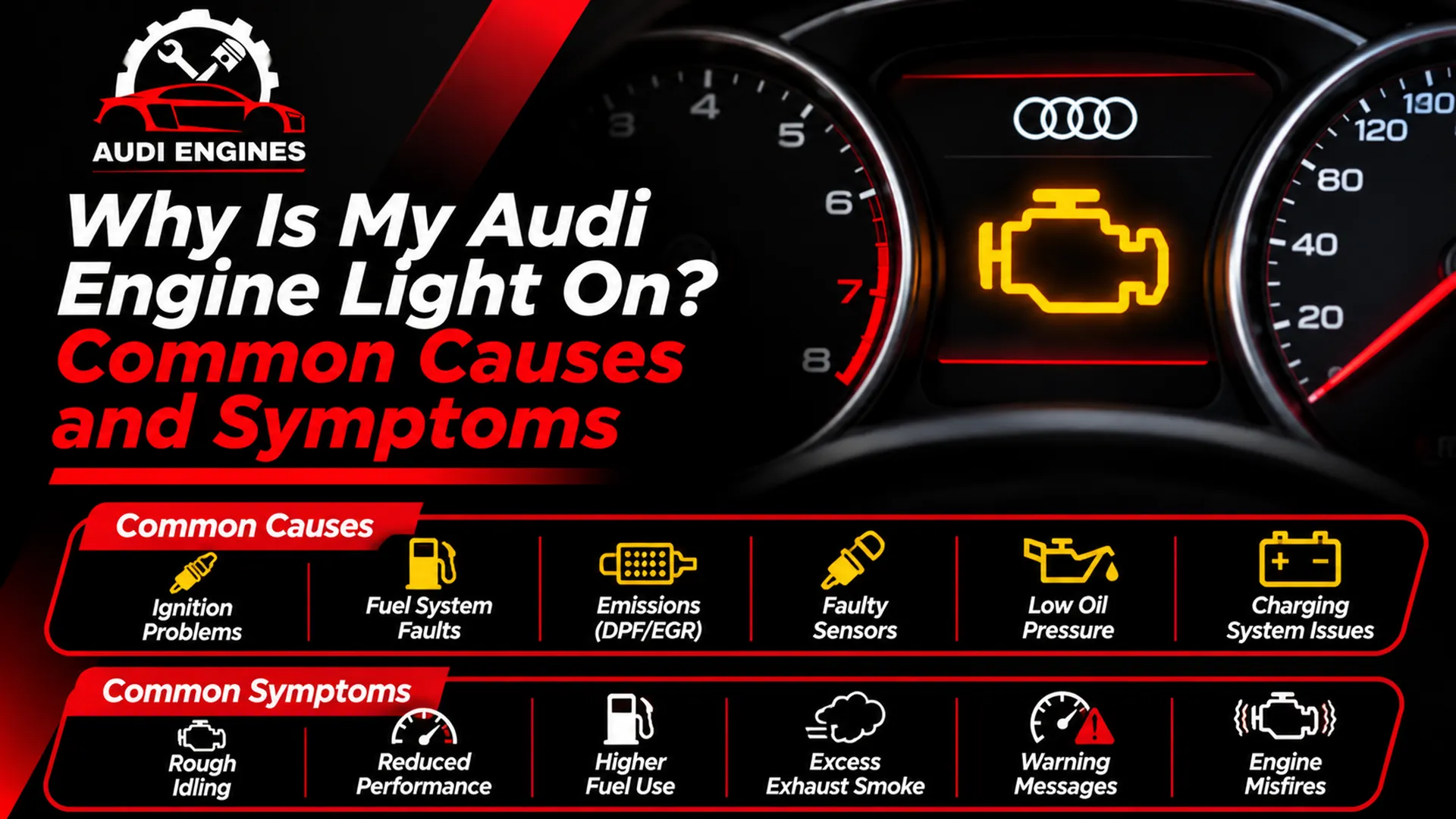
Because the ECU monitors so many systems, many different faults can switch the light on. Some are minor. Some are not. Only a proper diagnostic scan tells you which one you have.
Please treat everything below as a list of possibilities. A cause listed here is not guaranteed for your car, and nobody should replace parts by guesswork.
What Are the Most Common Causes of an Audi Engine Warning Light: Sensors, Misfires, EGR and DPF?
Oxygen or lambda sensor faults. These sensors measure oxygen in the exhaust so the ECU can balance the air-fuel mixture. A tired sensor can trigger the light and can cause poor fuel economy and higher exhaust emissions. Can a faulty oxygen sensor cause an Audi engine light? Yes, it is one of the most common triggers.
Mass airflow sensor problems. The mass airflow sensor, or MAF sensor, measures incoming air. If it reads wrongly, the ECU gets the mixture wrong. Symptoms include hesitation, rough idle and poor acceleration.
Ignition coil and spark plug problems. Worn plugs or failing coils cause misfires on petrol engines. You may feel the engine shake, stumble under load or lose power.
Fuel injector and fuel pressure problems. Faults in the fuel injection system or fuel pressure regulation can cause rough running, hard starting and a lean or rich mixture warning.
Turbocharger and boost pressure faults. A boost leak, a failed boost pressure sensor or a worn turbocharger can reduce power and set a fault code. Tuned cars are especially sensitive to this.
Catalytic converter problems. The catalytic converter reduces harmful exhaust pollutants. A failing one often follows a long-running misfire or a neglected sensor problem.
EGR valve faults. The exhaust gas recirculation valve feeds some exhaust gas back into the engine to lower emissions. It can clog with soot and stick open or shut.
DPF blockages on diesels. A blocked diesel particulate filter can trigger the engine light, often alongside a dedicated DPF warning. Frequent short journeys are a common reason.
Intake air leaks and vacuum leaks. Unmetered air entering the intake manifold upsets the mixture and can set lean fault codes.
Wiring and electrical connection problems. A damaged wire, a loose plug or a corroded connector can mimic a failed component. This is one reason testing matters before replacement.
How TFSI and TDI faults differ. Petrol Audis with TFSI or TSI engines more often show ignition, misfire, carbon deposit and fuel system faults. Diesel Audis with TDI engines more often show EGR, DPF and boost-related faults. Both types can suffer from sensor and wiring problems.
The same warning can look different depending on the car:
- Audi A3. Often linked to ignition, sensor or boost-related faults, especially on turbocharged engines.
- Audi A4. Commonly seen with misfires, oil-related issues on some engines and emissions sensors.
- Audi A6 and Q5. Frequently tied to DPF, EGR or sensor faults on diesel versions.
- Audi Q7. Larger, heavier and more complex, so boost, cooling and emissions faults all feature.
These are tendencies, not rules. The scan result is what counts.
Symptoms that often accompany the light:
- Rough idle or engine vibration
- Reduced engine power or limp mode
- Hesitation and poor acceleration
- Increased fuel consumption
- Exhaust smoke or a strong fuel smell
- Difficult starting or stalling
- Engine knocking or unusual noise
When the light comes with any of these, take it more seriously. When it comes with none, do not assume you are in the clear.
Why Is My Audi Engine Light On but the Car Drives Normally, or Stays On After a Repair?
This is one of the most searched questions, and it deserves a proper answer.
Light on, car feels fine. The ECU can detect small deviations long before you feel them. A sensor reading slightly out of range, a minor EVAP leak or an early emissions fault can set the light with no change in how the car drives. The fault is real, but it is not yet noticeable.
Light that comes and goes. An intermittent fault may trigger the lamp, then clear itself when conditions change. Cold starts, damp weather, refuelling and loose connections are all common reasons. The fault code usually stays in memory even after the light goes out, so a scan can still find it.
Light after servicing or a battery replacement. Disturbing connectors, sensors or electrical supply can set a fault. Sometimes the cause is a connector that was not refitted properly. Sometimes the battery change simply confused the car's systems until they are reset or adapted.
Light that returns after a repair. There are usually three explanations:
- The underlying cause was never fixed, only the symptom.
- A second fault was present alongside the first.
- The codes were cleared but the car has not completed its emissions readiness monitors, so pending faults can reappear.
A fault code is not a failed part. A code tells you what the ECU detected, not what broke. For example, a lean mixture code can come from a dirty MAF sensor, an intake leak, a weak fuel pump or a faulty injector. Replacing the first part that comes to mind often wastes money and leaves the problem in place.
A real example. A customer drives in with a steady amber light and no symptoms. They have already been told the oxygen sensor needs replacing. A full scan shows a stored misfire on one cylinder, and testing finds a failing ignition coil. After replacing the coil and retesting, the light stays off. The sensor was never the problem. Cases like this are why testing comes before spending.
Light on, symptoms present? If the light is on or flashing and your Audi is misfiring, losing power or running badly, book an Audi engine diagnostic with audiengines.co.uk before the problem gets worse.
How Is an Audi Engine Warning Light Diagnosed, and Will It Fail an MOT?
Diagnosis is a process. Reading a code is only the first step.
How Do Audi Specialists Read Fault Codes: OBD-II, VCDS and ODIS?
Most cars built in the last two decades support on-board diagnostics, known as OBD. A generic OBD-II scanner plugs into the diagnostic port and reads standard diagnostic trouble codes. That is useful, but it only goes so far.
Audi specialists go further with manufacturer-level tools. VCDS is widely used on Volkswagen Group vehicles and gives access to deeper fault memory, live data and adaptations. ODIS is the diagnostic platform used by Audi dealers. These tools can communicate with more control modules and show information that a basic reader will miss.
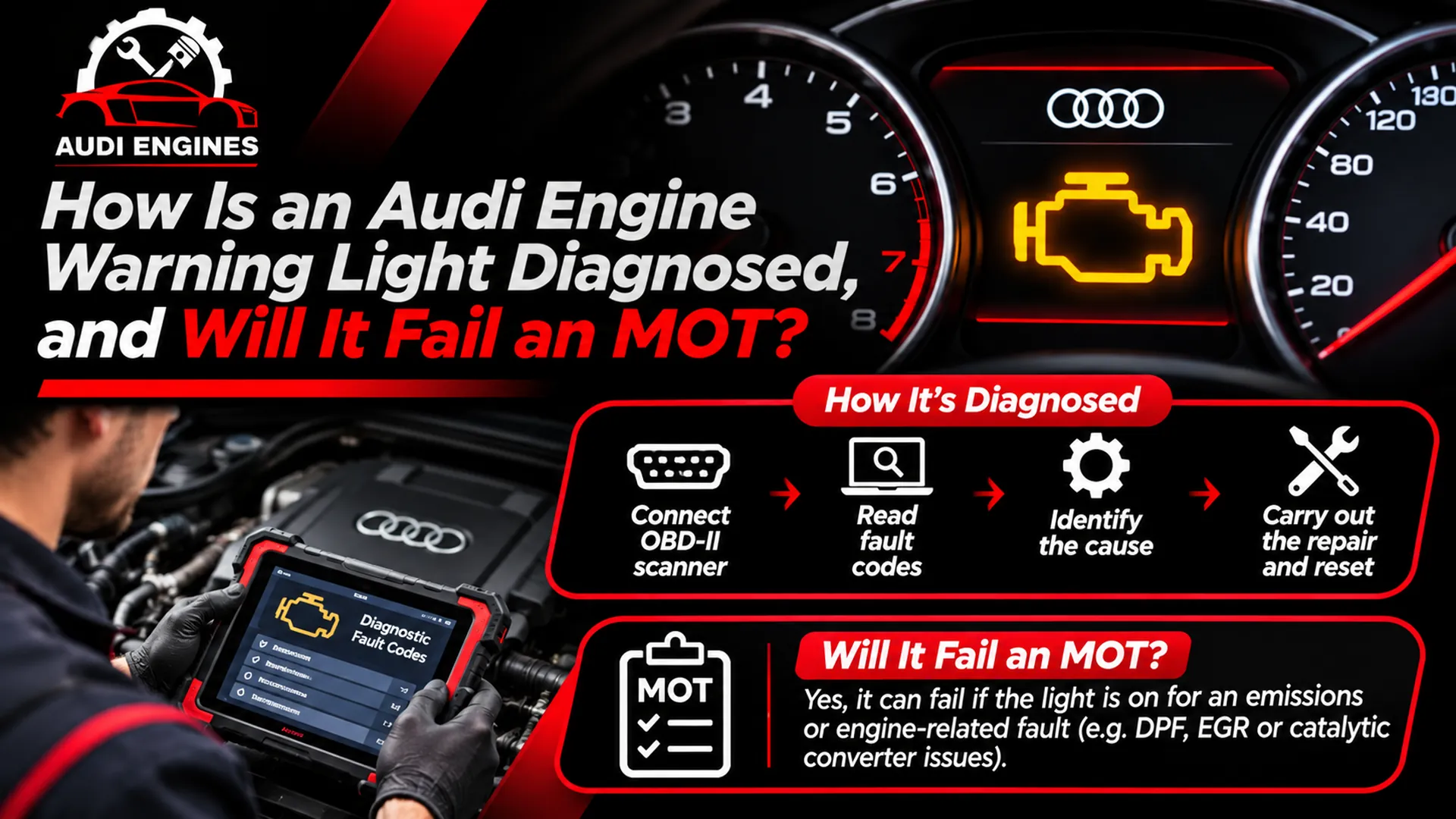
A proper diagnostic runs like this:
- Initial inspection. A technician checks for obvious problems such as damaged hoses, loose connectors, leaks and fluid levels, and talks to you about symptoms and when the light first appeared.
- Reading fault codes. The scanner pulls stored, pending and historical diagnostic trouble codes from the ECU fault memory.
- Checking freeze-frame data. This records conditions at the moment the fault was detected, such as engine speed, load and temperature.
- Monitoring live engine data. The technician watches sensor values, fuel trims, boost pressure and misfire counters while the engine runs.
- Testing the suspected component. Sensors, coils, valves and wiring are tested rather than assumed faulty.
- Repairing the underlying cause. The fix addresses what actually failed.
- Clearing codes and retesting. After repair, codes are cleared and the car is road tested to confirm the light stays off.
Example fault codes, for illustration only. These codes often appear in Audi diagnostics, but none of them is guaranteed to apply to your car:
Code | Common description | What it may point towards |
| P0300 | Random or multiple cylinder misfire | Ignition, fuel or compression issues |
| P0301 | Cylinder 1 misfire | Coil, plug, injector on that cylinder |
| P0302 | Cylinder 2 misfire | Coil, plug, injector on that cylinder |
| P0171 | System too lean | Air leak, MAF sensor, fuel delivery |
| P0420 | Catalyst efficiency below threshold | Catalytic converter or downstream sensor |
| P0101 | Mass airflow sensor range or performance | MAF sensor, intake leak, wiring |
| P0401 | Insufficient EGR flow | Blocked EGR valve or passages |
| P2002 | DPF efficiency below threshold | Blocked or failing particulate filter |
Fault code reader or professional diagnostic scan? A basic reader tells you a code number. A professional scan tells you why the code was set. The difference is the gap between guessing and knowing.
Can you reset the engine light yourself? You can clear codes with some scanners, and the light may go out. But clearing a fault does not fix it. If the cause remains, the light returns, and you may also erase useful diagnostic history. Reset only after the repair.
Will an engine warning light fail an MOT? Under current UK MOT rules, an engine management light that stays illuminated is treated as a major defect, and that results in a fail. Rules and testing standards can change, so confirm the latest position with the DVSA or your test station. Either way, you should not wait for the MOT to deal with an illuminated warning. Diagnosing it earlier gives you time to repair it properly.
For pricing, many people ask how much Audi engine diagnostics cost in the UK. The answer depends on the model, engine, the nature of the fault and how long testing takes. We do not publish fixed figures here. Ask for a written quote before work begins.
Where Can You Get an Audi Engine Warning Light Checked and Repaired in the UK?
Whether you are in Grays, elsewhere in Essex or anywhere else in the UK, the question is the same: who can diagnose the fault accurately and repair it properly? A specialist who works on Audi engines every day will usually get there faster than a generalist, because they recognise model-specific patterns.
When Should You Contact an Audi Engine Specialist?
Do not wait for the problem to get worse if any of these apply:
- The engine light is flashing
- The car has lost power or entered limp mode
- The engine idles roughly or vibrates
- You can see exhaust smoke or smell fuel
- The temperature gauge is climbing
- The light keeps coming back after previous repairs
- You are buying a used Audi and want its fault memory checked
A specialist with manufacturer-level diagnostic equipment can read deeper fault memory, interpret live data and test components properly. That means fewer unnecessary parts and fewer repeat visits.
If the fault turns out to be serious, such as internal engine damage, a failing turbocharger or catastrophic misfire damage, the options move beyond sensors and coils. Depending on the engine and its condition, that may mean repair, rebuild or replacement. The right choice comes after a proper assessment, not before.
At Audi Engines, we handle Audi engine diagnostics, engine fault repair, rebuilds and replacement engines. Start with the Audi engine diagnostic, and if the fault goes deeper, you will have clear information to decide what happens next.
Book your Audi engine diagnostic today with audiengines.co.uk. Tell us your model, engine and what the light is doing, and we will take it from there.
Frequently Asked Questions About the Audi Engine Light
What does the engine light mean on an Audi?
It means the ECU has detected a fault in the engine management or emissions system and stored a diagnostic trouble code. The light does not name the fault. A diagnostic scan is needed to find out what triggered it.
Why is my Audi engine management light on?
Common causes include faulty oxygen or MAF sensors, ignition coil and spark plug problems, EGR or DPF faults, boost leaks and wiring issues. Because many different faults trigger the same light, scanning the car is the only reliable way to know.
What does a flashing Audi engine light mean?
A flashing light usually indicates an active misfire that could damage the catalytic converter. Reduce speed, stop somewhere safe and arrange assistance, especially if the car is juddering or losing power.
Can a faulty oxygen sensor cause an Audi engine light?
Yes. A failing lambda sensor can upset the air-fuel mixture and emissions monitoring and set a fault code. But a code does not prove the sensor has failed, so test before replacing it.
Can an Audi engine light turn off by itself?
It can, if the fault was intermittent or conditions changed. The fault code usually stays in memory, so a scan can still reveal the cause. A light that disappears is worth checking, especially if it keeps returning.
Is an Audi engine light on but driving normally a problem?
It can be. The ECU detects faults before you feel them, so an early sensor or emissions problem may show no symptoms. Get it scanned soon rather than assuming it is harmless.
Can I drive with my Audi engine light on?
With a steady amber light and normal running, you can usually drive gently to a garage. With a flashing light, red warning, power loss or rough running, stop safely and get help.
How do I diagnose an Audi engine warning light?
Start with a fault code scan, then check live data and test the suspected component. Specialists use OBD-II tools alongside VCDS or ODIS for deeper access, then repair the underlying cause and retest.
Will the Audi engine light affect my MOT?
A persistent engine management light is treated as a major defect at MOT, which means a fail. Check the latest DVSA guidance, and have the fault diagnosed before the test.
How much does Audi engine diagnostics cost in the UK?
It varies with the model, engine, symptoms and how much testing the fault needs. We recommend asking for a written quote so you know what is included before work starts.
Are Audi TDI engine warning lights different from TFSI warnings?
The light itself looks the same, but the typical causes differ. TDI diesels more often involve EGR, DPF and boost faults. TFSI petrol engines more often involve ignition, misfire and fuel system faults.
Can servicing prevent Audi engine warning lights?
Regular servicing helps. Fresh spark plugs, clean filters, correct oil and timely inspection of the ignition, air intake and cooling systems all reduce the chance of avoidable faults.
Final Word: What Your Audi Engine Light Is Telling You
The Audi engine light on meaning comes down to one idea: your car has detected something it wants checked. A steady amber light gives you time to act. A flashing amber light or a red warning asks you to stop. In every case, the real answer comes from a proper diagnostic, not from guesswork or a quick reset.
Do not let a warning light sit for weeks hoping it goes away. Small faults grow. Catalytic converters, turbochargers and engines are expensive to repair when early warnings are ignored.
If your Audi is showing an engine warning, get it diagnosed by people who work on Audi engines every day. Contact audiengines.co.uk today to book your diagnostic, get the fault found and get your Audi running the way it should.