Audi Engine Repair in Grays, Essex Diagnostics, Repair and Replacement Specialists
There's a particular kind of dread that comes with an Audi engine warning light. It's not just the cost you're worried about, it's not knowing whether you're looking at a sensor that needs resetting or a fault that's about to leave you stranded on the A13.
There's a particular kind of dread that comes with an Audi engine warning light. It's not just the cost you're worried about, it's not knowing whether you're looking at a sensor that needs resetting or a fault that's about to leave you stranded on the A13.
That uncertainty is exactly why so many Audi owners across Grays end up putting off a proper diagnostic check, sometimes for weeks, hoping the problem sorts itself out. It rarely does. Engine faults on any car tend to get more expensive the longer they're left, but that's especially true on Audi's TDI and TFSI engines, where a relatively minor issue, a failing sensor, an early timing chain rattle, can escalate into something far more serious if it's ignored.
This page is built to answer the questions you're actually asking: what's likely wrong, how it gets properly diagnosed, what your repair options are, and what determines what you'll actually pay. If you'd rather skip straight to getting it looked at, get in touch to book an Audi engine diagnostic in Grays and we'll tell you exactly what's going on, honestly, before any work goes ahead.
Common Audi Engine Problems We Diagnose in Grays
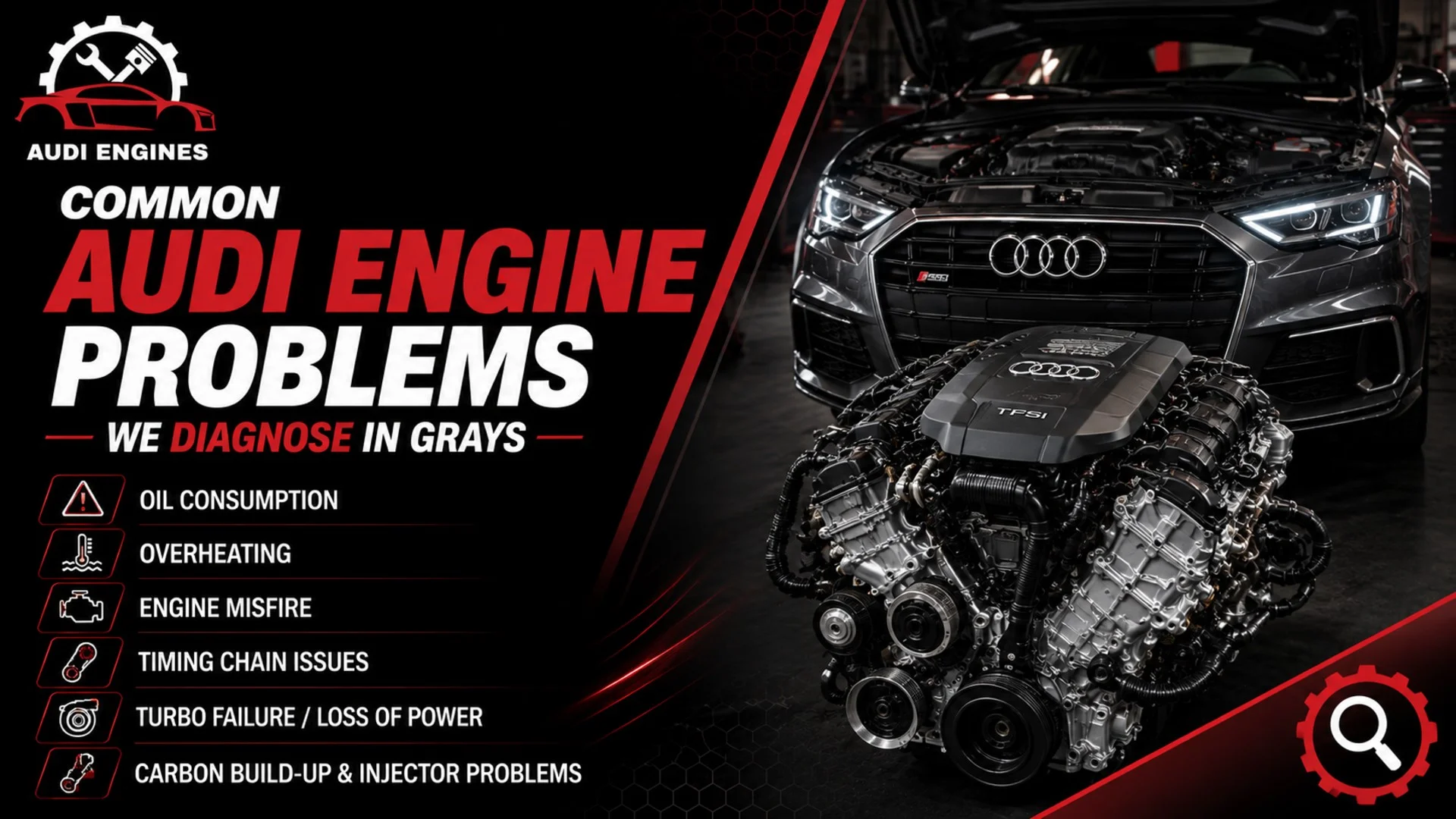
Audi engines, across the TDI diesel range and TFSI petrol range, are well engineered, but no engine is immune to wear, and certain faults come up again and again in our workshop. Recognising the pattern early is genuinely the single biggest factor in keeping repair costs down.
Why Is My Audi Engine Warning Light On?
The engine management light can mean anything from a minor sensor fault to something that needs immediate attention, which is exactly why guessing isn't a great strategy. It's triggered whenever the ECU detects a reading outside expected parameters, that could be an oxygen sensor, a boost pressure fault, an EGR issue, or dozens of other possibilities. A flashing light, as opposed to a solid one, generally signals something more urgent, often a misfire that risks damaging the catalytic converter if you keep driving on it. Either way, the light itself only tells you something's wrong, a proper diagnostic scan is what tells you what and why.
Why Is My Audi Losing Power or Misfiring?
Loss of power under acceleration and misfires often share root causes: worn ignition coils or spark plugs on TFSI petrol engines, failing injectors on TDI diesels, a turbo struggling to build boost, or a clogged air intake affecting the fuel-to-air ratio the ECU expects. Rough idle usually accompanies a misfire, since the engine's struggling to fire evenly across all cylinders. If it's happening consistently rather than as an occasional stumble, it's worth having looked at promptly, a sustained misfire can send unburnt fuel into the exhaust system and damage the catalytic converter over time.
Why Is My Audi Engine Knocking, Rattling or Smoking?
Unusual engine noise is one of the clearest early-warning signs an Audi engine gives, and different noises point toward genuinely different faults:
- A knocking noise, particularly deep and rhythmic, often indicates bearing wear or, in more serious cases, piston or connecting rod issues related to oil pressure problems
- A rattling noise on cold start that fades as the engine warms is a classic early sign of timing chain wear
- A whistling or whining noise under acceleration typically points to the turbocharger rather than the engine internals
- Blue smoke from the exhaust suggests the engine's burning oil, often via worn turbo seals or piston rings
- Black smoke under acceleration on TDI models usually indicates an overly rich fuel mixture, often from injector or turbo boost issues
- White smoke that persists once the engine's warm can point to a coolant leak into the combustion chamber
Audi Timing Chain Rattle, What It Means
This deserves its own mention because it's one of the most common, and most consequential, faults we see on certain Audi engine generations. Unlike a timing belt, which is replaced on a fixed schedule, the timing chain is designed to last the life of the engine. In practice, chain tensioners and guides can wear prematurely, particularly on engines with known chain-tensioner weaknesses, and the result is a rattling or clattering noise on cold start that fades once oil pressure builds. Ignore it and you're risking the chain skipping a tooth or, in the worst cases, snapping, which on an interference engine can mean valves meeting pistons and a full engine rebuild . A rattle heard early and dealt with promptly is a tensioner replacement. Left too long, it's a very different bill.
Why Is My Audi Overheating or Using Too Much Oil?
Overheating is never something to drive through. Common causes include a failing water pump, a stuck thermostat, a coolant leak (often from a perishing hose or a leaking head gasket), or a blocked radiator restricting airflow. If the temperature gauge starts climbing, pull over and let the engine cool rather than pushing on, sustained overheating can warp a cylinder head within minutes.
Excessive oil consumption is a separate but related concern, particularly on certain TFSI petrol engines known for burning oil faster than expected. This usually stems from worn piston rings, failing valve stem seals, or a PCV (positive crankcase ventilation) system fault. If you're topping up oil between services more than you'd expect, it's worth having checked, persistent low oil levels put every other component at risk of inadequate lubrication.
How We Diagnose and Repair Audi Engine Faults
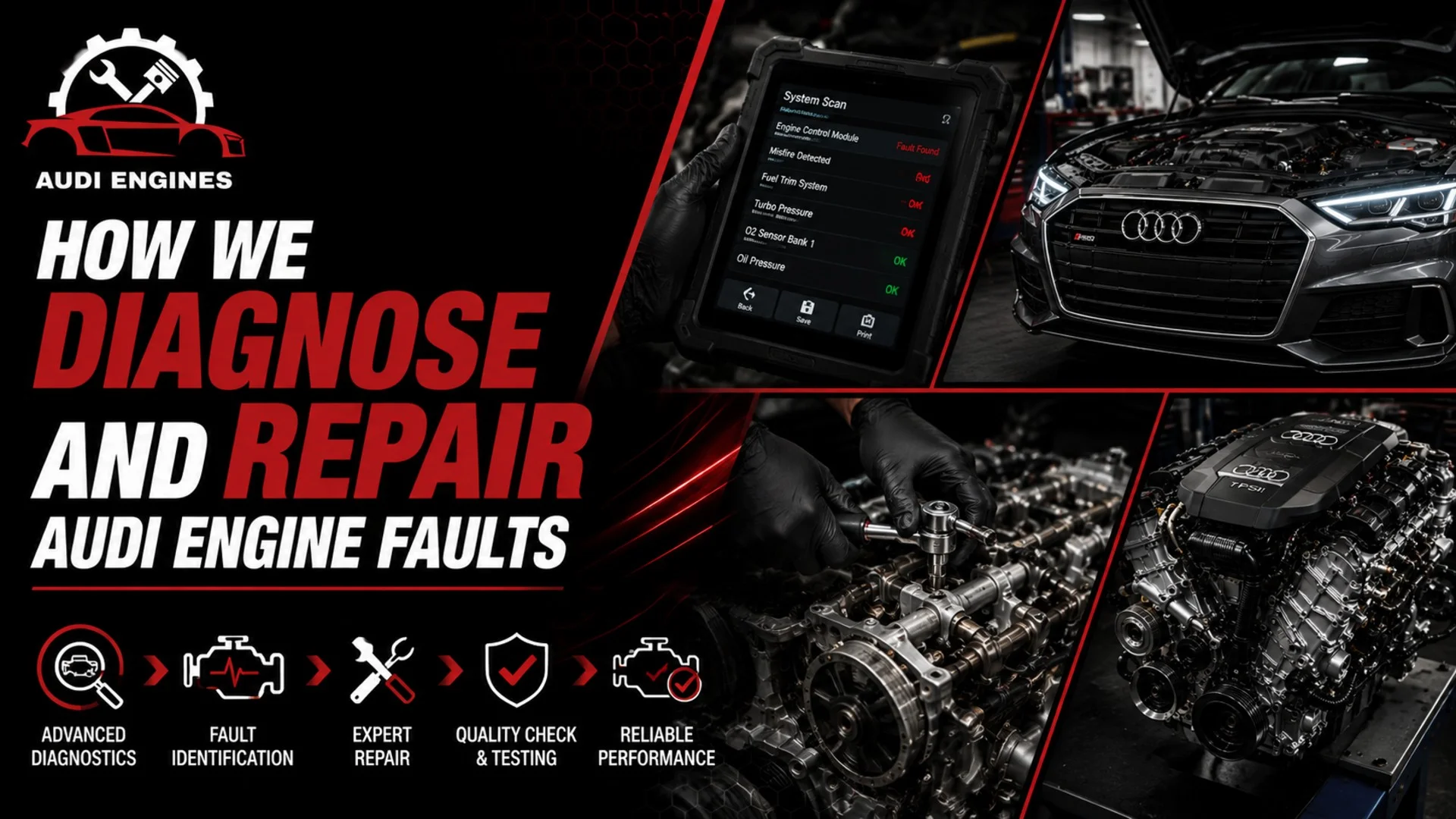
Recognising a symptom is the first step. Getting an accurate diagnosis of the actual cause is what separates a lasting repair from a guessing game that costs you twice.
Our Audi Engine Diagnostic Process
A proper Audi engine diagnostic doesn't start and end with a code reader. Our process typically follows this sequence: an initial discussion of the symptoms you've noticed, a full OBD diagnostic scan to pull stored and pending fault codes from the ECU, a mechanical inspection of relevant components based on what the codes and symptoms suggest, further targeted testing, compression testing, boost pressure testing, or sensor testing depending on the fault, to confirm the root cause, a clear repair recommendation with the reasoning behind it, and post-repair testing to confirm the fix has actually resolved the issue rather than just cleared the warning light.
Fault Codes, ECU Scanning and ECU Diagnostics
Fault codes are a starting point, not an answer. A code indicating a lean fuel mixture, for example, could point to a vacuum leak, a faulty MAF sensor, a fuel pump issue, or an injector problem, the code alone doesn't tell you which. That's why root-cause diagnosis matters so much: it's the difference between replacing the actual failing part and replacing parts based on a guess, hoping one of them fixes it.
Audi Timing Chain and Timing Belt Repairs
Depending on the engine, your Audi will have either a timing chain or a timing belt, and the maintenance approach differs significantly between the two. A timing belt has a fixed replacement interval and should be changed proactively regardless of symptoms, since belt failure on an interference engine causes catastrophic damage. A timing chain is designed to last far longer, but as covered above, tensioner wear is a real and fairly common issue on certain Audi engines. We assess chain condition through noise diagnosis, stretch measurement where accessible, and inspection of tensioner performance, then recommend tensioner or full chain replacement based on genuine findings rather than a blanket recommendation.
Audi Turbocharger Repair and Replacement
The turbocharger is under enormous thermal and mechanical stress on any Audi TDI or TFSI engine, and it relies entirely on clean oil supply to stay healthy. Common turbo faults include worn bearings causing that telltale whistling noise, failing seals letting oil into the intake or exhaust (producing blue smoke), and boost leaks from cracked hoses or a failing wastegate reducing power. We diagnose turbo faults using boost pressure testing alongside a physical inspection for shaft play and oil contamination, and repair or replace based on what's actually found, a full replacement isn't always necessary where a seal or hose repair will do the job.
Audi Head Gasket and Cooling System Repairs
A failing head gasket is one of the more serious faults an Audi engine can develop, and it's often the end result of prolonged overheating rather than a fault that appears out of nowhere. Symptoms include white smoke from the exhaust, coolant that keeps disappearing without an obvious external leak, oil that's taken on a milky appearance (a sign coolant and oil are mixing), and persistent overheating. Because head gasket failure is frequently a symptom of an underlying cooling system fault, a failed water pump or thermostat, for instance, we always investigate the cooling system alongside the gasket itself, so the repair addresses the actual cause rather than just the result.
Audi TDI vs TFSI Engine Problems
Treating every Audi engine the same misses an important distinction, because the diesel TDI range and petrol TFSI range have genuinely different common failure points.
Audi TDI (Diesel) | Audi TFSI (Petrol) | |
| Common weak points | EGR valve, DPF, injectors, turbo | Timing chain tensioner, oil consumption, ignition coils |
| Emissions-related faults | DPF blockage, AdBlue/NOx sensor issues | Carbon buildup on intake valves |
| Typical smoke symptom | Black smoke under acceleration | Blue smoke from oil burning |
| Oil-related concern | Oil contamination from failed regeneration | Excessive oil consumption between services |
Common TDI Faults, EGR, DPF and Injectors
TDI diesel engines are particularly prone to EGR valve sticking from carbon buildup, DPF blockage on vehicles doing frequent short journeys, and injector wear affecting fuel delivery and combustion efficiency. AdBlue and NOx sensor faults are also increasingly common as emissions systems have grown more complex on newer TDI generations. Many of these issues share root causes with problems we cover in more depth in our Audi engine diagnostics content, worth a read if your Audi's throwing an emissions-related fault.
Common TFSI Faults, Oil Consumption and Carbon Buildup
TFSI petrol engines, by contrast, are more commonly associated with above-average oil consumption, carbon buildup on intake valves (a particular issue on direct-injection engines, since fuel doesn't wash over the valves the way it does on port-injection designs), and ignition coil or spark plug wear causing misfires. Timing chain tensioner wear, discussed above, is also more strongly associated with certain TFSI engine generations than with the TDI range.
Repair, Rebuild or Replace, What Does Your Audi Engine Need?
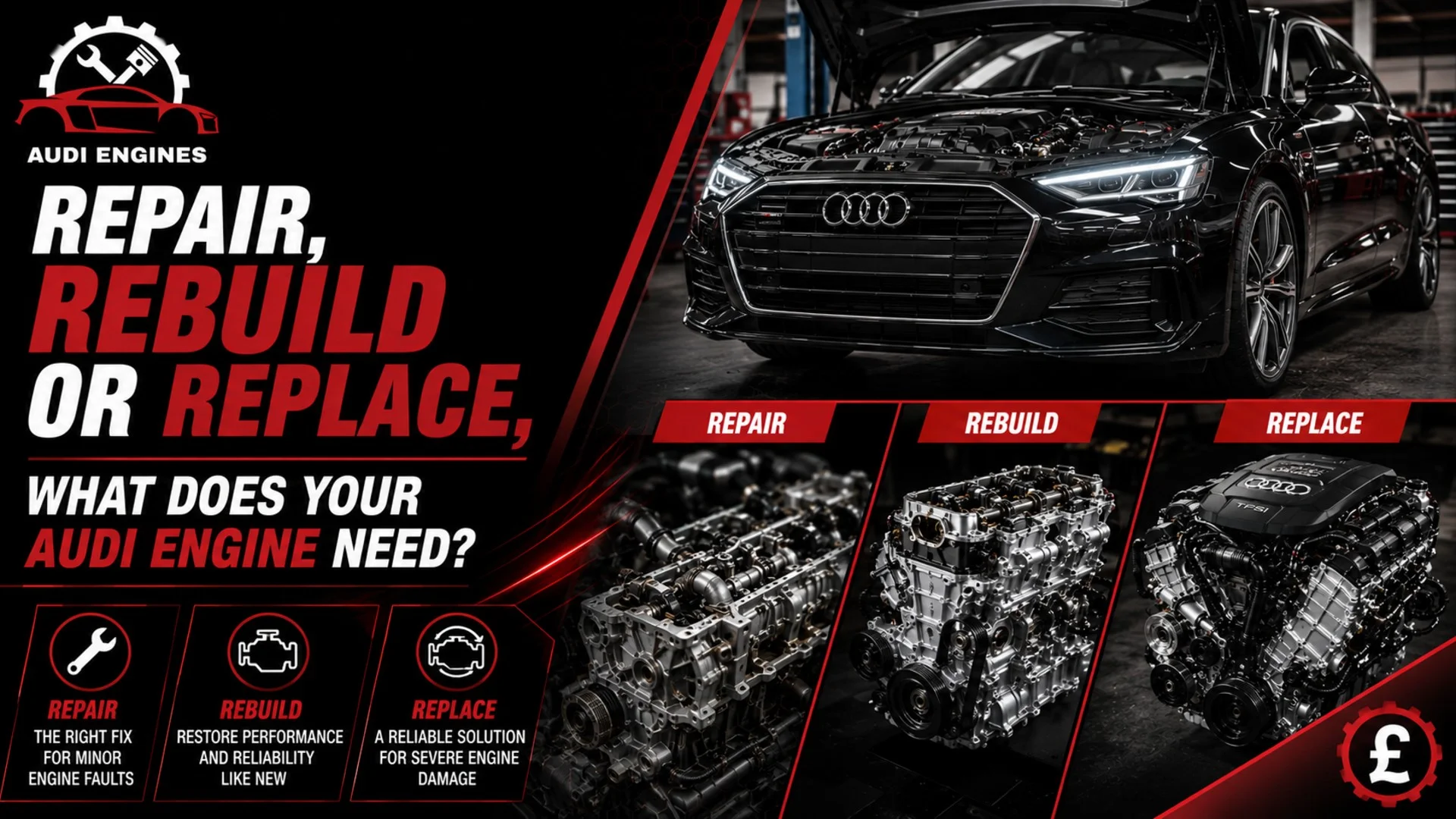
Once a fault's properly diagnosed, the next decision is what kind of fix makes sense. This is where a genuinely honest specialist earns their reputation, not every fault needs the most expensive solution.
Audi Engine Repair vs Rebuild vs Replacement
Option | Best When |
| Engine repair | The fault is isolated to a specific component, a turbo, injector, or sensor, with no wider internal damage |
| Engine rebuild | Internal components (pistons, bearings, valves) are damaged, but the engine block itself is structurally sound |
| Reconditioned engine | The existing engine isn't economical to rebuild, but a professionally reconditioned unit offers a reliable, tested alternative |
| Replacement engine | Failure is catastrophic, or replacement genuinely works out more cost-effective than repair given the vehicle's age and mileage |
The right choice depends on the extent of damage, the age and mileage of your Audi, and frankly, what makes financial sense relative to the vehicle's value. We'll always talk you through these trade-offs honestly rather than defaulting to whichever option costs the most.
How Engine Code and ECU Compatibility Affects Replacement
If replacement is the right route, matching the correct engine code matters enormously. Audi engines vary by generation, emissions specification, and ECU compatibility, even within the same model line, an engine that looks right on paper can be incompatible if the code doesn't match your vehicle's registration and emissions requirements. We verify engine code and compatibility against your specific vehicle before sourcing any replacement, which avoids the costly mistake of fitting an engine that technically won't run correctly with your car's ECU.
What Determines Audi Engine Repair Cost?
Rather than quote a generic figure that won't reflect your actual vehicle, it's more useful to understand what genuinely drives the cost of Audi engine repair:
- The specific fault and its severity, an isolated sensor replacement costs a fraction of a full turbo or timing chain job
- Your Audi's model and engine code, since parts availability and labour time vary across the range
- Diagnostic complexity, a fault that takes longer to isolate correctly adds to the overall time involved
- Parts required, and whether genuine Audi/OEM parts or quality aftermarket equivalents are appropriate for the repair
- Whether the fault has caused secondary damage, for example, a timing chain issue caught early is a tensioner job; left too long, it can mean a full rebuild
- Rebuild versus replacement decisions, which carry very different labour and parts costs
The only way to get an accurate figure is a proper diagnostic first, that's what tells us exactly what your Audi needs, and it means you're quoted for the actual repair rather than a rough estimate.
Does Audi Engine Repair Come With a Warranty?
Any reputable Audi specialist should stand behind their work with a warranty covering both parts and labour. This gives you confidence the repair's been done properly, and it's worth asking any garage directly what warranty terms apply before committing to work, a specialist confident in their diagnosis and repair quality won't hesitate to explain exactly what's covered.
Audi Models We Repair in Grays and Across Essex

Audi engine faults don't discriminate by model, from a compact A1 to a performance RS model, the same core principles of proper diagnosis and honest repair advice apply.
Audi A3, A4, A5 and A6 Engine Repair
These represent some of the most common Audi models on UK roads, and we regularly diagnose and repair engine faults across the full range, TDI and TFSI variants alike, whether it's an A3 with a timing chain rattle, an A4 losing power under load, an A5 with a persistent misfire, or an A6 showing oil consumption above what's expected for its mileage.
Audi Q3, Q5 and Q7 Engine Repair
The Q-range SUVs share much of their engine technology with the saloon and hatchback range, and we see similar fault patterns, turbo issues, EGR and DPF concerns on diesel variants, and timing chain wear, though the additional weight and towing demands some owners place on these vehicles can accelerate wear on certain components compared with a lighter A-range car.
Independent Audi Specialist vs Main Dealer, Which Is Better?
This is a genuinely common question, and the honest answer is that an experienced independent Audi specialist offers a strong alternative to a main dealer for the vast majority of engine repair work. The advantages typically include more competitive pricing without the dealership overhead, technicians who specialise specifically in Audi and VW Group engines rather than a broader general brand range, and often more flexibility and directness in explaining what's actually wrong and why. What matters most is making sure whichever specialist you choose uses proper diagnostic equipment, genuine or OEM-quality parts, and backs their work with a clear warranty, the same standards you'd expect from a dealer, without necessarily paying dealer rates.
Serving Grays, Thurrock and the Wider Essex Area
We're based in Grays and cover the surrounding Essex area, including Thurrock, Tilbury, South Ockendon, Stanford-le-Hope, and further afield across Essex. Wherever you're based locally, a proper Audi engine diagnostic and repair service is available without needing to travel into London or pay dealership premiums to get it done right.
Frequently Asked Questions
How much does Audi engine repair cost?
This varies significantly depending on the fault, your Audi's engine code, and whether repair, rebuild, or replacement is required. A minor sensor fault costs considerably less than a timing chain or turbo replacement, which is why we always recommend a proper diagnostic first, it's the only way to get an accurate cost specific to your vehicle and fault.
How do I know if my Audi engine needs repair?
Watch for the combination of symptoms covered above, an engine warning light, unusual noise (knocking, rattling, or whining), loss of power, excessive smoke, overheating, or noticeably increased oil consumption. Any one of these on its own is worth investigating; several together generally mean it's time to book a diagnostic rather than wait and see.
Is an independent Audi specialist cheaper than a dealer?
Generally, yes, independent specialists tend to offer more competitive pricing than main dealers for the same standard of diagnostic and repair work, provided the specialist has genuine Audi-specific expertise, proper diagnostic equipment, and uses quality parts. The savings come from lower overheads rather than any compromise on the quality of the actual repair.
Should I repair or replace my Audi engine?
This depends on the extent of the damage, your vehicle's age and mileage, and what makes financial sense relative to the car's value. An isolated fault is usually a straightforward repair; widespread internal damage may make a rebuild, reconditioned engine, or full replacement the more sensible long-term option. A proper diagnostic and an honest conversation about the trade-offs is the right starting point either way.
How often should an Audi be serviced to avoid engine problems?
Following Audi's recommended service intervals, typically based on mileage or time, whichever comes first, is genuinely one of the most effective ways to catch developing faults before they become expensive. Regular oil changes in particular matter enormously for both TDI and TFSI engines, since oil quality and level directly affect turbo, timing chain, and general engine longevity.
Get Your Audi Engine Properly Diagnosed in Grays
Every fault covered on this page, from a subtle cold-start rattle to a stubborn engine warning light, gives some warning before it turns into a serious repair. The Audis that end up needing a full rebuild are almost always the ones where an early symptom got ignored for a few thousand miles too many.
If your Audi's showing any of the signs covered here, whether it's a TDI or TFSI, an A-range saloon or a Q-range SUV, the smartest move is getting it properly diagnosed now. We cover Grays and the wider Essex area, specialise specifically in Audi engine diagnostics and repair, and we'll always give you an honest, code-verified assessment before recommending any work.
Book your Audi engine diagnostic in Grays today and find out exactly what your engine needs.