
Audi Limp Mode Causes and Fix (Complete Diagnostic Guide)
Your Audi suddenly feels sluggish. The revs won't climb past a certain point, a warning light flashes on the dash, and overtaking that lorry on the motorway is suddenly out of the question.
Your Audi suddenly feels sluggish. The revs won't climb past a certain point, a warning light flashes on the dash, and overtaking that lorry on the motorway is suddenly out of the question. This is limp mode, and if you're reading this, it's probably happening to you right now.
The good news: limp mode is not the end of your engine. It's a protective response, not a death sentence for your car. The less good news: figuring out why it happened requires more than a guess, and driving around blind turbo replacement.
This guide walks through exactly what's going on under the bonnet, the real causes split by petrol and diesel Audi engines, how to diagnose the fault properly instead of throwing parts at it, and what it actually costs to put right. If you own an A3, A4, A5, A6, Q5, Q7, or any other model in the range, the diagnostic logic here applies across the board.
What Is Audi Limp Mode and Why Does It Happen?
What Does "Limp Mode" Mean on an Audi?
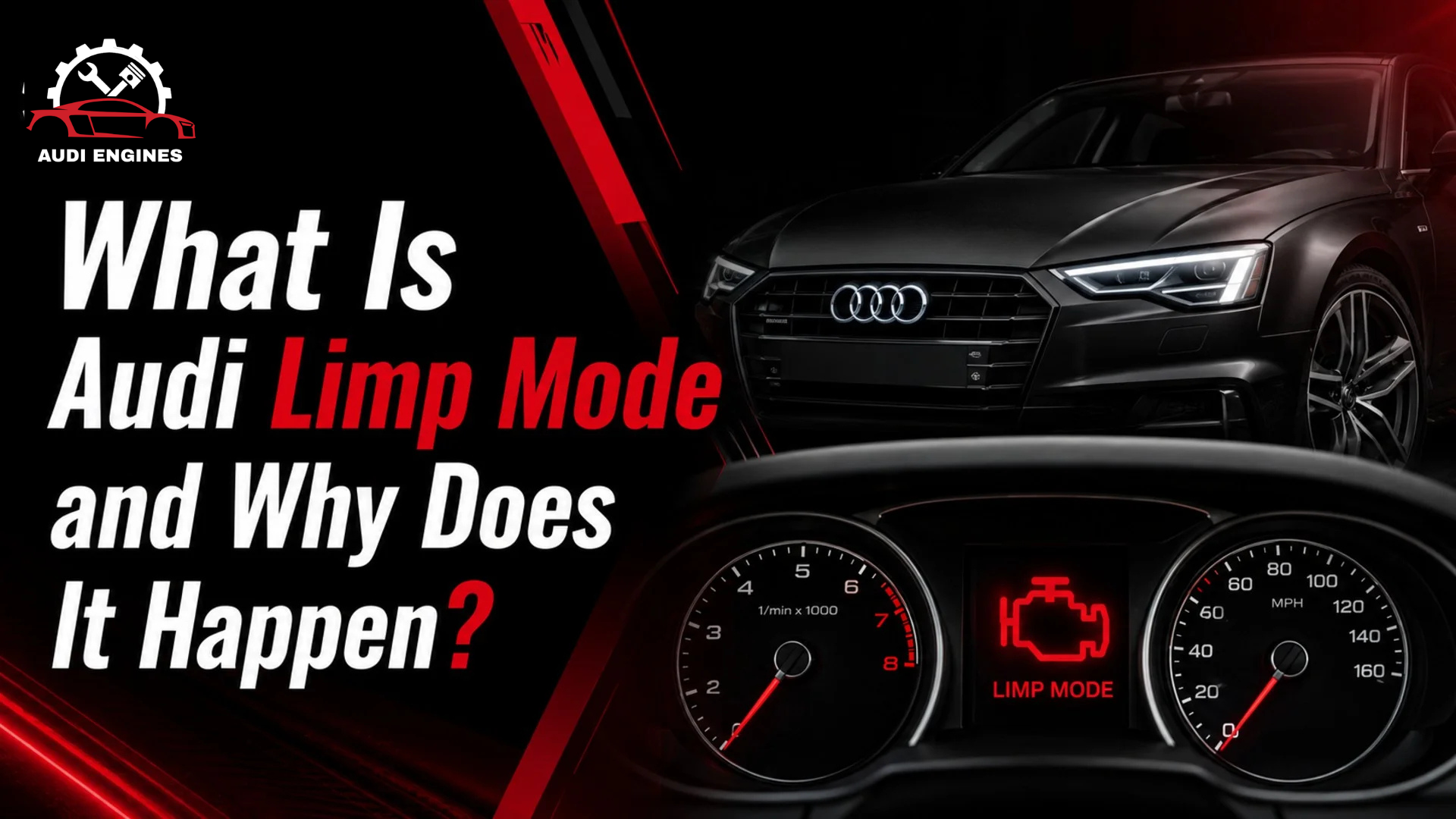
Limp mode, sometimes called reduced power mode, safe mode, or emergency mode, is a built-in protection strategy inside your Audi's engine management system. When the Engine Control Unit (ECU) detects a fault it considers potentially damaging, it deliberately restricts engine output. Torque gets capped, RPM gets limited, and in some cases the transmission changes how it shifts gears.
It's not a separate warning light or a single fault. It's a behaviour the car adopts once a specific trigger condition is met.
How the ECU Decides to Trigger Limp Mode
Modern Audi engines, whether TFSI, FSI, or TDI, run on constant fault monitoring. The ECU compares requested values (like requested boost pressure) against actual measured values (actual boost pressure) dozens of times per second. When the gap between what's expected and what's actually happening gets too large, or a sensor reading falls outside a safe range, the ECU logs a fault code and drops into a protective, torque-limited state.
Think of it less like a mechanical breakdown and more like a circuit breaker tripping. Something upstream, a sensor, an actuator, a leak, a blocked filter, is sending information the ECU doesn't trust, so the car protects itself by pulling back power until the issue is addressed.
Common Warning Signs You're in Limp Mode
Limp mode rarely arrives quietly. Most drivers notice a mix of the following:
- Reduced power and poor acceleration, the car feels flat, like it's driving through treacle
- Hesitation or stuttering under load, especially when accelerating hard or overtaking
- RPM or speed limiting, the engine simply won't rev past 2,500–3,500rpm regardless of throttle input
- One or more warning lights appearing on the dash at the same time
Reduced Power and Poor Acceleration
This is usually the first thing people notice, the car just doesn't respond the way it normally does when you press the accelerator.
RPM or Speed Limiting
Some Audis will cap you at a specific speed (often around 30-40mph) or refuse to let the revs climb, which is particularly noticeable on motorway slip roads.
Warning Lights (EPC, Check Engine, Glow Plug)
The EPC light (Electronic Power Control), the check engine light, or a flashing glow plug light on diesels frequently accompany limp mode, and which light appears is actually a useful diagnostic clue, which we'll cover later in this guide.
Is Limp Mode the Same as "Reduced Power Mode" or "Safe Mode"?
Yes, these are different names for the same underlying protective behaviour. Audi's own service documentation and independent workshops use these terms fairly interchangeably. Whether your dash shows "Engine Power Reduced," an EPC light, or you simply notice the car has gone soft on power, the mechanism behind it is the same fault-detection process described above.
What Causes an Audi to Go Into Limp Mode?
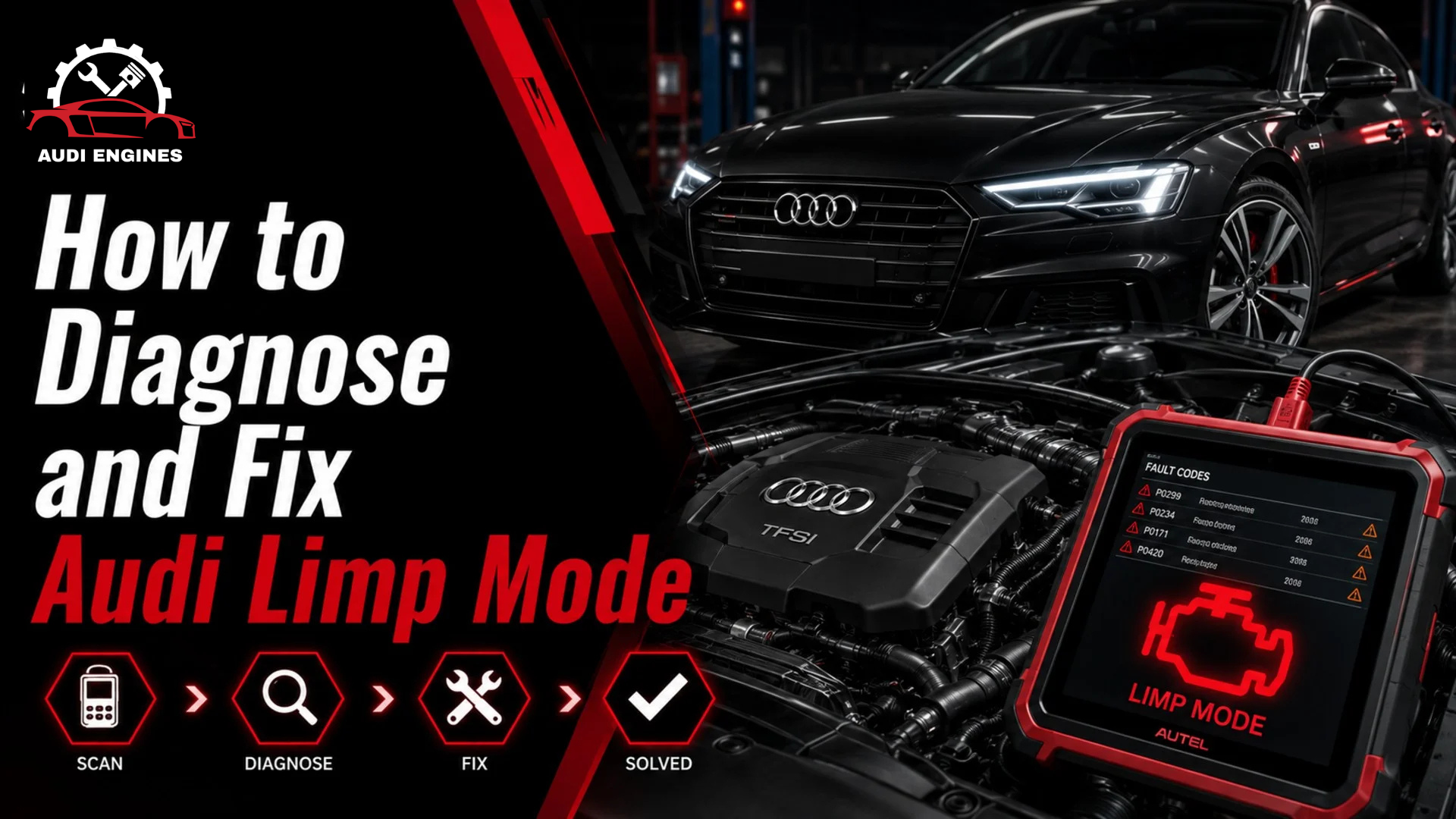
This is the part most guides get wrong. They list a generic pile of causes without separating petrol and diesel systems, but a TFSI engine and a TDI engine fail into limp mode for genuinely different reasons, because they rely on different subsystems entirely.
Common Causes on Petrol (TFSI/FSI) Engines
Audi's turbocharged petrol engines lean heavily on boost control, drive-by-wire throttle systems, and precise fuel/ignition timing. A fault in any of these areas is a common route into limp mode.
Turbocharger and Boost Pressure Faults
Underboost (not enough pressure) or overboost (too much pressure) are among the single most common limp mode triggers on TFSI engines. The ECU compares requested boost against actual boost, and when the two don't match closely enough, it protects the engine by cutting power.
Diverter Valve or Wastegate Problems
A sticking wastegate, a failed turbo actuator, or a worn diverter valve (also called a blow-off valve) can all cause boost pressure to fall outside the expected range. These are mechanical, moving parts, and they wear out, particularly on higher-mileage cars.
EPC, Throttle Body and Pedal Sensor Faults
Audi's drive-by-wire throttle system relies on the accelerator pedal sensor and throttle position sensor talking to the ECU accurately. A dirty throttle body, a fault at the pedal sensor, or a wiring issue in this circuit commonly triggers the EPC light alongside limp mode.
MAF/MAP Sensor and Ignition Misfires
A faulty Mass Air Flow (MAF) or Manifold Absolute Pressure (MAP) sensor feeds the ECU incorrect air/fuel data, while failing ignition coils or worn spark plugs can cause misfires, both are well-documented limp mode triggers on TFSI/FSI engines.
Common Causes on Diesel (TDI) Engines
TDI engines add emissions-control complexity into the mix, so limp mode here often traces back to systems petrol owners never have to think about.
DPF Blockage and Regeneration Failures
The Diesel Particulate Filter (DPF) traps soot from the exhaust. If it becomes blocked, often from repeated short journeys that never let it regenerate properly, the ECU restricts power to protect the engine and exhaust system.
EGR Valve and Carbon Build-Up
The Exhaust Gas Recirculation (EGR) valve can gum up with carbon deposits over time, causing it to stick open or closed. Either failure mode throws off the engine's emissions readings and is a frequent cause of reduced power warnings on TDI models.
AdBlue/SCR System Faults
Newer TDI engines use AdBlue and an SCR (Selective Catalytic Reduction) system to control NOx emissions. A fault here, low AdBlue level, a failed NOx sensor, or a blocked injector, can trigger both a dashboard warning and limp mode.
Glow Plug and Turbo Actuator Issues
A flashing glow plug light combined with limp mode is one of the more recognisable diesel-specific symptoms, often pointing to either the glow plug system itself or, just as commonly, a turbo actuator fault sharing the same warning light.
Electrical and Battery-Related Causes
It's easy to overlook, but a weak battery, a failing alternator, or poor earth connections can cause voltage fluctuations that the ECU interprets as a fault, triggering limp mode with no obvious mechanical cause at all. This is particularly common after a battery replacement that wasn't followed by a proper battery registration/coding procedure on VAG vehicles.
Why Does Limp Mode Disappear After Restarting the Car?
This is one of the most common, and most misunderstood, patterns Audi owners describe. You're driving, the car drops into limp mode, you pull over, switch off, restart, and suddenly it drives normally again.
Is the Fault Actually Fixed, or Just Reset?
In almost every case, the fault is not fixed, it's simply reset. Many limp mode triggers are intermittent by nature: a sensor reading briefly spikes out of range, or a boost leak only becomes significant under certain load conditions. Restarting the engine clears the immediate protective state, but the underlying fault code is usually still stored in the ECU's fault memory, waiting to reappear the next time conditions repeat. Treat a "self-resolving" limp mode exactly the same as one that persists, it needs a proper fault-code scan.
Common Audi Fault Codes Linked to Limp Mode
Certain diagnostic trouble codes (DTCs) show up again and again in limp mode diagnostics. Reading these correctly with a proper scan tool (VCDS, OBDeleven, or an equivalent) is the fastest route to an accurate diagnosis.
P0299 (Turbo Underboost)
Indicates the ECU is seeing significantly less boost than requested, commonly linked to boost leaks, a disconnected or split hose, a faulty diverter valve, or a struggling turbo actuator.
P0234 (Turbo Overboost)
The opposite problem, boost pressure exceeding the safe requested value, often pointing to a stuck wastegate or a faulty boost control valve (N75).
P2563 (Turbo Actuator)
Points directly at the turbocharger's boost control position sensor or actuator circuit, rather than a leak elsewhere in the system.
Fault Code | Common Name | Typical Cause Areas |
| P0299 | Turbo Underboost | Boost leaks, split hoses, diverter valve, turbo actuator |
| P0234 | Turbo Overboost | Stuck wastegate, faulty N75 boost control valve |
| P2563 | Turbo Actuator Fault | Actuator position sensor, wiring, turbo control circuit |
How to Diagnose and Fix Audi Limp Mode
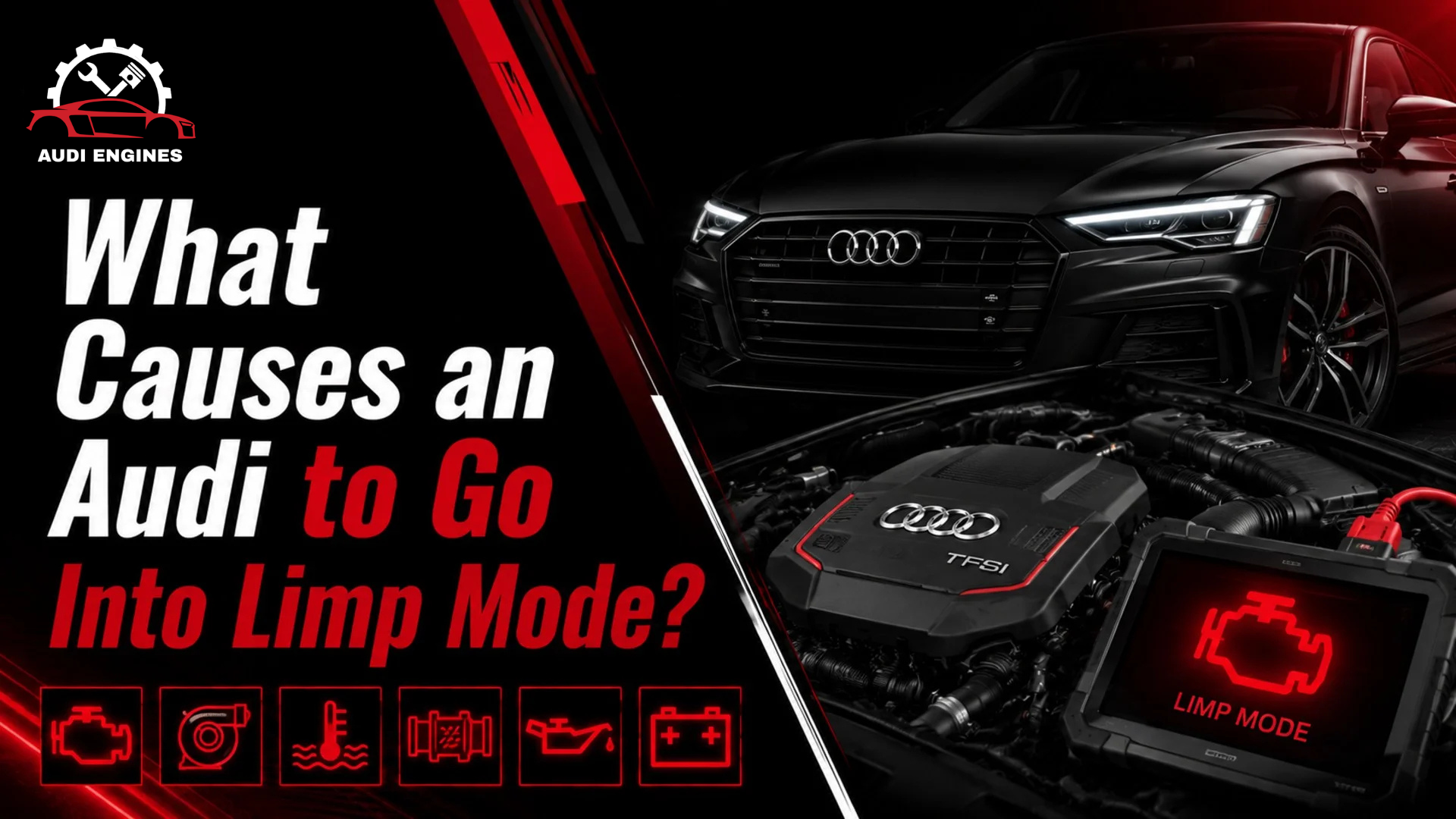
Here's the part most competitor pages skip entirely: a structured, logical path from symptom to confirmed cause. Guessing and swapping parts is expensive. Diagnosing properly, in order, is not.
How to Diagnose Limp Mode Correctly
Step 1, Read Stored and Pending Fault Codes
Every proper diagnosis starts with an OBD2 scan using a tool capable of reading VAG-specific fault codes, not just generic codes. This tells you which system flagged the problem in the first place.
Step 2, Check Live Data and Freeze-Frame Values
Once you know the fault code, live data (requested vs. actual boost, sensor voltage readings, fuel trims) tells you what the engine was actually doing at the moment the fault triggered.
Step 3, Inspect Boost System for Leaks
For turbo-related codes, a smoke test on the intake and charge-air system is the quickest way to find a physical leak, split hoses, loose intercooler pipework, or a perished vacuum line.
Step 4, Test Sensors, Actuators and Wiring
If there's no obvious leak, the next step is component-level testing: checking the wastegate actuator's movement, verifying MAF/MAP sensor readings against expected values, and inspecting connectors and wiring for corrosion or damage.
Warning Light Combinations and What They Mean
The specific combination of warning lights accompanying limp mode narrows down the likely fault area significantly, a detail most guides don't break down clearly.
Warning Light Combination | Likely System Involved |
| EPC light + limp mode | Throttle body, drive-by-wire, accelerator pedal sensor |
| Glow plug light + limp mode | Diesel engine management, turbo, or emissions system |
| Check engine light + reduced power | Stored engine fault, often sensor-related |
| DPF light + limp mode | DPF restriction or failed regeneration |
| AdBlue warning + limp mode | SCR/NOx sensor/AdBlue dosing system |
EPC Light + Limp Mode
Almost always points toward the drive-by-wire throttle system, the throttle body itself, the pedal position sensor, or the wiring between them.
Glow Plug Light + Limp Mode
On TDI engines, this combination frequently relates to the glow plug system, but boost or emissions faults sharing the same warning circuit are just as common, which is exactly why a proper fault-code read matters more than guessing from the light alone.
DPF/AdBlue Light + Limp Mode
Points straight at the emissions system, either a blocked filter needing regeneration or cleaning, or an AdBlue/SCR fault needing sensor or dosing-system repair.
How to Fix Audi Limp Mode by Cause
Fixing Boost Leaks and Turbo Faults
Where the diagnosis points to a leak, the fix is usually straightforward, repairing or replacing the damaged hose, pipe, or seal. Where the actuator, wastegate, or diverter valve itself has failed, component replacement is needed.
Fixing DPF, EGR and AdBlue Faults
Depending on severity, this ranges from a forced regeneration or DPF clean through to EGR valve cleaning/replacement or repairing the AdBlue dosing system and associated sensors.
Fixing Sensor and Electrical Faults
Faulty MAF, MAP, or pedal sensors are typically straightforward replacements once confirmed, while wiring and connector faults require careful inspection and repair rather than guesswork.
Should You Replace the Turbo First? (Common Mistake to Avoid)
This is genuinely one of the costliest mistakes we see. A turbo underboost code does not automatically mean the turbo has failed. In a large proportion of cases, the real cause is a split hose, a loose intercooler connection, a faulty diverter valve, or a sticking wastegate actuator, all considerably cheaper to fix than a turbocharger. Always rule out the boost delivery system with proper testing before authorising turbo replacement.
Can You Reset Limp Mode Without a Scanner?
Disconnecting the battery or clearing codes without a scan tool might make the warning light disappear temporarily, but it doesn't fix the underlying fault, and on modern Audis, disconnecting the battery incorrectly can trigger unrelated electrical issues that need their own reset procedure. Proper fault-code clearing after a confirmed repair, followed by a road test, is the only reliable way to resolve limp mode for good.
Driving Safely, Repair Costs and When to Get Help

Can You Drive an Audi in Limp Mode?
Generally, limp mode is designed to let you drive to safety, but that doesn't mean every situation is safe to continue in.
When It's Safe to Drive a Short Distance
If the car feels stable, no critical warning lights (oil pressure, overheating) are present, and power is reduced but controllable, it's usually fine to drive carefully and slowly to a garage.
When You Should Stop and Get Recovery Immediately
Stop the car and arrange recovery if you notice any of the following:
- The engine is shaking, knocking, or making unusual mechanical noises
- The oil pressure warning light is illuminated
- The temperature gauge shows overheating
- Excessive smoke is coming from the exhaust
- The car cannot maintain a safe speed in traffic
How Much Does Audi Limp Mode Repair Cost?
Costs vary enormously depending on the cause, which is exactly why proper diagnosis before repair matters so much:
- Sensor replacement (MAF, MAP, pedal sensor), typically the lower end of the cost range
- Boost leak repair (hoses, clips, diverter valve), moderate cost, often a same-day fix
- EGR/DPF cleaning or repair, mid-range, depending on whether cleaning or replacement is needed
- Turbo actuator or wastegate repair, higher cost due to labour and part complexity
- Full turbocharger replacement, the most expensive outcome, and one that should only follow confirmed diagnosis
An accurate diagnostic scan upfront is what prevents paying for the most expensive fix when a cheaper one would have solved it.
Book an Audi Limp Mode Diagnostic With Audi Engines
If your Audi has gone into limp mode, guessing at the cause risks paying for parts you don't need. At Audi Engines, based in the UK, we specialise specifically in Audi diagnostics and repair, fault-code reading, live data analysis, boost system testing, and emissions diagnostics, all carried out by technicians who work on nothing but VAG-group vehicles day in, day out.
Why Choose a UK Audi Specialist Over a General Garage
A general garage can read a generic fault code. An Audi specialist understands what that code means in the context of your specific engine, knows which components typically fail first on that platform, and can test properly rather than replacing parts on a hunch, saving you time and money in the process.
Frequently Asked Questions
Why does my Audi keep going into limp mode?
Recurring limp mode almost always means the underlying fault hasn't been properly repaired, only reset. Intermittent faults, in particular, tend to reappear under the same driving conditions (hard acceleration, motorway speed, or when the engine is hot) until the actual component causing them is identified and fixed.
Is limp mode covered under warranty?
It depends on the cause and the type of warranty in place. Manufacturer warranties typically cover genuine component failures, while extended or third-party warranties vary in what they include. It's worth getting a confirmed diagnosis first, since you'll need the specific fault identified before making a warranty claim.
Will disconnecting the battery reset limp mode?
It may temporarily clear the warning light, but it does not fix the underlying fault, and on some models it can cause separate issues that require their own reset procedure. It's not a substitute for proper diagnosis and repair.
Final Thoughts
Limp mode is your Audi's way of telling you something specific needs attention, not a reason to panic, but not something to ignore either. The causes range from a simple split hose to a failing sensor to a blocked DPF, and the only way to know which one you're dealing with is a proper diagnostic process: fault codes, live data, and physical testing, in that order.
Skip the guesswork, and you'll avoid paying for a turbo replacement when the real problem. If your Audi has gone into limp mode and you want it diagnosed properly the first time, get in touch with Audi Engines, we'll find the actual cause and give you a clear, honest repair plan before any work begins.