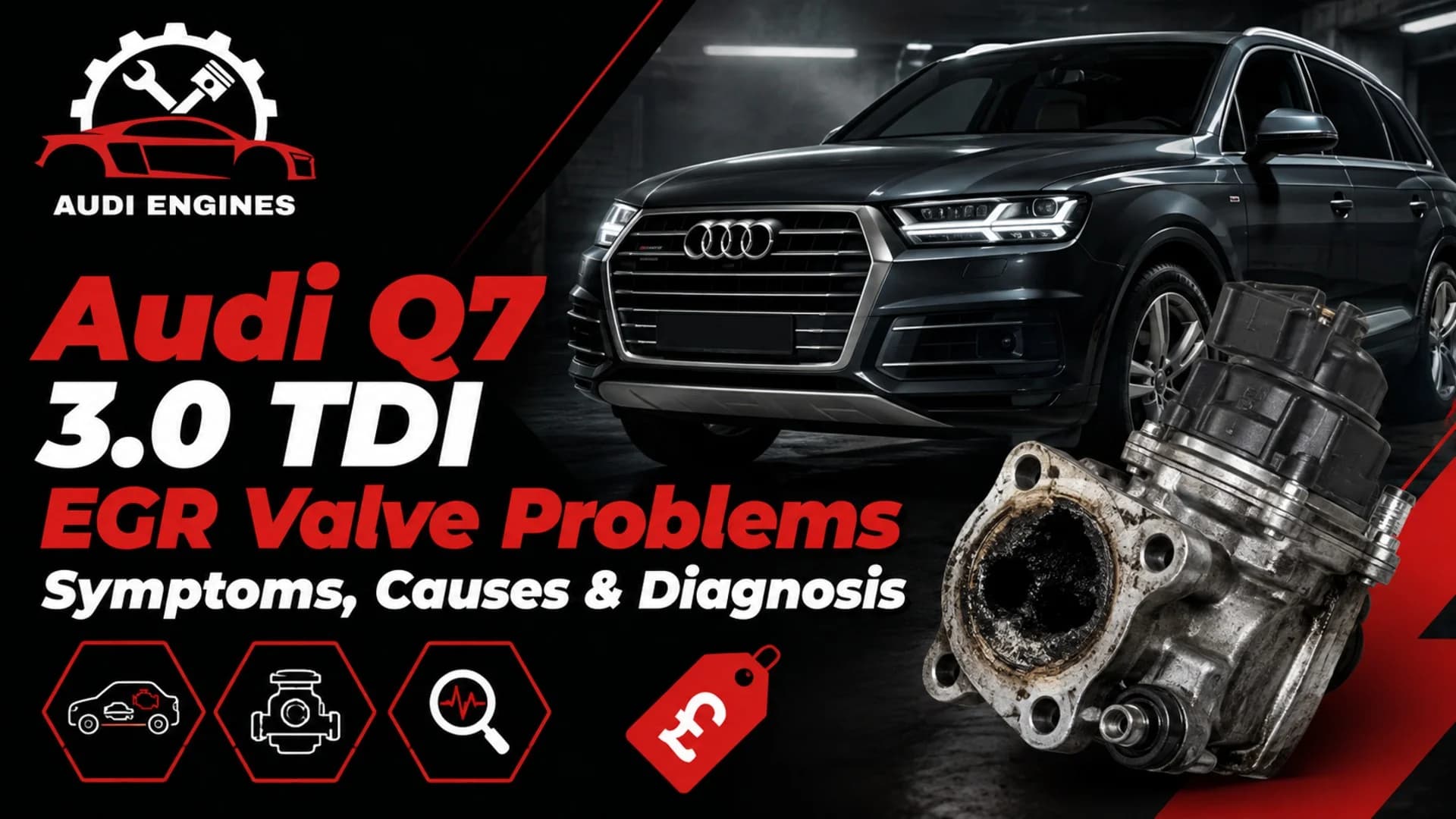
Audi Q7 3.0 TDI EGR Valve Problems Symptoms, Causes & Diagnosis
If your Q7 has started hesitating at junctions, dropped into limp mode on the motorway, or lit up the dash with a warning light you don't recognise, the EGR valve deserves a serious look before you assume the worst about the engine itself.
If your Q7 has started hesitating at junctions, dropped into limp mode on the motorway, or lit up the dash with a warning light you don't recognise, the EGR valve deserves a serious look before you assume the worst about the engine itself.
The 3.0 TDI V6 is a genuinely strong engine, but its EGR system is one of the most common sources of fault codes, power loss, and diagnostic confusion on the Q7 platform. Part of the difficulty is that EGR problems rarely announce themselves clearly, the same underlying fault can show up as rough idle in one car and limp mode in another, depending on exactly what failed and how.
This guide walks through Audi Q7 3.0 TDI EGR valve symptoms properly, organised by what's actually gone wrong, not just a generic list, along with the fault codes involved, how a proper diagnosis is carried out, and what your repair options actually look like.
What Is the EGR Valve & What Are the Symptoms of a Fault?
What Does the EGR Valve Do on an Audi Q7 3.0 TDI?
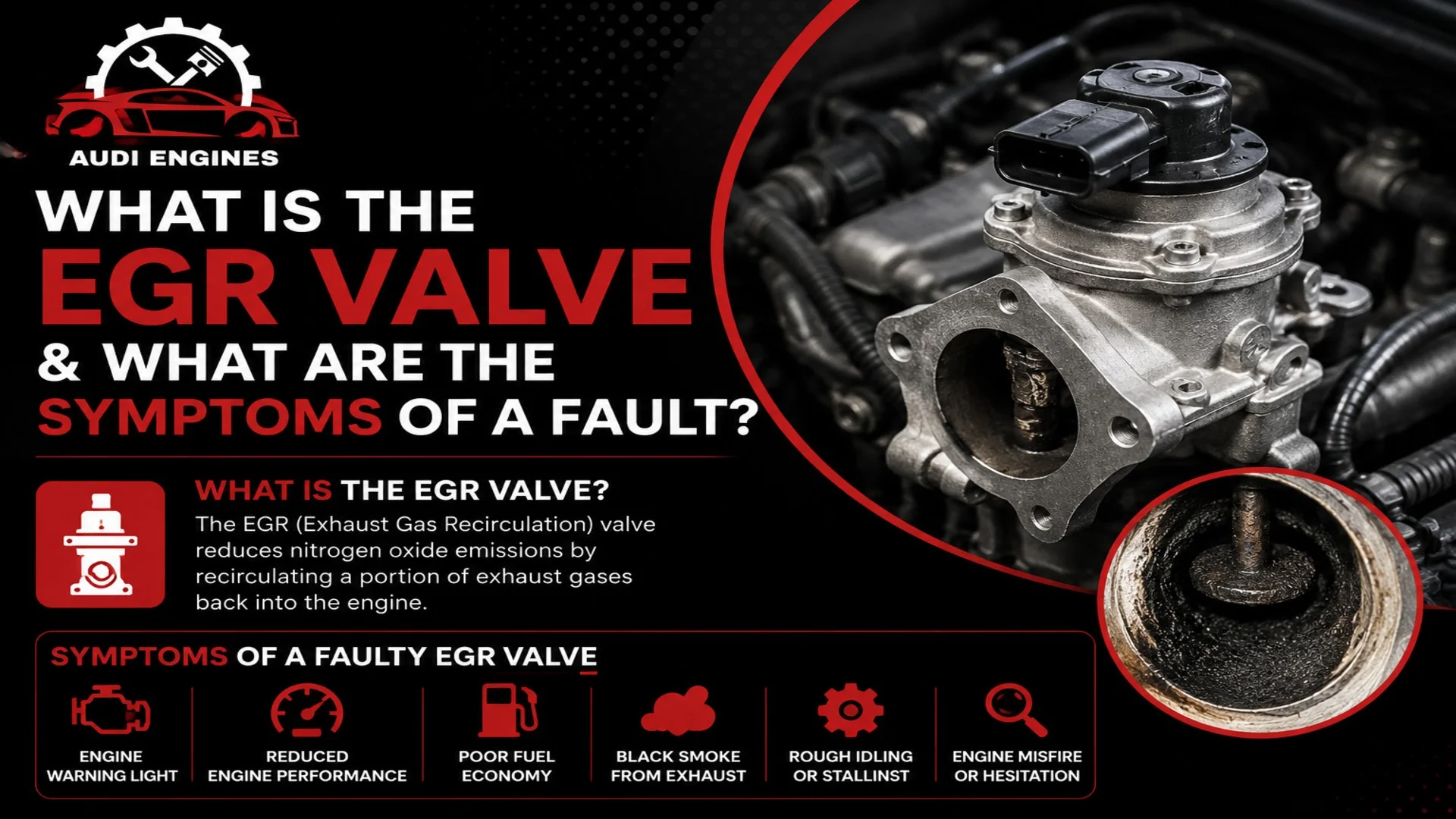
The EGR valve, short for exhaust gas recirculation valve, takes a controlled portion of exhaust gas and redirects it back into the intake manifold, mixing it with fresh air before combustion. This lowers peak combustion temperature, which in turn reduces nitrogen oxide (NOx) emissions.
On the Q7's 3.0 TDI V6, the EGR system works alongside the EGR cooler, MAF sensor, and ECU as an interconnected unit. The ECU constantly adjusts EGR valve position based on engine load, temperature, and airflow readings, opening and closing it via an electric actuator dozens of times during normal driving.
It's a genuinely clever system when it's working, but it also means several different components can fail and produce remarkably similar symptoms, which is exactly why proper diagnosis matters more than guesswork here.
10 Common Audi Q7 EGR Valve Symptoms
Rather than treating these as one interchangeable list, it helps to recognise that different symptoms often point toward different underlying faults. Here's what commonly shows up:
- Check engine light, often the first and only obvious sign in the early stages
- Flashing glow plug light, frequently accompanies more serious EGR-related fault codes
- Loss of power, noticeable hesitation, particularly under acceleration
- Rough or unstable idle, the engine feels lumpy or inconsistent at a standstill
- Poor acceleration, sluggish response when you put your foot down
- Hesitation and jerking, especially at low speeds or when pulling away
- Black exhaust smoke, visible soot output, often worse under load
- Increased fuel consumption, the ECU compensating for inefficient combustion
- Engine stalling, particularly at junctions or when slowing to a stop
- Limp mode, the ECU restricting power to protect the engine and emissions system
Loss of Power, Limp Mode & Warning Lights
These three tend to travel together and usually indicate the ECU has detected a fault serious enough to intervene directly. Limp mode in particular is the car's way of protecting itself, it's not something to drive through repeatedly, since it often signals an electrical fault or a flow reading well outside expected parameters.
Rough Idle, Stalling & Black Smoke
This trio more commonly points toward a mechanical or flow-related issue, carbon buildup restricting movement, or the valve stuck in a position that's disrupting the air-fuel mixture. Stalling at junctions is a particularly telling symptom, since it often means the EGR valve is holding a position the ECU didn't request.
EGR Valve Stuck Open vs Stuck Closed Symptoms
This distinction matters far more than most guides give it credit for, because the two failure modes point toward genuinely different problems, and different fixes.
EGR valve stuck open means exhaust gas keeps flowing into the intake even when the ECU wants it closed. This typically produces:
- Rough or surging idle
- Stalling, especially at low revs
- Poor acceleration and hesitation
- Black smoke under load
- Excessive EGR flow, often linked to fault code P0402
EGR valve stuck closed or restricted means little or no exhaust gas is recirculating when it should be. This tends to show up differently:
- Higher NOx output and a possible emissions warning
- Reduced flow, often linked to fault code P0401
- Less dramatic driveability symptoms, since the engine may run smoother without EGR, but at the cost of increased emissions and potential compensation faults elsewhere
Real-world example: a Q7 owner who notices stalling at roundabouts alongside black smoke on acceleration is describing a classic stuck-open pattern. A Q7 that's simply thrown an emissions-related warning with no obvious driveability change is more likely dealing with restricted or insufficient flow.
What Causes Audi Q7 3.0 TDI EGR Problems?
Carbon & Soot Buildup in the EGR System
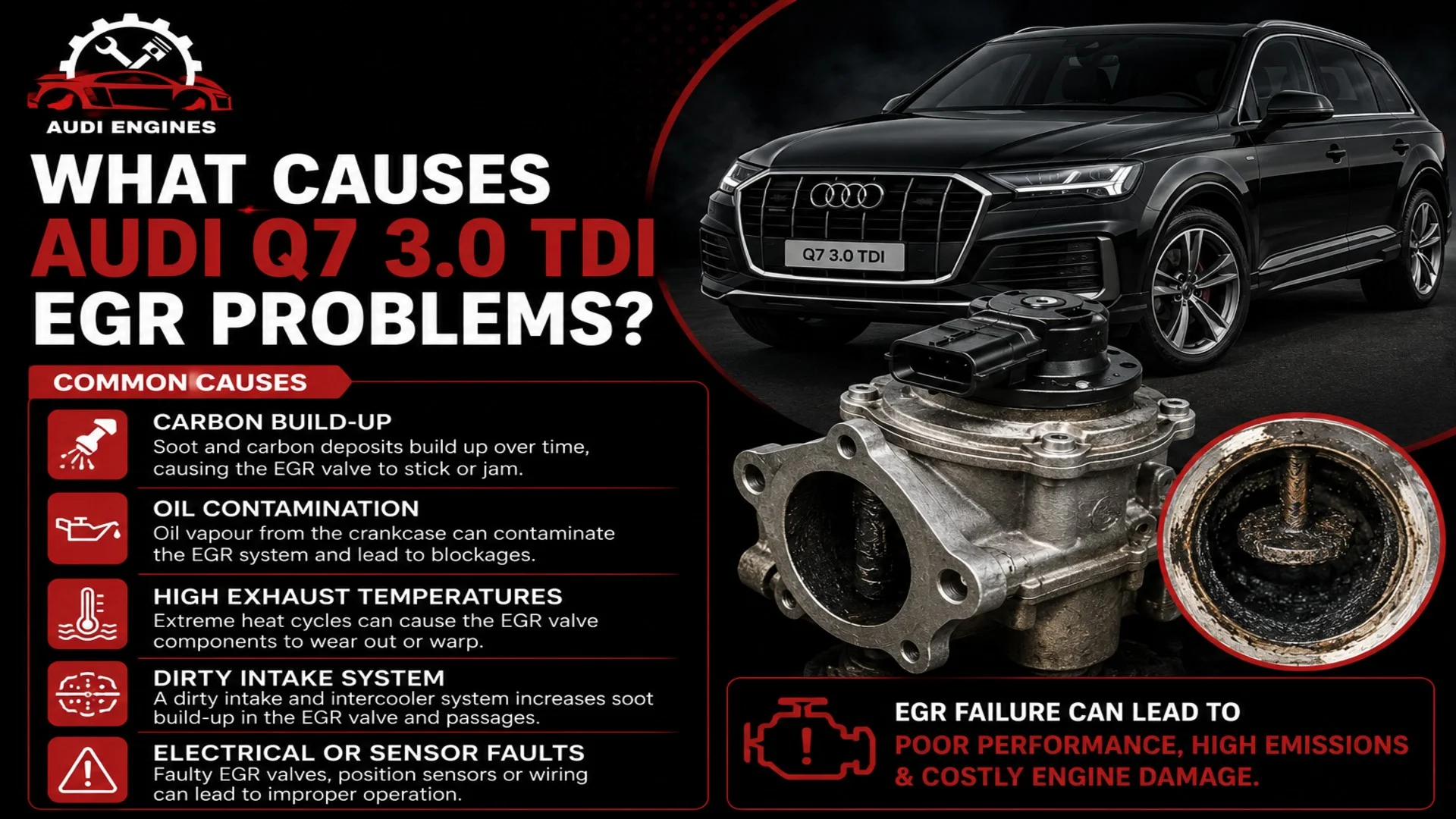
This is, by a wide margin, the most common root cause of EGR failure on diesel engines generally, and the 3.0 TDI is no exception. Diesel combustion naturally produces soot, and because the EGR system deliberately routes exhaust gas back through the intake, carbon deposits build up steadily on the valve, its passages, and the surrounding intake manifold over time.
Eventually, this buildup can physically restrict the valve's movement, preventing it from opening or closing fully, which is exactly what produces the stuck-open or stuck-closed symptoms described above. Short-journey driving, where the engine rarely reaches sustained operating temperature, tends to accelerate this buildup considerably compared to regular longer runs.
EGR Valve vs EGR Cooler: How to Tell the Difference
One of the most common mistakes in EGR diagnosis, and one that leads to unnecessary parts being replaced, is assuming every EGR-related fault code points to the valve itself. In reality, the valve and the cooler are separate components with distinct failure patterns, even though they work as part of the same system.
EGR Valve | EGR Cooler | |
| Typical failure | Sticks open or closed | Becomes internally restricted |
| Main cause | Carbon buildup on the valve mechanism | Soot blockage inside the cooler matrix |
| Electrical involvement | Motor/actuator failure possible | Rarely electrical |
| Common fault codes | P0403, P1440 (control circuit/open circuit) | P0401 (insufficient flow) |
| Symptom pattern | Rough running, stalling, jerking | Reduced EGR flow, emissions warning |
| Fix | Cleaning or valve replacement | Cooler replacement (rarely repairable) |
Getting this distinction right before ordering parts can save a genuinely significant amount of money, replacing a valve when the cooler is actually restricted won't resolve the underlying fault.
Electrical, Wiring & Sensor-Related EGR Faults
Not every EGR problem is mechanical. The valve is controlled by an electric actuator, position sensor, and wiring harness, any of which can fail independently of carbon buildup.
There's a particularly notable pattern on the Q7 3.0 TDI worth flagging here: oil or coolant contamination around the engine valley, the recessed area between the cylinder banks where the EGR components sit, can gradually damage the surrounding wiring and connectors. If you're dealing with an EGR fault alongside any sign of an oil or coolant leak in that area, it's worth having both investigated together, since one may well be contributing to the other.
Electrical faults typically produce codes like P0403 (control circuit fault) or P1440 (open circuit), and often trigger limp mode more abruptly than a gradual carbon-related failure would.
Audi Q7 3.0 TDI EGR Fault Codes & Diagnosis
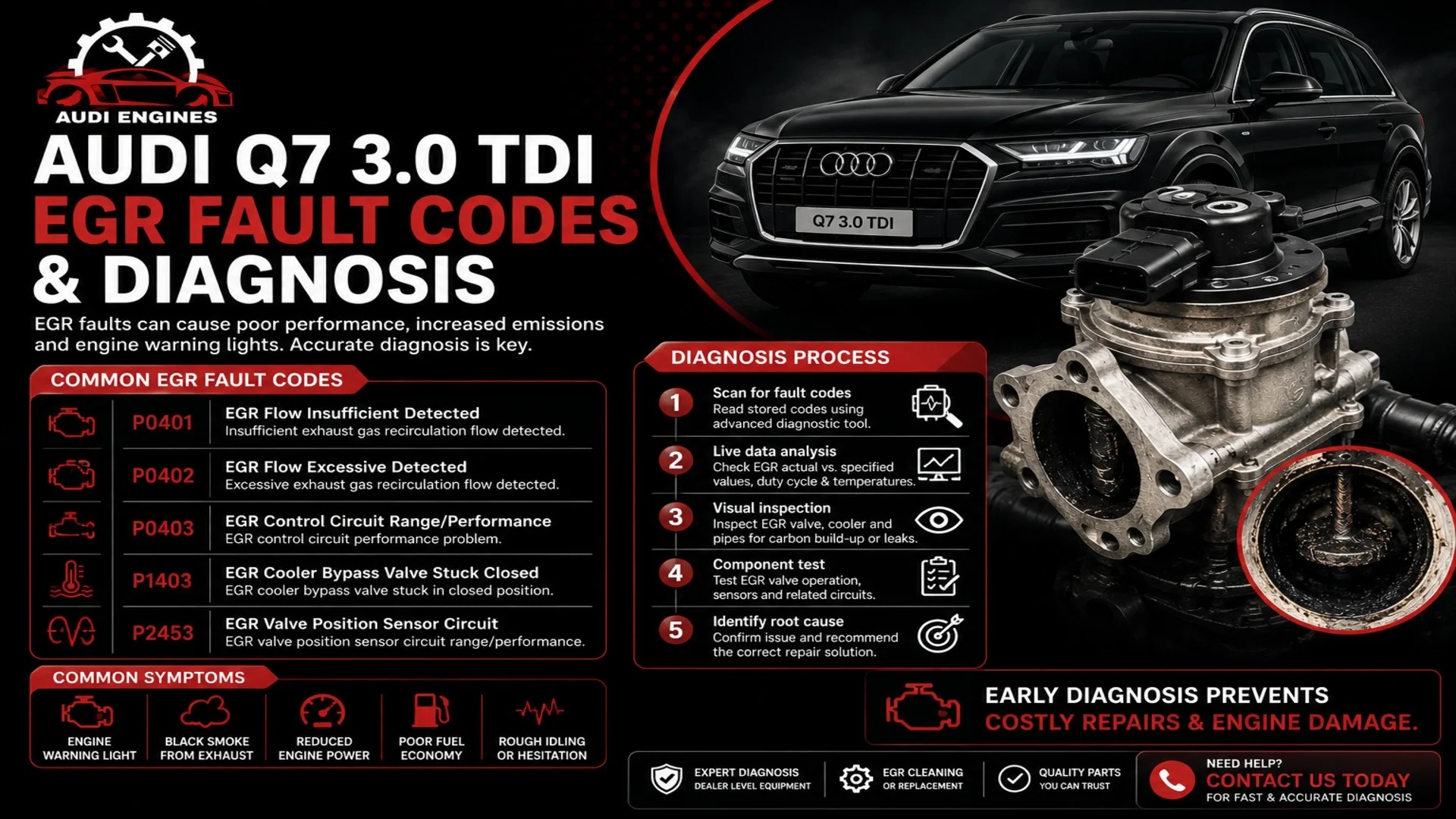
What Do P0401, P0402, P0403, P0404 & P1440 Mean?
These are the fault codes most commonly associated with EGR problems on the Q7 3.0 TDI. It's worth noting that while these codes follow generally accepted OBD-II definitions, the exact underlying cause on any individual vehicle should always be confirmed through proper diagnosis rather than assumed from the code alone.
Fault Code | General Meaning | Commonly Associated With |
| P0401 | Insufficient EGR flow detected | EGR cooler blockage, stuck-closed valve |
| P0402 | Excessive EGR flow detected | Stuck-open valve, faulty position sensor |
| P0403 | EGR control circuit malfunction | Wiring fault, actuator failure |
| P0404 | EGR circuit range/performance problem | Valve not reaching commanded position |
| P1440 | EGR valve open circuit (manufacturer-specific) | Wiring damage, connector failure |
If you've had a diagnostic scan and one of these codes has come back, treat it as a strong starting point rather than a final answer, the code tells you what the ECU detected, not necessarily which physical component is at fault.
How Is an Audi Q7 EGR Valve Properly Diagnosed?
A proper diagnosis goes well beyond simply reading the fault code and swapping the valve. The process a specialist should follow typically includes:
- Scanning for fault codes and reviewing freeze-frame data to understand exactly when the fault occurred
- Checking EGR valve operation directly, often via an output test that commands the valve to move while observing actual response
- Inspecting wiring and connectors, particularly around the engine valley given the oil-contamination pattern mentioned above
- Checking the EGR cooler for restriction, separate from the valve itself
- Performing EGR adaptation after any repair, to ensure the ECU recognises the corrected component behaviour
VCDS, MAF Readings & EGR Adaptation
VCDS (VAG-COM Diagnostic System) is the standard diagnostic tool for this kind of work on Audi platforms, and it allows a technician to go well beyond basic fault-code reading.
One of the most useful diagnostic relationships here involves the MAF sensor. When the EGR valve opens, exhaust gas entering the intake changes the fresh-air reading the MAF sensor reports. The ECU compares this actual airflow against the specified airflow it expects for that EGR position, and a significant mismatch is often what triggers codes like P0402, even when the root cause is a sticking valve rather than the MAF sensor itself.
This is precisely why a proper diagnosis often includes comparing actual-versus-specified MAF values via VCDS live data, rather than jumping straight to a parts replacement based on the fault code alone. After any EGR valve or cooler replacement, EGR adaptation should also be carried out so the ECU correctly relearns the component's operating range.
Can EGR Problems Affect the DPF or Intake Manifold?
Yes, and this relationship is often overlooked in less thorough EGR content. A malfunctioning EGR system disrupts the air-fuel mixture and combustion efficiency, which can increase soot production beyond what the engine was designed to handle.
That extra soot has to go somewhere, and a significant portion ends up loading the DPF (diesel particulate filter) faster than normal, potentially triggering more frequent regeneration cycles or contributing to DPF warning lights of its own. Similarly, carbon carried through the EGR system doesn't stop at the valve, it continues to build up in the intake manifold itself, gradually restricting airflow and compounding the original problem.
This is a good example of why treating an EGR fault in isolation, without considering the wider emissions and intake system, can leave you chasing symptoms rather than resolving the actual cause.
EGR Repair, Cost & When to See a Specialist
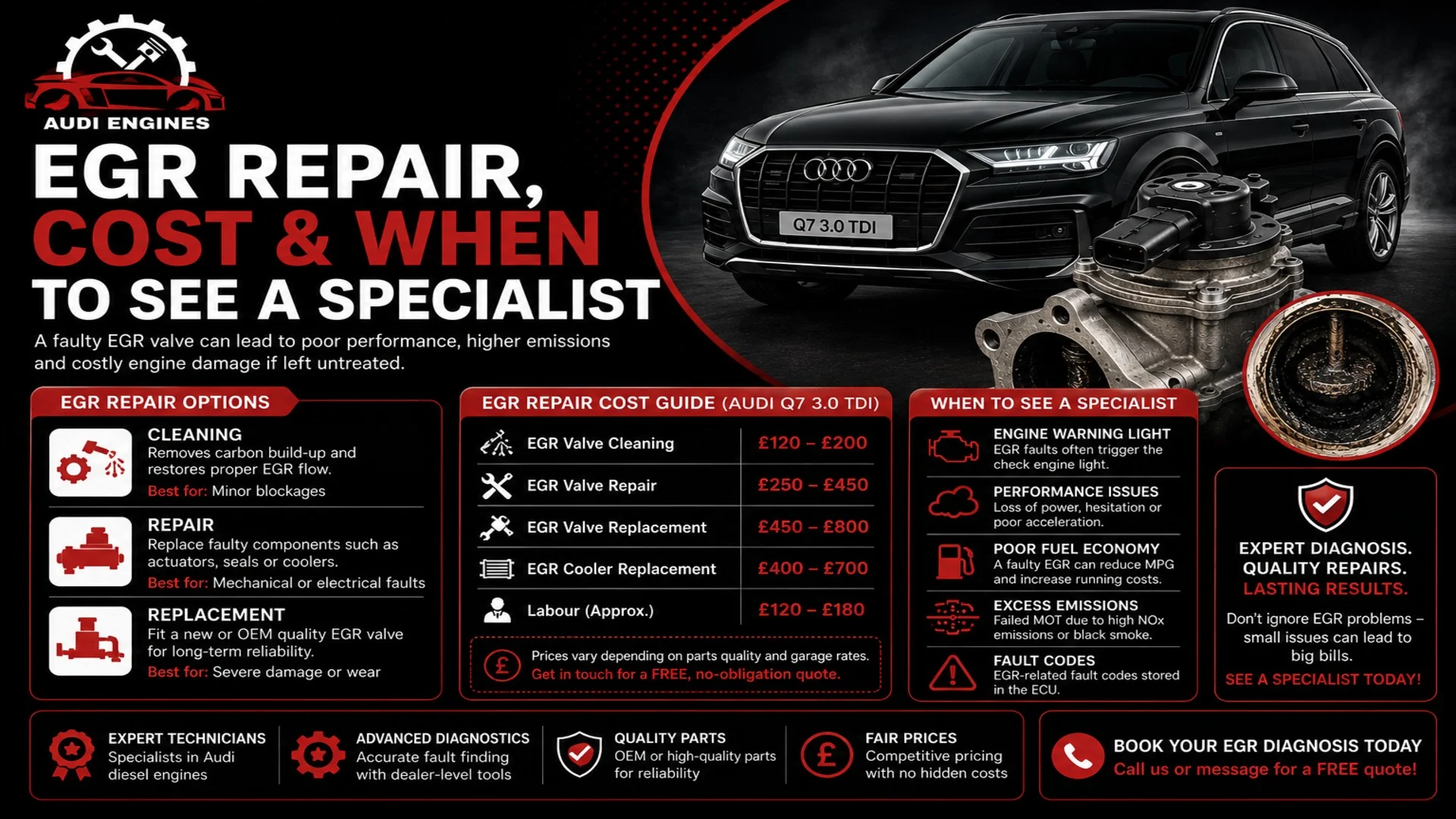
Can an Audi Q7 EGR Valve Be Cleaned, or Does It Need Replacing?
This genuinely depends on the extent and cause of the fault, which is another reason proper diagnosis matters before committing to a repair path.
Cleaning is often viable when:
- The primary issue is carbon or soot buildup restricting valve movement
- The valve's electrical components (motor, position sensor) test correctly
- The fault has been caught relatively early, before repeated stress has damaged the actuator
Replacement is usually the better route when:
- The fault involves the electrical circuit (P0403, P1440) rather than mechanical sticking
- The valve has failed to the point of not responding to commands during an output test
- The EGR cooler itself is restricted or damaged, since coolers are rarely economical to clean
Cleaning is the cheaper option, but it's worth being realistic, on a valve that's failed once due to carbon buildup, the same buildup pattern is likely to recur over time unless driving habits or servicing change alongside it.
Audi Q7 3.0 TDI EGR Repair Cost UK
Costs vary depending on whether you're looking at cleaning, valve replacement, cooler replacement, or a combination involving wiring repair. As a general guide for UK specialist pricing:
- Diagnostic assessment, confirms the exact fault before any parts are ordered, avoiding unnecessary spend
- EGR valve cleaning, the most affordable option where carbon buildup is the sole cause
- EGR valve replacement, a like-for-like OEM component plus fitting and adaptation
- EGR cooler replacement, typically a more involved job given its position within the engine, often priced higher than valve replacement alone
- Wiring or connector repair, variable depending on the extent of oil or coolant contamination found
We'd always recommend asking for an itemised quote rather than a flat figure, particularly given how often EGR faults on the Q7 3.0 TDI involve more than one component. A quote that separates diagnostic time, parts, and labour tells you a lot more about what's actually being done than a single bundled price.
Frequently Asked Questions
What are the symptoms of a bad EGR valve on an Audi Q7?
Common symptoms include loss of power, rough or unstable idle, limp mode, black smoke, increased fuel consumption, stalling, and warning lights on the dashboard. Which symptoms appear typically depends on whether the valve is stuck open, stuck closed, or affected by an electrical fault.
Can a bad EGR valve cause limp mode?
Yes. Limp mode is often triggered when the ECU detects an EGR-related fault serious enough to restrict power as a protective measure, particularly with electrical faults like those linked to codes P0403 or P1440.
What does P0401 mean on an Audi Q7 3.0 TDI?
P0401 generally indicates insufficient EGR flow, commonly associated with a blocked EGR cooler or a valve stuck in the closed position, though confirmation via proper diagnosis is recommended.
What does P0402 mean on an Audi Q7 3.0 TDI?
P0402 indicates excessive EGR flow, often linked to a valve stuck open or a faulty position sensor feeding incorrect data to the ECU.
Can an Audi Q7 EGR valve be cleaned instead of replaced?
Often, yes, provided the fault is due to carbon buildup rather than an electrical or mechanical failure. A proper diagnosis will confirm which repair path is appropriate.
Does EGR failure damage the DPF?
It can contribute to it. A malfunctioning EGR system can increase soot production, which loads the DPF faster and may lead to more frequent regeneration cycles or related warning lights.
Can you drive an Audi Q7 with a faulty EGR valve?
Short journeys are usually possible, but driving for extended periods with an unresolved EGR fault risks further carbon buildup, additional strain on the DPF, and potential damage to related components. It's best diagnosed and addressed promptly rather than ignored.
Does an EGR valve need adaptation after replacement?
Yes. EGR adaptation allows the ECU to correctly relearn the new component's operating range, and skipping this step can lead to ongoing fault codes even after a correct repair.
Final Thoughts
An EGR fault on the Audi Q7 3.0 TDI rarely announces itself with a single, obvious symptom, it's a system where carbon buildup, electrical faults, and even oil contamination around the engine valley can all produce overlapping signs, from rough idle to full limp mode. Understanding whether you're dealing with a stuck-open valve, restricted flow, or an electrical fault isn't just academic, it directly determines whether cleaning, replacement, or a wiring repair is the right fix.
Guessing at a repair based on a fault code alone is one of the most common ways Q7 owners end up replacing the wrong part. A proper diagnostic process, fault codes, live MAF data, wiring inspection, and an EGR output test, gets to the actual cause first, so the repair you pay for is the one your car actually needs.
If your Q7 is showing any of the symptoms covered here, get in touch with our team for a proper diagnostic assessment. We'll confirm exactly what's causing the fault and talk you through your repair options honestly, whether that's a straightforward clean, a valve replacement, or something further into the EGR system.