
Audi Q7 3.0 TDI Injector Problems: Symptoms, Diagnosis and Repair
Your Q7's idle has gone rough. Maybe there's a faint diesel smell when you open the bonnet, or the power just isn't there like it used to be. You've searched around, found forum threads full of guesswork, and you're no closer to knowing whether this is a genuine injector fault or something else entirely.
Your Q7's idle has gone rough. Maybe there's a faint diesel smell when you open the bonnet, or the power just isn't there like it used to be. You've searched around, found forum threads full of guesswork, and you're no closer to knowing whether this is a genuine injector fault or something else entirely.
That uncertainty is exactly why we've built this guide. The Audi Q7 3.0 TDI, like most V6 diesel engines running common-rail direct injection, relies on precisely engineered fuel injectors, and when one starts to fail, the symptoms can overlap with half a dozen other faults. We'll walk through what a genuine injector problem looks like, how it's properly diagnosed, and what your realistic repair options are.
Audi Q7 3.0 TDI Injector Failure Symptoms
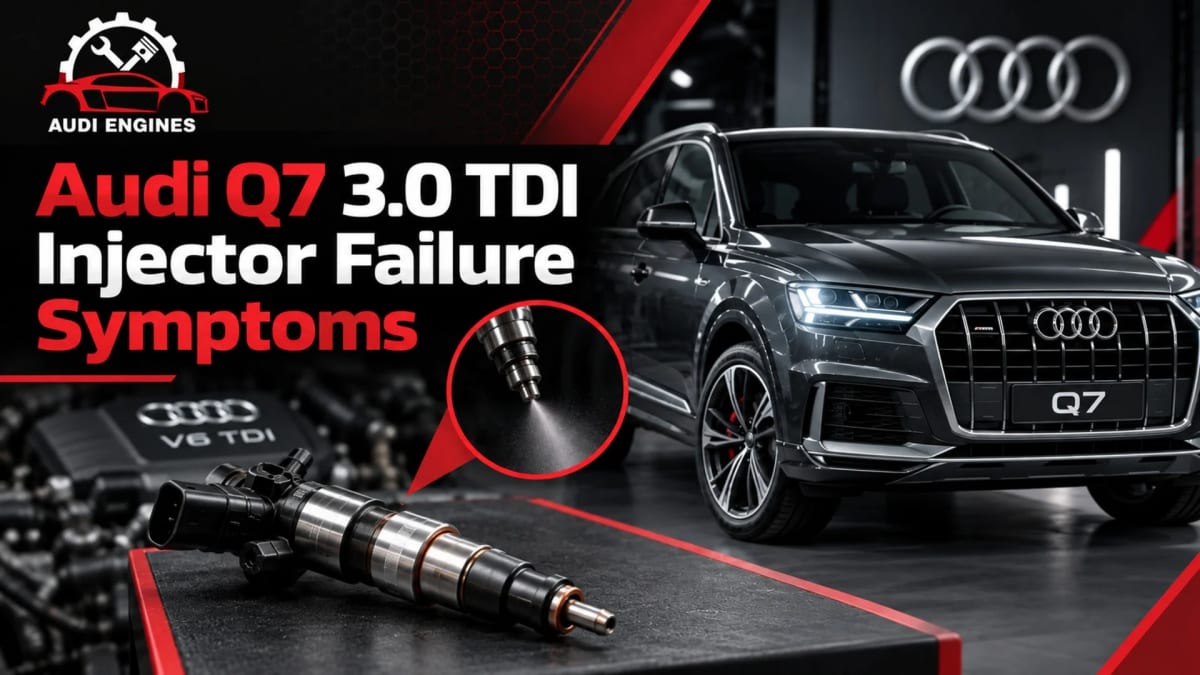
A fuel injector's job is simple to describe and difficult to execute perfectly: deliver an exact quantity of diesel, at an exact moment, at extremely high pressure, thousands of times a minute. When that precision starts to slip, the engine tells you, just not always clearly.
Rough Idle and Engine Vibration
A rough idle or noticeable engine vibration while stationary is one of the earliest signs of an injector issue. If one cylinder is receiving slightly less fuel than the others, or delivering it at the wrong moment, the engine loses the smooth, even rhythm you're used to feeling through the seat and steering wheel.
Misfiring and Uneven Engine Running
An engine misfire happens when combustion in one or more cylinders isn't completing properly. On a 3.0 TDI, this often traces back to inconsistent injection quantity or injection timing, the hallmark of a struggling injector. You might feel it as a stumble under light acceleration or notice it more clearly at a steady cruising speed.
Loss of Power and Poor Acceleration
Loss of power and poor acceleration are among the most commonly reported Q7 injector symptoms. If an injector can't deliver fuel accurately under load, the engine simply can't produce the output it's designed for, and on a vehicle the size and weight of a Q7, that shortfall is noticeable almost immediately.
Hard Starting and Cold-Start Problems
Hard starting, particularly on cold mornings, points toward a fuel delivery issue. Diesel engines depend on precise injection to achieve combustion at start-up, and a cold start problem that's inconsistent, fine one day, stubborn the next, is a classic sign that an injector is beginning to fail rather than failing outright.
White or Black Exhaust Smoke
Exhaust smoke tells you a lot, if you know what to look for:
- White smoke often indicates unburnt diesel or incomplete combustion, sometimes linked to an injector delivering fuel that isn't igniting properly
- Black smoke typically points to overfuelling, more diesel going in than the engine can burn cleanly, often from an injector stuck slightly open or delivering too much fuel
Neither symptom guarantees an injector fault on its own, but combined with rough running or a power loss, it strengthens the case considerably.
Increased Fuel Consumption
If your fuel consumption has crept up without any change in driving habits, a leaking or overfuelling injector could be the reason. Diesel that isn't being burned efficiently, or that's leaking past a worn seal, is diesel you're paying for without getting any benefit from.
Diesel Smell or Fuel Leak Around the Engine
A diesel smell in the engine bay, or visible fuel leakage, deserves immediate attention rather than a "keep an eye on it" approach.
Is This an Injector Seal Failure?
If you're noticing a faint hissing or ticking sound alongside the smell, along with carbon deposits building up around an injector's mounting point, you may be looking at injector seal failure, commonly caused by a failed copper crush washer allowing combustion gases and fuel to escape past the injector seat. This is a mechanical seal problem rather than an electronic or fuel-delivery fault, and it's one of the more Q7-specific issues we see on the 3.0 TDI.
What Causes Audi Q7 3.0 TDI Injector Failure?
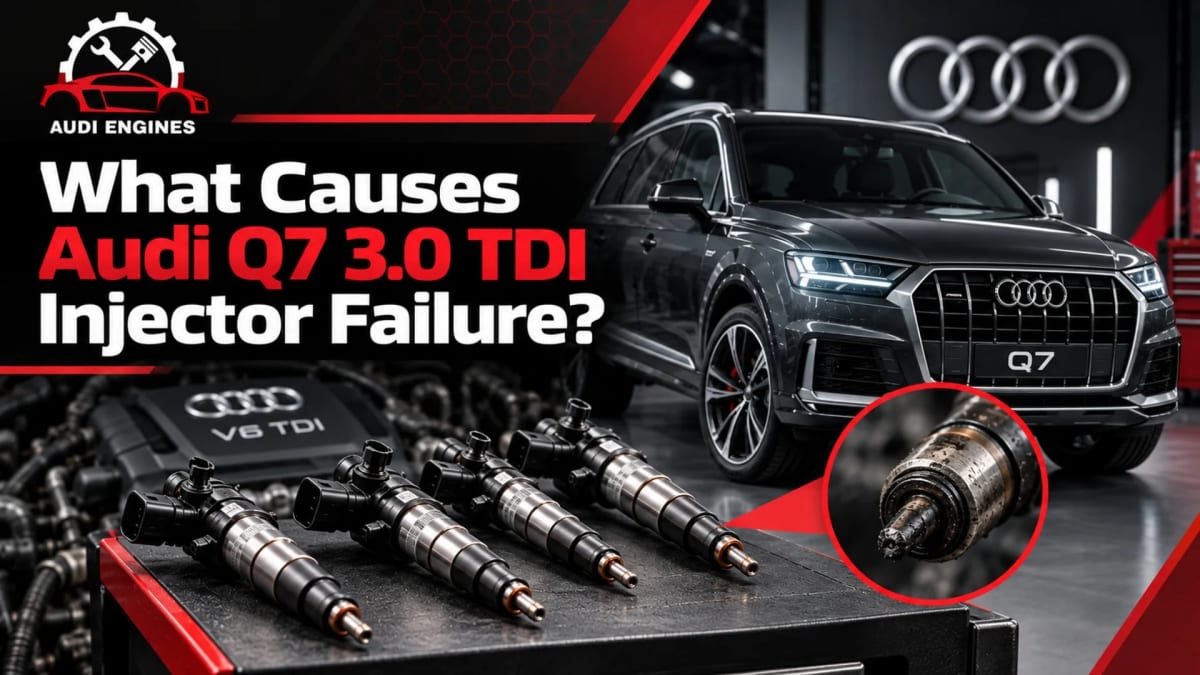
Understanding why injectors fail helps make sense of the symptoms, and helps set realistic expectations about repair.
Common Causes of Injector Wear and Failure
Injectors on the 3.0 TDI typically fail for one of a handful of reasons, and it's rarely sudden.
Injector Seal and Copper Washer Failure
Over time, the copper crush washer that seals the injector against the cylinder head can lose its shape and sealing ability, particularly if it wasn't replaced during a previous injector service. Once that seal degrades, combustion gases can blow past it, a problem sometimes described as injector blow-by, leading to carbon buildup, a damaged injector seat, and eventually a fuel or gas leak.
Injector Blockage, Contamination and Wear
Fuel contamination, natural wear of the injector nozzle, and gradual injector clogging all reduce an injector's ability to deliver fuel accurately. This kind of wear tends to develop slowly, which is exactly why symptoms often start subtly, a slightly rough idle here, a bit less punch under acceleration there, before becoming impossible to ignore.
Symptom, Injector Cause or Something Else? Diagnostic Table
Here's the problem with injector symptoms: almost none of them are exclusive to injectors. This table lays out what else could realistically be responsible, which is exactly the kind of detail most injector guides skip.
Symptom | Possible Injector Cause | Other Possible Cause |
| Rough idle | Injector imbalance/wear | EGR valve, MAF sensor |
| White smoke | Injector overfuelling or leak | Glow plug failure |
| Loss of power | Poor injection quantity | Turbo fault, blocked DPF |
| Hard starting | Poor fuel delivery | Glow plugs, low fuel pressure |
| Misfire | Injector fault | Low compression |
| High fuel consumption | Overfuelling injector | Blocked DPF, EGR fault |
| Diesel smell | Injector seal leak | Fuel line or fuel filter leak |
The practical takeaway here is straightforward: don't assume it's the injector just because the symptom matches. A proper diagnosis rules out the alternatives before committing to injector work.
Injector Problems vs High-Pressure Fuel Pump Problems
This is one of the trickiest distinctions on a common-rail diesel like the 3.0 TDI. Both a faulty injector and a failing high-pressure fuel pump (HPFP) can cause rough running, loss of power, and starting difficulty, because both affect the same end result, inconsistent fuel delivery to the combustion chamber.
The key difference usually comes down to scope: injector faults tend to affect one or two cylinders specifically, while an HPFP problem typically affects the whole engine's fuel pressure evenly across all cylinders. This is precisely why fuel rail pressure data and per-cylinder testing matter so much in getting the diagnosis right the first time.
How to Diagnose a Faulty Audi Q7 3.0 TDI Injector

Guessing at injector faults is an expensive habit, genuine diagnosis relies on data, not just symptoms.
Audi Q7 Injector Fault Codes and Check Engine Light
A check engine light paired with injector fault codes stored in the ECU is often the clearest starting point. These codes won't always name the exact injector, but they narrow the investigation considerably and point technicians toward specific cylinders or circuits worth testing further.
Audi Q7 3.0 TDI Injector Correction Values Explained
This is one of the most useful, and most misunderstood, diagnostic tools available on the 3.0 TDI.
What Do Positive and Negative Correction Values Mean?
Every injector on the engine has a correction value (sometimes called a deviation value), which reflects how much the ECU is adjusting injection quantity for that specific cylinder compared to a baseline. A positive correction generally means the ECU is adding fuel to compensate for an injector that's delivering less than expected. A negative correction suggests the opposite, the ECU is pulling fuel back because that injector is delivering more than it should.
Why Correction Values Alone Don't Confirm a Fault
Here's the nuance that matters: a single reading outside the "normal" range doesn't automatically confirm a bad injector. Correction values naturally shift with mileage, fuel quality, and general wear across all six cylinders. What matters more is cylinder contribution and injector balance, looking at how one injector's values compare to the others under matched conditions, ideally alongside live data rather than a single static reading.
Using VCDS and Live Data to Diagnose Injector Problems
VCDS diagnostics give a genuinely detailed picture of what's happening across all six cylinders in real time, correction values, cylinder contribution, fuel rail pressure, and injector response under load. This is the level of diagnosis that separates a confident repair from an expensive guess, and it's exactly why we lean on it rather than swapping parts and hoping.
Injector Leak-Off Testing
A leak-off test measures how much fuel is returning from each injector through the return line under controlled conditions. An injector leaking excessively will show a noticeably higher return flow than its neighbours, which is a strong, physical confirmation of a fault, not just an inferred one from correction values alone.
Audi Q7 3.0 TDI Injector Replacement and Cost
Once a fault is confirmed, the next questions are practical: what needs replacing, does it need reprogramming, and what will it cost.
Do Audi Q7 Injectors Need Coding After Replacement?
Yes. Modern common-rail injectors, including those on the Q7 3.0 TDI, are manufactured with unique injector adaptation values specific to that individual injector. When a new or refurbished injector is fitted, that value needs to be entered into the ECU through injector coding, skip this step, and the ECU is effectively working with inaccurate data for that cylinder, undermining the whole repair.
Should All Six Injectors Be Replaced at Once?
This is a genuinely debated question, and the honest answer depends on your specific situation. If one injector has failed due to age-related wear, it's reasonable to expect the others aren't far behind, and many specialists recommend replacing all six together to avoid paying for labour twice within a short period. If the failure is isolated, a seal issue on one injector, for example, with strong correction values across the rest, replacing just the affected injector is often the more sensible and cost-effective route. A proper diagnostic assessment should guide this decision rather than a blanket rule either way.
Audi Q7 3.0 TDI Injector Replacement Cost
Costs vary considerably depending on scope, so it's worth understanding what drives the final figure rather than expecting one flat number:
- Single injector replacement, including the part, seal, coding, and labour, sits at the lower end of the cost range
- Full set replacement (all six injectors) costs significantly more but reduces the likelihood of repeat labour costs in the near future
- Injector seal repair alone, where the injector itself is sound but the copper washer has failed, is typically a more affordable fix than full replacement
- Diagnostic time, including VCDS analysis and leak-off testing, is worth budgeting for separately, since accurate diagnosis is what prevents unnecessary parts replacement
We'd always recommend getting a diagnostic-first quote rather than a straight "replace and see" price, it's the difference between paying for a fix and paying for an educated guess.
Can You Drive With a Bad Diesel Injector?
Technically, often yes, for a short period. But it's not something we'd recommend relying on. A failing injector puts uneven strain on the engine, can accelerate DPF clogging from unburnt fuel, and in cases of a seal leak, allows combustion gases to escape where they shouldn't. What starts as a manageable, isolated injector fault can turn into a more expensive problem the longer it's left unaddressed.
Book an Audi Q7 Injector Diagnosis
If you're seeing any combination of the symptoms covered here, the most cost-effective next step is a proper diagnostic assessment, not a parts swap based on a hunch. We work on Audi 3.0 TDI fuel systems regularly and can tell you exactly what's happening across all six cylinders before you spend a penny on parts.
Frequently Asked Questions
What are the symptoms of a bad injector on an Audi Q7 3.0 TDI?
Common symptoms include rough idle, engine misfire, loss of power, hard starting, white or black exhaust smoke, increased fuel consumption, and in some cases a diesel smell caused by a leaking injector seal.
How do I know if my Audi Q7 injector is failing?
The clearest way is a proper diagnostic check using VCDS to review injector correction values, cylinder contribution, and live data, ideally supported by a leak-off test if a physical leak is suspected. Symptoms alone can point toward several different faults, so data-based diagnosis gives a far more reliable answer.
Can a bad injector cause rough idle on a Q7?
Yes, injector imbalance is a common cause of rough idle on the 3.0 TDI, though EGR and MAF sensor faults can produce similar symptoms, which is why proper diagnosis matters before assuming it's the injector.
What are normal 3.0 TDI injector correction values?
There isn't one universal "normal" figure, since correction values naturally vary with mileage and fuel quality. What matters more is how one injector's value compares to the others under the same conditions, a significant outlier relative to its neighbours is the stronger indicator of a fault.
How much does Audi Q7 injector replacement cost?
Cost depends on whether one injector or a full set needs replacing, whether the issue is a seal repair rather than full replacement, and diagnostic time. Single injector replacement costs considerably less than replacing all six, though a full set can reduce the risk of repeat labour costs down the line.
Do Audi Q7 3.0 TDI injectors need coding after replacement?
Yes. Each injector carries a unique adaptation value that needs to be programmed into the ECU after fitting. Without this step, the engine control unit won't have accurate data for that cylinder, which undermines the repair.
Is it safe to drive with a bad diesel injector?
Short-term driving is often possible, but it's not advisable long-term. A failing injector can accelerate DPF clogging and, if a seal has failed, allow combustion gases to leak where they shouldn't, an isolated issue can become a more serious one if ignored.
Can a faulty injector cause white smoke on a Q7?
Yes, white smoke can indicate unburnt diesel from an injector delivering fuel that isn't combusting properly, though glow plug failure can produce similar smoke, especially during cold starts.
Final Thoughts
Injector problems on the Audi Q7 3.0 TDI are common enough that most long-term owners will encounter one eventually, but "common" doesn't mean "simple to diagnose." Rough idle, smoke, power loss, and hard starting can all point toward an injector fault, or toward something else entirely sharing the same symptoms. The only way to know for certain is proper data: correction values, live diagnostics, and a leak-off test where needed.
If your Q7's showing any of the signs covered in this guide, get it properly assessed before committing to replacement parts. We diagnose and repair Audi 3.0 TDI injector faults regularly, and we'd rather give you an accurate answer than a guess, get in touch and we'll get your Q7's fuel system properly checked.