
Audi Q7 DPF Warning Light Keeps Coming Back On: Causes, Diagnosis & Fixes
You've done the motorway run. You've let the engine reach temperature. The DPF warning light went off, you breathed a sigh of relief, and then a few days later, it's back on your dashboard like nothing happened.
You've done the motorway run. You've let the engine reach temperature. The DPF warning light went off, you breathed a sigh of relief, and then a few days later, it's back on your dashboard like nothing happened.
If that sounds familiar, you're dealing with something more specific than a straightforward "dirty filter" problem. A DPF warning light that keeps returning after regeneration is one of the clearest signs that something beyond simple soot accumulation is going on underneath your Q7's bonnet.
This guide walks through exactly why that happens, what the underlying causes usually are, how to read the fault codes involved, and what actually needs to happen to stop the warning coming back for good, rather than just clearing it and waiting for round two.
Why Does the Audi Q7 DPF Warning Light Keep Returning After Regeneration?

Here's the thing most generic advice gets wrong: if the Audi Q7 DPF warning light keeps coming back on after you've already completed a regeneration drive, the problem probably isn't simply that the filter needs cleaning again. It's more likely that something is preventing the regeneration process from actually working properly, or something is causing soot to build up faster than the system can manage.
What Does the DPF Warning Light Actually Mean?
The diesel particulate filter (DPF) sits in your Q7's exhaust system and physically traps soot particles before they leave the tailpipe. Under normal driving, the engine periodically burns off this trapped soot in a process called regeneration, essentially an automatic self-cleaning cycle that happens without you noticing.
The warning light illuminates when the engine management system detects that soot loading in the filter has reached a level where regeneration is needed, or where regeneration hasn't successfully brought that level back down. On its own, a single illumination isn't unusual. A recurring one is where it gets more interesting.
Failed or Incomplete DPF Regeneration
Regeneration needs quite specific conditions to complete properly, sustained engine load, adequate exhaust temperature, and enough continuous driving time. If any of these conditions aren't consistently met, the regeneration cycle can start but never finish, leaving the filter still partially loaded even though the process technically ran.
What Conditions Are Needed for Regeneration to Complete?
For a successful active regeneration, your Q7 typically needs:
- Sustained higher-speed driving, generally at least 40mph, for around 15-20 minutes continuously
- Consistent engine load, rather than stop-start traffic or constant gear changes
- Sufficient exhaust temperature to actually burn off the trapped soot
- An uninterrupted drive cycle, stopping and restarting the engine partway through can abort the process
If your "motorway run" involved slowing for roadworks, sitting in traffic, or being under 20 minutes, there's a genuine chance the regeneration simply didn't get the chance to finish, even though the engine attempted it.
Why Does Regeneration Fail on the Q7?
Beyond simply not getting the right driving conditions, regeneration failure on the Q7's 3.0 TDI can stem from several mechanical issues, a faulty sensor feeding the ECU incorrect data, an EGR fault altering combustion temperature, a fuel injector delivering an inaccurate fuel dose during the regeneration burn, or excessive ash content that active regeneration simply can't remove (since ash, unlike soot, isn't combustible).
Short Journeys and Repeated Soot Build-Up
This is genuinely one of the most common root causes we see, and it's worth being honest about: if your Q7 spends most of its life doing school runs, short commutes, or stop-start city driving, the engine rarely gets hot enough for long enough for passive regeneration to happen naturally.
Audi's own guidance is clear on this point, the DPF is designed to self-clean during normal driving, but that self-cleaning simply cannot occur properly under continuous short-trip use. The soot keeps accumulating faster than it's being burned off, so even a successful forced regeneration only buys you a short reprieve before the warning returns.
Can a Faulty Sensor Cause the DPF Light to Return?
Yes, and this is a genuinely underappreciated cause. The ECU doesn't "see" soot directly, it estimates soot loading based on readings from the differential pressure sensor and exhaust gas temperature sensors. If either of these is giving inaccurate readings, the ECU can trigger a DPF warning even when the filter itself is in reasonable condition, or fail to recognise that regeneration has genuinely worked.
This is exactly why a warning light that keeps returning shouldn't automatically be treated as "the filter is blocked again." Sometimes the filter is fine, and the sensor telling the ECU otherwise is the actual fault.
Common Underlying Causes of a Recurring Audi Q7 DPF Warning
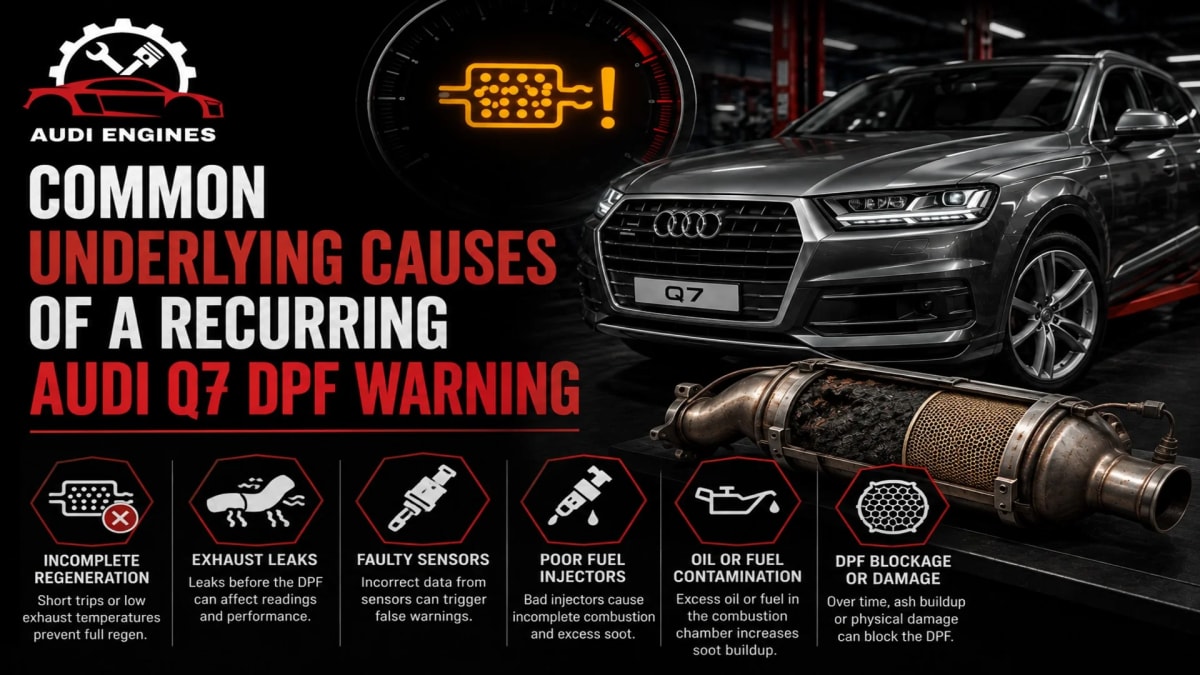
Once regeneration has been attempted and the warning still returns, it's time to look past the filter itself and at the components that manage the regeneration process. These are the causes we see most consistently on the Q7 3.0 TDI.
Faulty DPF Differential Pressure Sensor
The differential pressure sensor measures the pressure difference before and after the DPF, which the ECU uses to estimate how much soot is trapped inside. A failing sensor, a blocked pressure pipe, or a loose connector can all send inaccurate readings, making the ECU think the filter is more restricted than it actually is, or missing genuine restriction entirely.
What Are the Symptoms of a Faulty Pressure Sensor?
Common signs pointing toward a pressure sensor issue rather than a genuinely blocked filter include:
- DPF warning returning almost immediately after a regeneration that appeared to complete successfully
- Inconsistent live-data readings during a diagnostic scan, particularly readings that don't change as expected under load
- No noticeable performance loss, despite the warning suggesting a heavily loaded filter
- Fault codes relating specifically to sensor circuit or performance, rather than soot accumulation itself
If a diagnostic scan shows the actual soot mass reading is low but the warning persists, a pressure sensor fault becomes a strong suspect.
Faulty Exhaust Gas Temperature (EGT) Sensor
The EGT sensor monitors exhaust temperature at key points in the system, and the ECU relies on this data to know when conditions are right to begin, and safely continue, a regeneration cycle. If an EGT sensor is reading inaccurately, the ECU may abort regeneration prematurely, believing temperatures are too low or too high, even when the actual exhaust temperature is fine.
This is a particularly frustrating fault because everything can appear to be working correctly from the driver's seat, right up until the warning reappears a short time later.
EGR Valve or EGR Cooler Problems
The EGR (exhaust gas recirculation) system and the DPF are more closely linked than most owners realise. A malfunctioning EGR valve or a leaking EGR cooler changes combustion characteristics and exhaust composition, which in turn increases soot production and places extra strain on the DPF.
How Does EGR Failure Cause Repeated DPF Blockage?
When the EGR valve sticks, leaks, or fails to modulate correctly, the engine can end up running with an altered air-fuel mixture that produces more soot than normal. The DPF then fills up faster than it should, regeneration cycles become more frequent, and, because the underlying EGR fault hasn't been addressed, the warning keeps returning regardless of how often you regenerate.
This is a genuine example of why treating the DPF light as an isolated problem often doesn't work. If the EGR is the root cause, no amount of forced regeneration will provide a lasting fix until the EGR fault itself is repaired.
Audi Q7 DPF Fault Codes Explained
A proper diagnostic scan reads specific fault codes stored in the ECU, and these codes narrow down the actual cause far more precisely than the dashboard warning light alone ever could.
P2002, P2463 & P242F, What Do They Mean?
Fault Code | General Meaning |
| P2002 | DPF efficiency below the required threshold |
| P2463 | DPF soot accumulation, filter is genuinely carrying excess soot |
| P242F | DPF restriction, indicates the filter itself may be physically clogging |
P2453, P2458 & P2459, What Do They Mean?
Fault Code | General Meaning |
| P2453 | DPF differential pressure sensor range/performance fault |
| P2458 | DPF regeneration duration fault, regeneration is taking longer than expected |
| P2459 | DPF regeneration frequency fault, regeneration is being triggered more often than normal |
Seeing P2453 alongside a recurring warning points strongly toward a sensor issue rather than a genuinely overloaded filter. Seeing P2463 or P242F, on the other hand, suggests the soot loading itself is the real problem, which shifts the conversation toward driving pattern, EGR condition, or the filter's actual physical state.
What To Do If the DPF Warning Won't Clear
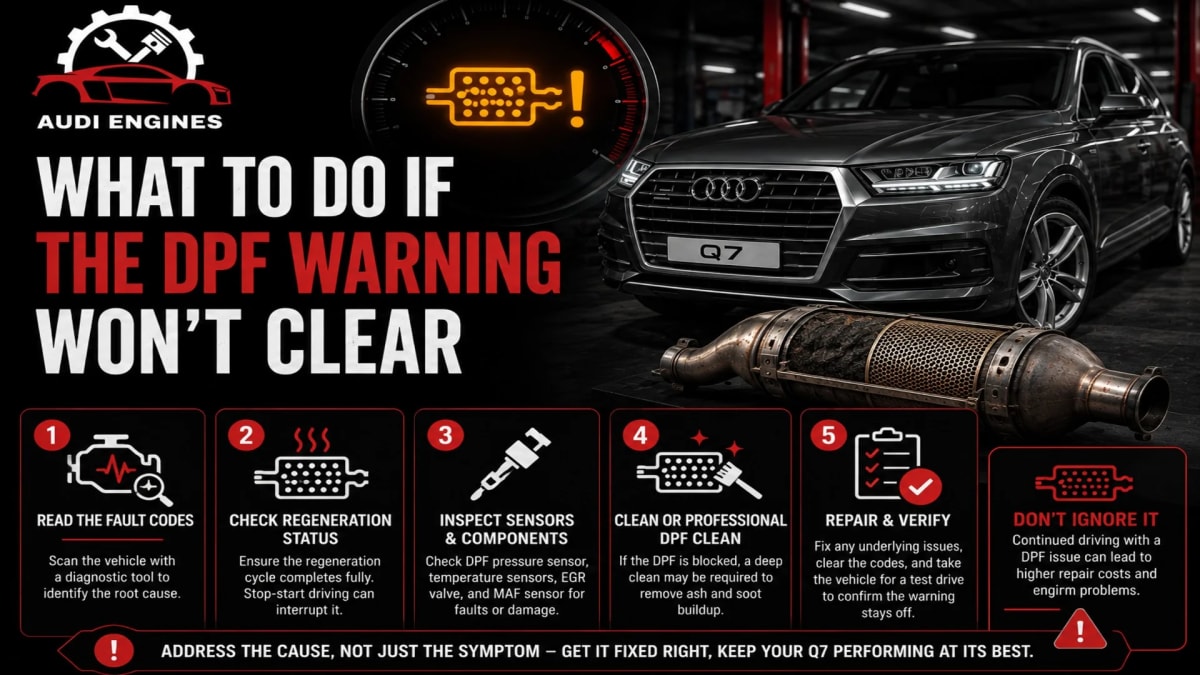
Once you understand that the warning might not simply mean "drive faster for longer," the next questions become far more practical, is it safe to keep driving, and what actually needs to happen next?
Can You Drive With the Audi Q7 DPF Warning Light On?
In most cases, yes, for a limited time, a solid amber DPF warning generally means the system wants a regeneration drive, and continuing to drive (ideally at sustained higher speed) may allow that to happen naturally. However, if the light is accompanied by a flashing check engine light, noticeably reduced power, or the vehicle enters limp mode, that's a different situation entirely, and continuing to drive risks further damage to the DPF, turbocharger, or engine itself.
If the warning has returned more than once despite genuine attempts at a proper regeneration drive, that's the point to stop relying on driving pattern alone and get the vehicle properly diagnosed.
DPF Cleaning vs Regeneration vs Replacement, What's the Difference?
These three terms get used almost interchangeably online, but they represent genuinely different levels of intervention:
Process | What It Does | When It's Needed |
| Regeneration | Burns off accumulated soot through normal or forced high-temperature operation | Routine, ongoing, happens automatically or via forced regeneration |
| Professional DPF cleaning | Physically removes soot and ash buildup that regeneration alone can no longer clear | When regeneration keeps failing or ash loading has built up over time |
| DPF replacement | Fitting a new filter | When the existing filter is damaged, cracked, or too heavily ash-loaded to clean effectively |
A recurring warning light doesn't automatically mean you need a replacement filter, in a lot of cases, a professional clean resolves it entirely, particularly if ash accumulation (rather than physical damage) turns out to be the issue.
When Should You Get Professional Audi Q7 DPF Diagnostics?
If you've genuinely completed a proper regeneration drive, sustained speed, adequate duration, uninterrupted, and the warning still returns within a short period, that's the point where continuing to attempt the same drive stops being useful. Audi's own guidance on this is straightforward: if the warning doesn't clear after the recommended regeneration drive, the vehicle should go to a qualified workshop rather than repeating the same attempt indefinitely.
A proper diagnostic scan will pull live data and fault codes directly from the ECU, showing whether you're dealing with genuine soot overload, a sensor fault, an EGR issue, or something else entirely, rather than guessing based on symptoms alone.
Fixing & Preventing Recurring DPF Warnings on Your Audi Q7

Once the underlying cause is identified, the fix itself is usually far more straightforward than the diagnostic process that got you there.
How Much Does Audi Q7 DPF Repair Cost?
Cost depends heavily on what's actually wrong, which is exactly why diagnosis matters before committing to any particular fix:
- Forced regeneration service, generally the lowest-cost option, appropriate when the filter simply needs a proper high-temperature burn under controlled conditions
- Differential pressure or EGT sensor replacement, a moderate cost, and often resolves recurring warnings entirely when a sensor fault is the true cause
- Professional DPF cleaning, removes soot and ash buildup that regeneration can no longer clear, sitting above sensor repair but well below full replacement
- EGR valve or cooler repair, cost varies depending on whether the valve or the cooler (or both) needs attention
- DPF replacement, the highest-cost option, reserved for filters that are physically damaged or too ash-loaded to clean economically
The real value of a proper diagnostic scan is avoiding the most common expensive mistake we see: owners paying for a full DPF replacement when the actual fault was a £150-range sensor the whole time.
How to Stop the DPF Warning Light From Coming Back
Once any underlying fault has been repaired, a few habits make a genuine difference in keeping the warning from returning:
- Build in a regular longer drive, ideally weekly, at sustained motorway speed for at least 20-30 minutes
- Avoid habitually short journeys where the engine never reaches proper operating temperature
- Don't ignore the warning light when it first appears, early action is far cheaper than a fault left to develop
- Keep up with servicing, since worn injectors or a neglected air filter can both increase soot production over time
- Address any EGR or sensor faults promptly, rather than repeatedly forcing regeneration around an unresolved underlying issue
Book an Audi Q7 DPF Diagnostic Today
If your Q7's DPF warning light keeps coming back despite genuine regeneration attempts, guessing at the cause tends to cost more in the long run than getting a proper diagnostic scan up front. Our team works specifically with Audi TDI engines and can pinpoint whether you're dealing with a sensor fault, an EGR issue, or genuine filter restriction, and give you a clear, honest recommendation on the right fix.
Frequently Asked Questions
Why does my Audi Q7 DPF light keep coming back?
A recurring warning usually points to something beyond simple soot buildup, commonly a faulty differential pressure sensor, an EGT sensor issue, an EGR fault, or a driving pattern that never gives regeneration the chance to complete properly.
Why does the DPF warning return after regeneration?
If regeneration was genuinely completed but the warning returns quickly, the underlying issue is often a sensor giving the ECU inaccurate data, rather than the filter itself remaining blocked.
Can a faulty sensor cause the DPF light to return?
Yes. Both the differential pressure sensor and the exhaust gas temperature sensor feed data the ECU relies on to judge filter condition and regeneration success. Faulty readings from either can trigger a warning even when the filter is in reasonable condition.
Can an EGR fault cause DPF blockage?
Yes. A malfunctioning EGR valve or leaking EGR cooler can increase soot production during combustion, causing the DPF to fill faster than normal and triggering more frequent regeneration warnings.
Can you drive with the Audi Q7 DPF warning light on?
Generally yes for a short period if the light is solid and performance is normal, since a sustained drive may allow regeneration to complete. If the light is flashing, power is noticeably reduced, or the car enters limp mode, get it checked rather than continuing to drive.
What does P2463 mean on an Audi Q7?
P2463 generally indicates DPF soot accumulation, meaning the filter is carrying more soot than the system considers acceptable.
What does P242F mean on an Audi Q7?
P242F typically points to DPF restriction, suggesting the filter itself may be physically clogging.
How much does Audi Q7 DPF cleaning cost?
Cost varies depending on whether a forced regeneration, professional cleaning, sensor replacement, or full replacement is needed, which is exactly why a diagnostic scan before committing to any repair is worthwhile.
How do I know if DPF regeneration is working?
A successful regeneration typically shows reducing soot mass values on live diagnostic data, along with the warning light clearing and staying off during normal subsequent driving. If the light returns quickly, that's a sign regeneration either didn't complete or wasn't the actual fix needed.