
Audi Q7 Engine Management Light: Common Causes, Symptoms & Diagnosis (UK Guide)
That amber engine symbol just lit up on your Audi Q7's dashboard, and now you're doing the mental math. Does it mean pull over immediately, or can you finish the school run first.
That amber engine symbol just lit up on your Audi Q7's dashboard, and now you're doing the mental math. Does it mean pull over immediately, or can you finish the school run first?
Here's the honest answer: it depends, and anyone who tells you otherwise without looking at your specific car is guessing. The Audi Q7 engine management light is triggered by dozens of different faults, ranging from a loose fuel cap to a genuinely serious turbo or emissions problem, and the diesel 3.0 TDI and petrol 3.0 TFSI versions of this SUV tend to throw completely different faults for completely different reasons.
This guide breaks it down properly. You'll learn what the light actually means, what's likely causing it on your specific engine, which symptoms tell you how urgent the problem is, and what proper diagnosis and repair looks like, rather than a generic "have it checked" shrug that doesn't actually help you.
What Does the Audi Q7 Engine Management Light Mean?

The engine management light, sometimes called the check engine light or malfunction indicator light, is triggered by the Q7's engine control unit (ECU) whenever it detects a reading outside its expected parameters. That could be from a sensor, an actuator, the emissions system, the ignition system, or dozens of other monitored components.
Behind the scenes, the ECU logs a diagnostic trouble code (DTC) every time this happens. That code is what a diagnostic scan tool reads, and it's the real starting point for figuring out what's actually wrong. The light itself doesn't tell you the cause, it just tells you the ECU noticed something worth flagging.
What the engine management light typically monitors:
- Air and fuel delivery, including sensor readings that control the mixture
- Ignition and combustion, covering spark, timing, and misfire detection (on petrol models)
- Emissions control, including the catalytic converter, EGR, and DPF systems
Because this single warning light covers such a broad range of systems, treating it as one problem with one fix is exactly where a lot of owners go wrong.
Is a Steady or Flashing Engine Light More Serious?
This distinction matters more than most owners realise, and it's genuinely useful for deciding how urgently you need to act.
A steady, unflashing amber light usually means the ECU has detected a fault, but it's not one that poses immediate risk to the engine. The car will generally still drive normally, and you can book in a diagnostic scan without treating it as an emergency.
A flashing light, on the other hand, typically indicates something more serious, most often a misfire severe enough to risk damaging the catalytic converter by dumping unburned fuel into the exhaust system. If your Q7's light is flashing, that's a much stronger signal to reduce your speed, avoid hard acceleration, and get it looked at as soon as possible rather than continuing your journey as normal.
Can I Still Drive My Audi Q7 With the Engine Management Light On?
In most cases, yes, a steady light with no other symptoms usually means it's safe to continue driving carefully to a garage. But that changes the moment other warning signs join the party.
Stop and seek help promptly if you notice any of these alongside the light:
- A flashing (rather than steady) engine management light
- Noticeable loss of power or the car entering limp mode
- Unusual noises, particularly knocking or grinding
- A strong smell of fuel or visible smoke
- The car struggling to maintain normal engine temperature
If none of those apply and the car is driving normally, a careful onward journey to a diagnostic appointment is generally fine. If in doubt, treat caution as the safer default, an unnecessary garage visit costs far less than ignoring a genuine warning sign.
Why Does the Light Come On and Then Go Off Again?
This is one of the most common, and most confusing, scenarios Q7 owners describe. An intermittent fault, such as a sensor giving an occasional bad reading or a connector with a loose contact, can trigger the light, then clear itself once the reading returns to normal.
Even if the light goes off, the fault code is usually still stored in the ECU's memory. That's important, because it means the problem hasn't actually gone away, it's just not currently active. A diagnostic scan will still pick up that stored code, which is exactly why it's worth getting checked even after the light has switched itself off.
What Are the Common Causes of an Audi Q7 Engine Management Light?
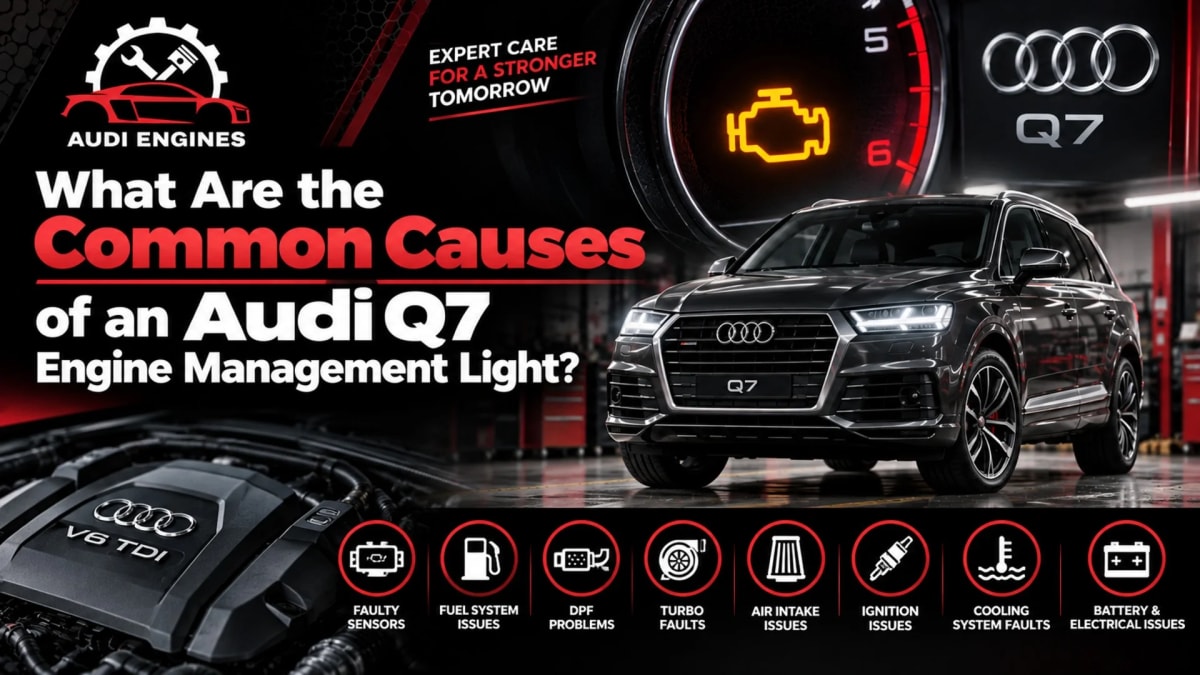
This is the section where genuinely useful diagnosis starts, and it's also where a lot of generic check-engine-light guides fall short. The Audi Q7 has been sold with both diesel and petrol engines over the years, and the causes behind the warning light differ significantly between them.
Treating "Audi Q7 engine management light" as one universal problem with one universal cause misses the point entirely. What's actually happening under the bonnet of a 3.0 TDI diesel is often nothing like what's happening in a 3.0 TFSI petrol.
Which Faults Affect the Audi Q7 3.0 TDI (Diesel)?
The 3.0 TDI diesel engine, fitted across much of the Q7 range, relies heavily on its emissions control systems, and that's where most engine management light triggers originate.
Common diesel-specific causes include:
- Blocked or failing DPF (diesel particulate filter), often from repeated short journeys that never let it complete a full regeneration
- EGR valve faults, typically from carbon and soot deposits causing the valve to stick
- NOx sensor failure, which can trigger an emissions-related fault even when the engine itself is running fine
- Glow plug faults, more common in colder months and often paired with harder cold starts
- Turbocharger or boost pressure issues, affecting how much air reaches the engine under load
Can a Blocked DPF or Faulty EGR Trigger the Light?
Yes, and on the diesel Q7, this is one of the most frequent causes of all. The DPF traps soot particles from the exhaust and periodically burns them off in a process called regeneration. If your driving is mostly short trips at low speed, the filter may never get hot enough to complete that process, and it gradually clogs.
A clogged DPF increases exhaust backpressure, which the ECU detects and flags, often alongside a genuine loss of power. The EGR valve, meanwhile, recirculates a portion of exhaust gas back into the intake to reduce emissions, and it's prone to sticking open or closed as carbon builds up around its moving parts. Both faults produce broadly similar symptoms: reduced power, rougher running, and occasionally a smell of diesel exhaust that's stronger than normal.
Which Faults Affect the Audi Q7 3.0 TFSI (Petrol)?
The petrol 3.0 TFSI engine doesn't share the diesel's DPF or EGR-heavy fault pattern. Instead, its engine management light triggers are more commonly tied to ignition, fuelling, and the emissions components specific to petrol combustion.
Common petrol-specific causes include:
- Oxygen (lambda) sensor failure, affecting the air-fuel mixture readings the ECU relies on
- Catalytic converter faults, either from age-related wear or from unrelated issues (like a misfire) damaging it over time
- Ignition coil or spark plug wear, leading to misfires under load or at idle
- EVAP system leaks, often starting with something as simple as a loose or damaged fuel cap
- Vacuum or intake leaks, which throw off the air-fuel ratio the ECU is trying to manage
Can a Faulty Oxygen Sensor or Catalytic Converter Cause It?
Definitely, and these two faults are closely linked. The oxygen sensor measures how much unburned oxygen is in the exhaust and reports back to the ECU, which uses that data to fine-tune the fuel mixture. When this sensor fails or drifts out of calibration, the engine can run either too rich or too lean, both of which trigger a warning light.
Left unaddressed, a failing oxygen sensor can also accelerate catalytic converter wear, since an incorrect fuel mixture puts extra strain on the catalyst. This is a good real-world example of why fixing the root cause matters: replacing a worn catalytic converter without addressing an underlying sensor fault often just means you're back in the garage again within months.
Can a Turbo, Boost Leak, or Sensor Fault Cause the Light?
Yes, and this applies to both engine variants, since both the diesel and petrol Q7 use turbocharging. A boost leak, where pressurised air escapes from the intake system before reaching the engine, is a surprisingly common and relatively inexpensive cause of an engine management light paired with noticeable power loss.
Sensor faults affecting the mass airflow (MAF) sensor or manifold pressure (MAP) sensor can produce very similar symptoms, since both feed critical data to the ECU about how much air is entering the engine. Getting these two mixed up, assuming a genuine turbo fault when it's actually a leaking hose or a faulty sensor, is one of the most common (and most avoidable) misdiagnoses on this platform.
What Symptoms Appear Alongside the Audi Q7 Engine Management Light?

The light rarely appears completely on its own. Paying attention to what else the car is doing gives you a much stronger clue about where the problem actually sits, long before a diagnostic scan confirms it.
Why Is My Audi Q7 Losing Power or Going Into Limp Mode?
Limp mode is the ECU's built-in protection system, when it detects a fault serious enough to risk further damage, it deliberately restricts engine power and often locks the transmission into a lower gear. It's frustrating to experience, but it exists specifically to stop a moderate fault from becoming an expensive one.
On the diesel Q7, limp mode paired with the engine management light often points to a DPF, EGR, or turbo-related fault. On the petrol variant, it's more commonly linked to a significant sensor fault or a boost leak severe enough to affect engine performance meaningfully.
Why Is My Audi Q7 Misfiring or Idling Roughly?
A misfire happens when one or more cylinders fail to combust properly, and it's one of the more noticeable symptoms an owner will feel directly through the car, a slight jolt, a rough patch at idle, or hesitation under acceleration.
On the petrol 3.0 TFSI, this usually traces back to worn spark plugs, a failing ignition coil, or a fuel injector not delivering the correct amount of fuel. On the diesel 3.0 TDI, similar symptoms can stem from fuel delivery issues or, less commonly, a glow plug fault affecting combustion consistency, particularly noticeable during cold starts.
What Do Common Audi Q7 Fault Codes Actually Mean?
A diagnostic scan tool reads specific fault codes stored by the ECU, and while a full interpretation should always come from proper diagnostic testing, knowing what the common ones generally point to helps you understand what a mechanic is telling you.
Fault Code | What It Typically Means |
| P0300 | Random or multiple cylinder misfire |
| P0420 | Catalytic converter efficiency below threshold |
| P0442 | Small EVAP system leak detected |
| P0128 | Coolant temperature below thermostat regulation |
| P0171 / P0172 | Fuel system running too lean / too rich |
| P0101 | Mass airflow sensor performance issue |
| P0299 | Turbocharger underboost condition |
| P0401 | Insufficient EGR flow detected |
| P2002 | DPF efficiency below threshold |
| P0089 | Fuel pressure regulation fault |
It's worth stressing that a fault code points you toward a system, not necessarily a single faulty part. A P0299 underboost code, for example, could mean a failing turbo, a boost leak, or a faulty sensor feeding the ECU incorrect data, which is exactly why proper diagnosis matters more than reading a code off a scanner and ordering a part.
How Is the Audi Q7 Engine Management Light Diagnosed and Fixed?
Once you know roughly what category of fault you're dealing with, the next step is confirming it properly, and this is where a lot of unnecessary expense gets avoided.
Why Isn't Clearing the Fault Code Enough?
Clearing a fault code turns the warning light off, but it does absolutely nothing to fix whatever triggered it in the first place. The underlying issue, whether it's a sticking EGR valve, a worn oxygen sensor, or a boost leak, is still there, and the light will almost always return once the ECU detects the same fault condition again.
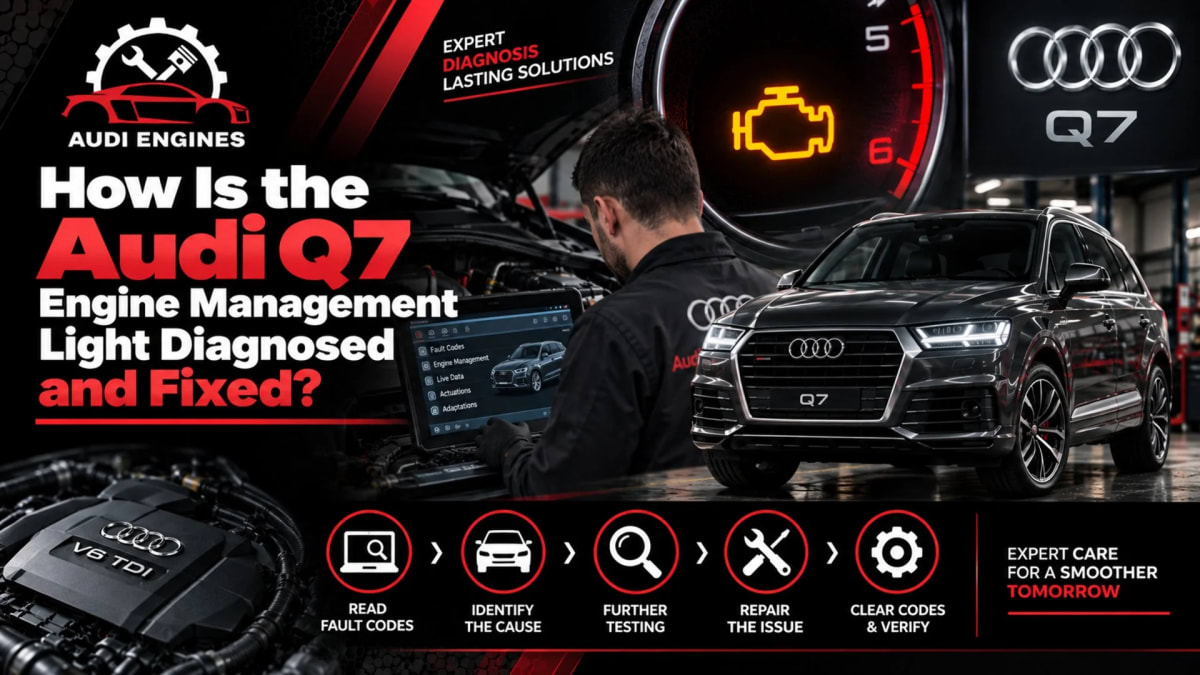
A proper diagnostic process looks like this: scan for stored codes → identify the affected system → inspect and test the specific component → confirm the root cause → carry out the actual repair → clear the code → road test → rescan to confirm it stays clear. Skipping straight from "scan" to "clear code" without everything in between is how owners end up with the same warning light reappearing a week later, no closer to an actual fix.
How Much Does Audi Q7 Engine Diagnostics Cost?
Diagnostic costs vary depending on how straightforward the fault turns out to be. A simple issue, a loose fuel cap, a failed sensor with a clear code, or a basic vacuum leak, tends to be quick and inexpensive to diagnose and resolve. More involved faults, particularly those touching the DPF, turbo, or emissions system on the diesel 3.0 TDI, take longer to properly investigate because multiple components need testing to rule out overlapping causes.
As a general guide, the initial diagnostic scan and inspection is usually the smaller part of the overall cost, the bigger variable is what repair work the diagnosis actually points to, whether that's a sensor replacement, an EGR clean, or something more involved like turbo or catalytic converter work.
Why Choose Audi Engines for Your Q7 Diagnosis and Repair?
At Audi Engines, we work specifically with Audi Q7 engine management faults across the UK, on both the 3.0 TDI diesel and 3.0 TFSI petrol variants. That means we're not guessing whether your fault sits with the DPF, the EGR, a sensor, or the turbo, we diagnose it properly first, then quote based on what's actually wrong.
Whether your Q7's engine light is paired with limp mode, a misfire, or just an occasional flicker that keeps coming back, our team can talk you through what the fault code actually means for your specific engine and what it will genuinely cost to put right. Get in touch for an honest diagnosis before committing to any repair.
Frequently Asked Questions
What causes the engine management light on an Audi Q7?
Causes range from minor issues like a loose fuel cap to more involved faults like a failing oxygen sensor, blocked DPF, faulty EGR valve, or turbo boost leak. The exact cause depends heavily on whether your Q7 is the diesel 3.0 TDI or petrol 3.0 TFSI, since the two engines have quite different common fault patterns.
Is it safe to drive an Audi Q7 with the engine management light on?
Usually yes, if the light is steady and the car is driving normally, though a diagnostic scan should still be booked promptly. If the light is flashing or accompanied by power loss, limp mode, or unusual noises, it's safer to stop and get it checked rather than continuing your journey.
Why is my Audi Q7 engine management light flashing?
A flashing light most often indicates a misfire severe enough to risk damaging the catalytic converter. This is more urgent than a steady light and generally means reducing speed and seeking diagnosis as soon as possible.
Can a DPF problem cause the Audi Q7 engine management light?
Yes, this is one of the most common causes on the diesel 3.0 TDI. A blocked DPF, often from frequent short journeys preventing proper regeneration, increases exhaust backpressure and typically triggers both the warning light and a noticeable drop in power.
Can an EGR fault trigger the Audi Q7 engine warning light?
Yes. Carbon and soot buildup can cause the EGR valve to stick, disrupting the exhaust recirculation process and triggering a fault code, often alongside rougher running or reduced performance.
Can a faulty turbo cause the Audi Q7 engine management light?
It can, though a boost leak or a faulty sensor feeding incorrect data to the ECU is often the actual cause rather than the turbocharger itself failing outright. Proper diagnostic testing is the only reliable way to tell the difference.
Can I reset the Audi Q7 engine management light myself?
You can clear the code with a suitable scan tool, but this doesn't fix the underlying fault. The light will almost certainly return once the ECU detects the same issue again, so a proper diagnosis and repair is the only lasting solution.
Final Thoughts: Don't Ignore It, and Don't Guess at It
An Audi Q7 engine management light is the car's way of flagging something worth investigating, not necessarily a crisis, but not something to dismiss either. The real risk isn't the light itself; it's either ignoring a genuine fault until it worsens, or throwing money at parts that were never actually the problem.
Whether your Q7 is the diesel 3.0 TDI dealing with a possible DPF or EGR issue, or the petrol 3.0 TFSI showing signs of a sensor or ignition fault, the fastest route to a real fix is proper diagnosis rather than guesswork.
If your Audi Q7's engine management light has come on, Audi Engines can give you a clear, honest diagnosis before recommending any repair. Get in touch with our UK team today to find out exactly what's triggering the light and what it will genuinely cost to resolve.