
Audi Q7 Engine Oil Leak Common Causes, Symptoms & Repair Guide
Found a dark patch on your driveway that wasn't there last week? Or maybe you topped up the oil a month ago and it's already low again. Either way, if you're here, your Audi Q7 is almost certainly leaking oil somewhere.
Found a dark patch on your driveway that wasn't there last week? Or maybe you topped up the oil a month ago and it's already low again. Either way, if you're here, your Audi Q7 is almost certainly leaking oil somewhere, and you want to know exactly where, why, and how bad it actually is before you start throwing money at gaskets that might not even be the problem.
That last part matters more than most articles on this topic let on. The Q7's engine bay is tightly packaged, and oil has a habit of tracking along components before it ever drips onto your driveway, which means the spot where you see the puddle isn't always where the leak actually starts. This guide walks through every common cause, how to actually pinpoint the source, what it means for your engine if you leave it, and what repair typically involves.
What Are the Common Causes of an Audi Q7 Engine Oil Leak?

An Audi Q7 oil leak almost always comes down to one of a handful of gaskets or seals degrading over time. These components are made from rubber or composite materials that harden and shrink as they age, and once that happens, they stop sealing properly against engine oil under pressure and heat. Add in the Q7's V6 and V8 engine layouts, which pack a lot of hardware into a relatively tight space, and you get several recurring leak points that show up again and again in workshop diagnostics.
Oil Pan, Valve Cover & Oil Filter Housing Gasket Leaks
The oil pan gasket sits at the bottom of the engine, sealing the sump where your engine oil is stored. On the Q7, this is actually split into upper and lower oil pan seals on many engine variants, and either can fail independently. A worn lower oil pan seal typically shows up as oil pooling directly underneath the engine, while the upper seal can leak more subtly, with oil tracking down the block before it ever reaches the ground.
The valve cover gasket seals the top of the engine, where the camshafts operate. Because it sits higher up, a valve cover leak often drips onto hot exhaust components below, which is why this particular leak is frequently first noticed as a faint burning oil smell rather than a visible puddle.
The oil filter housing gasket is a smaller, often-overlooked seal around the filter housing itself. It's a common failure point because it's exposed to repeated heat cycling every time the engine runs, and a leak here can look deceptively similar to an oil cooler leak since both sit in a similar part of the engine.
Oil Cooler and Rear Main Seal Leaks
The oil cooler gasket is one of the more commonly reported leak sources on Q7 diesel engines specifically. It seals the point where engine oil passes through the cooler to regulate temperature, and because it sits centrally in the engine, a failing oil cooler gasket often produces oil that pools in the engine valley before working its way down, making it a leak that's easy to misdiagnose without a proper inspection.
The rear main seal sits between the engine and gearbox, sealing the crankshaft where it meets the transmission. This is one of the more serious leak points because of where it's located, repairing it typically requires separating the engine from the gearbox, which is a significantly more involved (and costly) job than replacing an external gasket. Oil appearing specifically at the engine-to-gearbox junction is the classic sign of a rear main seal problem.
Camshaft Seals, Turbo Oil Seals & Drain Plug Leaks
A few additional leak points round out the list:
- Camshaft seals, these seal around the camshaft where it exits the cylinder head, and wear here often shows up as oil near the front of the engine, sometimes mistaken for a timing cover leak
- Turbocharger oil seals, the turbo relies on a constant oil feed for lubrication, and a worn seal here can leak oil into the turbo housing itself, sometimes producing visible smoke rather than a puddle
- Oil drain plug, the simplest leak on this list, usually caused by a worn sump washer or an over/under-tightened plug after an oil change, and typically the least serious of all the causes covered here
- PCV and crankcase ventilation, not a gasket leak in the traditional sense, but a faulty PCV valve or oil separator can increase crankcase pressure enough to force oil out through other seals, which is why some leaks reappear even after a gasket replacement
Audi Q7 3.0 TDI vs 3.0 TFSI, Do They Leak in Different Places?
This is a distinction most generic guides skip entirely, but it genuinely matters. The 3.0 TDI diesel and 3.0 TFSI petrol engines have different component layouts, and that translates into different common failure points.
Why Does the 3.0 TDI Commonly Leak at the Rear Main Seal or Oil Cooler?
On the 3.0 TDI, the rear main seal and oil cooler gasket come up repeatedly in workshop diagnostics and specialist parts catalogues, which specifically list an upper oiling-system gasket kit for TDI applications experiencing oil cooler leaks. The diesel's higher-torque operation and long service intervals mean these seals see sustained heat and pressure over extended periods, which accelerates wear compared to some petrol applications.
Why Does the 3.0 TFSI Commonly Leak Around the PCV/Oil Separator?
The 3.0 TFSI, by contrast, is more frequently associated with PCV and oil separator issues contributing to both oil leaks and oil consumption. Owner discussions on TFSI-specific forums consistently point to this system as a recurring weak point, distinct from the gasket-driven leaks more commonly seen on the TDI. If your Q7 is a TFSI and you're seeing both a slowly dropping oil level and a leak, it's worth having the PCV system checked specifically rather than assuming it's a straightforward gasket issue.
How to Identify Where Your Audi Q7 Is Leaking Oil
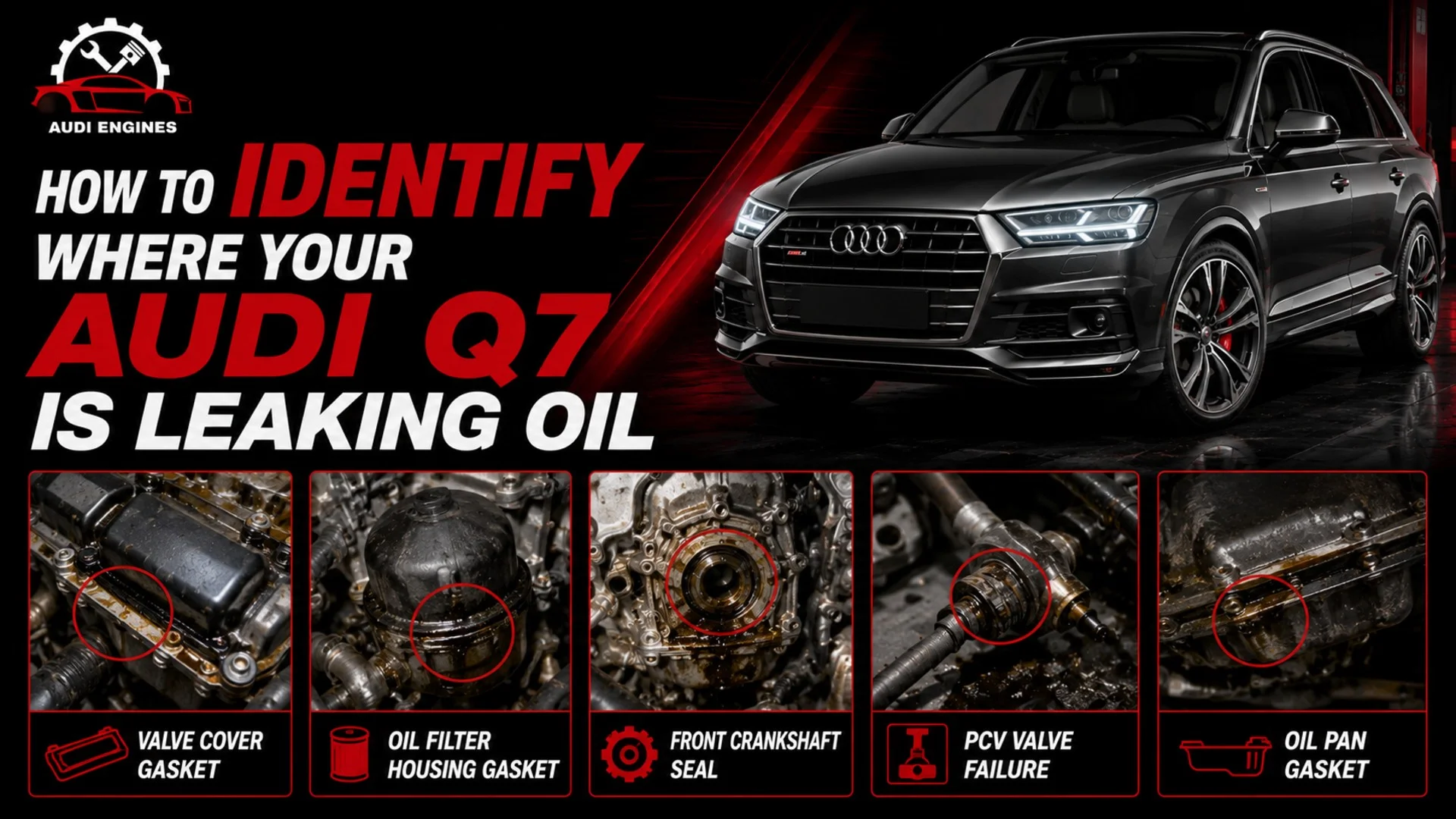
Guessing at the source of a leak based on where the puddle appears is one of the most common mistakes we see, and it leads to replacing the wrong gasket. Here's how to actually narrow it down.
Leak Location Guide, What Does the Drip Position Tell You?
The Q7's undertray and splash shields mean oil rarely drips straight down from its actual source. Instead, it tends to travel along the shield before dripping at a lower point. This table gives a general starting point, though it should always be confirmed with a proper inspection rather than treated as a final diagnosis:
Leak Location | Likely Cause |
| Front of engine | Camshaft seal / timing cover area |
| Top of engine | Valve cover gasket |
| Bottom of engine | Oil pan / sump gasket |
| Engine-to-gearbox junction | Rear main seal |
| Engine valley (central) | Oil cooler gasket / oil filter housing |
| Around the turbo | Turbo oil seal or oil feed pipe |
| Around the drain plug | Worn sump washer or loose drain plug |
| Undertray only, no clear point | Leak higher up, tracking down the shield |
Why Is My Audi Q7 Losing Oil but Showing No Visible Leak?
This one catches a lot of owners off guard. Not every drop in oil level means there's a puddle waiting to be found. Internal oil consumption, caused by worn piston rings or deteriorated valve-guide seals, can burn oil through the combustion process rather than leaking it externally, which means the oil simply disappears rather than dripping anywhere. This is a genuinely different problem from an external leak, and it's worth distinguishing clearly:
- External oil leak, oil escapes the engine through a failed gasket or seal, typically visible as a puddle, residue, or stain under the vehicle
- Internal oil consumption, oil is burned inside the combustion chamber due to worn rings or valve-guide seals, often producing blue-tinged exhaust smoke and a burning smell, but no external puddle at all
If your oil level keeps dropping but your driveway stays clean, it's worth having both possibilities checked rather than assuming it must be a hidden external leak.
Could the Undertray Be Hiding the Real Leak Source?
Yes, and this is a genuinely common issue on the Q7 specifically. The lower engine shields and undertray are designed to protect components from road debris, but they also catch and redirect oil, sometimes holding it for a considerable time before it eventually drips. This means the point where you actually see oil on the ground can be several inches, or more, away from where the leak originates, which is exactly why removing and inspecting the undertray is a standard part of a proper diagnostic process rather than an optional extra.
How Is an Audi Q7 Oil Leak Properly Diagnosed?
A thorough diagnosis follows a specific sequence rather than jumping straight to replacing the most commonly cited gasket:
- Check the oil level and condition to establish how much oil has actually been lost
- Remove and inspect the undertray, since this is where the true leak source is often hidden
- Clean the affected area thoroughly so any new oil residue can be clearly identified
- Run the engine to operating temperature, since some leaks only appear once the engine and oil are hot
- Inspect all common gasket and seal locations systematically, working from the most likely to least likely source
- Use UV dye if the source remains unclear, adding it to the oil and using UV light to trace exactly where it's escaping
- Confirm the source before ordering parts, since replacing the wrong gasket means paying for labour twice
Skipping the undertray removal or the UV dye step is a common shortcut that leads to a gasket being replaced without actually fixing the leak, something worth asking about if you're getting a quote from anywhere other than a specialist.
Symptoms and Severity, Is an Audi Q7 Oil Leak Serious?

What Are the Warning Signs of an Audi Q7 Oil Leak?
Beyond an obvious puddle, several other signs point toward an oil leak worth investigating:
- Fresh oil stains or residue on the driveway, even if it's just a small spot rather than a full puddle
- A burning oil smell, particularly noticeable after driving, which often points to oil dripping onto hot exhaust components
- Visible smoke from the engine bay, especially if oil is contacting the exhaust manifold or turbo
- A low oil warning light on the dashboard, indicating the oil level has dropped below a safe threshold
- An oil pressure warning, which is more urgent than a simple low-level warning and suggests the lubrication system itself may be compromised
- Oil consumption between services that's noticeably higher than what you'd expect for normal use
How Serious Is My Audi Q7 Oil Leak? (Low, Moderate & Urgent Cases)
Not every oil leak carries the same urgency, and understanding where yours sits helps you prioritise appropriately:
Low severity, A worn drain plug washer causing minor seepage. Easy and inexpensive to fix, with minimal risk if addressed within a reasonable timeframe.
Moderate severity, Valve cover gasket, oil filter housing, or a slow oil pan seal leak. These need attention but rarely present an immediate risk if the oil level is being monitored and topped up in the meantime.
Moderate-to-high severity, Oil cooler gasket leaks. These can develop into a more significant loss of oil over a shorter period and are worth addressing promptly rather than deferring.
High severity, Rear main seal leaks. Not urgent in the sense of immediate engine damage, but the repair complexity (requiring gearbox separation) means costs and labour time are considerably higher, so it's worth acting before the leak worsens.
Urgent, Any leak accompanied by an oil pressure warning light or a rapidly dropping oil level. This indicates the lubrication system may not be adequately protecting the engine, and the vehicle should be checked immediately rather than driven further.
What Happens If an Audi Q7 Oil Leak Is Left Unrepaired?
A slow, minor leak left unaddressed for a few weeks is unlikely to cause serious harm, provided the oil level is checked regularly and topped up as needed. The real risk comes from ignoring the warning signs of a worsening leak, as oil level drops further, oil pressure can become inconsistent, reducing lubrication to critical engine components. Sustained low oil pressure increases friction and heat between moving parts, which over time can lead to accelerated wear and, in severe cases, genuine engine damage that's far more expensive to repair than the original leak ever was.
Audi Q7 Oil Leak Repair, Cost & Prevention
How Much Does Audi Q7 Oil Leak Repair Cost?
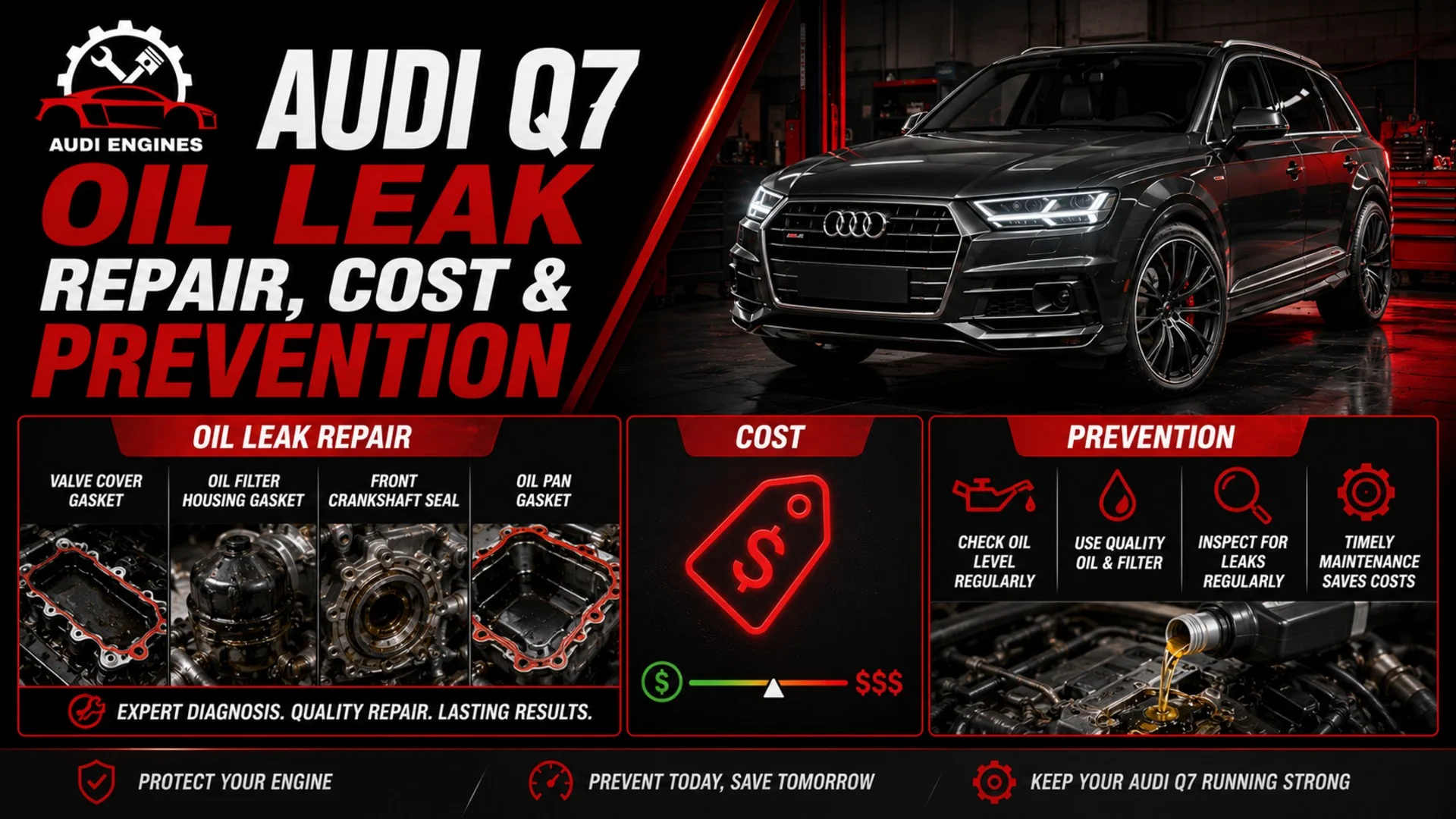
Repair costs vary considerably depending on which component has failed and how accessible it is. A drain plug washer or valve cover gasket replacement sits at the more affordable end, while an oil cooler gasket involves more labour to access. A rear main seal repair is the most expensive of the common causes, purely because of the gearbox separation required to reach it. Rather than relying on a generic estimate that may not reflect your specific engine and leak source, it's best to get an accurate quote once the leak has been properly diagnosed.
How to Prevent Future Audi Q7 Oil Leaks
While gaskets and seals will eventually wear regardless of how well a car is maintained, a few habits help reduce the risk of premature failure:
- Keep up with oil changes using the correct specification oil, since incorrect oil can accelerate seal degradation
- Avoid over-tightening the drain plug during oil changes, which can damage the sump thread and washer seal
- Address small leaks promptly rather than letting them worsen, since a minor seepage issue is far cheaper to fix than a leak that's been allowed to progress
- Have the PCV and crankcase ventilation system checked periodically, particularly on the 3.0 TFSI, since a faulty system can cause pressure-related leaks even with healthy gaskets
Why Choose an Audi Q7 Specialist for Oil Leak Repairs?
Diagnosing a Q7 oil leak properly requires genuinely understanding how oil tracks through this specific engine bay, including how the undertray can mislead a quick visual check. At Audi Engines UK, every oil leak diagnosis includes undertray inspection and, where needed, UV dye testing to confirm the exact source before any parts are replaced, so you're not paying to fix a gasket that was never actually the problem.
Frequently Asked Questions
Why is my Audi Q7 leaking oil underneath?
Oil appearing underneath the vehicle usually originates from the oil pan gasket, drain plug, or a leak higher up that's tracked down along the undertray before dripping. A proper inspection with the undertray removed is the only reliable way to confirm the actual source.
Can I still drive my Audi Q7 with an oil leak?
It depends on severity. A minor, slow leak with a stable oil level is generally safe to drive short-term while you arrange a repair, provided you're checking the oil regularly. Any leak accompanied by a low oil pressure warning should not be driven until it's been checked.
Does an oil leak affect my Audi Q7's oil pressure?
It can, particularly if the leak has progressed to the point where the oil level has dropped significantly. Insufficient oil in the system reduces the pump's ability to maintain consistent pressure, which is why an oil pressure warning light should always be treated as more urgent than a simple low oil level alert.
What's the most common oil leak on an Audi Q7?
Valve cover gasket and oil pan gasket leaks are among the most frequently reported, though the specific engine variant matters, TDI models more commonly show rear main seal and oil cooler issues, while TFSI models are more associated with PCV-related leaks.
Is a rear main seal leak expensive to fix on a Q7?
Yes, relative to other common leaks, primarily due to the labour involved in separating the engine from the gearbox to access the seal, rather than the cost of the part itself.
Final Thoughts
An Audi Q7 oil leak is rarely a mystery once it's properly diagnosed, the challenge is that the Q7's undertray and tightly packaged engine bay make guesswork unreliable, and guessing wrong means paying for a repair that doesn't actually fix the problem. Whether it's a straightforward drain plug seep or something more involved like a rear main seal, knowing the likely cause based on where you're seeing oil, and understanding how serious it actually is, puts you in a much stronger position before you book a repair.
Noticed oil under your Audi Q7, or a burning smell you can't quite place? Get in touch with Audi Engines UK for a proper diagnostic inspection, including undertray removal and UV dye testing where needed, so you get an accurate answer and a fair quote, not a guess.