
Audi Q7 Engine Overheating Causes: Symptoms, Diagnosis & Repair Guide
You're watching the temperature gauge creep up, or that dashboard warning light just flashed on, and your mind goes straight to the worst-case scenario: is this going to be a five-minute fix or a five-figure repair bill.
You're watching the temperature gauge creep up, or that dashboard warning light just flashed on, and your mind goes straight to the worst-case scenario: is this going to be a five-minute fix or a five-figure repair bill? The uncertainty is often worse than the problem itself, especially when you've already checked the coolant reservoir and it looks completely full.
That's the moment most Audi Q7 owners get stuck. A full coolant tank feels like it should rule out overheating entirely, but it doesn't. This guide walks through exactly why your Q7 might be running hot, how to tell which component is responsible, and what happens if the problem gets ignored.
What Causes an Audi Q7 Engine to Overheat?

An overheating Audi Q7 almost always traces back to one of a handful of usual suspects: a coolant leak, a failed water pump, a stuck thermostat, a blocked radiator, a faulty cooling fan, trapped air in the system, or, in more serious cases, a failing head gasket. Each of these disrupts the same basic process: coolant needs to circulate, absorb heat from the engine, and release that heat through the radiator. Break any link in that chain, and temperatures climb.
What often gets missed is that the Q7's exact cooling system architecture depends heavily on which generation and engine you're dealing with.
Audi Q7 4L vs 4M, Do They Overheat for Different Reasons?
The first-generation Q7 (4L) and the newer 4M generation don't share identical cooling systems, and treating them as the same vehicle when diagnosing overheating is a common mistake.
Audi Q7 3.0 TDI and 4.2 TDI, Older Cooling Architecture
The 4L generation, built on simpler mechanical water pumps and a single main coolant circuit, tends to develop overheating problems tied to age: worn hoses, deteriorating gaskets, and mechanical water pumps that wear out after years of service. If you're driving an older 3.0 TDI or 4.2 TDI Q7, general wear-and-tear on rubber and seals is a realistic starting point for your investigation.
Audi Q7 3.0 TFSI and Newer 4M, Electric Coolant Pumps and Multiple Circuits
The 4M generation, including the 3.0 TDI and 3.0 TFSI variants, introduced a noticeably more complex cooling setup. Many of these engines use an electric coolant pump in addition to (or instead of) a traditional mechanical pump, along with separate small and large coolant circuits that manage different parts of the engine independently. This added complexity means more potential failure points, a faulty control module or solenoid can cause overheating symptoms even when every physical component looks fine on a basic inspection.
Why Is My Audi Q7 Overheating When the Coolant Is Full?
This is the scenario that catches most owners off guard, and it's worth addressing directly: a full coolant reservoir does not mean a healthy cooling system. Coolant level tells you how much fluid exists in the system. It tells you nothing about whether that fluid is actually circulating.
Consider a real-world scenario: an owner tops up their Q7's coolant, sees the reservoir at the correct level, and assumes the overheating warning was a fluke. A week later, the same warning returns, because the actual problem was a failed water pump impeller, the coolant was sitting there, full and useless, going nowhere.
Common reasons a Q7 overheats despite a full tank include:
- A failed water pump that no longer pushes coolant through the system, even though the coolant itself is present.
- A thermostat stuck closed, blocking coolant from reaching the radiator when the engine needs cooling most.
- Air trapped in the cooling system (an airlock), which prevents proper circulation and often follows a recent coolant top-up, hose replacement, or repair.
- A blocked radiator, restricting flow even when coolant is technically present throughout the system.
- A fan control or solenoid fault, meaning the fan isn't spinning when it should, regardless of coolant level.
- An internal coolant leak, often linked to a failing head gasket, where coolant escapes into the combustion chamber or oil rather than out through a visible external leak.
If your Q7 is overheating and the reservoir looks fine, don't stop your investigation there. The real cause is almost always about movement, not volume.
The Most Common Audi Q7 Overheating Causes at a Glance
Before diving into individual components, it helps to see the full picture in one place.
Cause | How It Triggers Overheating |
| Coolant leak (external) | Reduces coolant volume, limiting heat absorption capacity |
| Failed water pump | Coolant present but not circulating properly |
| Stuck thermostat | Blocks coolant flow to the radiator when needed |
| Blocked or clogged radiator | Restricts coolant flow and reduces heat dissipation |
| Faulty cooling fan | Reduces airflow needed to cool the radiator, especially at idle |
| Air trapped in system (airlock) | Prevents proper coolant circulation |
| Faulty coolant temperature sensor | Sends incorrect readings, masking or exaggerating real temperature |
| Head gasket failure | Allows combustion gases into coolant or coolant into cylinders |
Audi Q7 Overheating Symptoms and Which Component Is Likely to Blame
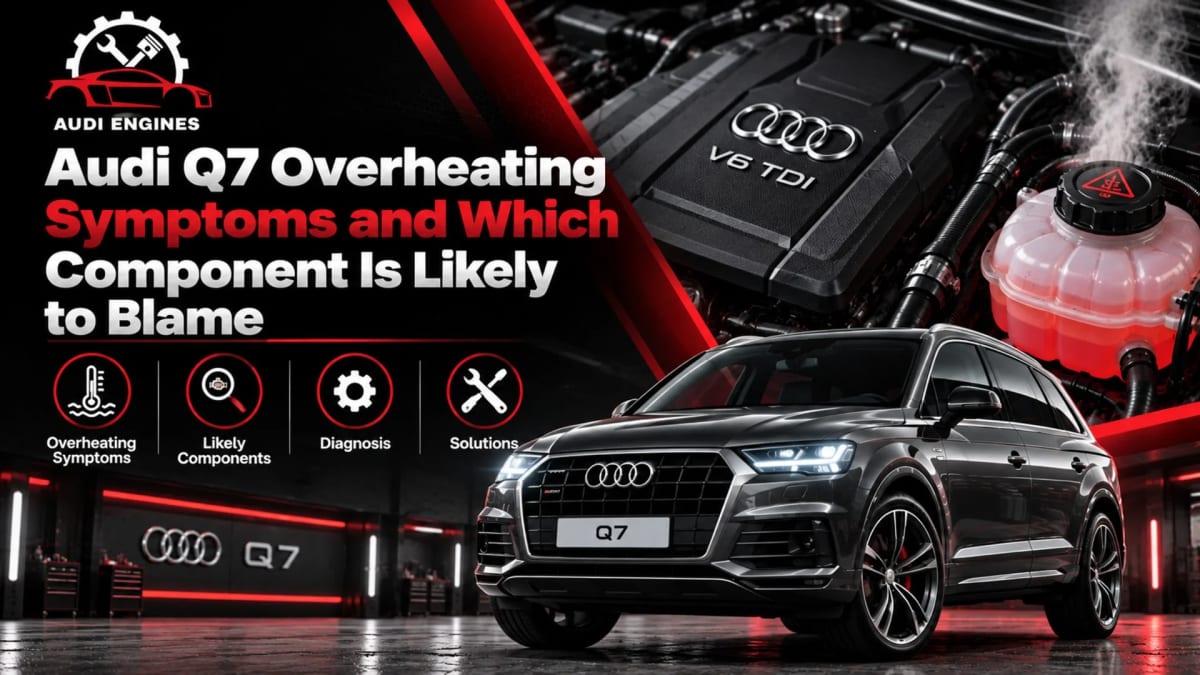
Different failure points tend to produce different warning signs. Learning to read these symptoms correctly can save you an unnecessary parts-swapping exercise.
Why Does My Audi Q7 Overheat While Driving?
Overheating that specifically appears while driving, rather than at idle, often points toward circulation or load-related issues. Under acceleration or motorway driving, the engine generates more heat and demands more from the cooling system. A weak water pump, a partially blocked radiator, or insufficient coolant flow may cope fine at low demand but fail to keep pace once you're pushing the engine harder, particularly if you're towing or carrying a heavy load.
Why Does My Audi Q7 Overheat at Idle?
Idle-specific overheating usually points toward airflow rather than circulation. At low speed or standstill, your Q7 relies heavily on the cooling fan to pull air through the radiator, since there's no forward motion generating natural airflow. If the fan isn't spinning, isn't spinning fast enough, or has a control fault, temperatures can climb specifically in stop-and-go traffic or while sitting at a junction, then improve once you're moving again.
Symptom-to-Cause Diagnostic Table
This table maps the exact symptom you're experiencing to the components most likely responsible, giving you a genuine starting point rather than a guessing game.
Symptom | Likely Cause |
| Temperature rises rapidly | Thermostat stuck closed, or poor coolant circulation |
| Coolant level keeps falling | External or internal coolant leak |
| Heater suddenly blows cold air | Low coolant or a circulation problem starving the heater core |
| Fan runs constantly, even when cold | Fan control fault or coolant temperature sensor issue |
| Overheats only under load or towing | Water pump weakness or restricted cooling capacity |
| Overheats at idle, fine while driving | Cooling fan fault or poor airflow |
| Coolant visible in engine oil | Head gasket failure or internal seal issue |
| White smoke from the exhaust | Possible internal coolant leak into the combustion chamber |
| Temperature fluctuates unpredictably | Faulty thermostat or failing temperature sensor |
| Overheats shortly after a repair | Trapped air (airlock) from incomplete bleeding |
Audi Q7 Water Pump Failure Symptoms
A failing water pump on the Q7 often announces itself gradually before it fails completely. Watch for a whining or grinding noise from the front of the engine, coolant pooling beneath the vehicle near the pump housing, and a temperature gauge that climbs specifically under load or after extended driving. On 4M models with an electric coolant pump, a failure can also trigger a fault code without any obvious mechanical noise at all, since there's no belt or pulley to give an audible warning.
Audi Q7 Thermostat Failure Symptoms
A stuck-closed thermostat prevents coolant from reaching the radiator, so temperatures rise quickly and often dramatically, sometimes within minutes of starting a journey. A stuck-open thermostat causes the opposite problem, the engine struggles to reach normal operating temperature at all, which isn't overheating but is still worth flagging during any cooling system inspection.
Audi Q7 Radiator Fan Not Working
If your fan isn't spinning when the engine's hot, or it runs constantly without ever stopping, you're likely looking at a fan control module, wiring fault, or a failed fan motor itself. This symptom is especially noticeable in slow traffic or while idling, since that's when the radiator relies most heavily on fan-driven airflow rather than the natural airflow generated while moving.
Audi Q7 Head Gasket Failure, The Warning Signs
Head gasket failure is the most serious cause on this list, and it deserves to be treated with real caution rather than optimism. Signs include coolant that disappears without any visible external leak, a milky or frothy appearance in the engine oil, white smoke from the exhaust (particularly persistent, not just a cold-morning puff), and a coolant temperature that fluctuates in ways that don't match your driving conditions. Any combination of these warrants a proper inspection before you drive the vehicle further.
How to Diagnose an Overheating Audi Q7, Step by Step

Random part-swapping wastes money and time. A systematic approach gets you to the actual answer faster.
Step 1–3: Coolant Level, Leak Inspection and Pressure Test
Start with the basics, even if they seem obvious. Check the coolant level against the reservoir's minimum and maximum markings while the engine is cold. Next, inspect visually for leaks, under the vehicle, around hose connections, near the water pump housing, and around the radiator itself. If nothing's visibly leaking, a pressure test is the next logical step, since it can reveal a slow leak or internal loss that a simple visual check would miss entirely.
Step 4–6: Scan for Fault Codes, Test the Fan and Thermostat
A diagnostic scan often reveals more than a physical inspection alone. Fault codes related to coolant temperature sensors, fan control modules, or electric coolant pump faults point you directly toward the likely culprit. From there, manually test the cooling fan's operation (does it activate at the expected temperature, and does it run at the correct speed) and check whether the thermostat opens and closes as it should, either through direct testing or by monitoring temperature behavior during a controlled test drive.
Step 7–8: Water Pump Circulation Check and Combustion-Gas Test
If the fan and thermostat check out, turn attention to the water pump's actual circulation performance rather than just its physical condition. A pump can spin and still fail to move coolant effectively if the impeller has degraded internally. Finally, a combustion-gas test in the coolant can confirm or rule out head gasket involvement, this test detects combustion byproducts in the coolant, which shouldn't be present under normal circumstances and strongly indicates a gasket or cylinder head issue if found.
What If Every Test Comes Back Normal but It Still Overheats?
This happens more often than you'd expect, and the answer is usually trapped air. An airlock in the cooling system, frequently introduced after a coolant top-up, hose replacement, or any repair that opened the system, can mimic almost every overheating symptom without any component actually being faulty. Proper bleeding of the cooling system, following the correct procedure for your specific Q7 generation, often resolves what looks like a mystery fault.
Is It Safe to Drive an Overheating Audi Q7, and What Will Repairs Cost?

This is the section that matters most if you're dealing with the problem right now, not researching it after the fact.
Can You Drive an Audi Q7 When It's Overheating?
No. If your Q7 shows a persistent high-temperature warning or the gauge is climbing into the red, stop driving as soon as it's safely possible to do so. Continuing to drive an overheating engine, even for what feels like "just a few more minutes to get home," risks turning a moderate repair into catastrophic, irreversible engine damage. This isn't caution for caution's sake, it reflects how quickly excess heat can warp components that were never designed to handle it.
What Happens If You Keep Driving an Overheating Q7?
Prolonged overheating doesn't just risk one component. It risks the entire engine. Extended exposure to excessive temperatures can warp the cylinder head, blow the head gasket, contaminate engine oil with coolant (destroying its lubricating properties in the process), damage the turbocharger through excessive heat exposure, and in severe cases, cause the engine to seize completely. What might have been a water pump replacement can escalate into a engine rebuild or full engine replacement if the warning signs are ignored for too long.
Audi Q7 Overheating Repair Options and Costs
Repair costs vary significantly depending on which component has failed and which Q7 generation you're driving, but as a general UK guide:
- Water pump replacement: typically 4M models with electric coolant pumps due to added labour and part complexity.
- Head gasket repair: typically reflecting the extensive labour involved in accessing and replacing the gasket properly.
- Full engine rebuild after prolonged overheating damage: costs can run well into the thousands, depending on the extent of internal damage.
An accurate diagnosis before repair work begins isn't just good practice, it's the difference between paying for the actual fault and paying to replace parts that were never the problem.
Frequently Asked Questions About Audi Q7 Overheating
Why Does My Audi Q7 Heater Blow Cold Air When It's Overheating?
This usually indicates a coolant circulation problem. The heater core relies on hot coolant flowing through it to produce warm air, so if circulation is disrupted, whether from low coolant, a failed pump, or trapped air, the heater can blow cold even while the engine itself is running hot.
Can a Bad Water Pump Cause My Audi Q7 to Overheat Without Leaking?
Yes, and this is a common source of confusion. A water pump can fail internally, with the impeller degrading or slipping, without producing any visible external leak. The coolant remains in the system, but it simply isn't moving effectively, which produces overheating symptoms despite a full reservoir.
How Much Does It Cost to Fix an Overheating Audi Q7 in the UK?
It depends entirely on the cause. A straightforward thermostat or water pump replacement generally falls in the range, while more serious issues like head gasket failure or engine damage from prolonged overheating can run into the thousands. Getting an accurate diagnosis first prevents paying for the wrong repair.
Should I Book a Diagnostic Check or Just Replace the Thermostat?
A proper diagnostic check first, rather than guessing. While the thermostat is a common and relatively affordable cause, replacing it without confirming the actual fault means you risk paying for a part that wasn't the problem, while the real cause continues to cause damage in the background.
Get Your Audi Q7 Cooling System Checked Before It Costs You More
An overheating Audi Q7 is never a problem worth waiting on. Whether it's a straightforward thermostat fault or something more serious involving the head gasket, the cost of a proper diagnostic check today is almost always smaller than the cost of engine damage caused by continuing to drive.
If your Q7's temperature gauge is climbing, the warning light won't clear, or you're simply unsure why it's overheating despite a full coolant tank, get it inspected by a specialist who works with Audi Q7 engine regularly. Book a cooling system diagnostic now, and protect your engine before a manageable repair turns into a rebuild.