
Audi Q7 Losing Power Intermittently, Causes, Diagnosis & Fixes
There's a particular kind of unsettling that comes with your Q7 losing power halfway through overtaking, or bogging down on a motorway slip road, only to drive perfectly normally five minutes later. No warning light, no obvious noise, nothing you can point to, just an engine that suddenly won't give you the power it had a moment ago.
There's a particular kind of unsettling that comes with your Q7 losing power halfway through overtaking, or bogging down on a motorway slip road, only to drive perfectly normally five minutes later. No warning light, no obvious noise, nothing you can point to, just an engine that suddenly won't give you the power it had a moment ago. That intermittency is exactly what makes this fault so frustrating to chase down, and it's also what most generic advice online gets wrong by treating it as a single, simple problem.
It isn't. Intermittent power loss on a Q7 is almost always the ECU deliberately pulling back performance to protect the engine, triggered by one of a fairly specific set of underlying faults. This guide walks through what's actually causing it, how to diagnose it properly, and when it's worth bringing in a specialist rather than guessing.
Why Is My Audi Q7 Losing Power Intermittently?

Before getting into individual systems, it helps to understand the general pattern. Your Q7's engine control module (ECU) constantly monitors data from dozens of sensors, boost pressure, airflow, fuel pressure, exhaust backpressure, and more. When one of those readings falls outside the range the ECU expects, it doesn't necessarily throw a warning light straight away. Often, it quietly reduces engine power as a protective measure, a state commonly called limp mode or reduced engine power mode. That's why the power loss can feel sudden and unexplained from the driver's seat, even though the ECU is reacting to something entirely logical on its end.
The most common underlying causes fall into four groups: turbo and boost problems, diesel emissions system faults (DPF and EGR), air intake and sensor problems, and fuel delivery problems. Most Q7 power-loss cases trace back to one of these.
Turbo & Boost Problems (Underboost, Boost Leaks, Turbo Actuator Faults)
Boost-related faults are the single most common cause of intermittent power loss on the Q7, particularly the diesel. When the turbocharger can't build the boost pressure the ECU is expecting, the system defaults to a safer, lower-power state.
- Boost leaks, a split, perished, or poorly seated hose anywhere along the charge air path lets pressure escape before it reaches the engine. These leaks are often intermittent by nature, worsening as components heat up and expand.
- Turbo actuator faults, the actuator controls the variable geometry vanes inside the turbo; if it sticks or responds inconsistently, boost pressure becomes unpredictable.
- Sticking VGT vanes, carbon buildup inside the turbo housing can cause the variable geometry vanes to stick intermittently, particularly once the engine is fully warmed up.
- Intercooler leaks, a failing seal or crack in the intercooler produces the same symptom as a hose leak: pressure loss before the air reaches the intake.
A genuinely useful real-world example: one documented Q7 3.0 TDI case involved intermittent limp mode with a flashing glow plug light and a stored P0299 underboost code. The dealership diagnosed it as a failed turbocharger. The actual fault turned out to be a charge air cooler hose that hadn't been properly reseated after unrelated radiator work, a visibly displaced O-ring was the entire problem. That's a useful illustration of why boost leaks deserve a proper physical inspection before anyone reaches for a new turbo.
DPF & EGR Problems (Diesel-Specific Causes)
On the 3.0 TDI, the diesel particulate filter and EGR system are two of the most frequent causes of intermittent power reduction, and they're closely related to each other.
- Blocked or restricted DPF, as soot accumulates, exhaust backpressure rises, and the ECU reduces power to limit further soot production and protect the filter.
- Failed or incomplete DPF regeneration, if a regeneration cycle is repeatedly interrupted by short journeys, soot load keeps climbing until performance is noticeably affected.
- Carbon buildup in the EGR system, a heavily carboned EGR valve can stick partially open or closed, disrupting the air-fuel mixture and reducing power under load.
- EGR vacuum leaks, this is a genuinely underappreciated cause. In documented cases on this engine family, a failed EGR membrane created a vacuum leak that disrupted turbo boost control without leaking boost pressure itself, meaning a standard smoke test on the charge pipes came back clean while the fault remained.
If your Q7 is showing a flashing glow plug light alongside intermittent power loss, this points strongly toward the emissions system rather than a purely mechanical fault.
MAF Sensor, Intake Manifold & Swirl Flap Problems
The MAF (mass airflow) sensor measures how much air is entering the engine, and the ECU uses that reading to calculate exactly how much fuel to inject. A dirty or drifting MAF sensor sends an inaccurate reading, which throws off the air-fuel mixture and produces hesitation, poor acceleration, or intermittent power loss, often worse under load or at higher RPM.
Related intake causes include:
- Intake manifold carbon buildup, which gradually restricts airflow, especially on diesel engines
- Swirl flap failure, where the small flaps inside the intake manifold that control airflow at low RPM stick or fail mechanically, sometimes triggering fault codes for intake runner control
- MAP sensor faults, since the manifold absolute pressure sensor works alongside the MAF and boost sensors, and an inconsistent reading here produces similarly inconsistent symptoms
Fuel System Problems (Fuel Filter, Fuel Pressure, Injectors)
Less common than turbo or emissions faults, but still a real cause of intermittent power loss, particularly under load or at higher speeds where fuel demand increases:
- Blocked or restricted fuel filter, gradually reducing fuel flow until the engine struggles to maintain power under demand
- Low fuel rail pressure, often linked to a failing high-pressure fuel pump, and typically worse under acceleration or sustained load
- Faulty injectors, which can cause uneven combustion and a power loss that feels closer to a misfire than a straightforward loss of boost
Audi Q7 Diesel (3.0 TDI) vs Petrol (3.0 TFSI), Different Causes
The systems above cover shared ground, but diesel and petrol Q7s have some genuinely different weak points worth knowing before you start chasing the wrong fault.
System | 3.0 TDI (Diesel) | 3.0 TFSI (Petrol) |
| Emissions | DPF and EGR are common power-loss sources | No DPF; EGR faults less common |
| Boost system | VGT turbo with actuator/vane wear | Turbo or supercharger depending on generation, boost hose leaks |
| Intake | Swirl flaps and manifold carbon build up over time | Intake carbon buildup on direct-injection engines, throttle body faults |
| Fuel system | High-pressure pump, injectors, fuel filter | Fuel pump, injectors, vacuum leaks |
| Warning sign | Flashing glow plug light often present | Check engine light without the glow plug indicator |
If you're not certain which engine your Q7 has, checking the fuel filler flap (diesel Q7s in the UK take diesel-specific fuel, obviously, but the badge and service history will confirm TDI vs TFSI) or your V5C is the quickest way to narrow down which of these two columns applies to you.
Why Does an Audi Q7 Go Into Limp Mode?

Limp mode isn't a fault in itself, it's the ECU's response to a fault, deliberately restricting power, and sometimes gear selection, to protect the engine or transmission from further damage while still letting you drive to safety.
Why Power Loss Happens Intermittently, Not Constantly
This is the detail most generic advice skips over. Genuinely intermittent power loss, rather than a constant, always-present fault, usually points toward one of these patterns:
- A boost leak or vacuum leak that only becomes significant once components have heated up and expanded
- A sensor with an intermittent or marginal fault, sending bad data only under certain load or temperature conditions
- Sticking VGT vanes, which can bind intermittently rather than constantly once carbon has built up
- Wiring or connector issues, where a loose or corroded connection produces a signal dropout only under vibration or specific conditions
- DPF regeneration cycles in progress, which can temporarily reduce available power while the system actively burns off soot
A real-world pattern many Q7 owners describe: power loss appearing specifically on a slight uphill gradient at motorway speed under moderate throttle, then clearing entirely once the ignition is cycled or the load drops. That pattern is a strong clue pointing toward boost control rather than a fixed mechanical failure, the fault is condition-dependent, not constant.
Can You Drive an Audi Q7 With Reduced Power?
You can, and limp mode is designed to let you do exactly that, get the car home or to a garage rather than stranding you. But it's not something to treat as a minor inconvenience to ignore. Driving for an extended period with an underlying boost, EGR, or fuel pressure fault risks turning a straightforward repair into a more expensive one, particularly where carbon buildup or a leak is left to worsen. Treat limp mode as a "get it looked at soon" signal, not a "drive on indefinitely" one.
Audi Q7 Fault Codes Linked to Power Loss
A handful of fault codes come up repeatedly in genuine Q7 power-loss and limp mode cases:
Code | System | Typical Symptom |
| P0299 | Turbo underboost | Reduced power, limp mode, often with flashing glow plug light |
| P0234 | Turbo overboost | Reduced performance, ECU protecting engine from excess pressure |
| P0235 | Boost pressure sensor circuit | Inconsistent power delivery, inaccurate boost readings |
| P0401 | EGR insufficient flow | Poor acceleration, restricted airflow |
| P2002 | DPF efficiency below threshold | Restricted performance, reduced power during high soot load |
| P2004 / P2006 | Intake manifold runner control | Reduced power linked to swirl flap position faults |
| P0087 | Fuel rail/system pressure too low | Power loss under acceleration or load |
| P0100–P0103 | MAF circuit | Poor acceleration, hesitation, inconsistent power |
These are genuine, standard diagnostic codes associated with these systems, but a stored code only tells you which system flagged a problem, not necessarily the root cause within that system. A P0299 code, for example, could mean a torn hose, a failing turbo actuator, or an EGR vacuum leak, and those three faults need very different repairs.
Power Loss With No Warning Light, What It Means
It's genuinely common for a Q7 to lose power intermittently without any dashboard warning appearing at all, particularly with marginal boost or sensor faults that haven't yet crossed the threshold the ECU uses to trigger a stored fault code. This doesn't mean nothing's wrong, it usually means the fault is still in an early or borderline stage, which is actually the best time to catch it before it worsens or starts throwing codes consistently.
How to Diagnose Intermittent Power Loss on an Audi Q7
Reading Stored Fault Codes & Live Data
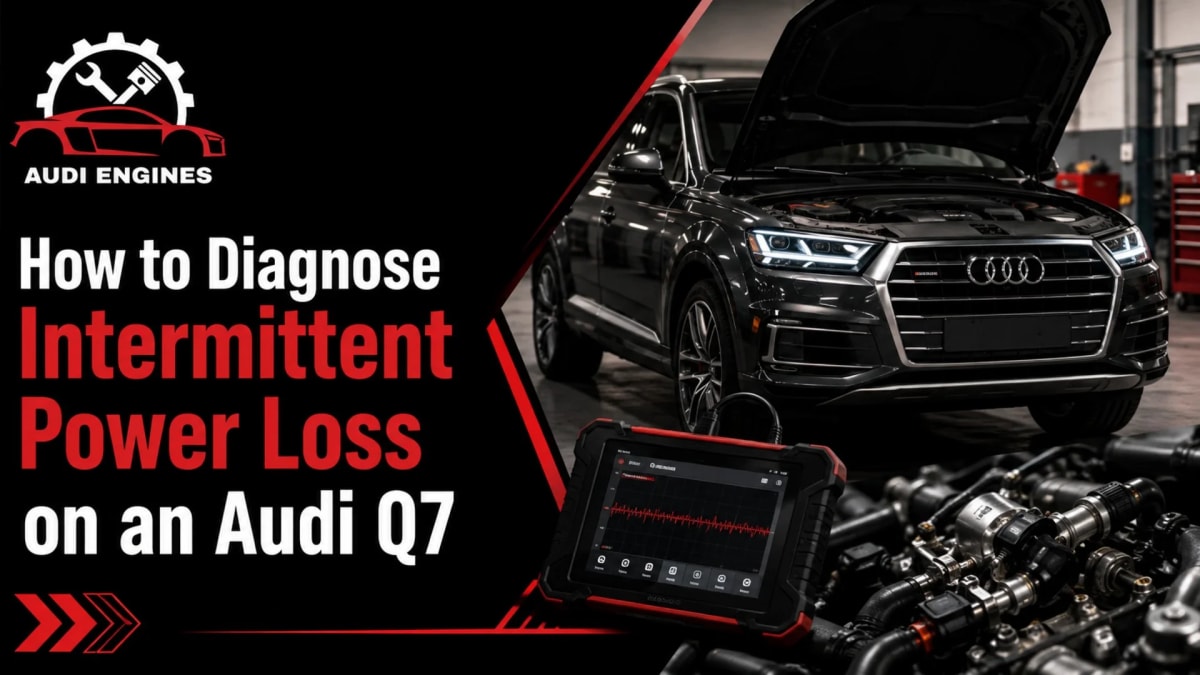
The first step is always pulling stored fault codes, but on an intermittent fault, live data matters just as much as the codes themselves. Watching boost pressure, MAF readings, and fuel rail pressure in real time, ideally while replicating the conditions that trigger the power loss, often reveals a marginal or fluctuating reading that a static code scan alone would miss entirely.
Testing Boost Pressure, MAF & Fuel Pressure
A proper diagnostic goes beyond reading codes:
- Boost pressure testing under load confirms whether the turbo is actually reaching its target pressure
- Smoke testing the charge air path identifies physical boost leaks that visual inspection alone can miss
- MAF and MAP sensor testing against expected values catches sensors that are reading plausibly but incorrectly
- Fuel pressure testing, particularly under simulated load, catches fuel delivery faults that only appear during acceleration
When a Generic Code Reader Isn't Enough
A basic OBD-II reader will tell you a code is stored, but it won't give you live boost data, won't run a proper turbo actuator test, and won't distinguish between the several different causes that can trigger the same code. This is exactly the gap that catches out DIY diagnosis and, sometimes, general garages too, as the earlier charge air cooler hose example shows, even a dealership can misdiagnose a boost leak as a failed turbo without a proper physical and data-based check.
When Should You Take Your Audi Q7 to a Specialist?
If you've had a code cleared and the power loss returns, if the fault only appears under specific conditions you can't easily replicate on demand, or if a previous repair hasn't resolved it, it's time for proper diagnostic equipment and Audi-specific knowledge rather than another round of guesswork. Genuinely intermittent faults are one of the areas where experience with this specific engine family, knowing where the common weak points are before you even connect a scanner, makes a real difference to how quickly the actual cause gets found.
Audi Q7 Diagnostics & Repair

Why Choose Audi Engines for Q7 Diagnostics
We diagnose Q7 power-loss faults using proper live data and boost testing, not just a code scan and a guess. Because we work on Audi engines specifically, we know the common failure points for both the 3.0 TDI and 3.0 TFSI, from charge air cooler hoses and EGR membranes to swirl flap actuators, which means less time spent ruling things out and more time spent fixing the actual fault.
How Much Does Audi Q7 Power-Loss Diagnosis Cost?
Diagnostic costs vary depending on how much testing is needed to pin down an intermittent fault, a straightforward stored code with an obvious cause costs less to diagnose than a fault that requires live data monitoring under load or a smoke test to trace. We'll always confirm the diagnostic cost with you upfront before any work begins, and that cost is typically deducted from the repair if you go ahead with us.
Book Your Audi Q7 Diagnostic Check Today
If your Q7 has been losing power intermittently, going into limp mode, or just doesn't feel right under acceleration, don't wait for it to become a constant fault. Get in touchAudi Q7 and we'll get it properly diagnosed.
Frequently Asked Questions
Why is my Audi Q7 losing power intermittently?
Intermittent power loss on a Q7 is usually the ECU reducing engine power in response to a fault with boost pressure, the EGR or DPF system, the MAF sensor, or fuel delivery. Because these faults are often condition-dependent, worse when hot, under load, or at specific RPM, the power loss can come and go rather than staying constant.
Why does my Audi Q7 go into limp mode?
Limp mode is triggered when the ECU detects a reading, typically boost pressure, airflow, or fuel pressure, outside its expected range, and reduces power to protect the engine while still allowing you to drive.
Can a bad turbo cause Audi Q7 power loss?
Yes, but a genuinely failed turbocharger is less common than a boost leak or actuator fault producing the same underboost symptom. Many cases diagnosed as "needs a new turbo" turn out to be a leaking hose, intercooler, or EGR vacuum leak instead.
Can a blocked DPF cause Audi Q7 power loss?
Yes. As the diesel particulate filter accumulates soot, exhaust backpressure rises and the ECU reduces power to limit further soot production, particularly if regeneration cycles have been repeatedly interrupted by short journeys.
Is Audi Q7 limp mode serious?
It's designed to let you drive safely to a garage rather than leaving you stranded, but it always indicates an underlying fault that needs diagnosing. Continuing to drive for an extended period without addressing it risks the underlying issue getting worse.
Audi Q7 loses power with no warning light, what does that mean?
It's common for marginal or early-stage faults, particularly boost or sensor issues, to cause noticeable power loss before they cross the threshold needed to trigger a stored fault code and warning light. The absence of a warning light doesn't mean there's nothing wrong.
How do I diagnose intermittent power loss on an Audi Q7?
Proper diagnosis combines reading stored fault codes with live data monitoring of boost pressure, MAF readings, and fuel pressure, ideally while replicating the conditions that trigger the fault, along with physical checks like smoke testing the charge air system for leaks.