
Audi Q7 Swirl Flap Fault Symptoms: Causes, P2015 Codes & Repairs
A warning light appears on your Audi Q7's dashboard, the engine feels noticeably less responsive than usual, and suddenly you're searching for answers you didn't expect to need. If your Q7 is fitted with the 3.0 TDI V6, there's a good chance you're dealing with a swirl flap fault.
A warning light appears on your Audi Q7's dashboard, the engine feels noticeably less responsive than usual, and suddenly you're searching for answers you didn't expect to need. If your Q7 is fitted with the 3.0 TDI V6, there's a good chance you're dealing with a swirl flap fault, one of the more well-documented issues on this engine, but also one that's frequently misdiagnosed because the symptoms can point to several different underlying problems.
This guide walks through exactly what those symptoms look like, what's actually happening inside your engine, what the fault codes mean, and what a proper repair should involve, without assuming every swirl flap fault has the same cause or the same fix.
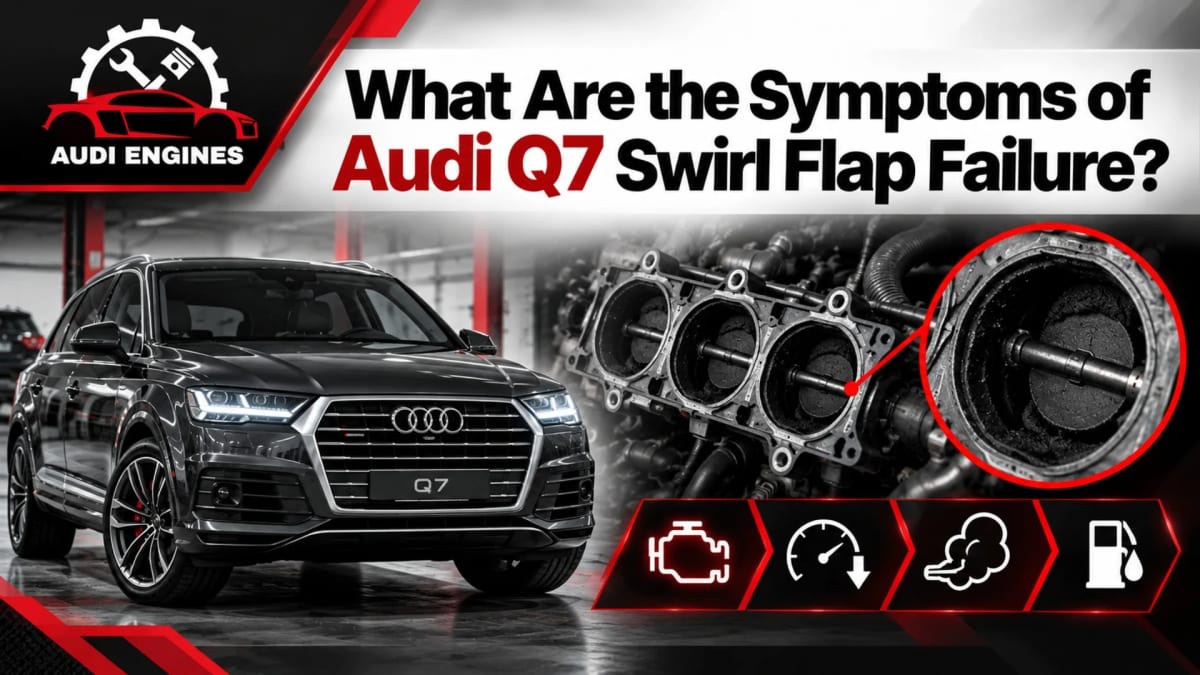
What Are the Symptoms of Audi Q7 Swirl Flap Failure?
What Does the Swirl Flap Do on the 3.0 TDI Engine?
Before the symptoms make sense, it helps to understand the job the swirl flap is actually doing. Inside the intake manifold, a set of swirl flaps, sometimes called intake runner flaps, open and close to control how air moves into each cylinder. At lower engine speeds, the flaps partially close to create a swirling motion in the intake air, improving combustion efficiency and reducing emissions. At higher RPM, they open fully to allow maximum airflow.
An electric actuator, controlled by the ECU, moves the flaps via a linkage system, with a position sensor feeding back the actual flap position so the engine management system knows the command was carried out correctly. When any part of that chain, actuator, linkage, sensor, or the flaps themselves, stops working properly, the engine reacts almost immediately.
Early Warning Signs, Check Engine Light and Intermittent Faults
The first indication is usually the check engine light, often triggered by a stored fault code before you notice any real difference in how the car drives. At this stage, the fault may be intermittent, appearing under certain conditions, then clearing itself temporarily. This is a genuinely useful window to get the car diagnosed before the problem develops further, rather than waiting for it to worsen.
Moderate Symptoms, Rough Idle, Sluggish Acceleration and Poor Fuel Economy
As the fault progresses, or if the flap is partially stuck rather than completely failed, you'll typically notice:
- Rough or unstable idle, particularly when the engine is cold
- Sluggish acceleration or a noticeable hesitation when you press the accelerator
- Increased fuel consumption, since incorrect airflow disrupts the air-fuel mixture and combustion efficiency
- Poor throttle response, especially at lower engine speeds where the swirl effect matters most
These symptoms tend to develop gradually, which is part of why owners often adjust to them without realising something is actually wrong.
Severe Symptoms, Limp Mode and Persistent Power Loss
Can a Faulty Swirl Flap Cause Limp Mode?
Yes, if the ECU detects that the flap position is significantly out of range from what's commanded, or if the fault becomes persistent rather than intermittent, the engine management system may activate limp mode as a protective measure. This restricts engine power and RPM to prevent further damage, and it's usually accompanied by a noticeably illuminated warning light and a significant, unmistakable drop in performance.
Can You Drive With a Faulty Audi Q7 Swirl Flap?
In the early stages, with an intermittent stored code and no noticeable performance change, driving short-term generally won't cause immediate damage. However, once you're experiencing rough idle, reduced power, or limp mode, continuing to drive risks compounding the problem, particularly if the root cause is carbon buildup or actuator strain, both of which tend to worsen with continued use. Getting it diagnosed promptly is the sensible move rather than waiting to see if it resolves itself.
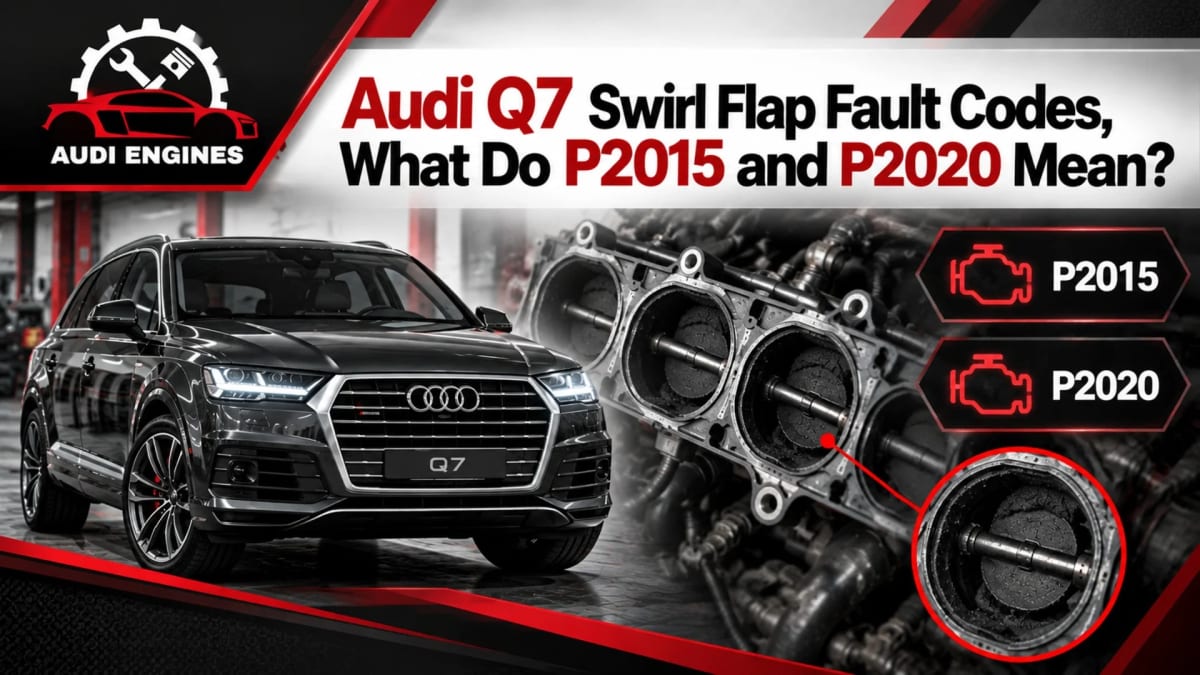
Audi Q7 Swirl Flap Fault Codes, What Do P2015 and P2020 Mean?
Fault codes are where a lot of online advice becomes vague or inaccurate, so it's worth being precise here.
Code | Meaning | Likely Area |
| P2015 | Intake manifold runner position sensor/switch circuit, range/performance | Bank 1 |
| P2020 | Intake manifold runner position sensor/switch circuit, range/performance | Bank 2 |
| P2004 | Intake manifold runner stuck open | Intake runner |
| P2006 | Intake manifold runner stuck closed | Intake runner |
| P1018 | Intake runner lower limit not reached | Intake runner |
| P3135 | Lower stop not reached | Runner actuator |
What Does Fault Code P2015 Mean on an Audi Q7?
P2015 indicates that the ECU has detected the intake manifold runner position sensor signal on Bank 1 isn't behaving as expected, the actual flap position doesn't match what the ECU commanded within an acceptable range. This is one of the most commonly reported codes on the 3.0 TDI, and it can stem from several different root causes, which is exactly why a code reader alone doesn't tell you the full story.
What Does Fault Code P2020 Mean on an Audi Q7?
P2020 is the equivalent fault on Bank 2, the same underlying issue, just affecting the opposite cylinder bank. Since the Q7's V6 TDI has two banks of cylinders, each with its own runner control system, it's entirely possible to see P2015 and P2020 stored together if both sides are affected, though it's more common to see one appear before the other.
P2015 vs P2020, Bank 1 vs Bank 2 Explained
Practically speaking, there's no meaningful difference in severity between the two, they represent the same type of fault on different sides of the engine. What matters more is establishing why the position sensor reading is off, which could be a mechanical issue (worn stop, linkage wear), an electrical issue (sensor or wiring fault), or a carbon-related restriction preventing the flap from reaching its commanded position.
Other Related Codes You Might See
P2004 and P2006, Runner Stuck Open or Closed
Unlike P2015/P2020, which relate to position sensor range and performance, P2004 and P2006 point to something more mechanically specific: the runner is stuck, either fully open or fully closed, rather than simply reading incorrectly. This distinction matters for diagnosis, since a stuck flap points more strongly toward a mechanical or carbon-related cause than an electrical one.
P1018 and P3135, Lower Limit and Actuator Stop Faults
P1018 and P3135 both relate to the actuator failing to reach its expected lower limit or stop position. These codes are frequently associated with a worn plastic stop inside the actuator mechanism, a known weak point on this system, where repeated movement gradually wears down a plastic component to the point where it can no longer provide an accurate mechanical reference point.
What Causes Audi Q7 Swirl Flap Failure?
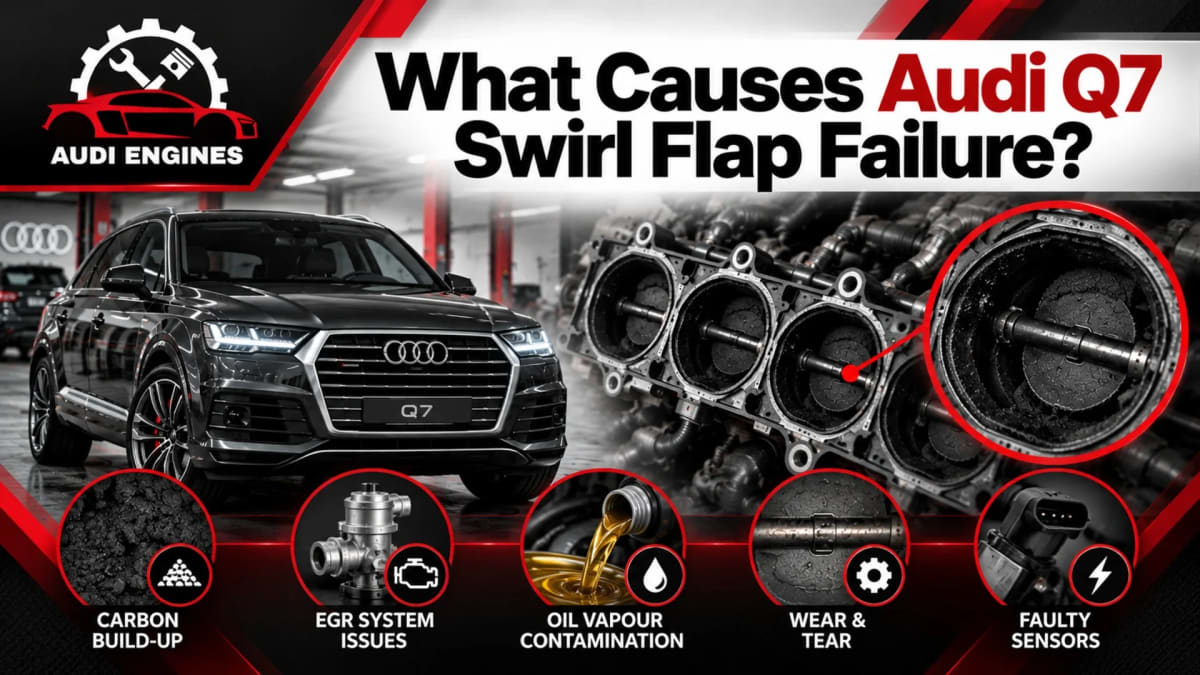
This is the section where most generic articles fall short, because they treat "swirl flap failure" as a single problem with a single fix. In reality, there are several distinct failure pathways, and knowing which one applies to your car changes the entire repair approach.
Worn Plastic Actuator Stop or Broken Linkage
The actuator mechanism relies on a small plastic stop to define its mechanical limits. Over time and repeated cycles, this component can wear down or crack, causing the actuator to over-travel past its intended position. Separately, the linkage connecting the actuator to the flaps themselves can wear, loosen, or break outright, a purely mechanical failure that shows up as inconsistent or implausible position readings.
Failed Actuator Motor or Position Sensor
Sometimes the mechanism itself is fine, but the actuator motor that drives it fails electrically, or the position sensor that reports flap location develops a fault. In this scenario, you might see no physical movement at all when the system is commanded to actuate, which is a meaningfully different symptom pattern from a worn mechanical stop.
Carbon Buildup and a Sticking Swirl Flap
How EGR Soot Contributes to Intake Manifold Carbon Buildup
Diesel engines with EGR (exhaust gas recirculation) systems, including the 3.0 TDI, recirculate a portion of exhaust gas back through the intake to reduce emissions. Over time, this process deposits soot and carbon inside the intake manifold and around the swirl flaps themselves. As deposits build up, the flaps can become stiff or physically restricted, unable to move freely even when the actuator and linkage are otherwise healthy. This is a gradual, mileage-related process rather than a sudden failure, and it's particularly common on vehicles used mostly for short journeys that rarely reach sustained higher engine speeds.
Wiring and Electrical Connector Faults
Less commonly, the issue traces back to the wiring harness or electrical connector serving the actuator or position sensor, corrosion, a loose connection, or damaged wiring can produce fault codes that look identical to a sensor or actuator failure until properly tested.
How to Tell Which Fault You Actually Have
Loose Linkage vs Stiff Linkage vs No Actuator Movement
This distinction is genuinely useful if you're trying to understand your own fault before booking a diagnostic appointment:
- Loose or excessive play in the linkage generally points to mechanical wear, a worn stop or a failing linkage arm
- Stiff or resistant movement, where the flap doesn't want to move freely, points toward carbon buildup restricting the mechanism
- No movement at all, even under a commanded actuator test, suggests an electrical fault, either the actuator motor itself or the wiring feeding it
Getting this differentiation right the first time saves both money and time, since a carbon-related fault needs cleaning, a mechanical fault needs a parts repair, and an electrical fault needs wiring diagnosis, three very different jobs that all start with the same warning light.
Diagnosing and Fixing an Audi Q7 Swirl Flap Fault

How Is a Swirl Flap Fault Diagnosed?
A proper diagnosis goes well beyond simply reading the stored fault code, since a code like P2015 tells you that something's wrong without telling you why.
VCDS Live Data and Actuator Output Testing
A thorough diagnostic approach using VCDS or a comparable diagnostic tool typically involves:
- Reading stored and pending fault codes across both banks, not just the one currently triggering the warning light
- Comparing commanded position versus actual position in live data, to see how far the real flap position deviates from what the ECU is requesting
- Running an actuator output test, physically commanding the actuator to move through its range while observing whether it responds correctly
- Checking basic settings and adaptation values, which can reveal whether the system has already tried and failed to relearn its reference positions
- A physical inspection of the linkage and actuator, checking for play, resistance, or visible wear once the manifold is accessible
This combination, electronic data plus physical inspection, is what actually identifies which of the failure pathways above applies to your specific car.
Swirl Flap Repair Options
Repair Bracket vs Actuator Replacement
For faults caused by a worn plastic actuator stop, a repair bracket, a metal replacement for the failed plastic component, is a well-established, cost-effective fix that avoids replacing the entire actuator or manifold. If the actuator motor itself has failed electrically, a full actuator replacement becomes the more appropriate option, since a bracket won't resolve a motor or sensor fault.
Intake Manifold Cleaning for Carbon-Related Faults
Where carbon buildup is the root cause, intake manifold cleaning, removing the manifold and thoroughly clearing accumulated soot and deposits from around the swirl flaps, can restore free movement without needing any parts replaced at all. This is often the most cost-effective outcome, provided the flaps and linkage haven't been mechanically damaged by the restriction over time.
Does the Intake Manifold Need Full Replacement?
Not always, and this is worth pushing back on if a garage jumps straight to replacement. Full intake manifold replacement is genuinely necessary when the flaps themselves are damaged or broken, when cleaning fails to restore proper movement, or when the manifold housing has sustained physical damage. But for many faults, particularly worn stops or carbon buildup, a targeted repair addresses the actual problem without the higher cost of full replacement.
How Much Does Audi Q7 Swirl Flap Repair Cost in the UK?
Costs vary significantly depending on which repair path applies. A repair bracket fix or intake manifold cleaning job typically sits at the lower end of the cost range, since it avoids expensive replacement parts. Actuator replacement costs more due to parts pricing, and full intake manifold replacement, particularly if both banks are affected, represents the highest cost outcome. This is exactly why an accurate diagnosis matters commercially as well as mechanically: a correct diagnosis can be the difference between a moderate repair bill and paying for a full manifold you didn't actually need.
Frequently Asked Questions
How do I know if my Audi Q7 swirl flap is faulty?
Watch for a combination of a check engine light, rough idle, sluggish acceleration, or reduced power. A definitive answer requires reading the stored fault code and checking live data to confirm whether the flap position matches what's being commanded.
Is Audi Q7 swirl flap repair expensive?
It depends entirely on the cause. Carbon-related cleaning or a repair bracket for a worn stop are comparatively affordable fixes. A failed actuator or a manifold requiring full replacement costs considerably more, which is why proper diagnosis before repair is worth the time.
Can swirl flap problems be prevented?
To some extent, yes. Regular longer journeys that let the engine reach higher, sustained RPM help reduce carbon accumulation around the flaps, and addressing any early warning light promptly, rather than waiting for symptoms to worsen, significantly reduces the risk of the fault progressing to actuator or linkage damage.
What does a stuck swirl flap sound like or feel like?
There's rarely a distinct noise associated with a stuck flap itself. Instead, you'll notice it through driving symptoms, rough idle, hesitation on acceleration, and reduced responsiveness, particularly at lower engine speeds where the swirl effect is most active.
Can carbon buildup really cause a fault code, not just a performance issue?
Yes. If carbon restricts the flap enough that it can't reach its commanded position, the ECU will register that mismatch as a fault code, even though the actuator and sensor themselves are working correctly.