
Audi Q7 Timing Chain Tensioner Replacement Cost UK 2026 Price Guide
Heard a rattle from under the bonnet when you start your Q7 on a cold morning? Before you assume the worst, it's worth knowing exactly what you're dealing with, because "timing chain tensioner replacement" and "full timing chain kit replacement.
Heard a rattle from under the bonnet when you start your Q7 on a cold morning? Before you assume the worst, it's worth knowing exactly what you're dealing with, because "timing chain tensioner replacement" and "full timing chain kit replacement" are two very different jobs with two very different price tags, and most cost guides don't make that distinction clearly enough.
That gap matters. Quote yourself for the wrong job, and you'll either overpay for work you didn't need, or underestimate a repair that turns out to be far more involved once a specialist gets the timing cover off.
This guide gives you a genuinely Q7-specific answer: what tensioner replacement actually costs in the UK, what the symptoms look like before it fails, when a tensioner-only repair is realistic, and when you're actually looking at a full timing chain kit, or something more serious.
How Much Does Audi Q7 Timing Chain Tensioner Replacement Cost?
In the UK, Audi Q7 timing chain tensioner replacement typically costs when the tensioner alone is the issue and no chain stretch or guide wear has developed. If the wider timing chain kit is also needed, which is common once a rattle has been present for a while, costs rise substantially, and on more involved Q7 3.0 TDI applications, the bill can reach or more.
For context, broader UK data on Audi timing chain work shows average replacement costs sitting around across the Audi range generally, while Q7-specific quote platforms report figures anywhere from roughly with dealer-level pricing often running. These wide ranges exist precisely because "Audi Q7 timing chain replacement" can mean several different repairs, which is exactly why breaking the cost down by actual repair scope matters more than a single average figure.
Audi Q7 Timing Chain Replacement Cost by Repair Scope
These figures are indicative rather than fixed. Actual pricing depends on your specific engine, how much has already worn, and how accessible the timing system is on your particular Q7's configuration, some layouts require considerably more labour to reach the timing chain than others.
Tensioner-Only Repair vs Full Timing Chain Kit
This is the distinction that most cost guides skip entirely, and it's the single most important thing to understand before you get a quote.
A tensioner-only repair replaces just the hydraulic tensioner unit, the component responsible for keeping constant pressure on the chain. If it's caught early, before the chain itself has stretched or the guides have worn, this is a comparatively contained job.
A full timing chain kit replaces the tensioner alongside the chain, guide rails, and often the sprockets too. This becomes necessary once chain stretch has developed, because a fresh tensioner paired with a worn, stretched chain won't solve the underlying problem, it'll just delay the same symptoms returning.
Audi Dealer vs Independent Specialist Cost
Where you have the work done makes a real difference to the final bill.
Factor | Audi Dealer | Independent Specialist |
| Labour rate | Typically higher | Usually lower |
| Parts | Genuine Audi only | Genuine or quality OEM-equivalent |
| Diagnostic fee | Often bundled, higher overall | Frequently more transparent |
| Turnaround | Can involve longer booking lead times | Often faster, especially for specialists |
| Q7-specific experience | Varies by branch | Frequently higher, if genuinely Q7/TDI focused |
An independent specialist with genuine Audi 3.0 TDI experience will often use the same quality of parts as a dealer, at a meaningfully lower labour cost, which is why so many Q7 owners are moving toward specialist repair rather than defaulting straight to the dealership.
Audi Q7 3.0 TDI Timing Chain Tensioner Cost
The 3.0 TDI V6 is the engine most commonly associated with Q7 timing chain and tensioner issues, and it's worth being specific here, "Audi Q7" alone isn't precise enough to price a repair accurately.
Engine Codes and Generations (4L vs 4M, CASA/CATA/CLZB/CRCA)
The first-generation Q7 (4L) covers earlier 3.0 TDI applications, commonly using engine codes such as CASA, CATA and CLZB. The second-generation Q7 (4M) moved to updated engine architecture, including codes like CRCA. These aren't interchangeable when it comes to repair, timing chain arrangement, access, and labour time can all differ between generations, which is part of why the cost range for "Q7 timing chain replacement" is so wide across different sources.
If you're getting a quote, having your exact engine code to hand (found on the engine block or your V5C alongside the VIN) will get you a far more accurate price than simply saying "Audi Q7 3.0 TDI."
What Affects the Final Price?
Beyond tensioner-only versus full kit, several factors move the price up or down:
- Engine generation and code, 4L and 4M Q7s aren't priced identically
- How much wear has already developed, caught early costs less than caught late
- Labour access, some Q7 timing system layouts require more disassembly than others
- Genuine vs aftermarket parts, genuine Audi components typically cost more but carry stronger reliability expectations
- Additional component wear, guides, sprockets, gaskets and seals often need attention alongside the chain itself
- Dealer vs independent specialist, labour rate differences alone can shift the bill by several hundred pounds
What Are the Symptoms of a Failing Audi Q7 Timing Chain Tensioner?
Catching tensioner wear early is what keeps this a £250–£450 job instead of a £1,400+ one. Here's what to listen and watch for.
Why Does My Audi Q7 Rattle on Cold Start?
This is the single most reported early symptom, and it's genuinely diagnostic, a tensioner in good condition maintains constant pressure on the chain even before oil pressure builds fully. As the tensioner wears, it loses some of that holding ability in the first few seconds after start-up, when oil is still circulating and pressure hasn't fully built. The result is a brief rattling or slapping noise that typically fades within a few seconds as oil pressure rises.
Cold-Start Rattle vs Normal Diesel Noise
It's worth being honest here: diesel engines are naturally louder and more mechanical-sounding than petrol engines, and not every noise on a cold Q7 means trouble. The distinction that matters is timing and consistency, a normal diesel clatter tends to be a steady, even sound throughout warm-up, while a tensioner-related rattle is typically sharper, more metallic, concentrated in the first few seconds, and often worsens gradually over weeks or months rather than staying constant.
Other Warning Signs to Watch For
Beyond the cold-start rattle, keep an eye out for:
- A ticking or knocking noise that persists even once the engine has warmed up, which can indicate the wear has progressed beyond the tensioner alone
- Chain slap, a looser, more rattly sound under light acceleration, suggesting the chain itself has developed some slack
- An illuminated engine warning light, sometimes accompanied by a stored fault code relating to camshaft or crankshaft correlation
- Rough running or misfires, which can appear once timing has drifted enough to affect valve timing accuracy
- Difficulty starting, occasionally reported alongside more advanced tensioner or chain wear
Ticking, Knocking or Chain Slap Noises
The progression from a brief cold-start rattle to a persistent tick or knock is genuinely meaningful. It generally signals that chain slack has increased to the point where guide rails are experiencing more movement than they're designed for, and guide wear is one of the key factors that turns a tensioner-only repair into a full timing chain kit replacement.
Rough Running, Misfires and Warning Lights
Once timing deviation becomes significant enough to affect valve or ignition timing, you'll typically notice it in how the engine actually drives, hesitation, uneven power delivery, or a warning light accompanied by stored codes referencing camshaft or crankshaft position sensors. At this stage, a proper diagnostic assessment isn't optional; it's essential before the vehicle covers further mileage.
How Is Audi Q7 Timing Chain Failure Diagnosed?
A proper diagnosis goes well beyond listening for noise. A thorough process typically includes:
- Noise assessment, confirming the rattle's timing and character on a cold start
- Fault code scan, checking for stored codes relating to timing or correlation faults
- Camshaft and crankshaft correlation check, comparing actual sensor data using diagnostic software such as VCDS
- Timing deviation measurement, quantifying how far the chain has drifted from its correct position
- Visual inspection where accessible, checking guide condition and chain tension directly
- Oil condition check, looking for metallic debris that can indicate advanced wear
This process is what separates a genuine diagnosis from guesswork, and it's exactly why a stored fault code alone shouldn't be treated as confirmation of which component has actually failed.
Can You Replace Just the Timing Chain Tensioner?
Sometimes, yes, but not always, and understanding the difference could save you from paying for a repair that doesn't actually solve the problem.
When Tensioner-Only Repair Is Appropriate
A tensioner-only replacement is realistic when the fault has been caught early: the rattle is brief and limited to cold starts, there's no persistent ticking once warm, no stored fault codes relating to timing deviation, and the chain itself hasn't developed measurable stretch. In this scenario, replacing the tensioner restores correct chain tension without the wider system needing attention.
Checking Chain Stretch, Guides and Sprockets
This is where a proper inspection earns its keep. Even if the tensioner is clearly the source of the noise, a specialist should still check:
- Chain stretch, elongation beyond factory tolerance means the chain itself needs replacing, not just the tensioner
- Guide rail condition, worn or cracked guides won't be fixed by a new tensioner alone
- Sprocket wear, damaged teeth on the camshaft or crankshaft sprockets indicate the fault has already affected more than just tension control
- Oil contamination, metallic particles in the oil suggest wear has progressed further than symptoms alone might indicate
- Overall mileage, a high-mileage Q7 with a failing tensioner is statistically more likely to have accompanying chain and guide wear than a lower-mileage example
If any of these are present, a tensioner-only repair isn't the right call, it addresses the symptom without the underlying wear, and the rattle or noise will likely return within a relatively short period.
What Happens If You Ignore the Rattle?
This is worth taking seriously, because the consequences of delay aren't gradual, they can escalate quickly.
From Chain Slack to Timing Deviation
Once a tensioner can no longer maintain proper chain tension, the chain develops slack. That slack allows small amounts of timing deviation to creep in, the camshaft and crankshaft no longer rotate in perfect synchronisation with each other. Modern engine management systems are often sensitive enough to detect this and log a fault code before things get dramatically worse, which is exactly why an early warning light shouldn't be ignored or reset without investigation.
Jumped Timing and Valve or Piston Damage
If slack progresses far enough, the chain can skip a tooth on a sprocket, commonly referred to as a jumped chain. On an interference engine, which the Q7's 3.0 TDI is, a significant timing jump can allow pistons and valves to make contact with each other. That's the point where a repair that could have cost a few hundred pounds turns into valve damage, piston damage, or in severe cases, a full engine rebuild running into several thousand pounds.
Repair or Engine Replacement? Making the Right Call
This decision depends on where the damage has actually reached:
- Tensioner or chain wear only, no internal contact, repair (tensioner-only or full kit) is the sensible option, and cost stays proportionate
- Minor timing deviation caught early with a fault code, usually still repairable without internal damage
- Confirmed valve or piston contact after a jumped chain, repair costs escalate significantly, and a rebuild or replacement engine may offer better value than attempting to salvage damaged components
- Older, higher-mileage Q7 with extensive damage, it's worth weighing the repair cost against the vehicle's overall value before committing
A useful real-world comparison: a Q7 owner who acts on a cold-start rattle promptly might pay or a tensioner replacement. An owner who ignores the same rattle for months, until it progresses to a jumped chain and valve damage, can end up facing a bill running into several thousand pounds, for what started as exactly the same fault.
Get Your Audi Q7 Timing Chain Tensioner Assessed
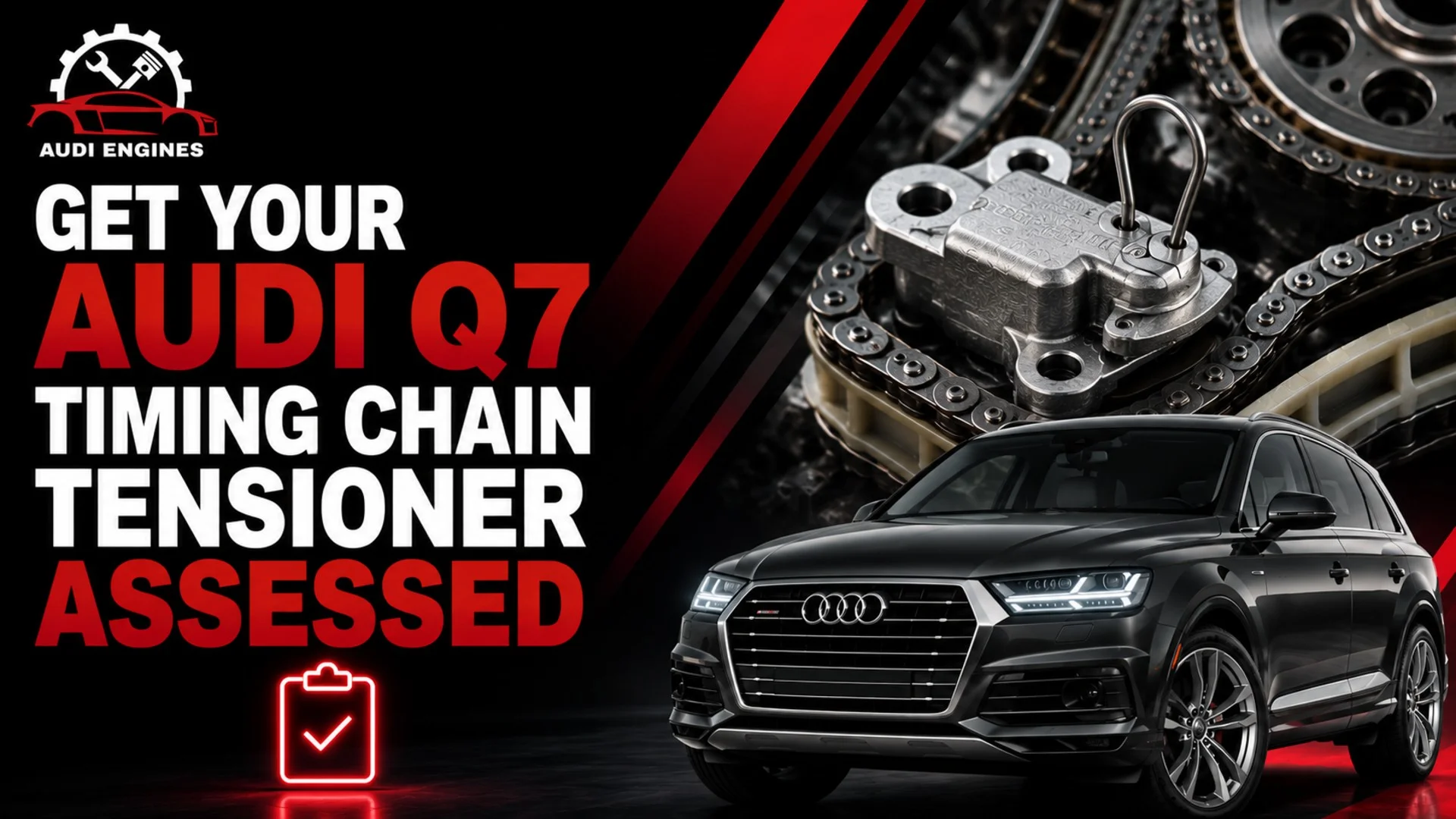
By now you should have a clear picture of what's realistic to expect cost-wise, what genuinely separates a tensioner-only repair from a full chain kit, and why acting on an early rattle is consistently the cheaper path.
Why Choose Audi Engines for Your Q7 Repair
As Audi-focused specialists, the team at Audi Engines works specifically on Q7 and 3.0 TDI timing systems, not as one job among many unrelated makes. That means faster, more accurate diagnosis, correctly sourced parts matched to your exact engine code and generation, and a transparent recommendation on whether your Q7 genuinely needs a tensioner-only repair or a full chain kit, rather than an automatic upsell to the more expensive job.
Frequently Asked Questions
How long does an Audi Q7 timing chain last?
There's no fixed replacement interval published for most Q7 timing chains, as they're designed to last the life of the engine under normal conditions. In practice, tensioner and chain wear becomes more common from around 80,000–120,000 miles onward, particularly where oil change intervals have been extended or missed.
Is a broken timing chain an MOT failure?
A timing chain fault severe enough to cause a warning light, rough running, or audible mechanical noise can result in an MOT failure, since testers are required to flag issues affecting safe and reliable operation of the vehicle. It's best addressed before the test rather than risking a fail.
Can I drive with a timing chain tensioner problem?
It's not advisable beyond getting the vehicle safely to a specialist for assessment. A failing tensioner can progress from a minor rattle to chain slack and timing deviation more quickly than owners expect, and continuing to drive increases the risk of the fault becoming a jumped chain with serious engine damage.
Does Audi Q7 timing chain replacement include the tensioner?
When a full timing chain kit is specified, yes, the tensioner is typically included alongside the chain, guides, and often the sprockets, since replacing the chain without a fresh tensioner would leave a worn component back in the system. If only the tensioner is being replaced, the chain and guides are inspected but not automatically replaced unless wear is found.
How much does Audi Q7 timing chain tensioner replacement cost in the UK?
Typically a tensioner-only repair where no chain stretch or guide wear is present. If the full timing chain kit is needed, costs rise to roughly depending on the engine and repair scope.
Which Audi Q7 has timing chain issues?
Timing chain and tensioner wear is most commonly reported on the 3.0 TDI V6 across both Q7 generations, the earlier 4L (engine codes including CASA, CATA, CLZB) and the later 4M (including CRCA), though exact susceptibility varies by production year and maintenance history.
Book a Diagnostic or Get a Fixed-Price Quote
If your Q7 is showing any of the symptoms covered here, a cold-start rattle, a persistent tick, a warning light, or rough running, the smartest next step is a proper diagnostic assessment before deciding on repair scope. Get in touch with Audi Engines for an honest, Q7-specific quote based on your exact engine and condition, not a generic estimate. Catching a tensioner fault early is consistently the difference between a straightforward, affordable repair and a far more expensive one down the line.