
Audi Q7 White Smoke on Startup: Causes and How to Diagnose It
You turn the key, your Audi Q7 fires up, and a cloud of white smoke rolls out from the exhaust. Maybe it clears within a few seconds. Maybe it lingers longer than you'd like.
You turn the key, your Audi Q7 fires up, and a cloud of white smoke rolls out from the exhaust. Maybe it clears within a few seconds. Maybe it lingers longer than you'd like. Either way, your first thought is probably somewhere between "is this normal?" and "please don't be a head gasket."
Here's the honest answer: it depends. A small puff of white vapour that disappears within a few seconds is often nothing more than condensation. But persistent or heavy white smoke, especially on an Audi Q7 3.0 TDI, can point to something far more specific, either coolant finding its way into the engine, or unburnt diesel that isn't combusting properly. These are two completely different problems with two completely different repair paths, and mixing them up is exactly why so many owners end up chasing the wrong fix.
This guide walks you through both pathways, shows you exactly how to tell them apart using the smell, timing, and accompanying symptoms of your smoke, and explains what to do next depending on what you find.
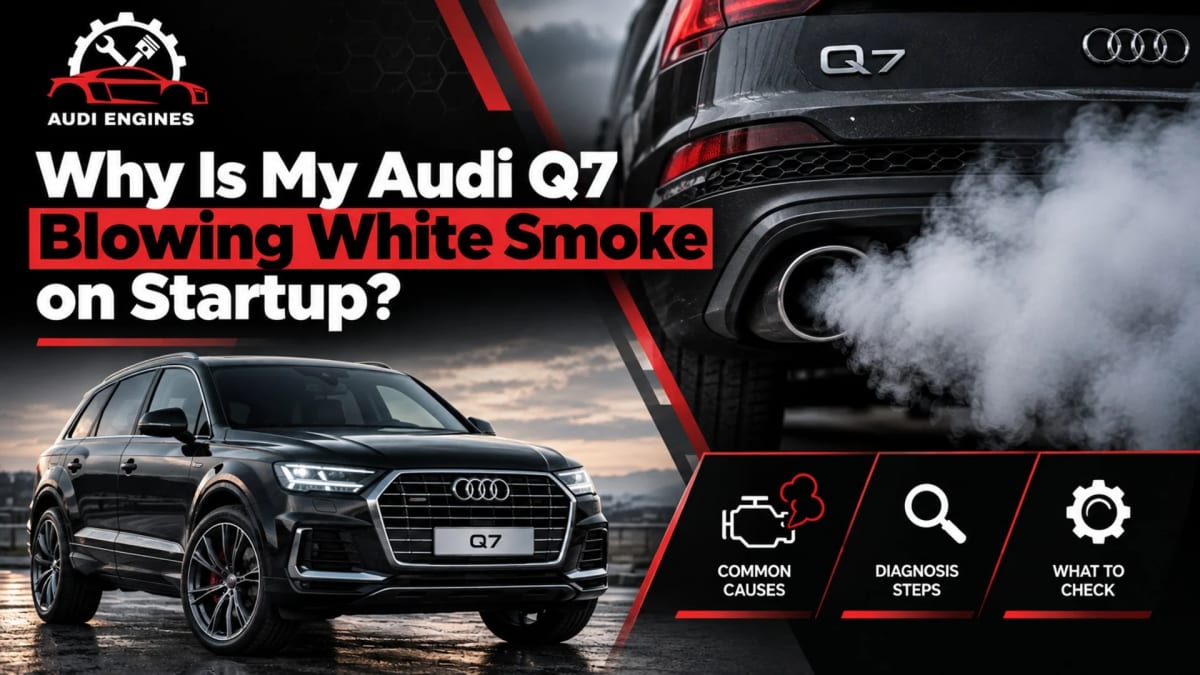
Why Is My Audi Q7 Blowing White Smoke on Startup?
Is White Smoke From an Audi Q7 Always a Problem?
No, not always. Every engine produces some water vapour as a natural byproduct of combustion, and on cold mornings, that vapour can condense in the exhaust system overnight and get pushed out as visible white smoke the moment you start the engine. This is completely normal and nothing to worry about.
Normal Condensation vs a Genuine Fault: How to Tell Them Apart
The key differences come down to duration and consistency. Condensation typically clears within a few seconds to maybe half a minute, tends to happen more on cold or damp mornings, and doesn't return once the exhaust has warmed through. A genuine fault, on the other hand, tends to produce smoke that lingers longer, returns every time you start the car regardless of weather, or shows up alongside other symptoms like coolant loss, hard starting, or a rough idle.
Does the Audi Q7 3.0 TDI Smoke More Than Other Engines?
The 3.0 TDI V6 diesel fitted to the Q7 isn't inherently more prone to smoking than other diesel engines, but it does have specific components, particularly the EGR cooler and glow plug system, that owner communities frequently associate with white smoke complaints when something goes wrong. Diesel engines in general are also more likely to produce visible white smoke during combustion issues compared with petrol engines, simply because of how diesel fuel burns.
Why Does My Audi Q7 Only Smoke When Cold or After Sitting Overnight?
This pattern is actually quite informative. Cold-start-only smoke that disappears once the engine warms up often points toward either condensation (the most benign explanation) or a combustion-related issue that's more pronounced when the engine and glow plug system haven't reached operating temperature yet.
Why the Smoke Often Disappears Once the Engine Warms Up
Once the engine and exhaust reach normal operating temperature, several things change simultaneously: any condensation has long since burned off, glow plugs (if functioning correctly) have finished their job, and combustion becomes more complete and efficient. This is why smoke that vanishes after a minute or two of driving is generally less alarming than smoke that persists continuously, even once the engine is fully warm.
The Two Real Causes Behind Audi Q7 White Smoke
Once you've ruled out simple condensation, genuine white smoke on the Q7 splits into two distinct diagnostic pathways, and figuring out which one you're dealing with changes everything about the repair.
Coolant Entering the Engine vs Unburnt Diesel: Why the Difference Matters
The first pathway involves coolant getting into the combustion chamber, typically via a failing EGR cooler, a leaking head gasket, or in more serious cases, a cracked cylinder head. When coolant burns alongside diesel, it produces a distinctive white smoke, often with a faintly sweet smell, and is usually accompanied by coolant loss over time.
The second pathway involves diesel fuel that isn't combusting properly, caused by faulty injectors, worn glow plugs, incorrect injection timing, or low cylinder compression. This produces white smoke that smells distinctly of raw diesel rather than anything sweet, and tends to come with hard starting or rough idling rather than coolant loss.
What's Causing the White Smoke, Coolant or Unburnt Diesel?

Does the Smoke Smell Sweet or Like Diesel Fuel?
Before you do anything else, get close enough to the exhaust (once it's safe to do so) and pay attention to the smell. This single detail does more diagnostic heavy lifting than almost anything else you can check without tools.
Audi Q7 White Smoke Diagnostic Table: Condensation vs EGR Cooler vs Head Gasket vs Injector/Glow Plug
Symptom | Condensation | EGR Cooler Leak | Head Gasket Failure | Injector/Glow Plug Fault |
| White smoke present | Yes | Yes | Yes | Yes |
| Clears quickly | Usually | Sometimes | Sometimes | Often |
| Sweet smell | No | Possible | Possible | No |
| Diesel smell | No | No | No | Often |
| Coolant loss | No | Often | Often | No |
| Hard starting | No | Possible | Possible | Common |
| Rough idle | No | Possible | Possible | Common |
| Cold-start specific | Yes | Possible | Possible | Common |
| Coolant reservoir pressure | Normal | Can increase | Can increase | Normal |
| How it's confirmed | Visual observation | EGR/pressure testing | Leak-down/block testing | Injector/glow plug/compression testing |
This table won't replace a proper diagnostic, but it gives you a strong starting point for narrowing down which specialist checks are worth prioritising.
Is Your Audi Q7 Losing Coolant Along With the White Smoke?
If you've noticed you're topping up the coolant reservoir more often than you used to, or the low coolant warning has appeared on the dash, this is a significant clue pointing toward the coolant pathway rather than a fuel-combustion issue.
Can an EGR Cooler Leak Cause Audi Q7 White Smoke and Coolant Loss?
Yes, and this is one of the more commonly reported causes among Q7 3.0 TDI owners. The EGR cooler uses coolant to cool exhaust gases before they're recirculated into the intake, and when its internal seals or core fail, coolant can leak into the exhaust or intake system. This produces exactly the combination many owners report: white smoke alongside gradually decreasing coolant levels, sometimes with no single obvious leak visible anywhere else in the engine bay.
Audi Q7 EGR Cooler vs Head Gasket: Which One Is Actually Leaking?
Both faults can produce a near-identical symptom picture, which is exactly why this comparison matters so much. An EGR cooler leak tends to develop gradually, with coolant loss appearing before more serious symptoms, and often without overheating in the early stages. A head gasket failure is more likely to bring overheating, a build-up of pressure in the coolant system, and sometimes a rougher-running engine as compression is affected. The only reliable way to tell them apart is through pressure testing the cooling system and, if needed, a leak-down or block test, guessing based on smoke alone risks paying for the wrong repair.
Is Your Audi Q7 Hard to Start Along With the White Smoke?
Hard or delayed starting paired with white smoke shifts the diagnostic conversation firmly toward the fuel-combustion pathway rather than coolant.
Can Faulty Glow Plugs or Injectors Cause White Smoke on a Q7?
Yes. Glow plugs heat the combustion chamber before and during cold starts to help diesel fuel ignite properly. When one or more glow plugs fail or weaken, combustion becomes incomplete, particularly on cold mornings, producing visible white smoke along with a longer crank time before the engine catches. Faulty injectors cause a similar effect by delivering fuel incorrectly, either too much, too little, or with poor atomisation, leading to unburnt diesel passing straight through as smoke.
Can Low Compression or Incorrect Injection Timing Cause White Smoke?
Yes, both can. Low compression means the engine struggles to generate the heat and pressure needed for diesel to ignite efficiently, especially when cold, resulting in incomplete combustion and smoke. Incorrect injection timing has a similar effect, disrupting the precise sequence diesel engines rely on for clean combustion, and Q7 owner discussions frequently mention timing and injector issues appearing together with hard-start symptoms.
Is the White Smoke Paired With Rough Idle or Loss of Power?
A rough or uneven idle alongside white smoke reinforces the combustion pathway rather than coolant, since it suggests the engine isn't burning fuel evenly across all cylinders. This combination, especially alongside hard starting, is a strong signal to have injectors, glow plugs, and compression checked before assuming anything coolant-related is at play.
How Is Audi Q7 White Smoke Diagnosed and Can You Keep Driving?

How Do Mechanics Diagnose the Cause of White Smoke on a Q7?
A proper diagnosis doesn't rely on guesswork or smoke colour alone, it uses specific tests designed to isolate exactly where the problem sits.
Coolant Pressure Testing, Compression Testing and Injector Testing Explained
A cooling system pressure test checks whether the system holds pressure correctly, which helps identify leaks at the EGR cooler, head gasket, or elsewhere in the cooling circuit without needing to dismantle the engine first. A compression test measures how well each cylinder holds pressure during the combustion stroke, quickly revealing whether low compression is contributing to poor combustion and smoke. Injector testing, meanwhile, checks fuel delivery and spray pattern for each injector individually, which can identify a single faulty injector causing disproportionate smoke from one cylinder rather than a system-wide fault.
Can You Keep Driving an Audi Q7 With White Smoke From the Exhaust?
This depends heavily on which pathway you're dealing with, and how severe the symptoms are.
When It's Safe to Drive a Short Distance vs When to Stop Immediately
If the smoke is brief, disappears within a minute of driving, and there's no coolant loss, overheating, or performance issue, it's generally safe to continue driving normally while you arrange a proper check. However, if you're seeing continuous heavy smoke, a rising temperature gauge, or your coolant warning light has appeared, you should stop driving as soon as it's safe to do so, continuing to drive with coolant entering the combustion chamber risks compounding damage to the cylinder head, pistons, or catalytic converter, turning a moderate repair into a much larger one.
How Much Does It Cost to Fix Audi Q7 White Smoke in the UK?
Costs vary enormously depending on which fault is actually responsible, so getting an accurate diagnosis first will save you money rather than cost you extra.
EGR Cooler Replacement vs Head Gasket Repair vs Injector Replacement Cost
An EGR cooler replacement is typically the more affordable of the coolant-related repairs, involving parts and a few hours of labour. Head gasket repair sits considerably higher, since it involves removing the cylinder head and checking for any warping or additional damage caused by overheating. Injector replacement cost depends on whether one or multiple injectors need attention, and glow plug replacement is usually one of the more affordable fixes on this list when caught early. Getting a specific quote based on your confirmed fault, rather than a generic estimate, is always the smarter approach given how differently these repairs are priced.
Get Your Audi Q7 White Smoke Properly Diagnosed and Fixed
Why Choose Audi Engines.co.uk for Q7 Diagnostics and Repair?
We work specifically on Audi Engines.co.uk and VAG-group engines, which means the distinction between an EGR cooler leak, a head gasket fault, and an injector or glow plug issue isn't guesswork for us, it's the kind of Q7-specific diagnosis we carry out regularly. Rather than assuming the worst-case repair, we test properly first, so you're only paying for the fix your Q7 actually needs.
Should You Buy a Used Audi Q7 That Blows White Smoke on Startup?
If you're viewing a used Q7 and notice white smoke on startup, it's not automatically a reason to walk away, but it absolutely deserves proper investigation before you commit to buying.
Checklist: Questions to Ask Before Buying a Smoking Q7 3.0 TDI
- Ask the seller how long the smoke lasts and whether it happens every single start or only occasionally
- Check the coolant level and coolant reservoir cap for any signs of contamination or unusual residue
- Ask for service history related to the EGR cooler, injectors, or glow plugs, not just general servicing
- Listen for hard starting during the viewing, ideally on a cold engine that hasn't been pre-warmed
- Check for any warning lights currently showing or recently cleared from the dashboard
- Consider requesting a pre-purchase diagnostic inspection if the smoke seems more than momentary condensation
How to Book an Audi Q7 White Smoke Diagnostic
If you're dealing with ongoing white smoke, coolant loss, or starting problems, the process starts with a simple conversation about your registration, the symptoms you've noticed, and how long you've had the issue. From there, we can run the appropriate pressure, compression, or injector tests to confirm exactly what's happening under the bonnet, and give you a genuine repair recommendation rather than a guess.
Frequently Asked Questions About Audi Q7 White Smoke on Startup
Is white smoke from an Audi Q7 always a sign of a serious problem?
No. Brief white smoke that clears within seconds, particularly on cold mornings, is often just condensation. Persistent or heavy smoke, especially paired with coolant loss or hard starting, is more likely to indicate a genuine fault.
How can I tell the difference between condensation and a coolant leak on my Q7?
Condensation clears quickly and doesn't return once the exhaust warms up. A coolant leak tends to produce smoke that returns consistently and is usually accompanied by falling coolant levels over time.
Why does my Audi Q7 smoke more on cold mornings than in warm weather?
Cold starts place more demand on the glow plug system and combustion process generally, which is why both condensation and early-stage combustion faults tend to show up more visibly when the engine is cold.
Can I keep driving my Audi Q7 if I see white smoke from the exhaust?
If the smoke is brief and there's no coolant loss or overheating, short-term driving is usually fine while you arrange a check. Continuous heavy smoke alongside a rising temperature gauge means you should stop driving and get it inspected immediately.
How much does it cost to fix an Audi Q7 that's smoking due to a head gasket issue?
Head gasket repair is one of the more expensive fixes on this list, since it requires removing the cylinder head and checking for any additional damage. Getting a confirmed diagnosis first ensures you're not paying for head gasket work when the actual fault is a cheaper EGR cooler or injector issue.
Can faulty glow plugs really cause white smoke, or is it always coolant-related?
Faulty glow plugs absolutely can cause white smoke, particularly on cold starts, and this is unrelated to coolant. The smell test is the easiest way to tell them apart, diesel smell suggests glow plugs or injectors, while a sweet smell suggests coolant.