

Audi RS3 Coolant Flange Leak Symptoms: How to Spot, Diagnose and Fix It
You top up the coolant on Saturday. By the following weekend, the level had dropped again. There's no puddle on the driveway and no obvious drip, yet the low coolant warning keeps coming back, and you may have caught a faint sweet smell after a hard drive.
You top up the coolant on Saturday. By the following weekend, the level had dropped again. There's no puddle on the driveway and no obvious drip, yet the low coolant warning keeps coming back, and you may have caught a faint sweet smell after a hard drive.
That pattern is one of the most common signs of a slow coolant leak on the 2.5 TFSI five-cylinder, and the cylinder-head coolant flange is one of the places it can come from.
The main Audi RS3 coolant flange leak symptoms are repeated coolant loss, a low coolant warning, a sweet smell after driving, dried pink or purple residue near the cylinder head, and temperature fluctuations. In advanced cases the engine overheats. The catch is that a water pump, thermostat housing or hose leak can look almost identical, so guessing can cost you money.
At audiengines.co.uk, we work on Audi engines in the UK, and cooling faults on the 2.5 TFSI are a regular part of that work. This guide covers what a flange leak looks like, how to tell it from its neighbours, what a proper diagnosis involves, and what the repair should include.
What Are the Symptoms of an Audi RS3 Coolant Flange Leak?
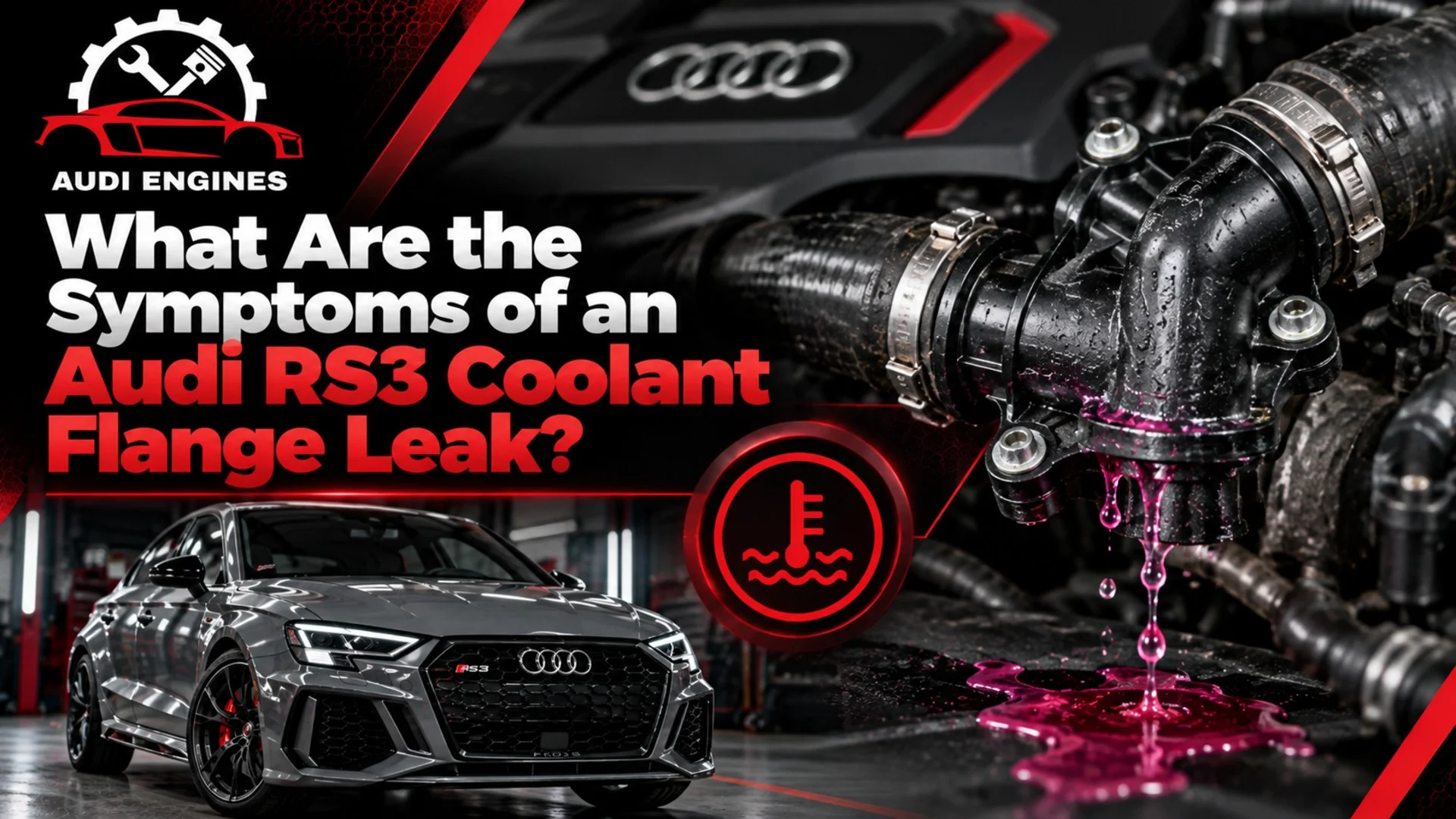
The coolant flange is a small component, but it carries hot, pressurised coolant. It connects the cooling circuit to the cylinder head, and it relies on a seal or O-ring to stay leak-free. When that joint starts to weep, the symptoms tend to build slowly rather than arrive all at once.
Here are the signs to watch for, roughly in the order most owners notice them:
- Repeated low coolant warnings. The warning returns even after you've topped up.
- A falling coolant level. You need to add coolant every few weeks, or more often.
- A sweet, syrupy smell. It's usually strongest after a drive, when the engine bay is hot.
- Pink or purple residue. You'll see it around the cylinder head or the flange area.
- Temperature fluctuations. The gauge wanders when it used to sit steady.
- Overheating. This is a late-stage symptom, and it means you should stop driving.
None of these on its own proves the flange is at fault. Together, especially with residue in the right place, they point strongly in that direction. Treat the list as a reason to investigate, not as a diagnosis.
Can an Audi RS3 Coolant Flange Leak Without a Visible Puddle?
Yes, and this is why so many owners are confused for weeks.
A flange leak often starts as a seep, not a drip. Under pressure and heat, a small amount of coolant escapes from the joint. It lands on hot metal and evaporates, leaving only a thin, dried deposit behind. When the engine cools and the system depressurises, the leak may stop altogether, so nothing reaches the ground.
That's why a car can lose coolant steadily while the parking spot stays dry. You may also notice the smell more than any visible fluid, because the coolant is turning to vapour before you can see it.
Here's a scenario we see often. An owner notices the level dropping about once a fortnight. They top up, assume its normal evaporation, and carry on. Weeks later the warning light stays on, and the underside shows nothing. Only a pressure test with the engine bay properly inspected reveals the source. A cooling system should not need regular topping up, so if yours does, something is leaking.
What Does Pink or Purple Coolant Residue Around the Flange Mean?
Residue is the closest thing to a fingerprint that a slow leak leaves. Audi coolant is typically pink or purple, so any coloured deposit near the cylinder head deserves a closer look.
Here's how to read what you're seeing:
- Wet and glistening. The leak is active or very recent.
- Dried and crusty. Coolant has been escaping for some time, and the moisture has evaporated, leaving a crust behind.
- A faint tide mark. This suggests an intermittent seep that only appears when the engine is hot and pressurised.
Look at where the residue sits as well as what it looks like. Coolant can run downhill from a higher joint, so the wettest spot isn't always the source. Always trace the trail upward to where it begins.
A quick safety note: coolant is toxic and harmful to pets, so wipe up spills and never touch the engine bay when it's hot. Wear gloves if you're inspecting by hand, and let the engine cool fully first.
Is It a Coolant Flange Leak or a Head Gasket Failure?
This is the worry that sends many owners into a spiral. The good news is that coolant loss does not automatically mean a failed head gasket.
An external leak, such as a weeping flange, loses coolant to the outside of the engine. You'll usually find residue, a smell, and a falling level, with no change in how the engine runs.
A head gasket problem is different. Coolant is lost internally, so you'd look for signs like persistent white exhaust smoke, milky or contaminated oil, bubbling in the expansion tank, or unexplained overheating and rough running.
If you're seeing residue and a slow drop in level, a flange, hose or pump leak is far more likely. We always recommend proper diagnosis before anyone assumes the worst, because an external leak is a much smaller repair.
How Do You Diagnose an Audi RS3 Coolant Leak Correctly?

Diagnosis is where the money is saved or wasted. Replacing parts on a hunch is a common mistake, and the RS3's cooling system has several joints and components packed into a tight engine bay.
A sound diagnosis follows a sequence:
- Visual inspection. Check the engine bay for wet areas, staining and residue.
- Coolant level check. Confirm the level when the engine is cold, and note how quickly it drops.
- Residue inspection. Trace any deposits back to their highest point.
- Cooling system pressure test. Pressurise the system to reproduce the leak.
- Component isolation. Narrow down the exact joint or part that is failing.
- Repair and refill. Replace the failed part and refill with the correct coolant.
- Bleed and recheck. Bleed the system, then pressure-test again to confirm the repair.
The pressure test matters most. It forces coolant out of the weak point even when the engine is cold, so a leak that hides during normal driving becomes visible. A leak-detection dye can help confirm a stubborn source, and a diagnostic scan can rule out related fault codes.
Where Is the Coolant Flange on an Audi RS3 8V and 8Y?
The coolant flange sits on the cylinder head, where it connects the head to the cooling circuit. Parts catalogues list it as a cylinder-head coolant flange on the driver's side of the cylinder head. Because the 2.5 TFSI is mounted transversely, "driver's side" can be confusing under the bonnet, so confirm the location on the car itself before you start looking.
Some context on the engines helps here:
- Audi RS3 8V: the 2.5 TFSI five-cylinder turbo, with the DAZA engine code on later cars.
- Audi RS3 8Y: the updated 2.5 TFSI, with the DNWA engine code.
The flange part number 07K121133E is listed for both the 8V (2018 onwards) and the 8Y RS3 2.5T. Even so, fitment can vary by build date, so verify the part against your VIN before you order anything. It's a five-minute check that can prevent a costly return.
Working in this area means dealing with a hot, pressurised system, which is another reason most owners leave the job to a specialist. If you're unsure about what you're looking at, a workshop can confirm it quickly.
How Can You Tell a Coolant Flange Leak From a Water Pump or Thermostat Housing Leak?
This is the question that matters most, because these components sit close together and can leave similar evidence. Most online guides focus on the water pump and thermostat housing and barely mention the flange. That's exactly why flange leaks get misdiagnosed.
The table below shows how the common leak sources compare:
Component | Typical symptoms | Where residue tends to appear |
| Coolant flange | Slow seepage, coolant loss, dried residue, sweet smell | On or around the cylinder-head flange joint |
| Water pump | Coolant loss, residue, overheating, sometimes noise | Around the pump body and its housing |
| Thermostat housing | Temperature regulation problems, seepage, coolant loss | Around the housing and its connections |
| Coolant hoses | Visible dripping, cracks, wet or loose connections | Along the hose and at the clamps |
| Expansion tank | Cracks, coolant loss, low level warning | Around the tank and its seams |
| Radiator | Coolant leak at the front of the car | Front end, under the radiator |
A few things stand out when you read across those rows. A thermostat problem often shows up as odd temperature behaviour, not just a leak. A radiator leak usually appears at the front, which separates it quickly from an engine-mounted flange. The water pump and flange are the hardest to tell apart by eye alone.
That's where the pressure test earns its keep. It shows which joint gives way under load, rather than which one merely looks wet. In our experience, a leak that looks like the flange is sometimes coming from a neighbouring component, and the reverse is true too.
Not sure which part is leaking? Our RS3 coolant diagnosis includes a full pressure test, so you know exactly what needs fixing before you spend anything on parts.
How Much Does Audi RS3 Coolant Flange Replacement Cost, and Why Choose a Specialist?

Cost is the question everyone asks, so it deserves an honest answer. The final figure depends on the car and on what else is found during the job, which is why a diagnosis comes first.
Can You Drive an Audi RS3 With a Coolant Leak, and What Does Repair Cost?
Start with the driving question. A small leak may let you drive for a short time, but it isn't safe to ignore. Coolant loss can build into overheating quickly, and overheating a turbocharged five-cylinder is the fastest way to turn a small repair into a major one. If the temperature gauge climbs or a warning appears, stop safely and switch off. Keep essential driving to a minimum until the leak is fixed.
Several things shape the cost of a coolant flange replacement:
- Labour time. Access on the 2.5 TFSI can be tight, and that affects the hours involved.
- The parts. This includes the flange itself and a new O-ring or seal.
- Coolant. The system needs refilling with the correct specification.
- Related components. If nearby hoses or connections are worn, replacing them at the same visit can save you a second repair bill.
A proper repair covers more than swapping one part. It should include replacing the flange and its seal, refilling with the correct coolant, bleeding the system to remove trapped air, and pressure-testing afterwards. Skipping the bleed or the final test is how leaks and airlocks come back.
Why Book Your Audi RS3 Coolant Leak Repair With Audi Engines?
A general garage can handle a coolant leak on many cars. The RS3 is a different proposition. The 2.5 TFSI is a compact, high-output engine, and its cooling system leaves little room for error.
Here's what we bring to the job:
- Audi-focused experience. We work on Audi engines every day, including the 2.5 TFSI.
- Proper diagnostics. Pressure testing and leak detection find the real source before we replace anything.
- Quality parts. We use genuine or OEM-quality components.
- Warranty on our work.
Owners often ask how a specialist compares with a main dealer on price and turnaround. What we can promise is a clear explanation of what's wrong, what it costs, and what needs doing now versus later.
Frequently Asked Questions About Audi RS3 Coolant Flange Leaks
Can a leaking coolant flange cause overheating?
Yes. A leak reduces the coolant available to carry heat away from the engine. A small seep may only trigger warnings at first, but as the level drops, the engine can overheat. Overheating is an emergency, so stop driving if it happens.
Can a pressure test find a coolant flange leak?
Yes. A cooling system pressure test is one of the most reliable ways to find one. It reproduces the pressure that pushes coolant out of a weak joint, even when the engine is cold and nothing is visibly leaking.
Should the O-ring be replaced with the coolant flange?
Yes, that's best practice. The seal is a key part of the joint, and reusing an old one risks the leak returning. Replacing it at the same time costs little and protects the repair.
Why is my Audi RS3 losing coolant but I can't see a leak?
The most likely reason is a slow seep that evaporates on hot metal before it reaches the ground. Residue, a sweet smell and a falling coolant level are the clues. Less commonly, coolant can be lost internally, which is why proper diagnosis matters.
How do I know if my Audi RS3 coolant flange is leaking?
Look for dried pink or purple residue around the cylinder-head flange, a falling coolant level, a sweet smell after driving and repeated low coolant warnings. A pressure test will confirm it.
Where is the coolant flange on an Audi RS3?
It sits on the cylinder head, listed on the driver's side of the head for the 2.5 TFSI. Confirm the exact location on your car, and check part number 07K121133E against your VIN.
How can I tell a water pump leak from a flange leak?
Residue location and a pressure test are the best guides. The water pump leaves evidence around the pump body, while a flange leak shows around the head joint. When it isn't clear by eye, a pressure test settles it.
What coolant should an Audi RS3 use after repair?
Use the specification Audi recommends for your car. A specialist will refill with the correct type, so you don't mix incompatible coolants.
Don't Wait for a Small Leak to Become a Big Bill
A falling coolant level is your engine telling you something is wrong. A coolant flange leak is often a small, fixable problem, but only if it's caught early and diagnosed properly. Left alone, it can lead to overheating and much more expensive damage.
Remember the key points. Repeated coolant loss, a sweet smell and dried pink or purple residue are the signs to act on. The flange, water pump, thermostat housing and hoses can all look alike, so a pressure test beats guesswork. Don't assume the head gasket has failed, because most external leaks are far simpler.
If your RS3 is losing coolant, the team at audiengines.co.uk can pressure-test the system, find the exact source and fix it properly.