
Audi RS3 Loss of Power Under Boost: Causes, Fault Codes and How to Diagnose It
You put your foot down, the RS3 pulls hard, and then the power falls away just as the turbo should be hitting its stride. Maybe a warning light comes on. Maybe the car drops into limp mode. Maybe nothing shows at all, and that is almost worse.
You put your foot down, the RS3 pulls hard, and then the power falls away just as the turbo should be hitting its stride. Maybe a warning light comes on. Maybe the car drops into limp mode. Maybe nothing shows at all, and that is almost worse.
The real question is whether you are dealing with a cheap hose or an expensive turbo. This guide helps you work that out. It explains what causes Audi RS3 loss of power under boost, what the fault codes really mean, how a proper diagnosis runs and when to stop driving.
Here is the principle behind almost every case. The engine control unit (ECU) compares requested boost with actual boost. When the two do not match, it cuts power to protect the engine. The usual causes are boost leaks, boost-control faults, faulty sensors, fuel or ignition problems, and modifications. One point up front: a P0299 code does not automatically mean the turbo has failed. Plenty of owners have replaced a turbocharger when a split hose was the real fault.
This guide covers the 2.5 TFSI five-cylinder in the RS3 8V and 8Y, and it treats standard and modified cars separately to confirm the generations and engine codes you want named.
At Audi Engines, we diagnose Audi power and boost faults and help owners choose between repair, reconditioned and replacement options. Insert: years trading / review score / warranty on work / technician training, only if true
What Causes an Audi RS3 to Lose Power Under Boost?
The 2.5 TFSI is a turbocharged petrol engine that relies on a sealed air path. The turbocharger compresses air, the charge pipes and intercooler cool and carry it, and the throttle body and intake manifold deliver it to the cylinders. A leak, a sticking part or a wrong sensor reading anywhere along that path can leave the car short of boost.
A note on evidence. Some points below come from documented sources, such as Ross-Tech's fault-code documentation for VAG vehicles. Others reflect owner reports on forums or general workshop patterns. We label which is which, because an owner's experience shows what can happen, not what happens to every car.
Is It a Boost Leak, a Turbo Fault, a Sensor or a Fuel and Ignition Problem?
Here are the main suspects, roughly in the order a technician checks them:
- Boost leaks: a split or disconnected charge pipe, a loose hose clamp, a cracked intercooler pipe, an intercooler end-tank leak or a leaking turbo outlet hose.
- Diverter valve: a faulty valve can let boost escape.
- Wastegate or turbo actuator: a sticking wastegate or a faulty actuator stops the turbo building or holding the requested boost.
- Turbocharger wear or damage: a worn bearing, damaged compressor wheel or failed seals.
- MAP or boost-pressure sensor: an incorrect reading makes the ECU think boost is low, or actually cuts it.
- Fuel delivery: low fuel pressure from the high-pressure or low-pressure fuel pump, or injector problems.
- Ignition: worn spark plugs or failing ignition coils causing a misfire under load.
- PCV or crankcase pressure faults: these can upset pressure in the intake.
- ECU intervention: the ECU deliberately limits power, sometimes entering limp mode.
- Tuning or modifications: a remap or hardware upgrade that pushes the system beyond its limits.
Boost leaks are among the most common finds, and they are usually cheaper to fix than most owners fear. Recent component-focused guides for the RS3 repeatedly link hissing noises, reduced power and P0299 with charge pipe, intercooler and hose failures.
The most useful distinction is between a boost leak and a turbo problem. This table shows how they usually differ:
Symptom or test | Boost leak | Turbo problem |
| Hissing or whooshing under acceleration | Common | Possible |
| P0299 stored | Common | Possible |
| Low boost | Yes | Yes |
| Oil smoke or oil in charge-air pipes | Not usually | Possible |
| Turbo whine or grinding | Not usually | Possible |
| Pressure test | Often finds the leak | Usually passes |
| Actuator test | Usually normal | May fail |
No single symptom settles it. A pressure test and live data do.
Now for the ECU's part. When actual boost falls short of requested boost, the ECU flags a boost-regulation fault and reduces power. That is why the car feels flat. It is protecting itself, and it is telling you something in the air path or the boost control is wrong.
Real-world example: An RS3 owner reports the car pulls well up to about 4,000 rpm and then goes flat under full throttle. A faint hiss appears under load. A pressure test finds a turbo outlet hose that has come loose at its connection. A few minutes' work refits it, and boost returns to normal. Replacing the turbo would have cost hundreds of times more and fixed nothing. Replace with a genuine case from your workshop.
Why Does My RS3 Lose Boost With No Fault Code, or After a Remap or Upgrade?
No fault code. Some owners describe boost dropping short of its normal level, with power vanishing and nothing stored in the fault memory. That does not mean nothing is wrong. Intermittent faults, such as a leak that only opens under heavy load, a sticking actuator or a borderline sensor, can fall below the threshold that stores a code. A technician then relies on live data and boost logging, comparing requested and actual boost through a full-throttle pull, and on a pressure or smoke test.
Modified cars. The RS3's boost control becomes far more sensitive once the car is tuned. Common triggers include:
- A remap or Stage 1 tune: higher boost targets leave less margin, so a marginal hose, plug or coil starts to show.
- Aftermarket intercoolers and charge pipes: poor fit, weak clamps or low-quality couplings can leak under higher pressure.
- Larger turbos and hardware upgrades: these need matching fuelling, calibration and boost control.
- Fuel changes: a tune written for one fuel can struggle on another.
If your RS3 is modified, tell your technician everything that has been done. It changes how the fault is diagnosed. We advise only on work that keeps a car lawful for UK road use, and we do not offer emissions-system removal.
How Do You Diagnose Power Loss Under Boost on an Audi RS3, and When Should You Stop Driving?
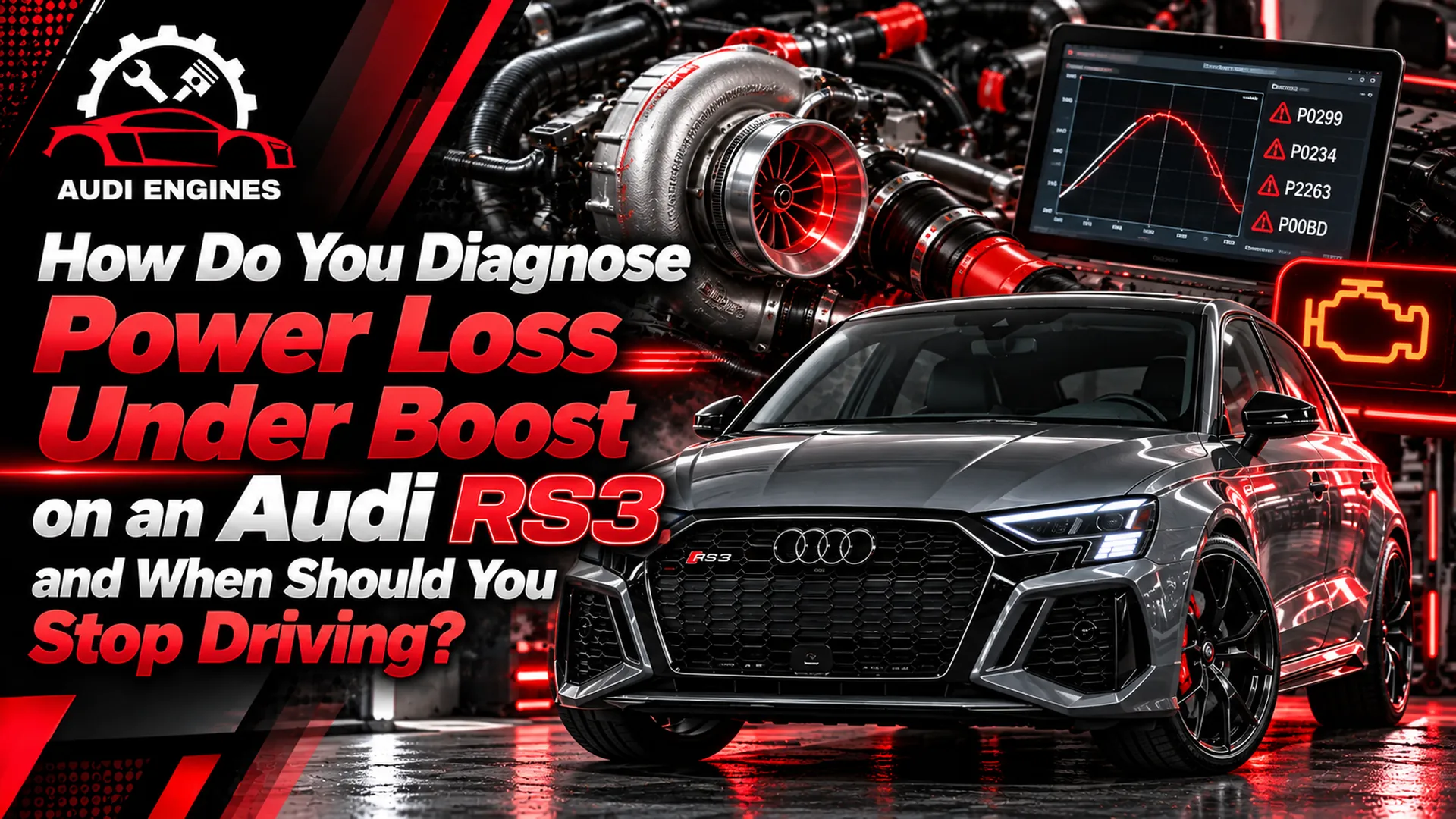
Replacing parts by guesswork is the fastest way to spend money without fixing anything. A structured diagnosis finds the actual cause first.
What Does P0299 Mean on an Audi RS3, and How Is It Tested?
P0299 is documented by Ross-Tech as a fault where the boost-pressure regulation control range was not reached. In plain terms, the turbo did not deliver the requested boost. Ross-Tech lists several possible causes: leaking or disconnected hoses and pipes, a charge-pressure control fault, a turbocharger fault and a diverter valve fault. It can bring reduced power and limp mode.
That list is the reason P0299 is only a starting point. It tells you the boost was short, not why.
P0234 is the opposite, an overboost fault. Ross-Tech links it to hoses, the boost-control valve, the boost-pressure sensor and the turbocharger.
You may also see other codes quoted online, such as P00AF, P2563, boost or MAP sensor codes, misfire codes and fuel-pressure codes. Treat these as examples, not a checklist. Their exact meaning can vary by generation and engine, so only a scan on your own car gives a reliable answer. Confirm the code list against your diagnostic tools before publishing.
Here is how a proper diagnosis usually runs:
- Read the fault codes and freeze-frame data from the engine and related modules.
- Inspect the charge-air path visually: pipes, hoses, clamps, intercooler connections and the turbo outlet.
- Pressure test or smoke test the system to find leaks you cannot see or hear.
- Check the diverter valve, wastegate and actuator for correct operation.
- Log boost pressure, comparing requested and actual boost through a full-throttle pull.
- Check the MAP and boost-pressure sensor readings against expected values.
- Check ignition and fuelling: spark plugs, ignition coils, fuel pressure and injector behaviour.
- Look at PCV and crankcase pressure if other checks are clear.
- Road test to confirm the fault is fixed.
If you want to help before the car reaches a workshop, stick to simple, safe visual checks. Look for a disconnected hose, a loose clamp or oil residue around the pipes with the engine off and cool. Leave pressure testing, sensor testing and anything involving the fuel system to a trained technician.
Can I Keep Driving My RS3 If It Loses Power Under Boost?
Sometimes, for a short distance, but not indefinitely. Your car's behaviour tells you which case you are in.
- Book in normally: an occasional, mild hesitation with no warning light and no unusual noises.
- Get checked soon: repeated boost loss, a stored P0299, a persistent hissing noise, poor acceleration or a warning light that comes and goes.
- Stop driving safely and seek help: limp mode, a flashing engine warning light, a heavy misfire, smoke, a loud turbo whine or grinding, or oil loss.
Continuing to drive with a misfire can damage the catalytic converter, and driving with a failing turbo can send debris into the engine. Neither is worth the risk.
Real-world example: A driver ignores a slowly worsening hiss and a few limp-mode episodes. The leak turns out to be a cracked charge pipe. By the time the car reaches a garage, the misfires under load have worn the spark plugs and one ignition coil. What was a single-part fix has become three. Replace with a genuine case from your records.
How Much Does It Cost to Fix Audi RS3 Boost Loss in the UK, and Should You Repair or Replace?

Cost is the question most competitor pages avoid. We will not pretend one number fits every car. Prices depend on the specialist, the parts, the generation and any modifications. The figures below are placeholders until you confirm your own pricing.
What Are Typical UK Costs for Boost Leak, Sensor, Turbo and Engine Repairs?
Job | Typical UK cost | Notes |
| Diagnostic scan and boost test | insert | Often credited against repair |
| Charge pipe or turbo hose | insert | Often a modest repair |
| Intercooler replacement | insert | Depends on parts and access |
| Diverter valve | insert | Check before replacing the turbo |
| Wastegate or actuator | insert | Diagnose first |
| MAP or boost-pressure sensor | insert | Compare readings before replacing |
| Spark plugs and ignition coils | insert | Common fix for misfire under load |
| Fuel system repair | insert | Depends on the fault |
| Turbo repair or replacement | insert | Cause must be found first |
| Engine repair, rebuild or replacement | insert | See next section |
Costs vary by specialist, parts, generation and modifications. Ask for a written breakdown before work begins.
Specialist or main dealer? A main dealer has factory tools and software but often quotes higher labour rates. A good independent specialist can diagnose and repair many boost faults for less. Ask whether they have the right diagnostic tools, and whether they will show you the evidence for the fault, such as the leak test result or the boost log.
The biggest saving comes from correct diagnosis. Fitting a turbo to cure a hose leak is expensive and does not fix the problem.
When Is the Turbo or Engine the Problem, and What Are Your Options?
Most boost faults are repairable without touching the turbo. But some signs suggest the fault has gone further:
- Oil in the charge-air pipes or intercooler: possible turbo seal failure.
- A damaged compressor wheel or shaft play: a turbo that needs repair or replacement.
- Persistent low boost after leaks, sensors, diverter valve and actuator have been ruled out.
- Internal engine damage after a prolonged misfire, overheating or debris from a failed turbo.
At that point you have three broad choices: repair the existing unit, fit a reconditioned turbo or engine, or replace it. A reconditioned option can offer a strong balance of cost and reliability, but ask exactly what was renewed and tested, and what warranty comes with it. Confirm the turbo, reconditioned engine and replacement services you offer.
Get a written diagnosis before agreeing to a major repair. It should tell you what failed, why, and what each option costs.
Audi RS3 Boost Loss FAQs: Quick Answers to the Most Searched Questions
Why Is My RS3 Losing Boost, Going Into Limp Mode or Hesitating Under Full Throttle?
The short answer is that the ECU is seeing less boost than it requested, or it has detected something it does not like, and it is reducing power. The questions below cover the specifics.
Why is my Audi RS3 losing power under boost?
Common causes are a boost leak, a diverter valve or wastegate fault, a sensor problem, a fuel or ignition fault or a modification. A pressure test and boost log identify which.
Why does my RS3 lose boost at high RPM?
A leak that opens under higher pressure, a wastegate or actuator fault, or a misfire under load often shows up at high RPM.
What causes limp mode on an Audi RS3?
The ECU reduces power when it detects a fault such as an underboost condition, a sensor error or a misfire. The stored codes show what triggered it.
What does P0299 mean on an Audi RS3?
The requested boost was not reached. Possible causes include leaking hoses or pipes, charge-pressure control, the turbocharger and the diverter valve.
Does P0299 mean my turbo has failed?
Not necessarily. Test for leaks and check the boost-control system before condemning the turbo.
How do I test an RS3 for a boost leak?
A technician uses a pressure test or smoke test on the charge-air system. You can check hoses and clamps visually, but leave pressure testing to a specialist.
What causes hissing under acceleration?
Most often, air escaping from a split hose, loose clamp or cracked charge pipe or intercooler component.
Can a bad MAP sensor cause low boost?
Yes. An incorrect reading can make the ECU cut power or misreport boost. Compare the readings against expected values before replacing anything.
Can spark plugs or ignition coils cause power loss under boost?
Yes. Boost raises cylinder pressure, and worn plugs or weak coils are more likely to misfire under load.
Can low fuel pressure cause power loss?
Yes. A failing fuel pump or injector problem can starve the engine under load, even when boost is normal.
Will a remap cause boost loss?
It can expose weaknesses, such as marginal hoses, plugs or coils, or an inadequate turbo. Poor calibration can also cause boost faults.
Why does my RS3 lose boost but show no fault code?
Intermittent faults may not store a code. Live data and leak testing are the next step.
How do I fix low boost on an Audi RS3?
Find the cause first. The fix might be a hose, a sensor, a plug or a coil, a diverter valve or an actuator. It is rarely the first thing people assume.
Can I drive my RS3 in limp mode?
Only briefly and carefully, to reach a safe place or garage. Do not drive on with a flashing engine light or heavy misfire.
Is a boost leak expensive to fix?
Often not. Many are a hose or clamp. Larger repairs such as an intercooler cost more. Insert your pricing.
Do the RS3 8V and 8Y have the same boost problems?
The 2.5 TFSI shares a lot of architecture, but components and calibration differ. Diagnose your specific generation.
Get the Right Fix for Your RS3's Power Loss
A car that loses power under boost is telling you something. Listen to it early and the repair is usually small. Ignore it and a hose leak can become a misfire, a damaged catalytic converter or a turbo problem.
If your RS3 is losing boost, going into limp mode or hesitating under full throttle, send us the details. We will explain what your symptoms usually point to, run a proper diagnostic including a pressure test and boost log, and give you a clear quote before any work starts.