Audi RS3 Misfire Under Acceleration: Causes, Fault Codes & How to Diagnose It (UK Guide)
Your RS3 idles smoothly and cruises without a murmur. Then you press the throttle, boost builds, and the car stumbles, judders or loses power just when it should be pulling hardest.
Your RS3 idles smoothly and cruises without a murmur. Then you press the throttle, boost builds, and the car stumbles, judders or loses power just when it should be pulling hardest.
That pattern is the key to the fault. Audi RS3 misfire under acceleration causes almost always to trace back to something that copes at light throttle but fails once the engine works harder. Under load, cylinder pressure, fuel demand and ignition demand all climb together. A tired plug, a weak coil, a struggling injector or a dip in fuel pressure can hide for weeks, then show itself the moment you ask for full power.
This guide is for owners of the 2.5 TFSI five-cylinder RS3 (8V and 8Y) with a hesitating, juddering or flashing-light car. It explains why the fault appears under acceleration, how to narrow down the cause, what it costs to put right, and when the damage is deep enough that a replacement engine becomes the sensible option. At Audi Engines we supply replacement engines across the UK, so we'll also tell you plainly when a repair is the better route.
Why Does an Audi RS3 Misfire Under Acceleration but Run Fine at Light Throttle?
A misfire means one or more cylinders failed to burn their fuel and air mixture properly. At idle, that is a low-stress job. Under acceleration, it is a very different one.
Here is the chain of events, in plain English:
- You press the throttle and the turbocharger builds boost.
- More air enters the cylinders, so cylinder pressure rises.
- Higher pressure makes it harder for the spark to jump the plug gap, so the ignition voltage demand goes up.
- The engine also needs far more fuel, which pushes the injectors and high-pressure fuel pump harder.
- Any component that was only just coping now fails, and that cylinder misfires.
This is why a load-dependent misfire feels so different from a rough idle. A car with a worn plug can idle perfectly, because a low-pressure cylinder lights easily. Add boost, and the same plug can no longer hold a spark.
The 2.5 TFSI (DAZA in the 8V and DNWA in the 8Y, though you should always confirm the code on your own car) is a turbocharged, direct-injection five-cylinder. It makes big power from a small displacement, which means high cylinder pressures and little margin for weak components.
Which Cause Shows Up Where? A Driving-Condition Matrix
Use this table to match what you feel to the likely cause. It shows how likely each fault is to appear in each driving condition.
Cause | Idle | Light throttle | Hard acceleration | High RPM |
| Worn spark plug | Possible | Possible | Very likely | Likely |
| Weak ignition coil | Possible | Possible | Very likely | Very likely |
| Clogged injector | Possible | Possible | Likely | Likely |
| Low fuel pressure / HPFP | Less likely | Less likely | Very likely | Very likely |
| Vacuum leak | Common | Possible | Possible | Variable |
| Boost leak | Less obvious | Possible | Likely | Likely |
| Carbon build-up | Possible | Possible | Possible | Possible |
| Compression loss | Possible | Possible | Likely | Likely |
If your car misfires only at hard acceleration and high revs, ignition and fuel supply move to the top of the list. If it also shakes at idle, vacuum leaks and carbon build-up become more likely.
What Are the Most Common Causes of an Audi RS3 Misfire Under Load, Boost or Full Throttle?
Each cause below follows the same pattern: what fails, why it shows up under load, and what it feels like.
Ignition: Spark Plugs and Ignition Coils
Spark plugs wear over time. The electrode gap widens, and the voltage needed to fire the spark rises. Under boost, that demand can exceed what the system can deliver. The result is spark blowout: the spark is extinguished before it ignites the mixture, and the cylinder misfires. An incorrect plug, or one gapped wrongly (especially after tuning), causes the same problem.
Ignition coils are the most frequent culprit on this platform. A coil that works fine at low load can break down when voltage demand increases. Typical signs are a stumble that appears above a certain boost level, and a single-cylinder misfire code that follows the coil if you move it to another cylinder.
What it feels like: a sudden hesitation, a stutter or a judder as boost arrives, often worse in higher gears.
Fuel: Injectors and the High-Pressure Fuel Pump
Fuel injectors deliver fuel directly into the cylinder. A clogged or failing injector delivers a poor spray pattern or the wrong quantity, causing a lean or uneven mixture. This can show at idle but tends to worsen under load.
Low fuel pressure, whether from a weakening high-pressure fuel pump (HPFP), a tired low-pressure pump or a clogged fuel filter, hits hardest at high demand. The engine asks for more fuel than the system can supply, and the mixture goes lean. Expect misfires at full throttle and high revs, sometimes with a loss of power rather than a clean stutter.
Air and Boost: Vacuum Leaks, Boost Leaks, MAF, MAP and PCV
A vacuum leak lets unmetered air into the intake, leaning out the mixture. A boost leak lets pressurised air escape between the turbo and the engine, for example from a split intercooler hose, a loose charge pipe or a faulty seal. The engine then receives less air than the ECU expects, and fuelling and ignition fall out of step.
Faulty MAF or MAP sensors feed the ECU wrong air readings. A blocked or failing PCV (crankcase ventilation) system can disturb crankcase pressure and cause rough running. These faults often leave clues in fuel trim data, so a scan tool reveals more than a listening ear.
Carbon Build-Up on the Intake Valves
The 2.5 TFSI uses direct injection, so fuel never washes over the back of the intake valves. Oily deposits gradually build up and restrict airflow, upsetting combustion. Carbon build-up is usually a slow-burning cause of rough running and hesitation, and it tends to appear at higher mileage. A specialist will often recommend intake valve cleaning (walnut blasting) once it is confirmed.
Tuning: Stage 1, Stage 2, E85 and Aftermarket Intakes
A remap raises boost and changes ignition timing. That increases cylinder pressure, so plugs and coils are worked harder than the factory intended. Modified cars often need a colder plug, a tighter gap and stronger coils. A car that runs perfectly on a stock map can start misfiring after a tune if the ignition system isn't up to the extra demand.
Stock vs modified at a glance:
Stock RS3 | Tuned RS3 | |
| Boost and cylinder pressure | Factory calibration | Higher |
| Ignition demand | Within OEM design | Often beyond stock parts |
| Plug spec | Factory | May need heat range and gap changes |
| Misfire risk under load | Lower | Higher without upgraded ignition |
Modifications aren't wrong, but they shift the diagnosis. If your car is tuned, tell the person diagnosing it at the start.
Mechanical: Low Compression and Internal Damage
Worn piston rings, damaged valves or a failed head gasket reduce cylinder compression, so the mixture can't ignite properly. This is the rarest cause and the most serious. It usually presents as a persistent misfire on one cylinder that survives new plugs, coils and injectors.
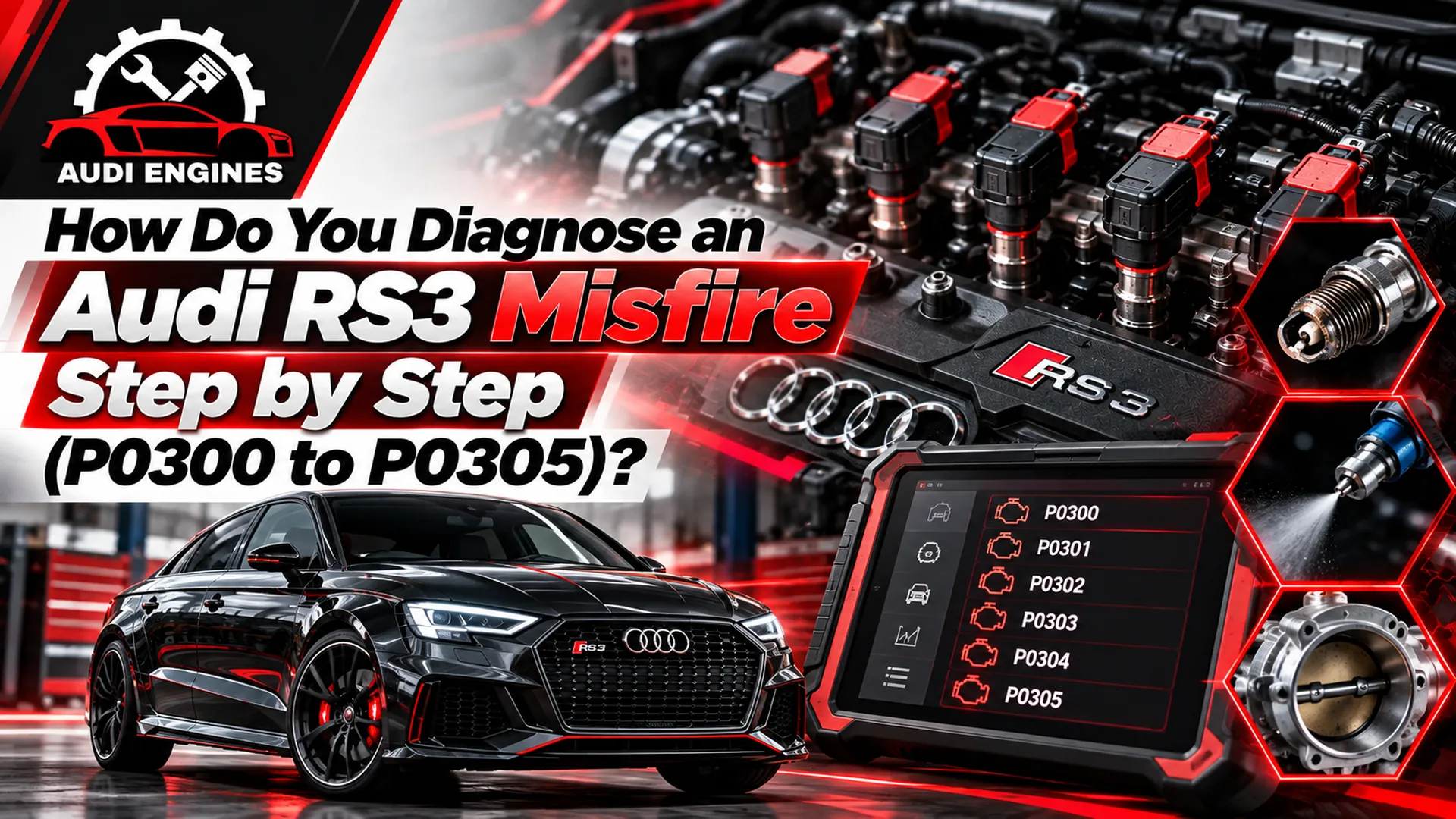
How Do You Diagnose an Audi RS3 Misfire Step by Step (P0300 to P0305)?
Guessing wastes money. Replacing all five coils, plugs and an injector without a diagnosis can cost more than the fault itself and still miss the cause. A methodical approach finds it faster.
What Do the Misfire Codes Mean?
The RS3 has five cylinders, so the codes run from P0301 to P0305.
Code | Meaning | What it suggests |
| P0300 | Random or multiple-cylinder misfire | System-wide cause: fuel pressure, air leak, boost issue, tuning |
| P0301 | Cylinder 1 misfire | Local fault: coil, plug, injector or compression |
| P0302 | Cylinder 2 misfire | Local fault |
| P0303 | Cylinder 3 misfire | Local fault |
| P0304 | Cylinder 4 misfire | Local fault |
| P0305 | Cylinder 5 misfire | Local fault |
The distinction matters. A single-cylinder code points to something specific to that cylinder, usually ignition or an injector. A random code (P0300) points to something affecting all cylinders, such as fuel pressure, an air leak or a fuelling problem. Codes like P0171 (lean condition) or boost-related faults can support a specific cause, but they are general codes and not RS3-specific.
The Diagnostic Workflow, in Order
A good specialist follows a sequence like this:
- Read the fault codes and any stored freeze-frame data.
- Check the misfire counters in live data to see which cylinders are affected and under what conditions.
- Identify the cylinder from the code and counters.
- Swap the coil to another cylinder and retest. If the misfire follows the coil, you have your answer.
- Inspect the spark plug for wear, fouling and correct gap.
- Test the injector for delivery and balance.
- Check fuel pressure under load, not just at idle.
- Smoke-test the intake to find vacuum leaks.
- Test the boost system for leaks and pressure loss.
- Perform a compression test and leak-down test if the simple checks don't resolve it.
- Investigate ECU logs and any remap if the car is modified.
Tools like VCDS, OBDeleven, a live data logger, a smoke tester and a compression tester make each step precise. A code reader alone tells you which cylinder complained, not why.
A real-world scenario: an owner reports a P0303 that appears on hard acceleration. The workshop swaps the cylinder 3 coil with cylinder 2, and the code moves to P0302. The coil is confirmed as the cause in a few minutes. Had they replaced the plugs and injectors first, the bill would have been several times higher.
Why Does My RS3 Only Misfire Under Boost, and How Is It Different From a Misfire at Idle?
An idle misfire and a boost-only misfire are different problems, even though both feel like a stumble.
- Idle misfire: the cylinders are at low pressure. Faults that show here are usually air metering problems, vacuum leaks, severe injector faults or carbon build-up.
- Boost-only misfire: the cylinders are at high pressure. The faults here are typically weak coils, worn or wrongly gapped plugs, boost leaks, fuel delivery limits and, on tuned cars, ECU corrections.
If the car is smooth around town but stumbles above roughly 4,000 rpm on a slip road, you are almost certainly looking at ignition demand or fuel supply, not carbon build-up. That one observation can shorten the diagnosis considerably.
Can You Drive an Audi RS3 With a Misfire, and What Will It Cost to Fix?
Short answer: avoid it. A mild, occasional misfire might let you limp to a garage, but continued driving makes it worse.
A flashing engine warning light means stop. It signals a misfire severe enough to damage the catalytic converter, and you should pull over safely as soon as you can.
Here is what continued driving risks:
- Catalytic converter damage. Unburnt fuel enters the exhaust and overheats the catalyst, an expensive part to replace.
- Cylinder wash. Excess fuel can strip oil from the cylinder wall, increasing wear.
- Overheating and internal damage. A prolonged misfire can lead to piston or cylinder damage.
- A worsening fault. A weak coil that is ignored can take out the plug or stress the ECU's corrections.
How Much Does an Audi RS3 Misfire Repair Cost?
Costs depend on the fault, the parts used and the garage's labour rate, so a single figure can mislead. This table shows where each repair typically sits relative to the others. Treat it as indicative, not a quote.
Repair | Relative cost | What pushes it up |
| Diagnostics | Low | Time needed for intermittent faults |
| Spark plugs | Low | Number replaced, genuine or performance parts |
| Ignition coils | Low to moderate | Replacing one or all five |
| Vacuum or boost leak repair | Low to moderate | Access and parts |
| Carbon cleaning (walnut blasting) | Moderate | Engine access and time |
| Injector replacement | Moderate to high | Number of injectors, coding |
| HPFP replacement | Moderate to high | Parts and labour |
| Catalytic converter | High | Damage from a prolonged misfire |
| Replacement engine | Highest | Engine type, condition, fitting |
Repair or Replace: Which Is Right for Your RS3?
Repair when the fault is isolated:
- Ignition faults (plugs and coils)
- Injector or fuel pressure faults
- Vacuum or boost leaks
- Carbon build-up
Consider a replacement engine when:
- A compression test or leak-down test confirms internal damage
- A misfire has caused piston or cylinder damage
- Repeated repairs haven't cured a persistent single-cylinder misfire
- Long-term misfiring has damaged the engine beyond sensible repair
The right decision comes from a confirmed diagnosis, not from the code alone. A misfire code is a symptom, not a verdict.
When Should You Take Your RS3 to a Specialist, and When Do You Need a Replacement Engine?
Go to a specialist when:
- The engine light is flashing
- The misfire returns after new plugs and coils
- You have a random misfire (P0300) that won't clear
- A compression test has failed
- The car is tuned and the misfire started after the remap
If your diagnosis points to internal damage, we can help. Send us your registration, engine code, any fault codes, your symptoms and whether the car is modified. We'll help you find the right replacement 2.5 TFSI, explain your options plainly and give you clear warranty and delivery details. If you're still investigating, explore our Audi RS3 engines page or related Audi engine guides.
Frequently Asked Questions
Why is my Audi RS3 misfiring under acceleration?
Because acceleration raises cylinder pressure, fuel demand and ignition demand. A weak plug, coil, injector or fuel supply that copes at light throttle fails under load. Spark plugs, coils, fuel pressure and boost leaks are the usual causes.
Can bad spark plugs or ignition coils cause an RS3 misfire?
Yes. They are among the most common causes, especially under boost. Worn plugs need more voltage to fire, and a weak coil may not supply it.
What does P0300 mean on an Audi RS3?
P0300 is a random or multiple-cylinder misfire. It usually points to a cause affecting all cylinders, such as fuel pressure, an air leak or a boost problem, rather than one faulty coil.
What do P0301 to P0305 mean?
Each code refers to one cylinder, from cylinder 1 (P0301) to cylinder 5 (P0305). The RS3 has five cylinders, so the sequence stops there.
Can I drive my RS3 with a misfire?
It isn't recommended. Continued driving risks catalytic converter damage and internal engine damage. If the engine light is flashing, stop driving.
Should I replace all the coils and plugs?
Not necessarily. Diagnose first. If one coil is faulty, replacing it may be enough. If the car has high mileage or is tuned, replacing all plugs is often sensible.
Does carbon build-up cause misfires on the RS3?
It can. On a direct-injection engine like the 2.5 TFSI, carbon deposits on the intake valves restrict airflow and disturb combustion, usually causing rough running and hesitation over time.
How do I find which cylinder is misfiring?
A scan tool reads the P0301 to P0305 codes and the live misfire counters, which show which cylinder is affected and under what conditions.
Why does my RS3 hesitate and lose power under boost?
Common causes are a boost leak, a weak coil, worn plugs, low fuel pressure or a tune that has increased demand beyond what the ignition system can deliver.
How serious is an RS3 misfire?
It ranges from a minor ignition fault to serious engine damage. The severity depends on the cause, how long it has continued and whether the engine light is flashing.
Final Thoughts: Diagnose the Load, Find the Cause
An RS3 that misfires only under acceleration is telling you something useful. The fault sits in the systems that come under stress when boost and load rise: ignition, fuel delivery, air and boost integrity, or, less often, internal engine condition.
Read the codes, identify the cylinder, work through the diagnosis in order, and never ignore a flashing light. Most misfires turn out to be repairable. When they don't, a properly matched replacement engine gets the car back on the road with confidence.
If your RS3 needs a new engine, send us your registration, engine code and symptoms. We'll match the right unit and give you a clear quote, including warranty and delivery.