

Audi RS3 Oil Consumption Problems: Causes, Diagnosis & Solutions (UK Guide)
The low oil message flashes up between services. Or you pull the dipstick and the level sits well below where it should. You look under the car, and the drive is bone dry. So where has the oil gone, and is it a problem.
The low oil message flashes up between services. Or you pull the dipstick and the level sits well below where it should. You look under the car, and the drive is bone dry. So where has the oil gone, and is it a problem?
Audi RS3 oil consumption problems are a common worry, and the answer is rarely a simple yes or no. Some oil use is normal on a high-output, turbocharged 2.5 TFSI. Rapid or increasing loss is not. Oil can leave the engine through external leaks, the crankcase ventilation system, the turbocharger, worn piston rings or tired valve stem seals, and only proper testing shows which route it is taking.
This guide is for owners and used buyers of the 8V and 8Y RS3. It explains what counts as normal, how to measure your own car's consumption, what causes excessive oil use, how a specialist finds the cause, and what it costs to fix. At Audi Engines we supply replacement engines across the UK, so we'll also tell you plainly when a repair is the smarter route. If your oil use comes with stumbling or juddering, our [Audi RS3 misfire under acceleration guide] covers that side in detail.
Is Audi RS3 Oil Consumption Normal, and How Much Oil Should a 2.5 TFSI Use?
Short answer: some consumption is expected. The 2.5 TFSI is a five-cylinder, direct-injection turbo engine that runs high cylinder pressures and temperatures. Even a healthy example burns a small amount of oil, because a thin film always stays on the cylinder walls and gets exposed to combustion.
Audi's own owner documentation for some RS3 model years acknowledges this. It gives a reference figure for acceptable consumption that depends on driving style and conditions. Check your own handbook for the figure that applies to your model year, because it isn't a universal rule for every RS3 generation.
Real-world use varies more than most owners expect. One car may barely move the dipstick between services. Another may need a top-up every few thousand miles. Driving style, track days, tuning, oil grade and service history all play a part, so nobody should assume every RS3 has a defect.
Use this table to judge where your car sits.
Consumption pattern | What it suggests | What to do |
| Minimal or no measurable use | Normal | Keep checking at each service |
| Small top-ups between services | Within a normal range for many cars | Monitor and record it |
| Consumption that is increasing | Something is changing | Investigate |
| Rapid oil loss | Likely a fault | Book an inspection promptly |
| Repeated low oil warnings | Level is dropping too far | Act now, and stop driving if the pressure warning appears |
Important: a low oil pressure warning is different from a low oil level message. If the pressure warning comes on, stop driving and get the car checked. Running an engine short of oil is one of the fastest ways to turn a repairable fault into an engine replacement.
How Do You Measure Audi RS3 Oil Consumption Correctly Before Blaming the Engine?
Guesswork leads to wrong conclusions. A proper measurement takes a little discipline, but it gives you data that a specialist can use straight away.
Check the level correctly:
- Park on level ground.
- Check with the engine at a consistent temperature each time, ideally warm and after it has rested for several minutes so the oil drains back.
- Use the same method every time, whether that's the dipstick or the on-board level reading, and don't mix the two.
Then run a simple test:
- Fill to the top mark and record the mileage.
- Drive a set distance, ideally 1,000 miles or more, in your normal way.
- Re-check under the same conditions and record how much you had to add.
- Work out the loss in litres per 1,000 miles.
Keep a note of:
- Any top-ups and the date and mileage of each
- The oil brand and grade used
- Your driving mix: motorway, short trips, spirited driving or track use
- Whether the car is remapped or modified
- When it was last serviced
A single low reading tells you little. A recorded trend tells you a great deal, and it is the first thing a good specialist will ask for.
Where Does the Oil Go? Causes of Excessive Oil Consumption on the 2.5 TFSI
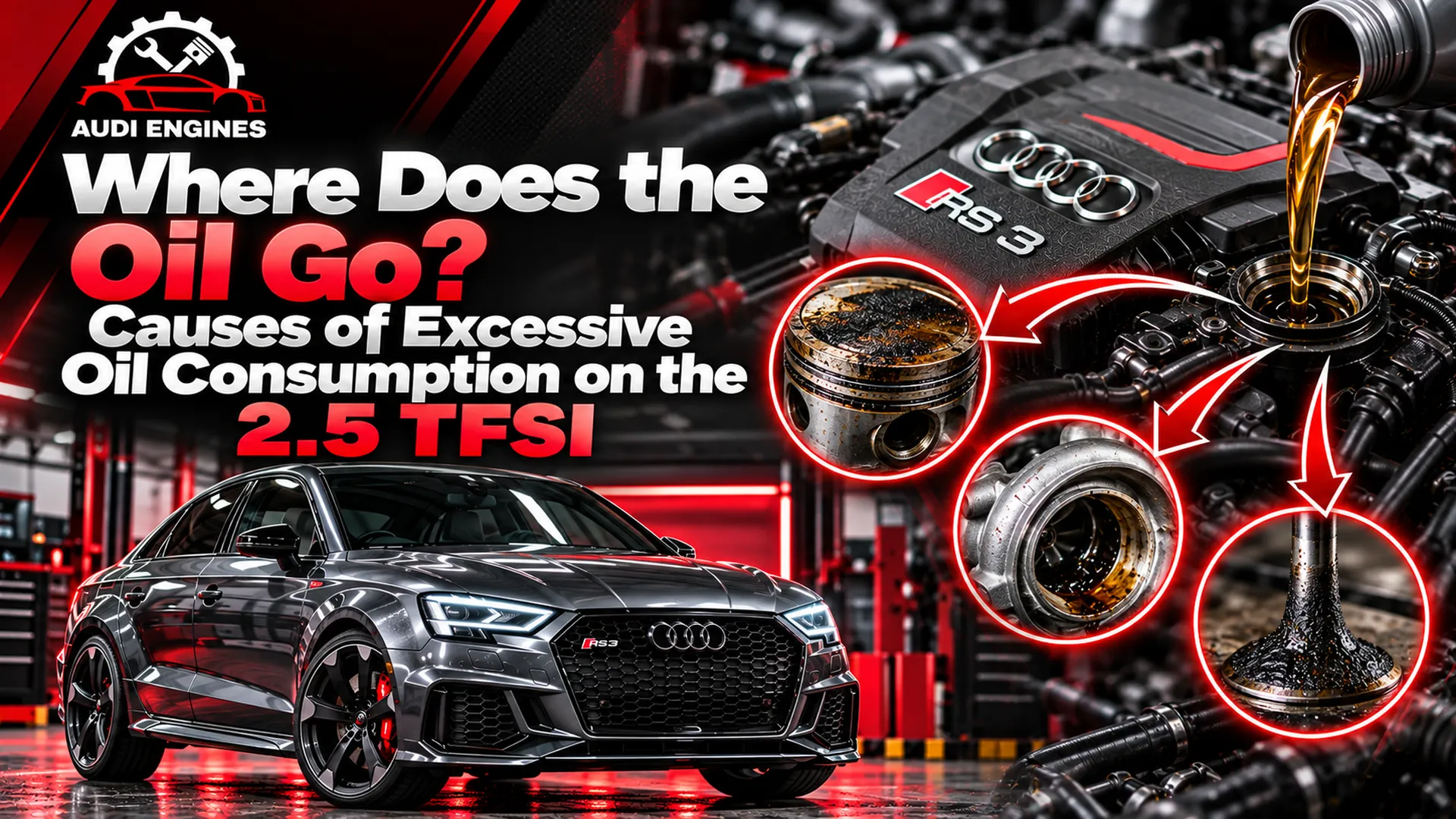
Here is the point that surprises many owners: no visible leak does not mean no problem. Oil that vanishes without a puddle is usually being burned or drawn into the intake, not dripping onto the road.
Oil can leave the engine in several ways:
- External leaks from gaskets, seals or connections, sometimes onto hot components where it burns off before it drips
- The PCV and crankcase ventilation system, which manages pressure and blow-by gases inside the engine
- The turbocharger, if oil passes its seals or bearings into the intake or exhaust
- Piston rings and oil control rings, which regulate the oil film on the cylinder walls
- Valve stem seals, which stop oil running down the valve stems into the combustion chamber
- Head gasket problems, which are rare but possible
These are possibilities, not verdicts. Any one of them can produce the same symptom, which is why testing matters more than guessing.
What each area does, and how it can go wrong:
PCV and crankcase ventilation. As the engine runs, small amounts of combustion gas slip past the pistons into the crankcase. The ventilation system routes those gases back to the intake, and an oil separator removes the oil mist. If a diaphragm or valve fails, or the separator stops working well, oil can be pulled into the intake and burned. It is one of the cheaper causes to eliminate, so it is usually checked early.
Turbocharger. Turbo seals and bearings work under extreme heat and speed. If oil passes them, it can enter the intake tract or the exhaust. Signs include blue-grey smoke and, in some cases, oil in the intercooler piping. A worn turbo can also affect boost.
Piston rings and oil control rings. Worn or stuck rings let oil into the combustion chamber. This is a more serious cause and often shows as steady consumption that gradually rises.
Valve stem seals. Hardened or worn seals let oil seep past the valves, most often after the engine has been idling or decelerating with high intake vacuum. Compression may stay normal even when the seals are failing, which is why compression testing alone doesn't clear them.
What Do the Smoke and Symptoms Tell You?
Use this table as a guide to where a specialist may look first. It is not a diagnosis.
What you notice | Area to investigate |
| Blue smoke after start-up | Valve stem seals, oil entering the combustion chamber |
| Blue smoke under acceleration | Piston rings, or turbo-related oil entry |
| Blue smoke after deceleration | Valve seal wear is a possibility |
| No visible smoke | The catalytic converter can mask oil burning, so consumption may still be real |
| Oil smell in the engine bay | External leak onto hot parts |
| Low oil warning with no visible leak | Internal consumption or a concealed leak |
Other symptoms to watch for include frequent top-ups, a burning oil smell, oil-fouled spark plugs, a misfire or rough running, and reduced performance. If you notice stumbling under load, read our [RS3 misfire guide] alongside this one, because oil on the plugs can contribute to misfires.
Does Tuning or Engine Generation Make a Difference?
It can. A remap or modifications raise boost, cylinder pressure and heat, which puts more stress on the rings, seals and turbo. Hard or track use can also increase oil use, because oil runs hotter and the engine spends longer at high load.
Generation matters for context, too. The 8V and 8Y RS3 use related versions of the 2.5 TFSI, and the engine codes you may see referenced include DAZA, DNWA and DNWC, plus CZGB on earlier cars. Confirm the code on your own engine before ordering parts or a replacement, because fitment and specification differ between years. Don't assume that a symptom seen in one generation applies identically to another.
How Do You Diagnose an Audi RS3 Using Oil With No Leak and No Smoke?
A methodical sequence finds the cause faster than replacing parts on a hunch. A specialist typically works in this order:
- Scan for fault codes and check live data for anything related to boost, misfires or ventilation.
- Confirm the level and the consumption rate, using the data you recorded.
- Inspect for external leaks, including the valve cover, oil filter housing, turbo lines and sump area.
- Check the PCV and crankcase ventilation system for a failed diaphragm, blocked separator or restriction.
- Inspect the turbo and intake for oil residue, including the charge pipes and intercooler.
- Pull and read the spark plugs. Oil deposits on one or more plugs can point toward a specific cylinder.
- Run a compression test to check overall cylinder sealing.
- Run a leak-down test to see where a cylinder is losing pressure, for example past the rings or the valves.
- Use a borescope to look inside the cylinders for scoring, deposits or wear.
Each step rules something in or out. A leak-down test that shows air escaping past the rings points one way, and air escaping past the valves points another. Normal compression doesn't clear valve stem seals, but it does help rule out serious ring or bore wear.
A real-world scenario: an owner adds roughly a litre of oil every 800 miles. The driveway is spotless, there is no smoke, and the car drives well. The specialist checks the PCV system first because it is the cheapest cause to eliminate. It passes. The plugs then show oil on cylinders 2 and 4, and a leak-down test points to valve seal leakage rather than ring wear. The repair is a cylinder head job, not an engine rebuild. That distinction saved the owner a considerable amount of money.
How Do You Fix Audi RS3 Oil Consumption, and What Does It Cost in the UK?

The fix depends entirely on the cause, which is why diagnosis comes first.
Repairs by cause:
- PCV or breather fault: replace the diaphragm, valve or separator as diagnosed.
- External leak: replace the leaking gasket or seal.
- Turbocharger: repair or replace the turbo if seals or bearings are confirmed as the source.
- Valve stem seals: replace the seals, which usually means cylinder head access.
- Piston rings and bottom-end wear: a major job that often means an engine rebuild or replacement.
How Much Does It Cost to Fix RS3 Oil Consumption?
Costs vary with the fault, the parts used and the garage's labour rate, so a single number would mislead you. This table shows where each repair typically sits relative to the others. Treat it as indicative, not a quote.
Repair | Relative cost | What pushes it up |
| Diagnostics and consumption test | Low | Time for intermittent faults |
| PCV or breather parts | Low to moderate | Parts and access |
| External leak repair | Low to moderate | Location and labour |
| Valve stem seal replacement | Moderate to high | Cylinder head work |
| Turbo repair or replacement | Moderate to high | Parts, labour, related damage |
| Piston ring and bottom-end work | High | Engine strip-down |
| Rebuilt engine | High | Engine type and fitting |
| Replacement engine | Highest | Engine type, condition, fitting |
Repair, Rebuild or Replace?
Repair when the cause is external or peripheral:
- Leaks
- PCV and ventilation faults
- A turbo problem with no other damage
Consider a rebuild or replacement engine when:
- Leak-down and borescope checks confirm ring, bore or valve wear
- Oil starvation or a low oil pressure event has damaged the bearings
- Consumption is heavy and rising, and internal wear is confirmed
- The cost of bottom-end work approaches the cost of a good replacement unit
The decision should always follow a confirmed diagnosis. If you do need a replacement, our guide to Audi engine replacement options explains the difference between used, reconditioned and rebuilt units, and what to ask a supplier.
Should You Buy a Used RS3, and When Should You See a Specialist About Oil Use?
If you're buying a used RS3, check:
- Service history. Regular oil changes matter more than almost anything else.
- Evidence of top-ups. Ask the seller how often oil is added, and whether they keep records.
- Cold-start smoke. Watch the exhaust at start-up and under acceleration.
- Spark plug condition. Oil deposits are a warning sign.
- Remap history. A tuned car deserves closer inspection.
A pre-purchase inspection by an Audi specialist is money well spent on any high-performance five-cylinder.
Prevention helps, too:
- Use oil that meets the specification in your handbook, and don't guess.
- Shorten oil change intervals if you drive hard or use the car on track.
- Check the level regularly, not only at service time.
- Let the engine warm up before demanding full power.
Book a specialist promptly if:
- Oil loss is rapid or increasing
- The low oil warning keeps returning
- You see blue smoke
- Oil use comes with misfires or rough running
- A compression or leak-down test has failed
If diagnosis confirms internal wear, we can help. Send us your registration, engine code, measured oil use, smoke pattern, service history and whether the car is modified. We'll help you match the right replacement 2.5 TFSI, explain your options plainly and give you clear warranty and delivery details. You can also browse our Audi RS3 engines page.
Frequently Asked Questions
Is Audi RS3 oil consumption normal?
Some oil use is normal on a turbocharged 2.5 TFSI, and Audi's documentation for some model years acknowledges it. Rapid or increasing loss is not normal and should be investigated. Check your own handbook for the figure that applies to your car.
How much oil should an Audi RS3 use?
It depends on the model year, driving style and conditions. Measure your own car's use over a set distance and compare it with your handbook. A steady, small loss is far less concerning than a rising one.
Why is my Audi RS3 using oil but not leaking?
The oil is probably being burned or drawn into the intake, not dripping out. Common routes are the crankcase ventilation system, the turbo, worn valve stem seals and piston rings. A leak-down test and borescope inspection can identify which.
Can a PCV valve cause RS3 oil consumption?
Yes, it can. A failed PCV valve, diaphragm or oil separator can draw oil into the intake, where it burns. It is one of the cheaper causes to check, so it is usually looked at early.
Can the turbo cause oil loss on an RS3?
It can. Worn turbo seals or bearings may let oil into the intake or exhaust, sometimes with blue-grey smoke. A technician should inspect it before condemning it.
Can piston rings or valve seals cause oil consumption?
Yes. Worn piston rings or oil control rings allow oil into the combustion chamber, and failing valve stem seals let it seep past the valves. A leak-down test helps separate the two.
Why is my RS3 producing blue smoke?
Blue or blue-grey smoke usually means oil is burning. Smoke at start-up often points to valve seals, and smoke under acceleration may suggest rings or the turbo. It's a pattern to investigate, not a diagnosis.
What oil does the Audi RS3 2.5 TFSI use?
It depends on the model year, so follow the specification in your handbook. Use oil that meets the approval listed there, and avoid guessing on grade.
How often should RS3 oil be changed?
Follow the handbook interval as a minimum. If you drive hard, tow, tune or use the car on track, shorter intervals are wise.
Is oil consumption worse on tuned RS3s?
It can be. Higher boost, cylinder pressure and heat put more strain on rings, seals and the turbo. Tuned cars deserve closer monitoring.
Can oil consumption damage the engine?
Yes, if the level is allowed to drop too far. Low oil can starve bearings and cause serious internal damage. Check the level regularly and never ignore a pressure warning.
Final Thoughts: Measure First, Then Find Where the Oil Goes
An RS3 that uses some oil isn't necessarily a faulty one. The 2.5 TFSI is a high-output engine, and a small, steady loss can be normal. What matters is the trend. Measure your consumption, record it, and act when it rises or the warnings return.
When the cause is a leak, a PCV fault or a turbo problem, a repair usually solves it. When the wear is inside the engine, a properly matched replacement gets the car back on the road with confidence.
If your RS3 needs a new engine, send us your registration, engine code and a note of your oil use. We'll match the right unit and give you a clear quote, including warranty and delivery.