

Audi RS3 Rough Idle After Cold Start: Causes, Diagnosis & Fixes
You start your RS3 on a cold morning, and instead of that familiar five-cylinder growl settling into a smooth idle, the engine shudders, hesitates, or shakes for a few seconds before finding its rhythm. Naturally, you're wondering.
You start your RS3 on a cold morning, and instead of that familiar five-cylinder growl settling into a smooth idle, the engine shudders, hesitates, or shakes for a few seconds before finding its rhythm. Naturally, you're wondering: is this just how the 2.5 TFSI behaves when cold, or is something actually wrong?
It's a fair question, and it's one we get asked constantly. The truth is, both answers can be correct, some cold-start roughness is completely normal on this engine, while other symptoms are early signs of a genuine fault that's worth addressing before it gets worse.
This guide walks through exactly how to tell the difference, what's most likely causing a rough idle after a cold start on an Audi RS3, and what a proper diagnosis and fix actually involves.
Is a Rough Cold Start Normal on an Audi RS3?

Before jumping to conclusions, it's worth understanding how the 2.5 TFSI is designed to behave during warm-up, because some of what feels alarming is actually the engine doing exactly what it should.
Normal Cold-Start Behaviour vs a Genuine Fault
The RS3's engine control unit runs a specific warm-up strategy when the engine is cold, and this can genuinely change how the engine sounds and feels for the first minute or two.
Elevated Cold-Start RPM and Warm-Up Strategy
It's normal for the RS3 to idle at a slightly higher RPM immediately after a cold start. This is a deliberate strategy, the ECU raises idle speed to help the catalytic converter reach operating temperature faster, which reduces emissions during warm-up. You might also notice the exhaust note sounds slightly different during this period. On its own, this isn't a fault.
When Rough Idle Disappears Once the Engine Warms Up
Similarly, a very brief period of slightly uneven running, a second or two of hesitation right as the engine fires, before it settles, is common across turbocharged five-cylinder engines and isn't necessarily a red flag. The key word here is brief. If the roughness fades within moments and the engine runs perfectly once warm, that's a very different situation to what we cover next.
Warning Signs That Point to a Real Problem
Where things shift from "normal cold-start character" to "something needs looking at" comes down to duration, consistency, and accompanying symptoms.
Rough Idle With No Check Engine Light
This catches a lot of owners out. The absence of a warning light doesn't mean the absence of a problem. Many early-stage ignition or fuelling issues won't trigger a fault code until they've progressed far enough to exceed the ECU's detection threshold. If you're noticing consistent roughness every cold start, don't wait for a light to confirm it, get it checked.
Rough Idle That Returns Even When Warm
If the roughness isn't confined to the cold-start window, if it appears again after the engine's fully warmed, under load, or at random, this points away from a simple warm-up characteristic and toward a genuine mechanical or electrical fault that needs proper diagnosis.
Common Causes of Audi RS3 Rough Idle After Cold Start

Once you've ruled out normal warm-up behaviour, several components on the 2.5 TFSI are the usual suspects. Understanding why each one causes rough idle, not just that it does, makes it much easier to explain your symptoms accurately to whoever diagnoses the car.
Worn or Fouled Spark Plugs
Spark plugs fire thousands of times per minute under load, and over time the electrode wears or becomes fouled with deposits. A worn plug produces a weaker spark, which leads to incomplete combustion in that cylinder. Incomplete combustion means uneven power delivery between cylinders, and that unevenness is exactly what you feel as a rough, shaky idle, particularly noticeable when the engine is cold and combustion is already less efficient.
Faulty Ignition Coils
Each cylinder on the 2.5 TFSI has its own ignition coil. When a coil starts to fail, it delivers inconsistent spark energy, sometimes firing correctly, sometimes weakly, sometimes not at all. This inconsistency causes an intermittent misfire, which often shows up specifically at idle and cold start, since the engine has less margin to compensate at low RPM.
Fuel Injector Problems
The RS3 uses a dual-injection system, combining direct and port injection. If an injector becomes partially clogged or starts leaking, the air-fuel ratio in that cylinder becomes imbalanced. Too much or too little fuel disrupts the combustion event, producing the same rough-running, misfire-like symptoms, often worse when cold, since fuel atomises less efficiently at lower temperatures.
Vacuum or Intake Leaks
Any unmetered air entering the intake system after the mass airflow sensor throws off the engine's air-fuel calculations. The ECU can't account for air it doesn't know is there, which creates a lean condition, one of the more common causes behind a fault code like P0171. A lean mixture burns unevenly, and that unevenness is felt directly as rough, unstable idle, especially pronounced at cold start when the engine is already running a specific warm-up fuel map.
Carbon Buildup on Intake Valves
This is one of the most talked-about issues on direct-injection engines, and the RS3's 2.5 TFSI is no exception.
Why Direct Injection Engines Are More Prone to Carbon Deposits
With direct injection, fuel is sprayed straight into the combustion chamber rather than over the intake valves. That means fuel no longer washes away the small amount of oil vapour that naturally passes through the crankcase ventilation system and settles on the valves. Over time, that vapour bakes onto the intake valves as hard carbon deposits, gradually restricting and disrupting airflow into each cylinder. Uneven airflow between cylinders creates uneven combustion, and once again, that's felt as rough idle, particularly noticeable when cold since the engine is more sensitive to airflow inconsistencies during warm-up.
PCV and Crankcase Ventilation Faults
The PCV system manages pressure and oil vapour from the crankcase, routing it back into the intake. If the PCV valve or its associated hoses fail, it can introduce unmetered air into the intake system, similar in effect to a vacuum leak, or allow excessive oil vapour through, both of which disrupt the air-fuel mixture and contribute to rough, unstable running.
Fuel Pressure Problems
The 2.5 TFSI relies on precise fuel pressure from both its low-pressure and high-pressure fuel systems to deliver the correct amount of fuel at the correct moment. A failing fuel pump, a faulty fuel pressure sensor, or a fuel pressure regulator issue can all cause inconsistent fuel delivery, and inconsistent fuel delivery, cylinder by cylinder, produces exactly the kind of rough idle and misfire symptoms covered throughout this guide.
DAZA vs DNWA, Does Engine Code Affect Rough Idle?
The RS3 has been built with a couple of different 2.5 TFSI engine code variants across its generations, broadly, DAZA on earlier 8V models and DNWA on later 8V facelift and 8Y models. While the underlying causes of rough idle are largely the same across both, there are minor differences in injection strategy and component design between the two. If you're getting a diagnosis, it's worth confirming which engine code your car has, since it affects exactly which parts and specifications apply to your repair.
How to Diagnose an Audi RS3 Cold-Start Rough Idle
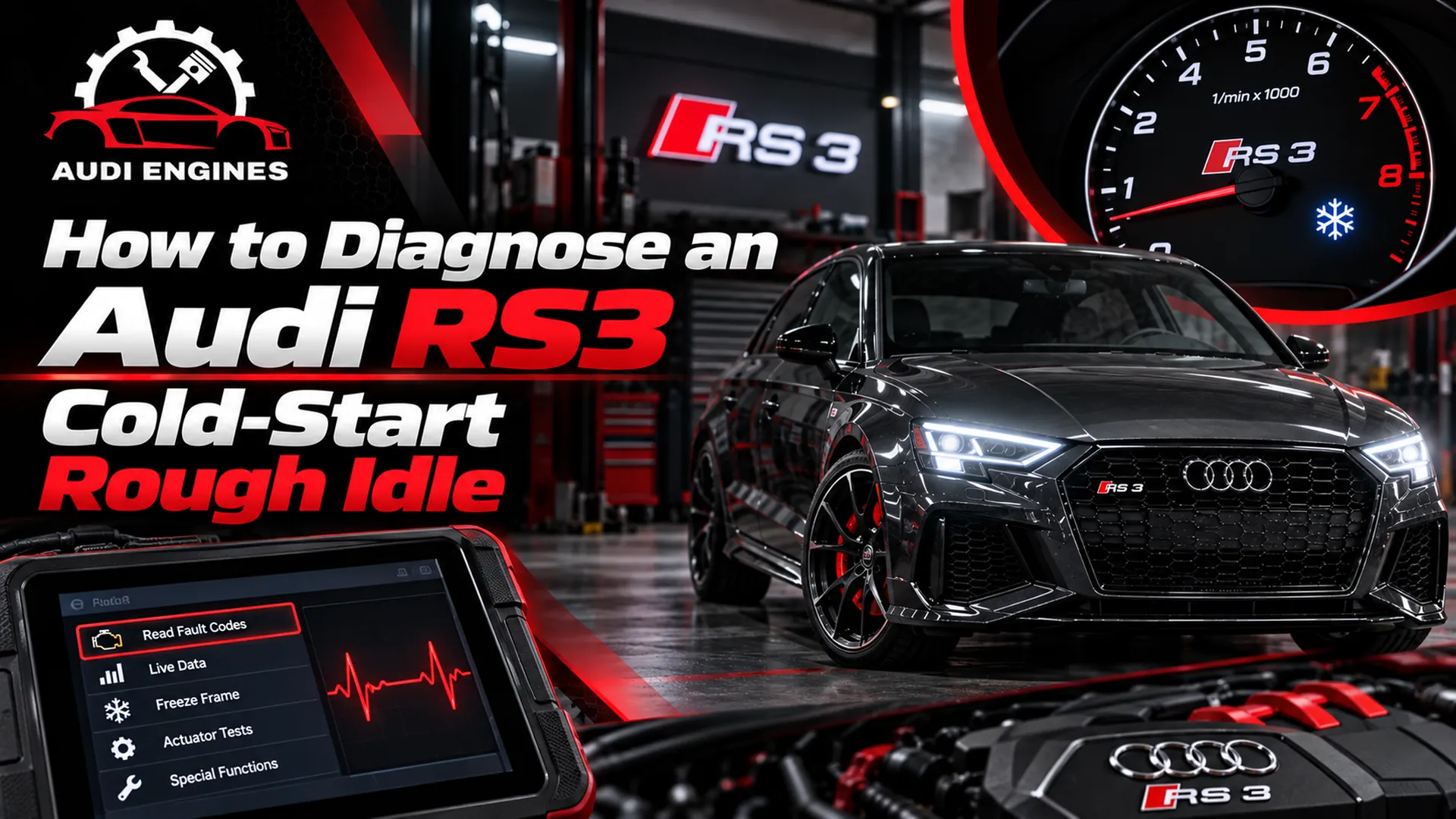
Guessing at a cause based on symptoms alone often leads to replacing parts that weren't actually faulty. A proper diagnostic process narrows things down methodically before any parts get changed.
Audi RS3 Misfire Codes to Check (P0300–P0305)
If your RS3 has triggered a check engine light, a diagnostic scan will typically point to one of these codes:
- P0300, random or multiple-cylinder misfire detected
- P0301, misfire detected on cylinder 1
- P0302, misfire detected on cylinder 2
- P0303, misfire detected on cylinder 3
- P0304, misfire detected on cylinder 4
- P0305, misfire detected on cylinder 5
You might also see P0171, indicating a lean fuel mixture, often linked to intake or vacuum leaks.
Random Misfire (P0300) vs Cylinder-Specific Misfire
This distinction matters a lot for diagnosis. A cylinder-specific code (P0301–P0305) usually points toward that individual cylinder's spark plug, coil, or injector, a more contained problem. A random misfire code (P0300) affecting multiple cylinders simultaneously often points toward something affecting the whole engine at once, like a vacuum leak, fuel pressure issue, or carbon buildup across several intake valves. Knowing which type you're dealing with immediately narrows the likely cause.
Cold vs Warm Symptom Comparison
Where your symptoms sit on this table gives a strong clue toward the underlying cause:
Symptom | Cold Only | Cold + Warm | Likely Diagnostic Direction |
| Rough idle | ✓ | Ignition or fuelling-related | |
| Misfire | ✓ | Spark plugs, coils, injectors, or carbon deposits | |
| Rough idle + P0171 | ✓ | ✓ | Vacuum or intake leak, lean condition |
| Rough idle + P030x | ✓ | ✓ | Cylinder-specific misfire |
| Fuel smell noticed | ✓ | ✓ | Injector or fuel system fault |
| Smooth once warm | ✓ | Temperature-dependent, less urgent but still worth checking |
If your rough idle only ever appears when cold and disappears completely once warmed through, that's a meaningfully different situation to symptoms that persist regardless of engine temperature.
Step-by-Step Diagnostic Process
A thorough diagnosis on an RS3 with cold-start rough idle typically follows this sequence:
- Scan for stored fault codes, including freeze-frame data showing conditions at the moment the fault was recorded
- Check misfire counters per cylinder to see if the issue is isolated or spread across the engine
- Review fuel trims and live data to spot lean or rich running conditions
- Inspect spark plugs and swap ignition coils between cylinders to isolate ignition-related faults
- Perform an intake smoke test to check for vacuum or intake leaks
- Test fuel pressure across both the low and high-pressure systems
- Check injector operation individually where a specific cylinder is implicated
- Inspect intake valves for carbon buildup, particularly on higher-mileage examples
Scanning Fault Codes and Misfire Counters
This is always the starting point. Even without a check engine light on, a scan tool can often reveal misfire counters building in the background, evidence of a developing problem the ECU hasn't yet flagged as serious enough for a warning light.
Checking Fuel Trims and Live Data
Fuel trim data shows how much the ECU is having to compensate to maintain the correct air-fuel ratio. Persistently high positive fuel trims often indicate the engine is compensating for unmetered air, a strong pointer toward a vacuum or intake leak.
Audi RS3 Rough Idle Repair Costs and When to Get It Checked
Once the cause is confirmed, the fix itself is usually straightforward, but costs vary quite a bit depending on what's actually wrong.
How Much Does It Cost to Fix an Audi RS3 Rough Idle?
Costs depend heavily on which component is at fault and how many cylinders are affected.
Spark Plug and Ignition Coil Replacement Cost
Spark plug replacement across all five cylinders is generally one of the more affordable fixes, and it's often done as a set rather than individually, since plugs wear at a similar rate. Ignition coil replacement costs more per unit but is usually only needed for the specific cylinder showing a fault, unless multiple coils are found to be failing together.
Carbon Cleaning and Walnut Blasting Cost
If carbon buildup on the intake valves is confirmed as the cause, walnut blasting, a process that physically removes carbon deposits from the valves using a fine abrasive media, is the standard fix. This tends to sit higher up the cost scale than a simple parts replacement, given the labour involved in accessing the intake valves, but it's a well-established and effective solution for this specific issue on direct-injection engines like the 2.5 TFSI.
The only way to get an accurate cost for your car is against a confirmed diagnosis, quoting a fix before knowing the actual cause risks paying for the wrong repair entirely.
When Is a Rough Idle Serious Enough to Stop Driving?
Most cold-start rough idle issues aren't an emergency, but a few situations warrant getting the car checked before you drive it further:
- The rough idle is accompanied by a flashing check engine light, rather than a steady one, a flashing light typically signals an active misfire that can cause catalytic converter damage if driving continues
- You notice a strong fuel smell alongside the rough running, which could point to a leaking injector
- The engine stalls or nearly stalls at idle
- Power delivery feels significantly reduced, not just rough at idle
If none of these apply and the issue is a mild, consistent cold-start roughness, it's still worth booking a diagnostic check reasonably soon, but it's not something you need to stop driving over immediately.
Frequently Asked Questions
Why does my RS3 idle rough after sitting overnight?
This is a classic cold-start scenario. After sitting overnight, all the engine's components return to ambient temperature, and any marginal wear in spark plugs, coils, or minor carbon buildup becomes more noticeable during that first cold combustion cycle before things settle. If it's consistent every morning, it's worth having checked rather than assumed as "just how it is."
Why does my RS3 run rough for a few minutes then smooth out?
This pattern, rough at first, smooth once warm, often points toward something temperature-sensitive, like fuel atomisation being less efficient when cold, or a marginal component (a weak spark plug or coil) that performs adequately once the engine reaches full operating temperature but struggles during the cold-start fuel map. It's less urgent than a persistent fault, but still worth a diagnostic check to catch it before it worsens.
Is a rough cold start normal on a 2.5 TFSI?
A very brief moment of unevenness right at startup, followed by a smooth transition to normal idle, is generally considered normal on this engine. Anything beyond a few seconds, or symptoms that repeat and worsen over time, moves into fault territory and is worth having looked at.
Does DAZA vs DNWA affect rough idle diagnosis?
The underlying causes are largely the same across both engine codes, but confirming which one your RS3 has ensures the correct parts and specifications are used during any repair, worth mentioning when booking a diagnostic appointment.
Final Thoughts
A rough idle after a cold start on your RS3 isn't something you need to panic about, but it's also not something to wave away indefinitely. The difference between a quick, affordable fix and a bigger repair almost always comes down to catching the problem early and diagnosing it properly, rather than guessing at parts and hoping for the best.
If your RS3 is shaking, misfiring, or just not settling the way it should on cold mornings, get in touch with our team for a proper diagnostic check. We'll confirm exactly what's causing it, what it'll take to fix, and give you a straight, honest quote before any work begins.