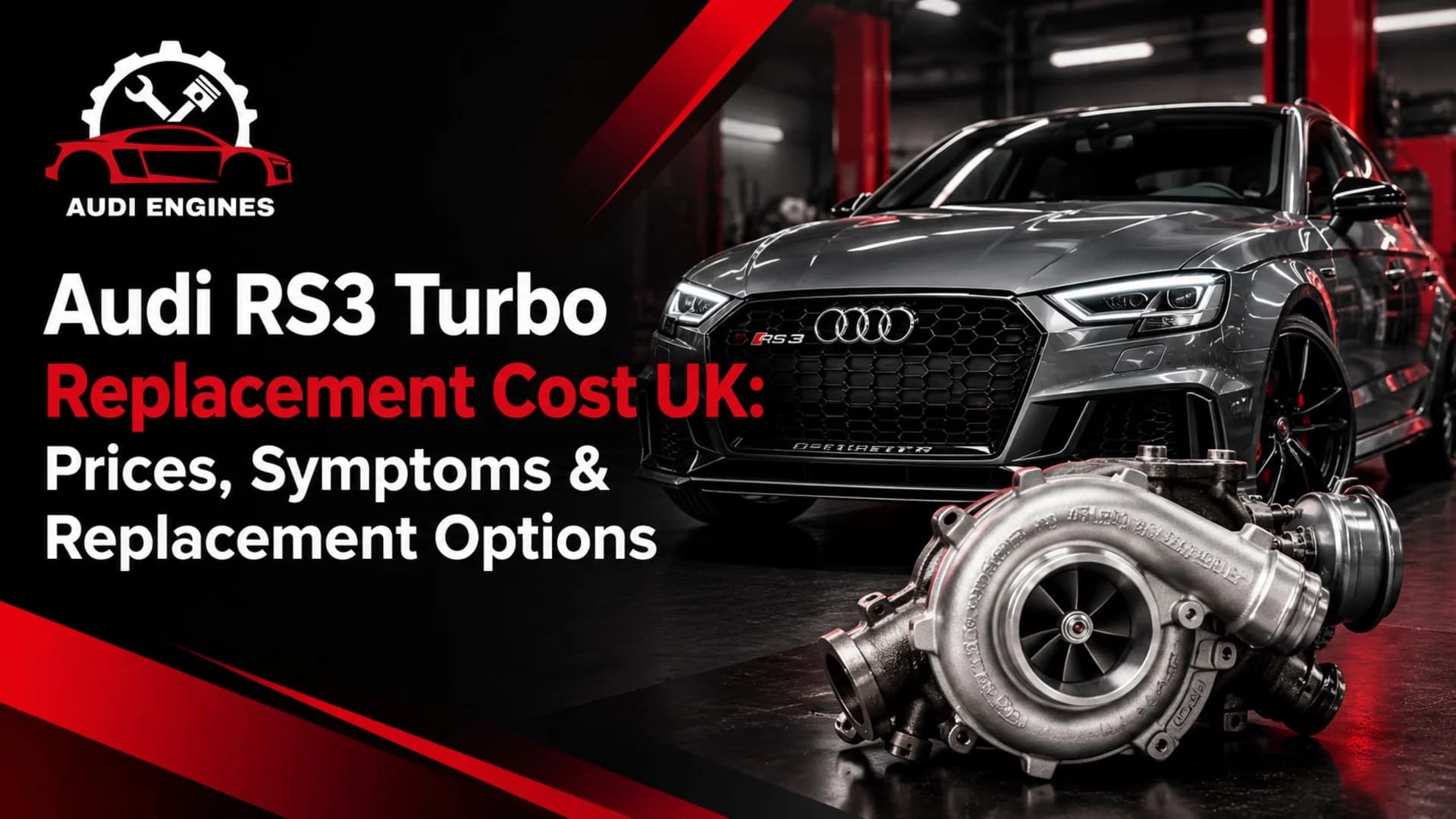
Audi RS3 Turbo Replacement Cost UK: Prices, Symptoms & Replacement Options
If your Audi RS3 has started whining under boost, lost some of its usual shove, or thrown a P0299 code at you, you're probably here for one reason: you want to know what a turbo replacement is actually going to cost before you commit to anything.
If your Audi RS3 has started whining under boost, lost some of its usual shove, or thrown a P0299 code at you, you're probably here for one reason: you want to know what a turbo replacement is actually going to cost before you commit to anything. Fair enough, RS3 turbo work isn't cheap, and getting stung by a vague quote or the wrong part is a genuinely common problem.
This guide gives you real UK pricing context, explains what's actually driving that cost, and, just as importantly, helps you work out whether your turbo has actually failed at all. Not every underboost code means a dead turbocharger, and knowing the difference before you spend money is where most owners go wrong.
How Much Does an Audi RS3 Turbo Replacement Cost in the UK?
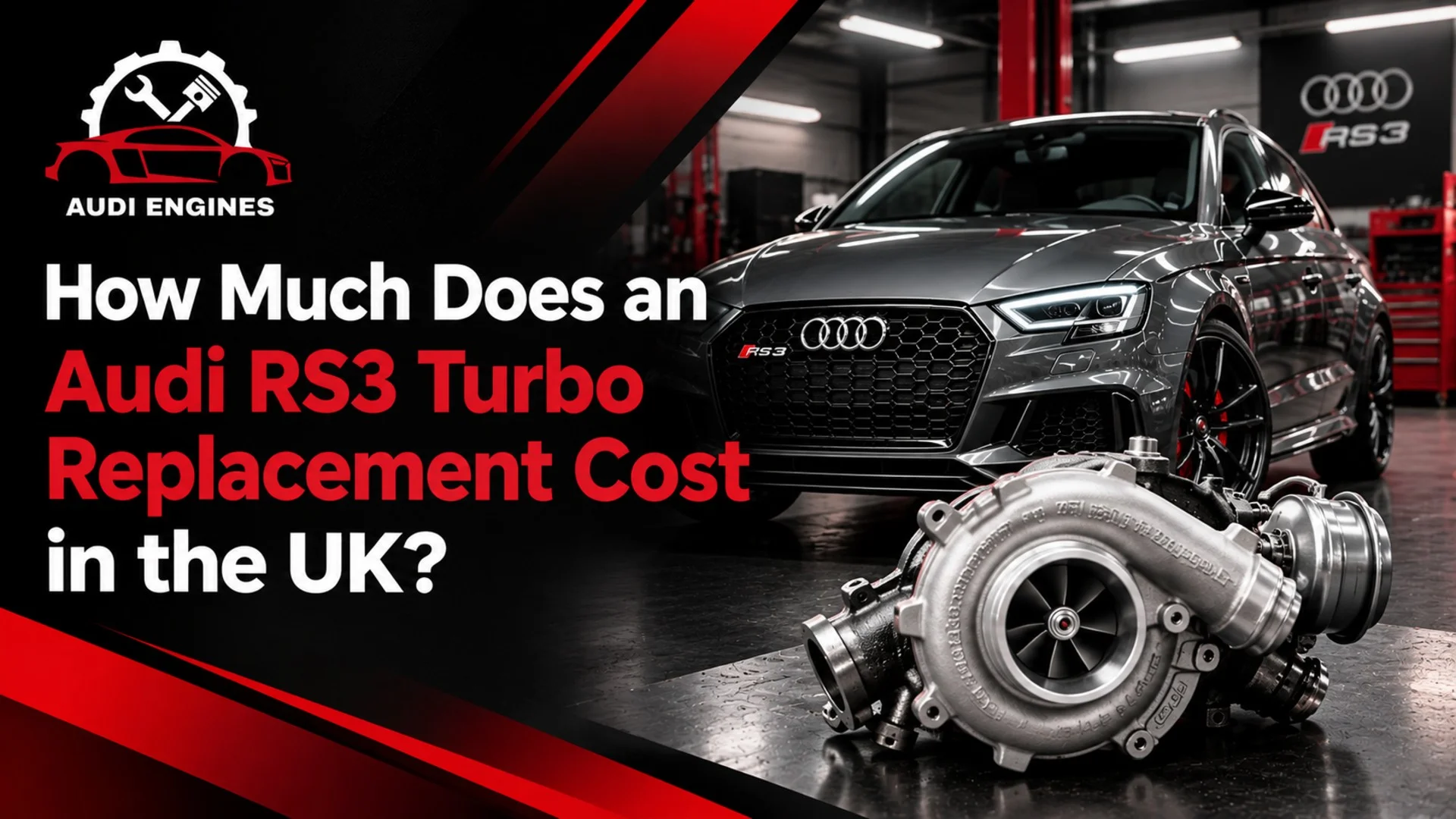
Let's answer the headline question first, because that's what brought you here.
A full Audi RS3 turbo replacement, fitted, typically sits somewhere between in the UK, depending on whether you go for a used OEM unit, a reconditioned turbo, a brand-new genuine part, or a hybrid/upgraded turbo. That's a wide range, and it exists for good reason, the part you choose changes the price far more than the labour does.
It's worth being clear about one thing upfront: a lot of pages you'll find quote the price of the turbo unit alone, not the total fitted cost. A turbo listed at appealing until you realise gaskets, oil, diagnostics, and several hours of labour still need adding on top. We'll break that down properly below so you're comparing like for like.
Audi RS3 Turbo Replacement Cost Breakdown (Parts vs Labour)
Here's a realistic breakdown of where the money actually goes on a typical RS3 turbo job:
Cost element | Notes |
Turbocharger unit | Varies hugely by new/recon/used/hybrid |
Labour (fitting) | 4–7 hours depending on access and generation |
Gaskets & seals | Should always be replaced, not reused |
Oil feed/return pipes | Often overlooked, but critical |
Fresh engine oil & filter | Contaminated oil is a leading cause of repeat failure |
Diagnostic scan & boost test | Confirms the fault and verifies the fix |
Add it up and you can see why "just the turbo price" is a misleading way to shop. A properly done job accounts for everything that touches the turbo, not just the part itself.
New OEM vs Reconditioned vs Used RS3 Turbo Cost
Each route comes with a different price and a different risk profile:
- New OEM turbo, The most expensive option, usually for the unit alone, but it comes with full warranty and zero unknowns about prior wear.
- Reconditioned turbo, A strong middle ground, typically for the unit, rebuilt with new bearings, seals and often a balanced core, usually backed by a 12–24 month warranty.
- Used OEM turbo, The cheapest route at, but you're relying entirely on the seller's honesty about mileage and condition, with little to no warranty in many cases.
- Hybrid/upgraded turbo, Priced similarly to or above new OEM, aimed at owners chasing more power rather than a straight like-for-like replacement.
If your RS3 is a daily driver and you want it sorted properly without gambling on unknown history, reconditioning is usually the sweet spot most specialists, including us, steer sensible owners toward.
Hidden Costs: Gaskets, Oil, Pipes & Diagnostics
This is the section most cost guides skip, and it's exactly where quotes quietly balloon.
A genuinely thorough turbo replacement should always include fresh gaskets, a proper look at the oil feed and return pipes (carbon build-up here is common and can starve a brand-new turbo of oil within weeks), a full oil and filter change, and a diagnostic scan both before and after the work to confirm boost pressure is correct. Skipping any of these to save money on the quote is a false economy, it's the single biggest reason a "replacement" turbo fails again within months.
RS3 8V vs 8Y Turbo Replacement Cost, Does Generation Affect Price?
Yes, and this is a detail a lot of generic turbo-cost pages miss entirely.
The RS3 8V, 8V facelift, and RS3 8Y all use variations of Audi's 2.5-litre five-cylinder TFSI engine, but the turbo hardware and manifold assembly differ across engine codes. Getting the wrong variant isn't just inconvenient, it simply won't fit or function correctly, and mismatched components are a common cause of comeback jobs.
DAZA vs DNWA vs DNWC Turbo Cost Differences
Here's how the main engine codes break down:
- DAZA, Found in earlier RS3 8V models; parts availability is generally strong and pricing tends to sit at the lower end of the range.
- DNWA, Used in later 8V facelift and early 8Y applications; shares some compatibility with DAZA turbo hardware but always worth confirming against your exact part number.
- DNWC, The newer 8Y-specific code, and typically the priciest to source since parts availability is still catching up compared to the older, more established DAZA units.
Before you buy anything or get a quote, it's worth checking your engine code against your specific part number rather than assuming "RS3 turbo" is a one-size-fits-all purchase. If you're unsure how to find yours, our team can confirm compatibility from your registration or VIN before you spend a penny.
Audi RS3 Turbo Failure Symptoms and What They Mean
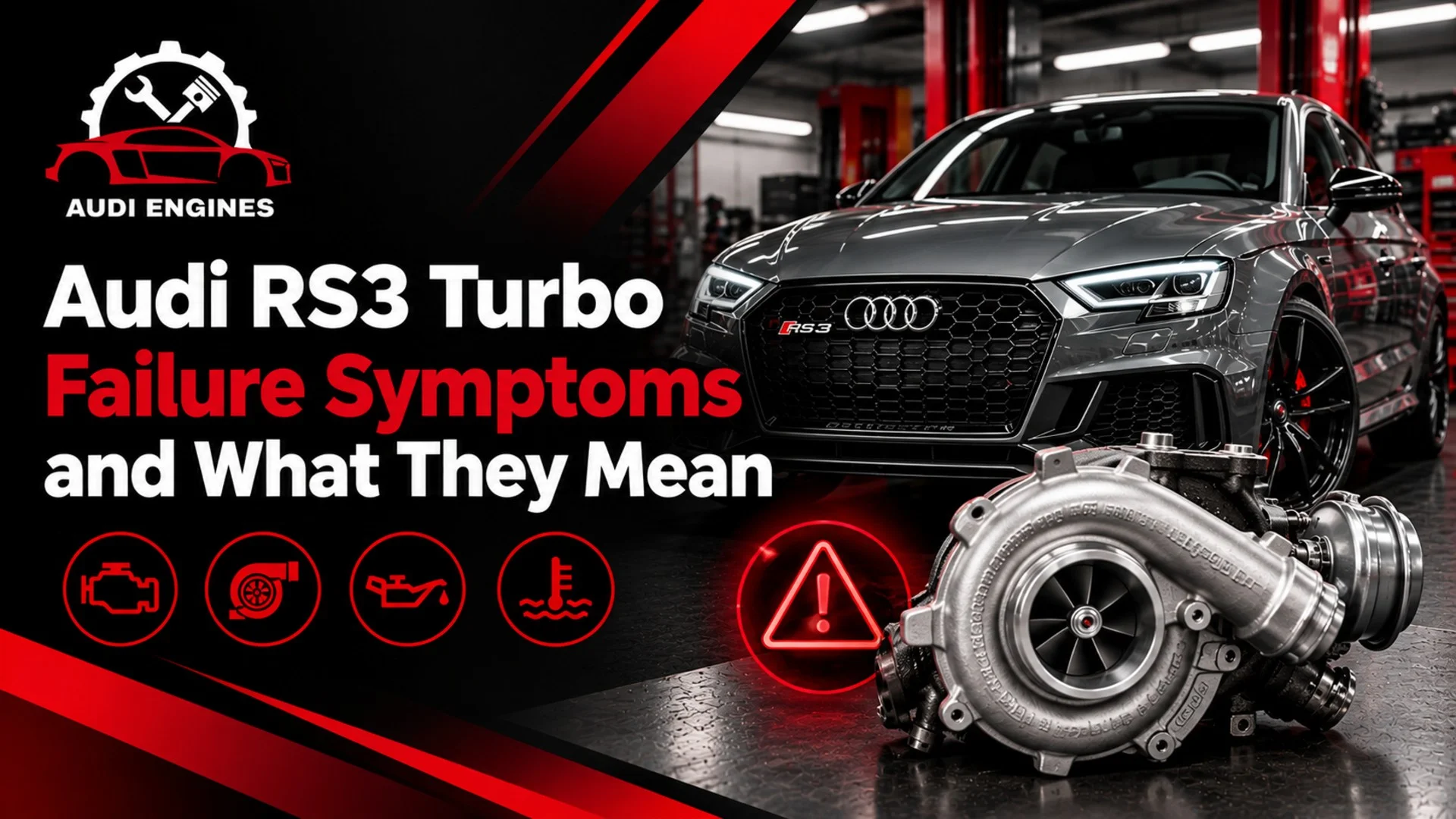
Before you replace anything, it's worth being confident the turbo is actually the problem. Here's what genuine turbo failure tends to look like.
Common Signs of a Failing RS3 Turbo
Watch out for:
- Noticeable loss of power, particularly a flat feeling under acceleration where the car used to pull hard.
- Excessive oil consumption with no obvious external leak, often a sign of worn internal seals.
- Limp mode, where the engine restricts power to protect itself once it detects a serious boost problem.
- Visible smoke from the exhaust under load, which points to oil getting where it shouldn't.
Any one of these on its own isn't necessarily a dead turbo, but a combination of two or more is a strong signal it's time for a proper inspection rather than guesswork.
Turbo Whining, Whistling or Blue Smoke
A high-pitched whine or siren-like whistle under boost is one of the most commonly reported RS3 turbo symptoms, and it's usually linked to a boost leak, worn bearings, or a failing wastegate rather than always meaning the whole unit is finished. Blue-grey smoke, on the other hand, is a more specific tell, it usually means oil is getting past worn seals and burning in the exhaust, which is a genuine sign of internal turbo wear.
What Does an Audi RS3 P0299 Code Actually Mean?
P0299 is the underboost fault code, and it's the one that sends most RS3 owners straight into panic mode. In reality, it simply means the engine isn't seeing the boost pressure it expects, it doesn't automatically mean the turbo itself has failed.
Underboost vs Boost Leak: Is It Really the Turbo?
This is genuinely one of the most important things we can tell you, and it's the section most turbo-selling websites conveniently leave out: a large proportion of P0299 code are caused by something other than the turbocharger itself.
Common culprits that mimic turbo failure include:
- A boost leak from a split or loose intercooler pipe or clamp
- A faulty turbo actuator or wastegate that isn't opening or closing correctly
- A failing boost pressure sensor giving the ECU bad data
- A cracked or perished diverter valve
A proper diagnostic scan and a boost pressure test will usually tell you which of these it is within an hour, often for a fraction of the cost of a full turbo replacement. If you've been quoted for a new turbo without anyone actually running this test first, it's worth asking why.
Can You Still Drive an Audi RS3 With a Failing Turbo?
Technically, yes, for a short distance, but we wouldn't recommend it. Continuing to drive on a turbo that's shedding metal internally risks sending debris further into the engine's oil system, potentially turning a turbo replacement into a full engine rebuild. If you're in limp mode or hearing metallic noises alongside the whine, get it looked at before driving any further than necessary.
What Causes Audi RS3 Turbo Failure, and Can It Be Prevented?
Understanding why turbos fail helps you avoid paying for the same repair twice.
Oil Starvation, Contamination and Bearing Wear Explained
The overwhelming majority of turbo failures come down to oil, one way or another. Turbochargers spin at extraordinarily high speeds and rely entirely on a clean, consistent oil supply for lubrication and cooling. When that supply is interrupted, through a blocked feed pipe, contaminated oil, or extended servicing intervals, the bearings inside the turbo wear rapidly, eventually leading to shaft play, seal failure, and the classic symptoms covered above.
This is exactly why a proper replacement always includes an oil and filter change, and why we always check the oil feed pipe for carbon build-up rather than simply bolting a new turbo onto old, restricted pipework.
Does Remapping or Tuning Increase Turbo Failure Risk?
It can, if it's done carelessly. Pushing more boost through a turbo than it was designed for increases thermal and mechanical stress, and a poorly calibrated map can accelerate wear significantly. This doesn't mean tuning is off the table, plenty of RS3s run modest, well-executed maps without issue, but it does mean a turbo replacement following a remap is worth pairing with a hybrid or upgraded unit rather than a straight OEM swap, if you intend to keep the extra power.
Can an Audi RS3 Turbo Be Repaired or Rebuilt Instead of Replaced?
In many cases, yes. If the core housing and turbine wheel are undamaged, a rebuild, replacing bearings, seals, and the actuator, can restore the turbo to good working order at a lower cost than a full replacement. This isn't always possible, though. If there's been foreign object damage to the compressor or turbine blades, or the shaft has excessive play, a rebuild won't hold and replacement becomes the only sensible option.
What a Proper RS3 Turbo Replacement Actually Involves
A job done properly, rather than rushed, generally follows this sequence:
- Diagnostic scan and boost pressure test to confirm the fault
- Removal of the turbo and manifold assembly
- Inspection of oil feed and return lines for blockages or contamination
- Fitting new gaskets, seals, and pipework where needed
- Priming the new or rebuilt turbo with oil before startup
- Reassembly and a full boost pressure verification
- A proper road test under load to confirm the fix has actually worked
If a quote you've received skips several of these steps, it's worth asking exactly what's included before you agree to anything.
Choosing the Right RS3 Turbo Replacement, and Getting a Quote
Once you know what's wrong and roughly what it'll cost, the last decision is which route to take.
New vs Reconditioned vs Used vs Hybrid Turbo: Which Should You Choose?
There's no single "best" answer here, it depends on your car, your budget, and how long you plan to keep it:
- Keeping the car long-term and wanting peace of mind? A new OEM or a quality reconditioned unit with warranty makes the most sense.
- Selling soon or on a tight budget? A used OEM turbo can work, provided you're confident in its history and mileage.
- Already remapped or chasing more performance? A hybrid or upgraded turbo is worth the extra spend rather than replacing like-for-like.
How to Check You're Getting the Correct Turbo for Your RS3
Always confirm the exact engine code (DAZA, DNWA, or DNWC) and OEM part number before buying, rather than searching simply for "RS3 turbo." The 8V and 8Y platforms share a family resemblance but aren't interchangeable across the board, and a mismatched part can cause fitment issues, boost problems, or outright failure to run correctly. If you're not sure how to check this yourself, sending us your registration or VIN lets us confirm compatibility before you commit to a purchase.
Frequently Asked Questions: Audi RS3 Turbo Replacement Cost
How much does an Audi RS3 turbo replacement cost?
Fitted, a full replacement typically runs between in the UK, depending on whether you choose a used, reconditioned, new, or hybrid turbo, plus associated parts and labour.
How much does an RS3 turbo cost on its own?
The unit alone can range from around a used OEM turbo up or more for a new genuine or hybrid unit, before labour and additional parts are added.
Is an RS3 turbo replacement worth it?
In most cases, yes, particularly compared to the cost of a full engine rebuild if a failing turbo is left too long and sends debris into the oil system. A rebuild may also be worth considering over full replacement if damage is limited.
What are the symptoms of a failing RS3 turbo?
Loss of power, a whining or whistling noise under boost, blue-grey exhaust smoke, excessive oil consumption, and limp mode are the most commonly reported signs.
Does a P0299 code always mean the turbo has failed?
No. Underboost codes are frequently caused by boost leaks, a faulty actuator, a failing boost pressure sensor, or a damaged diverter valve rather than turbo failure itself.
Can an Audi RS3 turbo be rebuilt instead of replaced?
Often, yes, if the core housing and turbine wheel are undamaged. A rebuild replacing bearings and seals can be more cost-effective than a full replacement.
How long does an RS3 turbo replacement take?
A typical job takes between four and seven hours of labour, depending on generation and access, plus time for diagnostics and a proper road test afterward.
Is an RS3 Turbo Replacement Worth It on a High-Mileage Car?
Generally, yes, provided the rest of the engine is in good health. A turbo replacement on a high-mileage RS3 that's otherwise been well maintained is a sound investment, since the turbo is a wear item rather than a sign the whole engine is failing. The bigger question worth asking is whether oil changes and servicing have been kept up to date, since that history tells you far more about long-term reliability than mileage alone.
How Long Does an Audi RS3 Turbo Replacement Take?
Most straightforward replacements are completed within a working day once the correct part is on hand, though sourcing the right turbo, particularly for less common 8Y engine codes, can occasionally add to the timeline if it's not already in stock.
Get a Free Audi RS3 Turbo Replacement Quote
If you've read this far, you now know more about RS3 turbo costs and diagnosis than most quotes you'll be handed on the phone. The next sensible step is finding out exactly what your specific car needs, rather than relying on a generic average.
At Audi Engines, we specialise in RS3 turbo diagnosis, replacement, and rebuilds across both the 8V and 8Y platforms, and we'll confirm your exact engine code and compatible part before quoting you a penny. Whether you're dealing with a genuine turbo failure or just want a proper boost test to rule one out, get in touch with our team for a straightforward, no-pressure quote based on your car, not a generic price range.