

Audi RS4 Carbon Buildup Symptoms: Signs, Causes & Fixes (UK Guide)
Your B7 RS4 doesn't feel quite like it used to. It idles a little rough on a cold morning, hesitates when you ask for power, or throws a misfire that seems to come and go. The engine light may have appeared once, then vanished.
Your B7 RS4 doesn't feel quite like it used to. It idles a little rough on a cold morning, hesitates when you ask for power, or throws a misfire that seems to come and go. The engine light may have appeared once, then vanished.
If that sounds familiar, carbon buildup on the intake valves is one of the first things to look at. On the 4.2 FSI V8 (BNS), Audi RS4 carbon buildup symptoms usually include rough idle, cold-start misfires, hesitation, a gradual loss of power and sometimes poorer fuel economy. The catch is that other faults can cause the same symptoms, so confirming the cause matters before you spend any money.
This guide explains why the RS4 gets carbon deposits, how the symptoms progress, how to tell carbon from a coil, plug, injector or vacuum fault, how cleaning works, and what to ask a specialist. At Audi Engines, we work on Audi engines in the UK. If you'd rather talk to someone now, send us your registration and symptoms for a free inspection enquiry.
Quick answer: RS4 carbon buildup symptoms at a glance
Symptom | How it feels | Could carbon be the cause? | What to check next |
| Rough idle | Shaky, uneven tickover | Yes, but so are coils, plugs and leaks | Scan, misfire counters, intake inspection |
| Cold-start misfire | Rough first minute, then smooths out | Often | Fuel trims, injector and valve inspection |
| Hesitation | Stumble when accelerating | Yes | Airflow data, ignition check |
| Loss of power | Flatter, slower than before | Yes, usually gradual | Compare data, inspect intake valves |
| Poor throttle response | Delayed, dull pickup | Possible | Throttle body, intake and valve condition |
| Poorer fuel economy | More fuel for the same driving | Possible, but many causes | Fuel trims, sensors, service history |
| Engine management light | Steady or flashing light | Possible | Read stored and pending codes |
Symptoms point you toward a cause. They don't prove it. A visual inspection of the valves is the real confirmation.
What Are the Symptoms of Carbon Buildup on an Audi RS4?

The B7 RS4 uses a naturally aspirated 4.2-litre V8 with FSI (Fuel Stratified Injection), Audi's direct-injection system. It's a superb engine, and it has one well-known weakness: deposits form on the intake valves and in the intake ports, and over time they restrict airflow into the cylinders.
The effects are rarely dramatic at first. They creep in. Typical symptoms include:
- Rough or unstable idle, especially when cold
- Cold-start misfires, where the engine stumbles for the first minute or two
- Hesitation under acceleration
- Loss of power, usually gradual
- Reduced throttle response
- Weak performance at high RPM
- Poorer fuel economy
- An engine management light, steady or intermittent
Not every RS4 shows all of these, and mileage, driving style and service history all play a part.
Why Does the Audi RS4 4.2 FSI Get Carbon Buildup on the Intake Valves?
It comes down to how direct injection works.
On older port-injected engines, fuel was sprayed onto the back of the intake valves. It acted as a natural cleaner, constantly washing away deposits. On an FSI engine, fuel is injected straight into the combustion chamber, so nothing washes the intake valves.
Meanwhile, the crankcase ventilation (PCV) system routes oil vapour and blow-by gases back into the intake tract. That vapour lands on the hot valves and bakes into hard carbon deposits.
The chain runs like this:
- Fuel goes directly into the cylinder, so the valves are never washed.
- Oil vapour and PCV gases reach the intake tract.
- Deposits build up on the valve stems, valve throats and ports.
- Airflow is restricted and the air-fuel mixture is disrupted.
- Combustion quality drops, causing misfires, hesitation and power loss.
Because this happens slowly, many owners adapt without noticing. Some only realise how much performance they'd lost when it comes back after cleaning.
How Do Early, Moderate and Severe Carbon Buildup Symptoms Differ?
Carbon buildup progresses. Knowing the stage helps you judge how urgent it is.
Stage | Typical symptoms |
| Early | Slightly dulled throttle response, mild hesitation, gradual power loss you might put down to age |
| Moderate | Rough idle, cold-start roughness, intermittent misfires, worsening fuel economy, reduced acceleration |
| Severe | Persistent misfires, engine management light, marked power loss, poor running |
Why severe symptoms shouldn't be ignored: a persistent misfire sends unburnt fuel into the exhaust, which can overheat and damage the catalytic converters. A flashing engine light means an active misfire. Reduce load and get the car checked promptly.
A typical scenario: an owner notices the RS4 feels a bit flat and idles slightly rough on cold mornings. Months later, a misfire appears at higher revs and the engine light comes on. A scan shows misfire codes. When the intake manifold comes off, the valves are heavily coated. Once cleaned, the car idles smoothly again and the throttle feels sharper. The earlier symptoms were the warning, and the later ones were the consequence.
Recognise these signs? Book an RS4 inspection with Audi Engines and we'll tell you whether carbon is really the cause.
Is It Carbon Buildup, or Another RS4 Problem Like a Coil, Plug, Injector or Vacuum Leak?
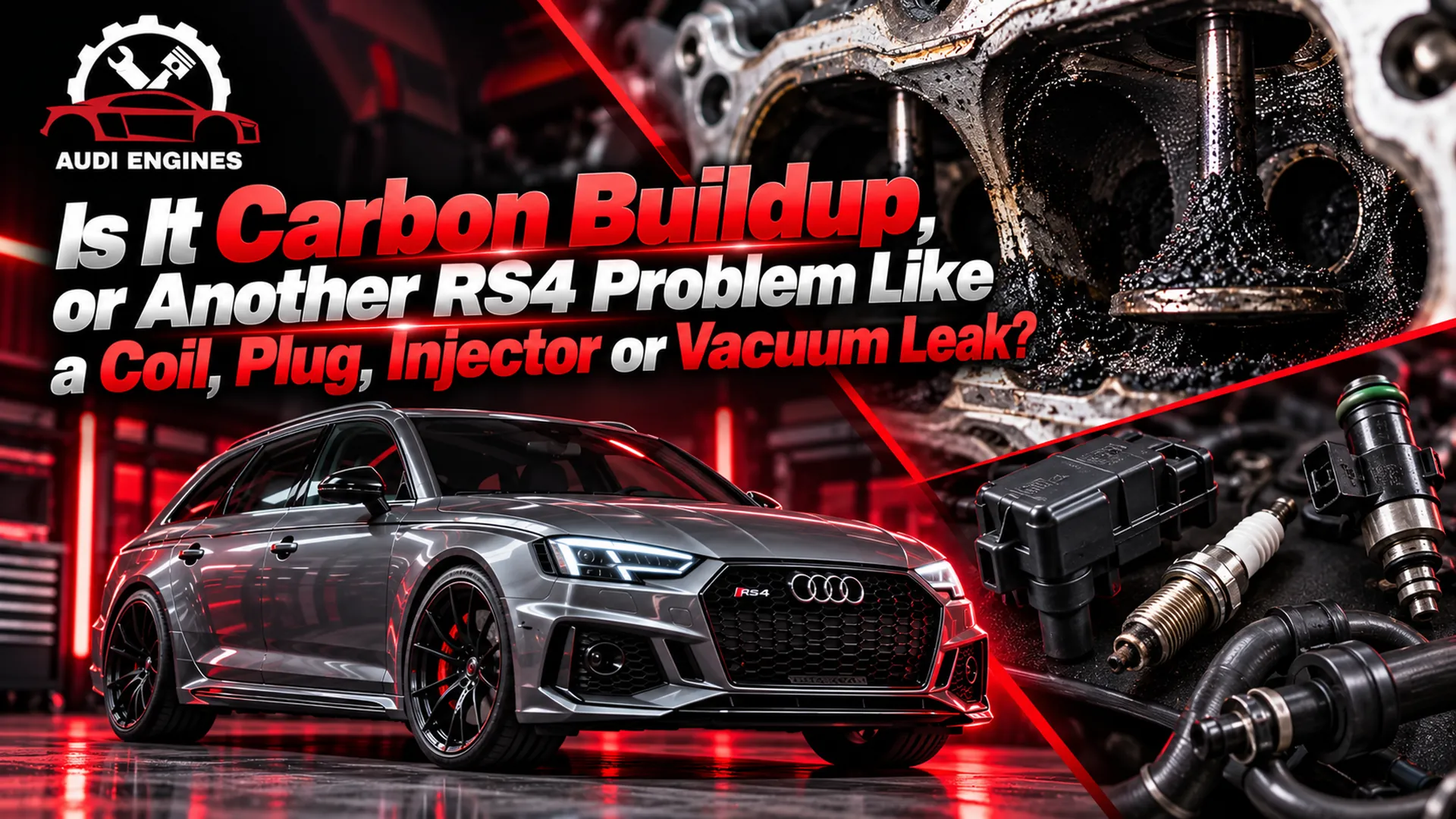
This is the question that saves owners the most money. A misfire on an RS4 isn't automatically carbon. Ignition components, injectors, intake flaps and vacuum leaks can all produce the same symptoms.
How Is Carbon Buildup Diagnosed on an Audi RS4, and Can Symptoms Alone Confirm It?
No, symptoms alone can't confirm it. They tell you where to look. Here is how the possible causes overlap:
Symptom | Carbon buildup | Ignition coil | Spark plug | Injector | Vacuum leak |
| Rough idle | Yes | Yes | Yes | Yes | Yes |
| Misfire | Yes | Yes | Yes | Yes | Yes |
| Power loss | Yes | Yes | Yes | Yes | Yes |
| Gradual performance decline | Typical | Usually not | Usually not | Sometimes | Sometimes |
| Cold-start roughness | Common | Sometimes | Sometimes | Sometimes | Sometimes |
| Visible deposits on valves | Yes | No | No | No | No |
The pattern that points toward carbon is a gradual decline in performance and cold-start roughness, rather than a sudden failure on one cylinder. But the only way to be sure is to look.
A specialist's diagnostic sequence
- Read stored and pending fault codes with a proper diagnostic tool, such as VCDS.
- Check cylinder misfire counters to see which cylinders are affected and when.
- Review fuel trims to see how the engine is compensating.
- Inspect ignition coils and spark plugs, the cheapest and most common culprits.
- Check injector performance, since injector faults can mimic carbon symptoms.
- Check for vacuum leaks and inspect the intake system, including manifold flaps.
- Inspect the intake valves visually, using a borescope where appropriate, or with the manifold removed.
- Confirm the fault before cleaning, so you only pay for work the car needs.
What the misfire codes mean
Misfire codes you may see include P0300 (random or multiple cylinder misfire) and P0301 to P0308 (a misfire on a specific cylinder). A code points to a system, not a part. A P0307, for example, tells you cylinder 7 is misfiring. It doesn't tell you whether the cause is a coil, a plug, an injector or carbon on that cylinder's valves. Replacing parts from the code alone is how owners end up paying twice.
Could it be carbon on the valves or an injector? Both can cause cold-start misfires and rough running, which is why they're often confused. If coils and plugs are healthy and the fuel system checks out, valve deposits move to the top of the list. A visual check settles it.
How Is Carbon Cleaned From an Audi RS4, and How Much Does It Cost in the UK?

Once carbon is confirmed, the fix is a proper clean. Additives and "run it hard" advice rarely remove baked-on deposits from an FSI engine, because the deposits sit where no fuel washes over them.
What Does RS4 Carbon Cleaning Involve, and How Often Is It Needed?
The process, in general terms
- The intake manifold is removed to expose the intake ports and valves.
- Deposits are removed from the valves and ports. Walnut shell blasting is the usual method, because the media is hard enough to remove carbon but softer than the metal.
- The intake manifold is cleaned, and new gaskets are fitted.
- Components are refitted, and fault codes are checked and cleared.
- A road test confirms smooth running.
This is skilled, time-consuming work, because the manifold has to come off and the cleaning has to be done carefully so debris doesn't enter the cylinders.
How often does an RS4 need it?
There's no single manufacturer figure, and claims you read online vary widely. How quickly carbon builds depends on mileage, driving pattern, oil quality, the condition of the PCV system and the individual engine. A sensible approach is to treat it as condition-based: watch for symptoms, and inspect the valves if you're unsure or buy a used car.
Cost guide (Audi Engines UK guide prices)
- Inspection and diagnostic scan:
- Carbon clean (intake valves and ports):
- Related parts if needed (spark plugs, coils, manifold gaskets):
- Further engine repair, if misfires have caused damage:
What moves the price: the severity of the deposits, labour time, whether coils, plugs or gaskets need replacing at the same time, and whether any other faults turn up during diagnosis.
How to slow carbon buildup
- Use the correct oil and change it on schedule, because poor oil adds to the vapour reaching the intake.
- Keep the PCV system in good condition, since a tired system pushes more oil vapour into the intake.
- Use good-quality fuel.
- Don't make a habit of constant short trips with a cold engine.
- Have the valves inspected if symptoms appear or when buying a used RS4.
No method prevents carbon completely on a direct-injection engine, but good maintenance slows it down.
What Should I Ask a Specialist Before Booking an RS4 Carbon Clean?
- Do you have experience with the 4.2 FSI V8?
- How will you confirm that carbon is the cause? A good answer includes a scan and a visual inspection.
- What cleaning method do you use?
- What will be replaced during the job? Gaskets, for example.
- What warranty comes with the work?
- How long will the car be off the road?
- Can I have a written quote?
When carbon isn't the end of the story: if a car has run for a long time with persistent misfires, the damage can go beyond the valves. Catalytic converters can suffer, and in serious cases the engine may need further repair or a reconditioned replacement. That's another reason to act early. Audi Engines can advise on each route, from a clean to a full engine solution.
Get a free inspection enquiry. Send your registration and symptoms to Audi Engines or call, and we'll tell you what's likely wrong and what the next step should be.
Frequently Asked Questions
What are the symptoms of carbon buildup on an Audi RS4?
Rough idle, cold-start misfires, hesitation, gradual power loss, reduced throttle response, poorer fuel economy and sometimes an engine management light.
How do I know if my Audi RS4 has carbon buildup?
Symptoms give clues, but only an inspection confirms it. A scan, misfire counter review and a visual check of the intake valves give a definite answer.
Can carbon buildup cause an Audi RS4 to misfire?
Yes. Deposits restrict airflow and disrupt the air-fuel mixture, which can cause misfires. But coils, plugs, injectors and vacuum leaks can too, so confirm the cause first.
Can carbon buildup cause loss of power?
Yes, and it's usually gradual. Many owners only notice how much power they'd lost after a clean.
Can carbon buildup cause a rough idle or cold-start misfire?
Yes. Cold-start roughness is a commonly reported symptom, though injectors and ignition faults can look similar.
Can carbon buildup trigger the engine management light?
It can, usually through misfire or fuel trim faults. The code points to a system, so the cause still needs confirming.
How is carbon buildup diagnosed?
With a diagnostic scan, a review of misfire counters and fuel trims, checks on ignition and injectors, and a visual inspection of the valves.
How do you clean carbon from RS4 intake valves?
Typically by removing the intake manifold and cleaning the valves and ports, often by walnut blasting, then refitting with new gaskets.
Do fuel additives clean RS4 intake valves?
Generally not effectively, because fuel never washes the valves on a direct-injection engine and baked-on deposits are hard.
How often should an RS4 be carbon cleaned?
There's no fixed figure. It depends on condition, mileage and use, so inspect when symptoms appear or when buying a used car.
How much does RS4 carbon cleaning cost?
It depends on the car and what the inspection finds. Send us your registration and symptoms for a clear quote.
Can carbon buildup be prevented?
It can be slowed with good oil, a healthy PCV system and regular servicing, but not eliminated on a direct-injection engine.
Final Thoughts
Audi RS4 carbon buildup symptoms build slowly: a rougher idle, a flatter throttle, a misfire on cold mornings. The cars that end up with bigger bills are usually the ones where those signs were put down to age or ignored.
Confirm the cause before you spend money, rule out coils, plugs, injectors and leaks, and have the valves inspected rather than guessing. Done early, a carbon clean can bring back the sharpness a B7 RS4 is famous for.
If your RS4 is showing these symptoms, Audi Engines can help. Send us your registration and a short description of the problem for a free inspection enquiry, or call for a quote.