
Audi RS4 Misfire Causes and Diagnosis: What's Behind It and How to Fix It
Your B7 RS4 is shuddering at idle, the engine light is flashing, or a P0300-series code has appeared and nobody can tell you why. It's a stressful moment on a car like this, because a misfire can be a ten-minute fix or the first sign of something expensive.
Your B7 RS4 is shuddering at idle, the engine light is flashing, or a P0300-series code has appeared and nobody can tell you why. It's a stressful moment on a car like this, because a misfire can be a ten-minute fix or the first sign of something expensive.
Here's the short answer. Most Audi RS4 misfire problems on the 4.2 FSI V8 come from three areas: worn ignition components, carbon deposits on the intake valves, or a fuel delivery fault. A smaller share points to low compression and internal engine damage, and that's where diagnosis matters most.
This guide walks you through the causes, the symptoms, the diagnostic order and the point where repair stops making sense. If your light is flashing, stop driving and get the car checked. Unburnt fuel can damage the catalytic converters quickly.
Need it looked at properly? Book an RS4 engine diagnostic with our team using the form on this page.
What Causes an Audi RS4 to Misfire, and Which Cause Is Most Likely on a B7?
A misfire is incomplete combustion in one or more cylinders. The cylinder fails to burn its air-fuel mixture properly because of a weak spark, the wrong amount of fuel, the wrong amount of air, or lost compression. The engine control module (ECU) detects the resulting change in crankshaft speed and logs a fault code.
On the B7 RS4, the 4.2-litre naturally aspirated V8 (BNS) uses FSI direct injection. That design is the reason carbon deposits feature so heavily in RS4 misfire reports. Fuel is sprayed straight into the combustion chamber, so it never washes over the back of the intake valves.
Misfire causes and how they usually show up
This table shows the most common causes, the symptoms that point towards them and how each one is confirmed.
Cause | Typical symptom | How likely | How it's confirmed |
| Intake valve carbon buildup | Rough cold start, unstable idle, hesitation | Very common | Borescope inspection, misfire counters, airflow symptoms |
| Faulty ignition coil | Repeatable single-cylinder misfire, flashing light under load | Common | Coil swap test, misfire counter follows the coil |
| Worn or fouled spark plug | General roughness, poor response, weaker power | Common | Plug inspection and gap check |
| Faulty or leaking injector | Misfire with strong fuel smell, poor idle | Less common | Injector test, fuel trim analysis |
| Low fuel pressure or HPFP fault | Loss of power, misfire under load, hard starting | Less common | Fuel pressure test with live data |
| Vacuum or intake leak | Rough idle, high fuel trims | Moderate | Smoke test |
| MAF or oxygen sensor fault | Poor running, fuel economy loss, odd fuel trims | Moderate | Live data and fuel trim analysis |
| Intake manifold or runner flap fault | Rough running, power loss, fault codes | Less common | Scan and physical inspection |
| Low compression | Persistent single-cylinder misfire after other tests clear | Less common, serious | Compression and leak-down test |
What does the pattern of the misfire tell you?
When and how the misfire appears narrows the search before you touch a tool.
- Cold start misfire: points towards intake valve carbon, injector issues or a weak coil. It often settles as the engine warms.
- Misfire at idle: suggests carbon, a vacuum leak, a sensor fault or a throttle body problem.
- Misfire under acceleration or load: most often an ignition coil, spark plug or fuel pressure issue, because demand on spark and fuel is highest.
- Misfire at high RPM: often a coil breaking down under load, or fuel delivery that can't keep up.
- Random or multiple cylinder misfire (P0300): suggests something shared across cylinders, such as fuel pressure, air metering, a leak or widespread carbon.
- One cylinder, every time: usually a local component such as a coil, plug or injector, or in worse cases a compression problem in that cylinder.
Can Carbon Buildup, Bad Coils or Worn Spark Plugs Cause an RS4 Misfire?
Yes, all three can, and telling them apart saves money. The pattern matters.
Carbon buildup is the signature fault of direct-injection Audi V8s. Deposits collect on the intake valves and restrict airflow, upsetting the mixture. The typical result is a rough cold start, a lumpy idle and hesitation. Cleaning the valves properly often restores smooth running.
Ignition coils fail in a more repeatable way. If the same cylinder misfires every time and the fault moves when you swap the coil to another cylinder, the coil is the culprit.
Spark plugs wear gradually. Rather than a single dramatic failure, you notice a general loss of smoothness and response, and a misfire that appears under load as the plug struggles to fire.
A scenario we see often: an owner replaces a coil after a P0303 code. The fault disappears for a few weeks, then returns on a cold morning. The coil swap moved nothing, because the real issue was carbon on the intake valves of that cylinder. A borescope inspection settles the question in minutes. Guessing costs far more than testing.
Not sure which one you have? Ask us about RS4 carbon cleaning and diagnostics before you buy parts.
How Do You Diagnose an Audi RS4 Misfire Step by Step, and What Do P0300-P0308 Codes Mean?
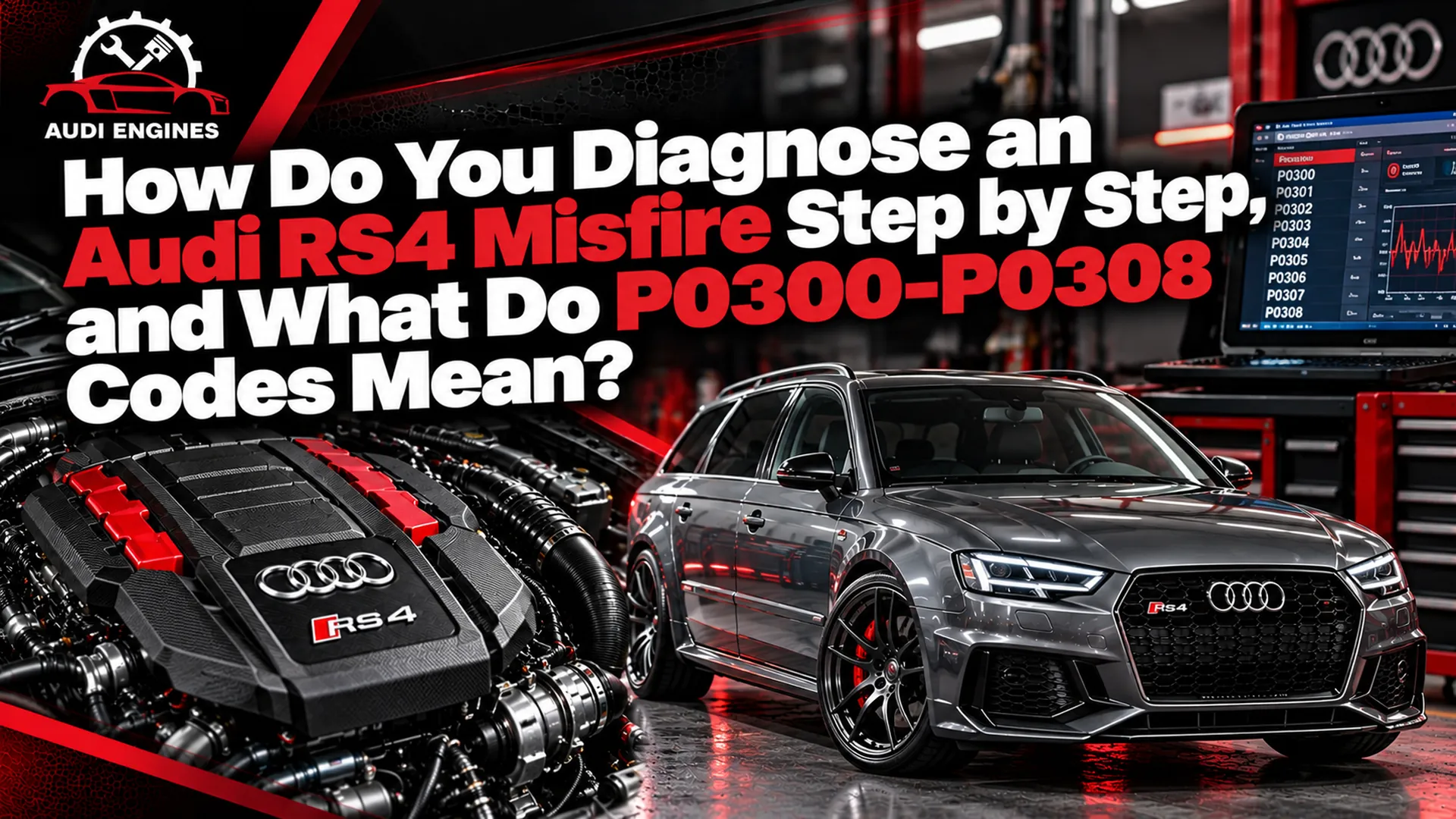
Diagnose in order, from cheapest and quickest to most invasive: scan, read the code, identify the cylinder, test ignition, test fuel, test air and vacuum, inspect for carbon, then test compression and leak-down. Skipping steps is how people end up replacing parts that were never faulty.
What do the P0300 to P0308 misfire codes mean?
These diagnostic trouble codes are logged by the ECU when it detects misfires. They're generic OBD-II codes, so any decent scanner will read them.
Code | Meaning | What it usually tells you |
| P0300 | Random or multiple cylinder misfire | A shared cause: fuel pressure, air metering, leaks, widespread carbon |
| P0301 | Cylinder 1 misfire | A local cause on cylinder 1: coil, plug, injector, carbon, compression |
| P0302 | Cylinder 2 misfire | Same approach for cylinder 2 |
| P0303 | Cylinder 3 misfire | Same approach for cylinder 3 |
| P0304 | Cylinder 4 misfire | Same approach for cylinder 4 |
| P0305 | Cylinder 5 misfire | Same approach for cylinder 5 |
| P0306 | Cylinder 6 misfire | Same approach for cylinder 6 |
| P0307 | Cylinder 7 misfire | Same approach for cylinder 7 |
| P0308 | Cylinder 8 misfire | Same approach for cylinder 8 |
Keep one point in mind: a cylinder-specific code names the cylinder that is misfiring, not the part that has failed. A P0307 doesn't mean "replace the cylinder 7 coil." It means "start testing cylinder 7."
Owners often see P0300 appear alongside one or more cylinder-specific codes. When a P0300 sits next to several cylinders, look for a common cause before chasing individual parts.
What tools do you need to diagnose an RS4 misfire?
- OBD-II scanner: reads generic fault codes and clears them. Fine for a first look.
- VCDS: reads Audi-specific fault memory, live data, misfire counters and freeze-frame data. This is the tool that shows you what the ECU saw at the moment of the fault.
- Compression tester: measures cylinder compression.
- Leak-down tester: shows where compression is escaping (rings, valves or head gasket).
- Smoke machine: finds vacuum and intake leaks.
- Borescope: lets you see intake valve carbon without removing the manifold.
- Oscilloscope: checks ignition and injector signals when electrical faults are suspected.
How Do You Test an RS4 Misfire Without Replacing Parts at Random?
Follow this sequence, and write down each result.
- Scan the ECU for fault codes. Record every code, including stored and pending ones.
- Check the misfire counters. In live data, see which cylinders are counting misfires, and under what conditions.
- Inspect freeze-frame data. Note engine speed, load and temperature when the fault occurred. A cold-only misfire points you in a different direction from a hot, high-load one.
- Swap the ignition coil. Move the coil from the misfiring cylinder to another. If the fault follows the coil, replace it. If it stays, move on.
- Inspect the spark plug. Check the electrode wear, deposits and gap. Oil, fuel or heavy wear tells you something about the cylinder.
- Test the fuel injector. Check operation and look for leakage or poor spray, particularly if there's a fuel smell.
- Check fuel pressure. Compare live fuel pressure against specification, including under load. Low pressure suggests a high-pressure fuel pump or supply problem.
- Review fuel trims. High positive trims often point to unmetered air or a vacuum leak. Check the MAF and oxygen sensor data too.
- Perform a smoke test. This finds intake and vacuum leaks that a visual check will miss.
- Inspect intake valve carbon. A borescope shows the condition of the valves.
- Test compression, then leak-down. If everything above is clear and one cylinder still misfires, test the mechanical side.
What not to do: don't clear the codes and carry on driving. Don't replace parts without a test result behind the decision. Don't ignore a flashing light.
DIY limits: an owner with a decent scanner can read codes, check counters and try a coil swap. Smoke testing, fuel pressure checks, borescope work, compression and leak-down testing need workshop equipment and experience.
When Does an RS4 Misfire Point to Low Compression or Internal Engine Damage?
When ignition, fuel and air have all been tested and cleared, but one cylinder still misfires, the problem is probably mechanical. These are the warning signs:
- A misfire that stays on one cylinder after the coil, plug and injector have been ruled out.
- Low or uneven compression readings between cylinders.
- A leak-down result that shows the escape route: air leaking past the rings, a burned or poorly seated valve, or the head gasket.
- Persistent power loss that doesn't improve after carbon cleaning and ignition service.
Possible causes include a burned valve, valve seat damage, worn piston rings, scored cylinder bores, or a mechanical timing problem. Intake manifold runner flap faults can also cause rough running and codes, so we rule those out first.
Why running with a misfire is risky: unburnt fuel enters the exhaust and can overheat and damage the catalytic converters. It can also wash oil from the cylinder walls, which accelerates wear. In worse cases, it leads to bore damage.
Can you drive an RS4 with a misfire? With a steady engine light and a mild misfire, a short, gentle trip to a workshop is generally acceptable. With a flashing light, stop. Flashing means the misfire is severe enough to damage the catalytic converters.
Is It Time to Repair, Rebuild or Replace the RS4 Engine?
Repair when the fault is in ignition, fuel or air. Coils, plugs, injectors, carbon cleaning, leaks and sensors are all fixable at a fraction of the cost of an engine. Consider a rebuild or replacement only when compression loss or internal damage is confirmed by testing.
For the full picture, read our guide to Audi RS4 engine problems.
How Does Audi RS4 Engine Replacement Work, and What Does a Reconditioned Engine Cost?
If testing confirms internal damage, a reconditioned Audi RS4 engine, supplied and fitted, is often the most practical route. It's an engine that has been stripped, cleaned, inspected, machined where needed, rebuilt with new wearing parts and tested. At audiengines.co.uk, we supply the correct engine for your RS4 and fit it, so one team handles everything from quote to handover.
Reconditioned vs used vs rebuilt engines
Engine type | What it is | Cost position | Main concern | Best for |
| Used engine | Lifted from a donor car, usually untouched | Lowest | Unknown history and wear | Tight budgets |
| Reconditioned engine | Stripped, inspected, machined, rebuilt with new wearing parts and tested | Mid-range | Quality depends on the rebuild standard | Long-term value |
| Rebuilt engine | Your own engine repaired and reassembled | Mid to higher | The scope of the rebuild must be clearly defined | When the original block is sound |
Reconditioned vs used: a reconditioned engine has been measured and tested, so you know what's inside it. A used engine is a gamble.
How supply and fit works
- Enquiry: send your registration number, mileage, fault codes and symptoms.
- Engine match: we verify the engine code and specification before quoting.
- Quote: you receive a clear price showing what's included.
- Recovery or drop-off: if the car can't be driven, talk to us about recovery options.
- Removal and installation: the failed engine comes out, and the replacement goes in.
- Fluids and checks: fluids and filters are renewed as needed, and the lubrication system is primed.
- Diagnostics and ECU checks: a full scan, with adaptation where required.
- Road test: we confirm it idles, pulls and warms up properly.
- Handover: you collect the car with your warranty documents.
What does Audi RS4 engine replacement cost?
The total is the engine, plus labour, plus consumables, plus any ancillary parts the job reveals, plus diagnostics and recovery where needed. Be wary of any quote that gives a single number with no breakdown.
What moves the price:
- Engine specification and availability: the RS4 engine is a specialist unit.
- Ancillary condition: worn parts replaced alongside the engine protect the new one.
- Recovery distance: if the car must be collected.
- Additional faults found: during diagnosis or fitting.
Our quotes are itemised, so you can compare like with like.
Warranty
A warranty is only as good as its terms. Before you commit, we put these in writing: the length of cover, what parts and labour it includes, how to claim, and what can invalidate it, such as missed servicing, wrong oil, ignored warning lights or overheating.
Why choose audiengines.co.uk?
- Audi focus: we work with Audi engines, so we know the 4.2 FSI's weak points.
- Diagnosis first: we test before recommending a rebuild or replacement.
- Verified matching: no engine is supplied until the code is confirmed.
- Tested engines: every engine is quality checked and tested before fitting.
- Honest advice: if a repair is all you need, we'll say so.
Audi RS4 misfire FAQs
What causes an Audi RS4 to misfire?
The most common causes are intake valve carbon buildup, faulty ignition coils and worn spark plugs. Injectors, fuel pressure, vacuum leaks, sensors and low compression are less common.
Why does my RS4 misfire when cold?
Cold-start misfires often point to carbon deposits on the intake valves or injector issues. Fuel doesn't vaporise as well when cold, so deposits have more effect.
Does carbon cleaning fix an RS4 misfire?
It often does when carbon is the cause, because it restores airflow past the valves. It won't fix a failed coil or a compression problem, so confirm the cause first.
How often does an RS4 need carbon cleaning?
It depends on mileage, driving style and the car's history. A borescope inspection shows when it's needed.
Can a bad spark plug cause an RS4 misfire?
Yes. Worn or fouled plugs commonly cause roughness and misfires under load.
Should I replace all the coil packs?
Not automatically. Test first. If one coil has failed and the others are original and ageing, replacing them together can be sensible, but let the diagnosis decide.
What does P0307 mean on an RS4?
It means the ECU has detected a misfire on cylinder 7. It names the cylinder, not the part. Test the coil, plug, injector, carbon and compression on that cylinder.
Can I drive with a flashing engine light?
No. A flashing light signals a severe misfire that can damage the catalytic converters.
Can low compression cause an RS4 misfire?
Yes. A burned valve, worn rings or scored bores prevent proper combustion. A compression and leak-down test confirms it.
Can a vacuum leak cause an RS4 misfire?
Yes. Unmetered air upsets the mixture, especially at idle. A smoke test finds it.
Can a failing HPFP cause an RS4 misfire?
Yes. A high-pressure fuel pump that can't hold pressure causes lean misfires, particularly under load.
How much does RS4 misfire diagnosis cost?
It depends on how far the diagnosis goes. A scan is quick, but compression and leak-down testing take longer. We confirm what's involved before we start.
Can You Get a Quote for RS4 Misfire Diagnosis or a Reconditioned Engine Supplied and Fitted?
Yes. Send us:
- Your registration number
- Your approximate mileage
- Any fault codes you've read
- A short description of the symptoms
- Your contact details
We'll tell you what we think is going on, whether a repair or an engine replacement makes sense, and what each would involve. There's no obligation, and if a repair is all you need, we'll say so. Book your RS4 engine diagnostic or request a reconditioned engine quote using the form on this page, or call our team directly.