Audi RS4 Turbo Failure Symptoms: Signs, Causes & Repair Options (UK Guide)
Your RS4 pulls hard, then suddenly it doesn't. There's a hiss or a whistle under acceleration, the car drops into limp mode, or a P0299 appears on the dash. Naturally, you start wondering whether a turbo is about to cost you thousands.
Your RS4 pulls hard, then suddenly it doesn't. There's a hiss or a whistle under acceleration, the car drops into limp mode, or a P0299 appears on the dash. Naturally, you start wondering whether a turbo is about to cost you thousands.
Before you assume the worst, know this: Audi RS4 turbo failure symptoms (loss of power, loss of boost, whining or whistling, blue smoke, rising oil consumption and an engine light) don't always mean the turbo itself has failed. Boost leaks, cracked charge pipes and wastegate faults can look identical, and they're usually cheaper to fix.
This guide explains which RS4 generations actually have turbos, what each symptom points to, how to tell a failed turbo from a leak, what P0299 really means, whether you can keep driving, and what repair or replacement involves. At Audi Engines, we work on Audi engines in the UK. If you'd rather talk to someone now, send us your registration and symptoms for a free diagnostic enquiry.
Quick answer: RS4 turbo symptoms at a glance
Symptom | What you notice | Likely cause | What to check next |
| Loss of power | Flat, slow acceleration | Turbo, boost leak or wastegate fault | Scan codes, compare requested and actual boost |
| Loss of boost | Boost builds late or not at all | Leak, wastegate or actuator, or turbo | Pressure or smoke test |
| Whine or siren noise | High-pitched sound under load | Turbo bearing or compressor wear | Shaft play, oil supply |
| Hiss or whoosh | Air escaping under acceleration | Boost leak (pipe, hose, clamp) | Inspect charge and intercooler pipes |
| Blue or grey smoke | Smoke on start-up or under load | Turbo oil seal or other oil burning | Oil level, turbo oil leakage |
| Rising oil consumption | Oil level dropping between services | Turbo seals or engine wear | Oil feed and return lines, compression |
| Limp mode | Reduced power, warning light | Boost, sensor or turbo fault | Stored and live data |
| P0299 | Underboost code, engine light | Leak, wastegate control or turbo | Full boost diagnosis |
This table is a guide, not a diagnosis. Several faults share the same symptoms, so testing comes before parts.
Does My Audi RS4 Have a Turbo, and What Are the Symptoms of Turbo Failure?
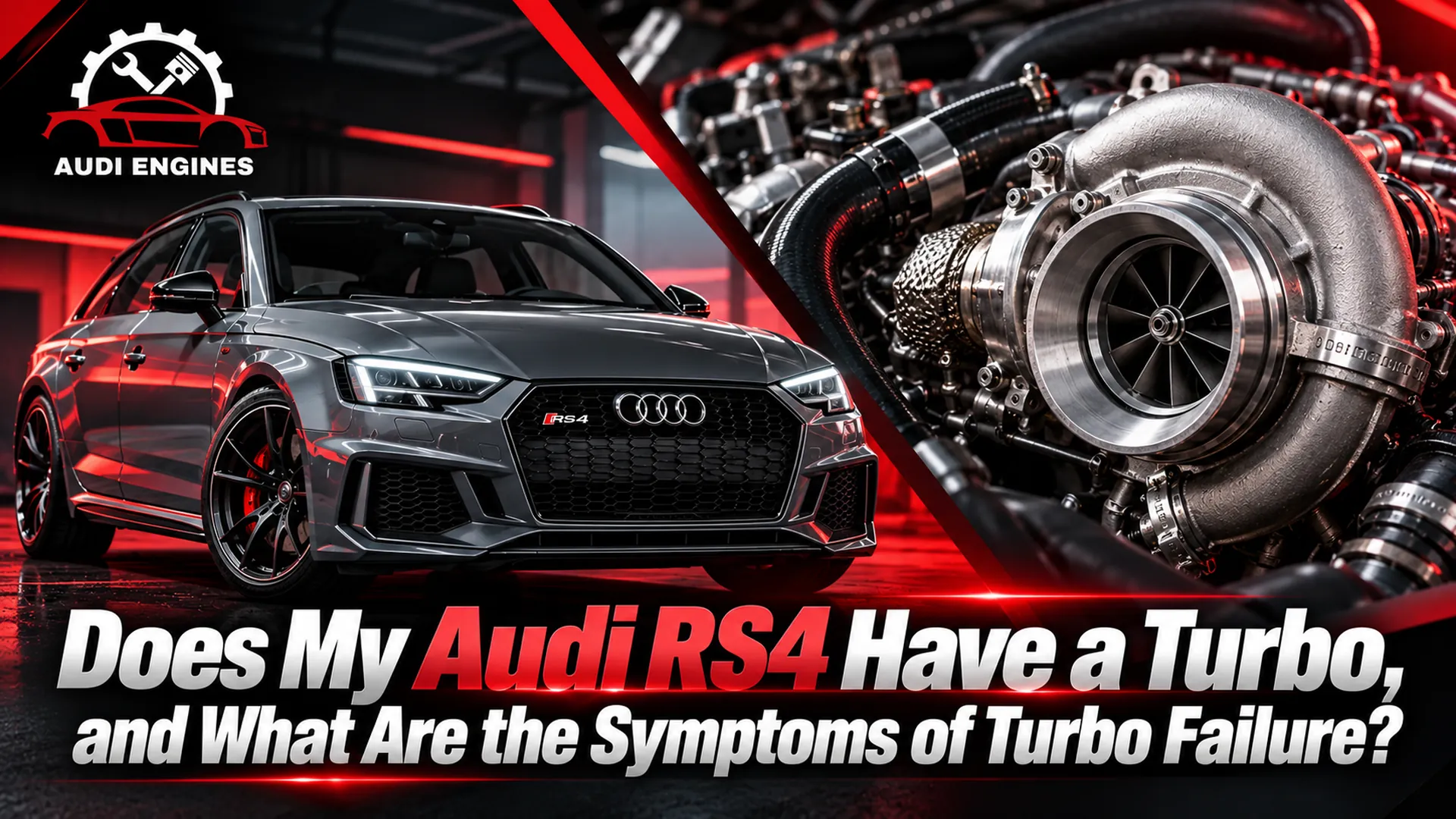
Not every RS4 has a turbo, so start here. It saves owners a lot of confusion.
Which RS4 Generations Are Turbocharged: B5, B7, B8 or B9?
Generation | Engine | Turbocharged? |
| B5 | 2.7-litre V6 biturbo (K04 turbos) | Yes |
| B7 | 4.2-litre FSI V8 | No, naturally aspirated |
| B8 | 4.2-litre FSI V8 | No, naturally aspirated |
| B9 | 2.9-litre TFSI twin-turbo V6 (EA839) | Yes |
If you own a B7 or B8, there is no turbo to fail. Rough running, hesitation or a gradual loss of power on those cars is far more likely to be intake valve carbon buildup, which we cover in our guide to Audi RS4 carbon buildup symptoms.
If you own a B5 or B9, read on. The two cars share a twin-turbo layout, but their weak points differ:
- B5 (2.7 biturbo): age matters here. Worn turbos, oil seal leaks, split hoses and boost leaks are the usual suspects on cars that are now decades old, and the K04 turbos are a known area of attention.
- B9 (2.9 TFSI): the turbos sit in the "hot V" of the engine, where heat is high. Owners and workshops commonly report charge pipe and intercooler pipe failures, boost leaks and wastegate control faults, often showing up as P0299.
How Do I Know If My RS4 Turbo Is Failing: Power Loss, Whistling, Smoke or Oil Use?
A failing turbo rarely announces itself with one dramatic event. It usually builds through several of these signs:
- Loss of power or poor acceleration: it can be sudden or gradual. A gradual decline is easy to dismiss as age.
- Loss of boost and excessive turbo lag: the car feels lazy until boost finally arrives.
- Whining or siren-like noise: often points to bearing or compressor wheel wear.
- Hissing or whooshing: usually air escaping, which suggests a leak rather than a dead turbo.
- Blue or grey smoke: can indicate oil getting past the turbo seals.
- Rising oil consumption: a turbo with failing seals can draw oil into the intake or exhaust.
- Engine light, EPC light or limp mode: the engine management cutting power to protect itself.
- Rough running or poorer fuel economy: a less obvious knock-on effect.
What the noise is telling you
Noise | What it usually means |
| Hissing or whooshing | Boost leak (pipe, hose or clamp) |
| Whistling | Boost leak, or an early turbo issue |
| Siren-like whine | Turbo bearing or compressor wear |
| Grinding | Serious mechanical damage inside the turbo |
| Rattle | Wastegate or actuator fault, or another engine component |
What the smoke is telling you
- Blue smoke: oil is being burnt, which can point to turbo seal leakage, though worn engine internals can cause it too.
- Grey or blue-grey smoke: often linked to oil leaking from a failing turbo.
- Black smoke: a fuelling or airflow issue, so it doesn't automatically mean the turbo is dead.
A typical scenario: an owner notices their RS4 feels slower on the way out of roundabouts. A faint hiss appears under load, then a limp-mode warning. They assume the turbo has gone and brace for a big bill. A pressure test finds a cracked charge pipe. Replacing it restores full boost, and the turbo was fine all along.
Recognise these signs? Book an RS4 diagnostic check with Audi Engines and we'll find out what's really failing.
Is It Turbo Failure, a Boost Leak or a Wastegate Fault, and What Does P0299 Mean?
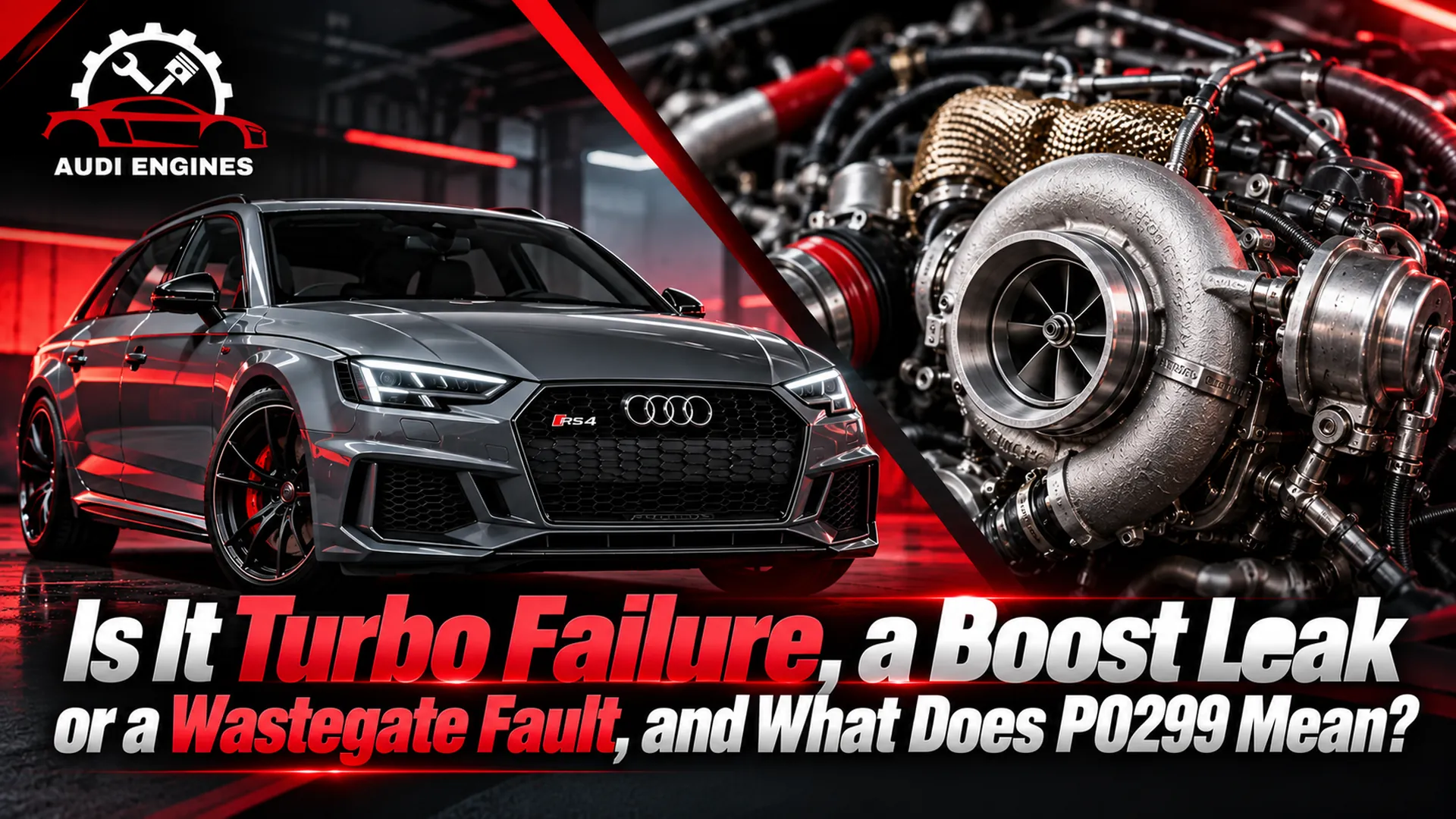
This is the question that saves owners the most money. A turbo turns exhaust energy into boost pressure. Anything that stops that pressure reaching the engine, or stops the system controlling it properly, can mimic a failed turbo.
How Do I Tell a Failed Turbo From a Cracked Charge Pipe or Faulty Wastegate?
Failed turbo | Boost leak | Wastegate or actuator fault | |
| Typical causes | Bearing or seal damage, oil starvation, contamination, wear | Cracked charge or intercooler pipe, loose clamp, split hose | Stuck or weak actuator, control fault, linkage problem |
| Typical clues | Whine or grinding, blue smoke, oil use, shaft play | Hissing or whooshing, sudden power loss, P0299 | Boost too low or erratic, rattle, boost control codes |
| Smoke | Often blue or grey | Usually none | Usually none |
| How it's confirmed | Shaft play, oil in the intake, wheel inspection | Pressure or smoke test | Actuator test, live boost data |
What P0299 means
P0299 is an underboost code. It tells you the engine isn't getting the boost pressure it asked for. It does not tell you the turbo has failed. On B9 cars in particular, cracked charge pipes, intercooler pipe leaks and wastegate control problems are common alternative causes. A code points to a system, not a part.
A specialist's diagnostic sequence
- Scan the diagnostic trouble codes with proper equipment such as VCDS.
- Compare requested and actual boost in live data to see where the shortfall happens.
- Inspect charge pipes, intercooler pipes, hoses and clamps for cracks, splits and loose fittings.
- Pressure or smoke test the intake system to find leaks you can't see.
- Check the wastegate and its actuator for correct movement and control.
- Check boost pressure, MAP and MAF sensors to rule out false readings.
- Assess the turbo itself: shaft play, oil feed and return lines, and the condition of the compressor and turbine wheels.
- Confirm the cause before replacing parts, so you only pay for what the car needs.
Replacing a turbo because of a code alone is a costly gamble. If the real fault was a leak, the new turbo won't fix it.
Can I Still Drive My RS4 With Turbo Problems, and What Does Repair or Replacement Cost in the UK?
Sometimes, briefly and gently. Sometimes absolutely not. The symptom decides.
When Should I Stop Driving, and Should I Repair, Rebuild or Replace the Turbo?
Symptom | Safe to drive? | Urgency |
| Mild loss of boost, car otherwise normal | Short, gentle trips only | Medium |
| Hissing with power loss | Reduce load, book a check | Medium to high |
| Limp mode | Avoid prolonged or fast driving | High |
| Blue smoke with fast oil loss | No | Critical |
| Grinding or loud siren noise | No | Critical |
| Oil pressure warning | No | Critical |
Stop driving now if you hear grinding, see heavy blue smoke, lose oil quickly or get an oil pressure warning. A failing turbo can send debris into the engine, and a repair that should have been limited to the turbo becomes much wider.
Repair, rebuild or replace? A simple framework
Situation | Usually best option |
| Cracked charge or intercooler pipe, loose clamp, split hose | Repair or replace the leaking part |
| Wastegate or actuator fault | Repair or replace the actuator or control component |
| Worn turbo with an otherwise healthy engine | Rebuilt or reconditioned turbo |
| Severely damaged or older turbo | New or genuine replacement turbo |
| Turbo failed from oil starvation or contamination | Fix the root cause first, then replace the turbo |
The last row matters most. If the oil feed line is blocked or the oil is contaminated, a new turbo will fail the same way. Always find out why it failed.
Cost guide (Audi Engines UK guide prices)
- Diagnostic scan and boost test:
- Boost leak or charge pipe repair:
- Wastegate or actuator repair:
- Turbo rebuild or reconditioning:
- Turbo replacement:
- Supply and fit:
What moves the price: whether it's a leak, an actuator or the turbo itself, whether the part is new, genuine, rebuilt or reconditioned, labour time, related parts that should be replaced at the same time, and any damage found elsewhere in the engine.
How to reduce the risk of turbo failure
- Use the correct oil and change it on time, because the turbo depends on clean oil.
- Let the engine warm up before demanding full boost, and let it settle after hard driving.
- Have charge pipes, intercooler pipes and hoses inspected, especially on older cars or after tuning.
- Check the oil level regularly and investigate any drop.
- Don't ignore small symptoms such as a faint hiss or a brief limp-mode event.
- Scan the car early when a light appears, before the symptom grows.
What Should I Ask a Specialist Before Booking an RS4 Turbo Repair?
- Do you have experience with the B5 or B9 RS4?
- How will you confirm the diagnosis before replacing parts? A good answer includes a scan, live boost data and a pressure test.
- What are my options? Repair, rebuilt turbo, reconditioned turbo or new.
- What warranty comes with the work?
- How long will the car be off the road?
- Can I have a written quote?
When turbo failure goes deeper: if a car has run for a long time with a failing turbo, debris or oil starvation can damage the engine. Audi Engines can advise on each route, from a boost leak repair to a turbo replacement and, where needed, wider engine repair or replacement. See our pages on Audi RS4 engine rebuild and replacement for more.
Get a free diagnostic enquiry. Send your registration and symptoms to Audi Engines or call, and we'll tell you what's likely wrong and what to do next.
Frequently Asked Questions
What are the symptoms of turbo failure on an Audi RS4?
Loss of power, loss of boost, whining, whistling or hissing, blue or grey smoke, rising oil consumption, limp mode, an engine light and sometimes a P0299 code.
Does P0299 mean my RS4 turbo has failed?
No. P0299 means underboost. Boost leaks, cracked charge pipes and wastegate faults are common alternatives, so the cause needs confirming.
Do the B7 and B8 RS4 have turbos?
No. Both use a naturally aspirated 4.2 FSI V8. Only the B5 (2.7 biturbo) and the B9 (2.9 TFSI twin-turbo) are turbocharged.
What does a failing RS4 turbo sound like?
A high-pitched whine or siren noise often points to bearing or compressor wear. Grinding suggests serious damage. Hissing is more likely a leak.
Can a bad turbo cause smoke on an RS4?
Yes. Blue or grey smoke can come from oil leaking past the turbo seals, though other engine wear can cause it too.
Can a failing turbo cause high oil consumption?
It can, particularly if the seals are worn. Check the oil feed and return lines and the engine's condition to find the real source.
Why is my RS4 losing boost?
The usual causes are a boost leak, a wastegate or actuator fault, a sensor fault or a worn turbo. A pressure test and live data show which.
Why is my RS4 in limp mode?
The engine management is limiting power, usually because of a boost, sensor or turbo fault. A scan with live data finds the cause.
How do you diagnose RS4 turbo failure?
By scanning codes, comparing requested and actual boost, inspecting pipes and hoses, pressure testing for leaks, checking the wastegate and then assessing the turbo itself.
Can an RS4 turbo be rebuilt?
Often, yes, depending on the damage. A specialist can advise whether a rebuilt, reconditioned or new turbo makes more sense.
Can I drive an RS4 with a failing turbo?
Only briefly and gently for minor boost loss. Stop immediately for grinding, heavy blue smoke, fast oil loss or an oil pressure warning.
How much does RS4 turbo replacement cost?
It depends on the car, the turbo option and what the diagnosis finds. Send us your registration and symptoms for a clear quote.
Final Thoughts
Audi RS4 turbo failure symptoms are easy to misread. A hiss, a flat feeling or a P0299 might mean a failed turbo, or it might mean a cracked pipe that costs a fraction as much to fix. The difference lies in testing before spending.
Know which generation you own, get a proper boost diagnosis, and fix the root cause so a repaired or replaced turbo doesn't fail again. If your RS4 is showing these symptoms, Audi Engines can help.
Send us your registration and a short description of the problem for a free diagnostic enquiry, or call for a quote.