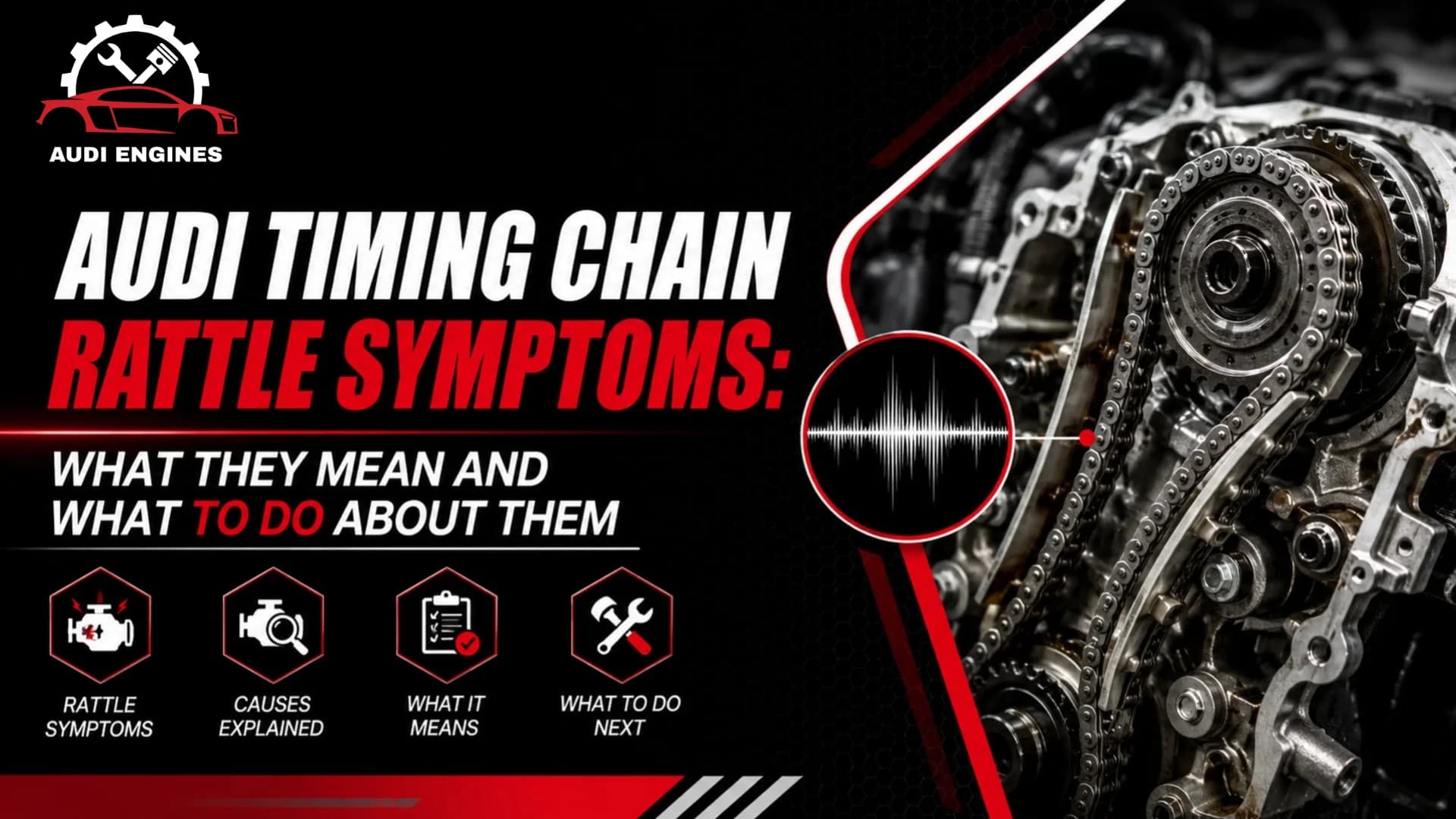
Audi Timing Chain Rattle Symptoms: What They Mean and What to Do About Them
You turn the key. For a second or two, there's a metallic rattle from under the bonnet before it smooths out into a normal idle. Then it happens again the next morning. And the one after that.
You turn the key. For a second or two, there's a metallic rattle from under the bonnet before it smooths out into a normal idle. Then it happens again the next morning. And the one after that.
If you've noticed this pattern, you're not imagining things, and you're not alone. Timing chain rattle is one of the most common, and most misunderstood, warning signs on modern Audi engines, particularly the EA888 2.0 TFSI found across the A3, A4, A5, A6, and Q5 ranges. Some owners get told it's nothing to worry about. Others get quoted thousands for a repair they didn't need yet. The truth sits somewhere in between, and knowing where your car falls on that spectrum can save you both money and a stranded roadside call.
This guide walks through exactly what that rattle means, which Audi models are most exposed, what's actually happening inside the engine, and what a sensible next step looks like, whether that's a quick oil check or booking a proper diagnostic.
What Does a Timing Chain Rattle Actually Sound Like?
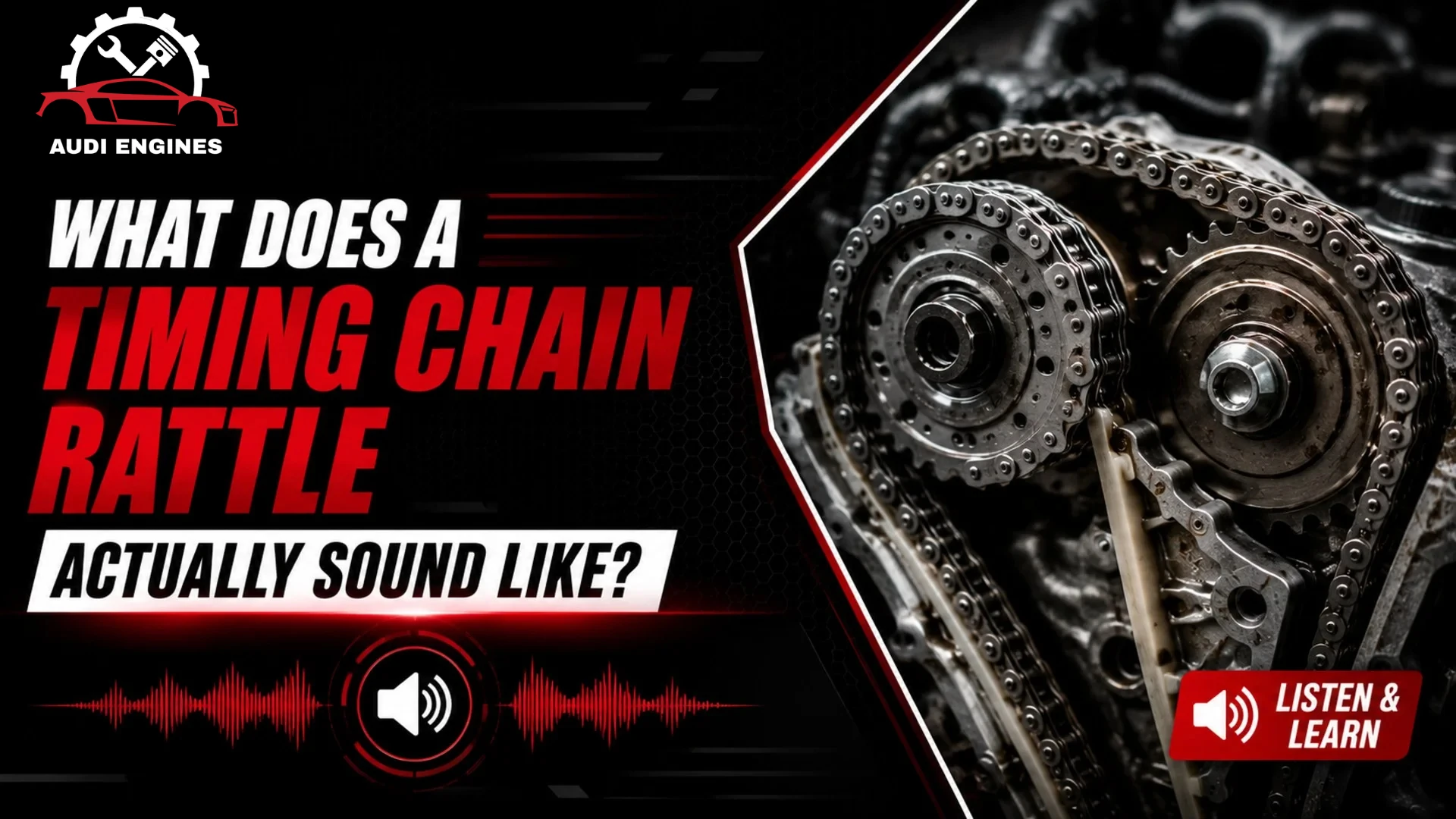
Not every noise from under the bonnet is timing chain related, so it helps to know what you're actually listening for. A genuine timing chain rattle tends to have a distinct metallic, chattering quality, closer to a handful of loose ball bearings shaking in a tin than a dull knock or a whine.
Why Does My Audi Rattle on Cold Start?
This is the classic presentation. When an engine sits overnight, oil drains back down into the sump, leaving the upper timing components, the chain, guides, and tensioner, running dry for the first second or two after start-up. The hydraulic tensioner needs oil pressure to take up slack in the chain properly. Until that pressure builds, the chain has a small amount of play, and that play is what you're hearing.
A brief rattle of half a second to one second on a cold start, which disappears as soon as oil pressure builds, is common and doesn't necessarily mean failure is imminent. A rattle that lasts several seconds, gets louder over time, or now also shows up on a warm restart is a different story, that pattern usually points to a tensioner that's losing its ability to hold tension consistently.
Does the Noise Change at Idle vs. During Acceleration?
Yes, and this distinction matters for diagnosis. Timing chain noise typically:
- Is loudest at idle or just after start-up, when oil pressure is lowest
- Fades or disappears under load, once revs and oil pressure rise
- Doesn't usually track directly with acceleration, unlike a knock sensor-related detonation issue or exhaust-related noise
If your rattle gets worse specifically when accelerating, or sounds more like a knock than a chatter, that's worth mentioning separately to a technician, since it could point toward a different mechanical issue entirely rather than the timing chain.
How to Tell Timing Chain Rattle Apart From Other Engine Noises
A lot of owners lump every strange sound into "the timing chain," but several other issues can mimic it:
- Belt tensioner squeal a higher-pitched, continuous noise, usually from an auxiliary belt, not the timing chain itself
- Exhaust heat shield rattle a lighter, buzzy rattle that often changes with engine vibration rather than oil pressure
- Injector tick a rhythmic ticking tied to engine speed, distinct from the more random chatter of a loose chain
- Hydraulic lifter tick a lighter tapping sound, often from valve train wear rather than the chain system
Quick Sound Check You Can Do at Home
Before booking anything, there's a simple check that costs nothing:
- Start the car from cold and listen closely for the first three to five seconds
- Time roughly how long the rattle lasts
- Note whether it returns on a warm restart later the same day
- Check your oil level and colour on the dipstick while the engine is off
Write down what you hear. This detail becomes genuinely useful information for whoever diagnoses the car, and it's exactly the kind of context a good technician will ask you for anyway.
Which Audi Models and Engines Are Most Affected?
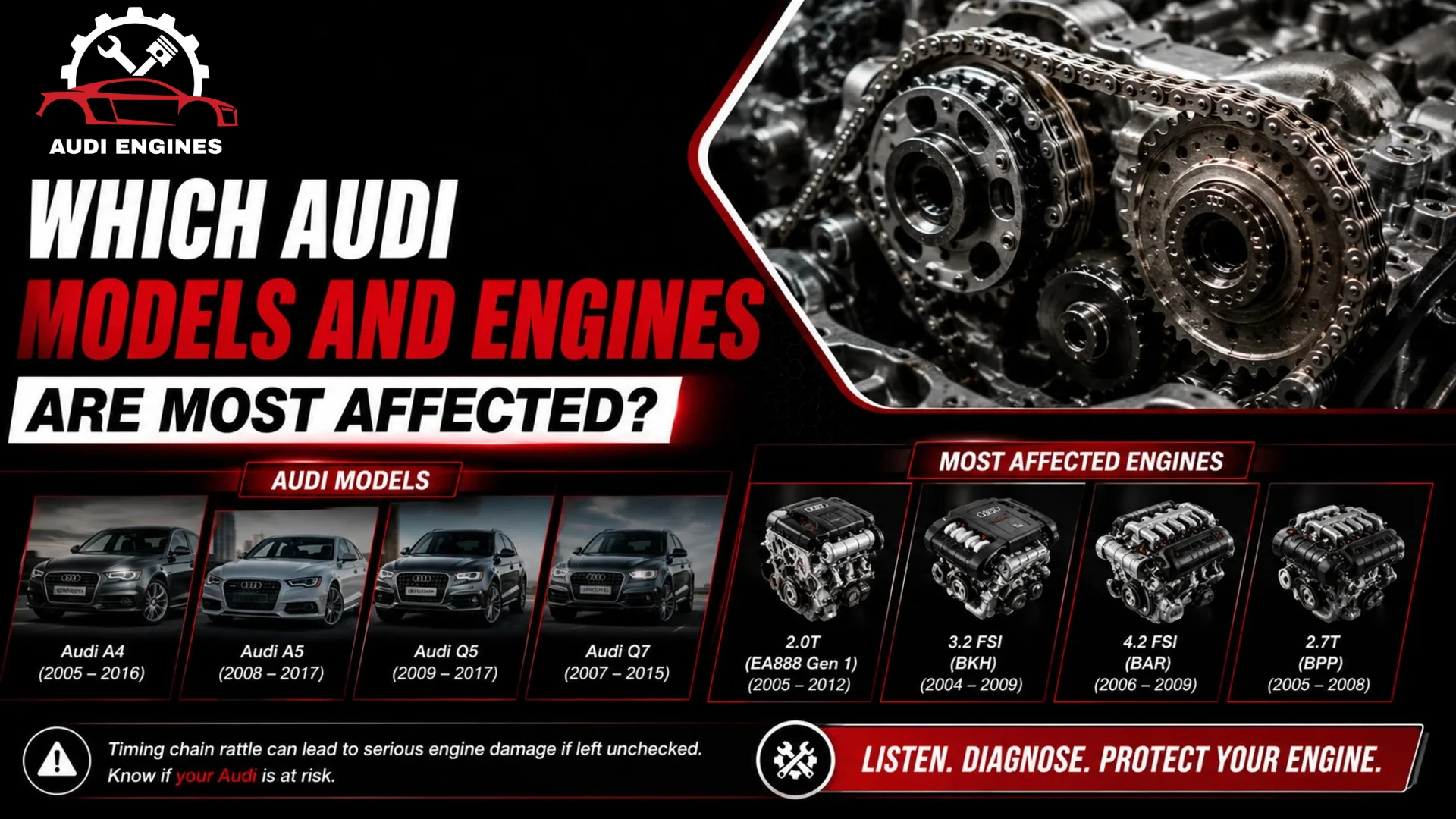
Timing chain tensioner issues aren't random. They cluster heavily around a specific engine family, which makes it easier to know if your car falls into the higher-risk category.
Is the Audi EA888 2.0 TFSI Prone to Timing Chain Issues?
Yes. The EA888 2.0 TFSI, used extensively across Audi's range from the mid-2000s through several generations of updates, has a well-documented history of timing chain tensioner wear. Earlier versions of the engine (particularly Gen 1 and early Gen 2 units) used a tensioner design that was more prone to losing hydraulic pressure over time, allowing the chain to develop slack and rattle.
Later revisions improved the design, but the underlying wear pattern, tensioner losing grip, chain stretching slightly, guides wearing down, is still something to watch for on any high-mileage 2.0 TFSI, regardless of generation.
Which Model Years Are at Highest Risk?
Model | Engine | Typical Risk Period | Common Symptom Reported |
| Audi A3 (8P/8V) | 2.0 TFSI | Higher risk on early Gen 1/2 units | Cold-start rattle |
| Audi A4 (B8) | 2.0 TFSI | Moderate to high, especially over 80,000 miles | Rattle plus occasional rough idle |
| Audi A5 (8T) | 2.0 TFSI | Moderate | Intermittent cold-start noise |
| Audi A6 (C7) | 2.0 TFSI | Moderate | Rattle on cold start, improves once warm |
| Audi Q5 (8R) | 2.0 TFSI | Moderate to high | Rattle plus fault codes on some units |
This isn't an exhaustive list, and plenty of cars outside these ranges run perfectly fine for well over 100,000 miles. But if your Audi falls into one of these model and engine combinations, it's worth being a little more proactive about checking rather than waiting for the noise to get worse.
What Role Does the Timing Chain Tensioner Play in This?
The tensioner is a small hydraulic component that uses oil pressure to keep constant tension on the timing chain, stopping it from developing slack as the chain very gradually stretches with age and mileage. When the tensioner works correctly, you shouldn't hear anything beyond a brief moment of noise on cold start.
When the tensioner starts to fail internally, usually due to a worn piston, a weakened spring, or oil pressure loss, it can no longer take up slack quickly enough. That's the mechanical root cause behind most of the rattling described above.
Early Warning Signs by Model
Across the affected models, owners typically report the same rough progression:
- Stage one brief rattle only on cold start, gone within a second
- Stage two, rattle extends to two or three seconds, sometimes returns on warm restart
- Stage three rattle present most starts, occasionally accompanied by a rough idle or a check engine light
- Stage four persistent noise, possible cam or crank correlation fault codes, and a real risk of chain skip
Catching the issue at stage one or two is significantly cheaper and less risky than waiting until stage four.
What Causes Timing Chain Rattle, and How Serious Is It?
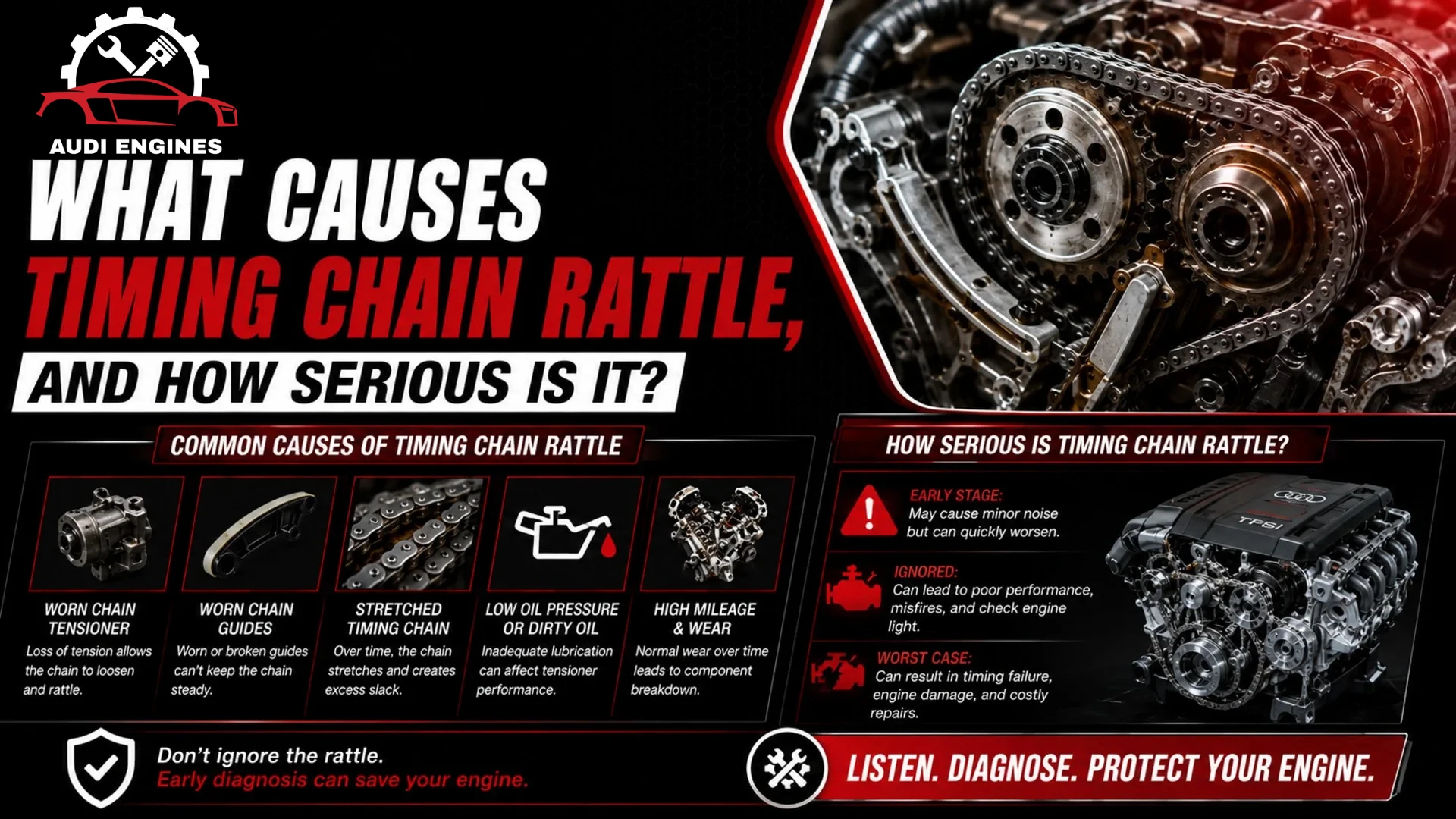
Understanding the underlying cause helps you judge urgency, rather than just reacting to the noise itself.
Common Causes: Low Oil Pressure, Worn Tensioner, Chain Stretch
Three factors tend to combine to create this symptom:
- Low or degraded oil pressure using the wrong oil grade, extending oil change intervals too far, or a failing oil pump can all starve the tensioner of the pressure it needs
- Worn or failing tensioner a mechanical part that simply wears out over time, particularly on earlier EA888 units
- Chain stretch timing chains don't snap suddenly; they very gradually elongate with age and mileage, which is normal to a point but becomes a problem once it exceeds what the tensioner can compensate for
Poor service history often makes this worse. A car that's had irregular oil changes, or has run on the wrong viscosity oil, tends to show timing chain symptoms earlier than one that's been maintained on schedule with the correct spec.
Can I Keep Driving With a Rattling Timing Chain?
In the short term, a brief cold-start rattle that resolves quickly generally doesn't mean you're at immediate risk. Plenty of owners drive for months with this exact symptom without incident. That said, "can" and "should" aren't the same thing here.
The real risk with ignoring it is that timing chain failure doesn't always give you much warning before it becomes serious. If the chain skips a tooth or, in a worst case, snaps, the pistons and valves can collide, which usually means a full engine rebuild or replacement rather than a simple chain job. That's the gap between a repair costing a few hundred pounds and one costing several thousand.
When Does This Become an Emergency Repair?
Certain signs mean you shouldn't keep driving and should get the car looked at immediately:
- The rattle is now present for several seconds on every start, cold or warm
- You notice a rough or uneven idle alongside the noise
- A check engine light appears, especially with cam or crank correlation codes
- You hear the noise briefly under load or acceleration, not just at start-up
- There's any hint of metal shavings on the dipstick when checking oil
Any one of these on its own is worth booking a diagnostic soon. More than one together warrants getting the car seen as a priority rather than waiting for a routine service slot.
What Happens If the Timing Chain Fails Completely?
On an interference engine like the EA888 2.0 TFSI, the pistons and valves occupy the same space at different points in the engine cycle, timed precisely by the chain. If the chain skips or breaks, that timing is lost instantly, and valves can be struck by pistons. The typical outcome is bent valves at minimum, and often damaged pistons or cylinder head damage in more severe cases, repairs that usually mean an engine rebuild or full replacement rather than a straightforward chain and tensioner job.
How Is Timing Chain Rattle Diagnosed and Fixed?
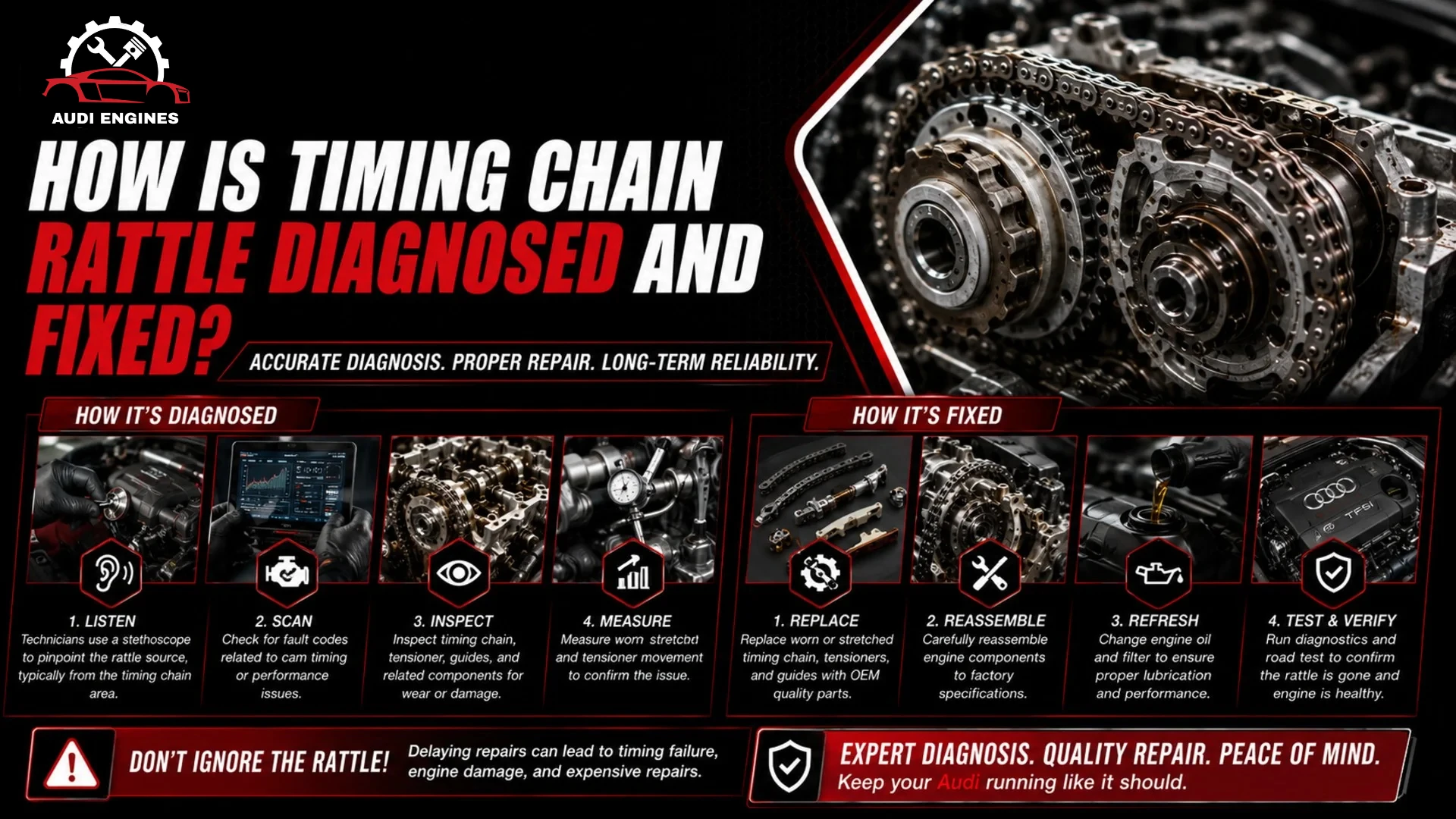
This is where a proper inspection earns its cost. Guessing based on sound alone only gets you so far.
What Does a Professional Diagnostic Check Involve?
A thorough diagnostic for suspected timing chain issues typically includes:
- A cold-start listening test, often repeated to confirm the pattern is consistent
- A full scan for fault codes, particularly cam and crank correlation codes, which indicate the ECU has detected timing drift
- An oil condition and level check, including grade verification against Audi's approved specification
- A borescope inspection in some cases, allowing a technician to visually check chain and guide condition without fully dismantling the engine
- A review of service history, since oil change intervals and grade history are strong indicators of how much wear to expect
Timing Chain Replacement: Process, Timeline, and Cost
If the tensioner and chain do need replacing, the job on most EA888-equipped Audis involves removing the front timing cover, replacing the chain, guides, and tensioner as a set, and resetting cam and crank timing precisely using factory tooling. This isn't a job that lends itself to shortcuts, timing set incorrectly by even a fraction can cause exactly the kind of engine damage the repair was meant to prevent.
Depending on the model and labour required, this kind of repair typically takes a day or more of dedicated workshop time, and cost varies significantly based on whether it's caught early (tensioner and chain only) versus caught late (potential head or internal engine damage on top). Getting an accurate quote for your specific model and mileage is far more useful than any generic figure, since parts and labour vary across the A3, A4, A5, A6, and Q5 ranges.
Why Choose Our Audi Specialists for This Repair?
Working on Audi and Volkswagen Group engines day in, day out gives a workshop a different level of familiarity than a general garage sees. At our shop, that means recognising the difference between a harmless cold-start chatter and a tensioner on borrowed time, without defaulting to the most expensive fix as a precaution. We work with genuine or OE-equivalent parts, use proper VCDS diagnostic tooling to check for cam and crank correlation faults, and we're upfront about what actually needs doing now versus what can reasonably wait until your next service.
Schedule Your Audi Diagnostic Inspection Today
If your Audi is showing any of the signs covered above, the sensible next step is a proper listen-and-scan diagnostic rather than waiting to see if it gets worse. It's a quick appointment that gives you a clear answer either way, peace of mind if it's minor, or an accurate repair plan if it isn't.
Frequently Asked Questions
Is a brief rattle at startup always the timing chain?
Not always, but it's the most common cause on EA888-equipped Audis. Belt tensioners, heat shields, and hydraulic lifters can produce similar sounds, which is why a proper diagnostic is worth doing rather than assuming.
Can I keep driving if the noise goes away after a second or two?
Many owners do drive for a while with a brief, consistent cold-start rattle without incident. However, it's a symptom worth monitoring closely and having checked, since tensioner wear tends to progress rather than improve on its own.
What's the typical repair cost for a timing chain tensioner replacement?
Cost depends heavily on the model, mileage, and whether damage is limited to the chain and tensioner or has spread further. It's best to get a specific quote based on an inspection of your car rather than relying on a generic average.
Do Audis use timing belts or timing chains?
It depends on the engine. Many of Audi's turbocharged petrol engines, including the widely used 2.0 TFSI (EA888), use a timing chain rather than a belt. Some diesel and older engines use belts instead, so it's worth confirming which your specific model uses.
How can I prevent timing chain wear?
Sticking to Audi's recommended oil change intervals, using the correct oil specification, and addressing any rattle early rather than waiting are the most effective ways to reduce the risk of tensioner and chain problems progressing into something more serious.
The Bottom Line
A timing chain rattle on an Audi isn't something to panic over the first time you hear it, but it's also not something worth ignoring indefinitely. The difference between a straightforward tensioner replacement and a full engine rebuild often comes down to how early the issue gets caught.
If you've noticed any of the symptoms covered here, a cold-start chatter, a noise that's started lasting longer, or a check engine light alongside it, book a diagnostic inspection with our Audi specialists. We'll give you a clear, honest answer on what's happening under the bonnet and what it'll actually take to sort it, before it turns into a bigger repair bill than it needs to be.