
Audi Timing Chain Replacement Cost UK, Prices, Symptoms & Specialist Repairs
That faint rattle when you start your Audi on a cold morning isn't your imagination, and it isn't something that'll simply go away on its own. If you're hearing it, or you've already had a garage mention the words timing chain.
That faint rattle when you start your Audi on a cold morning isn't your imagination, and it isn't something that'll simply go away on its own. If you're hearing it, or you've already had a garage mention the words "timing chain" in a diagnosis, you're probably wondering two things: how bad is this really, and what's it going to cost to fix.
Fair questions, and ones worth answering properly rather than with a vague "it depends, come in for a quote." The timing chain is one of the most safety-critical components in your Audi's engine, responsible for keeping the crankshaft and camshaft perfectly synchronised. When it wears, stretches, or fails, the consequences range from an annoying noise to genuinely catastrophic engine damage, and knowing where your car sits on that spectrum matters.
This guide covers everything: the warning signs worth acting on, realistic UK pricing by model and engine, what a proper replacement involves, and how to choose a specialist who'll fix it right rather than just clear the fault temporarily.
Signs Your Audi Needs a Timing Chain Replacement
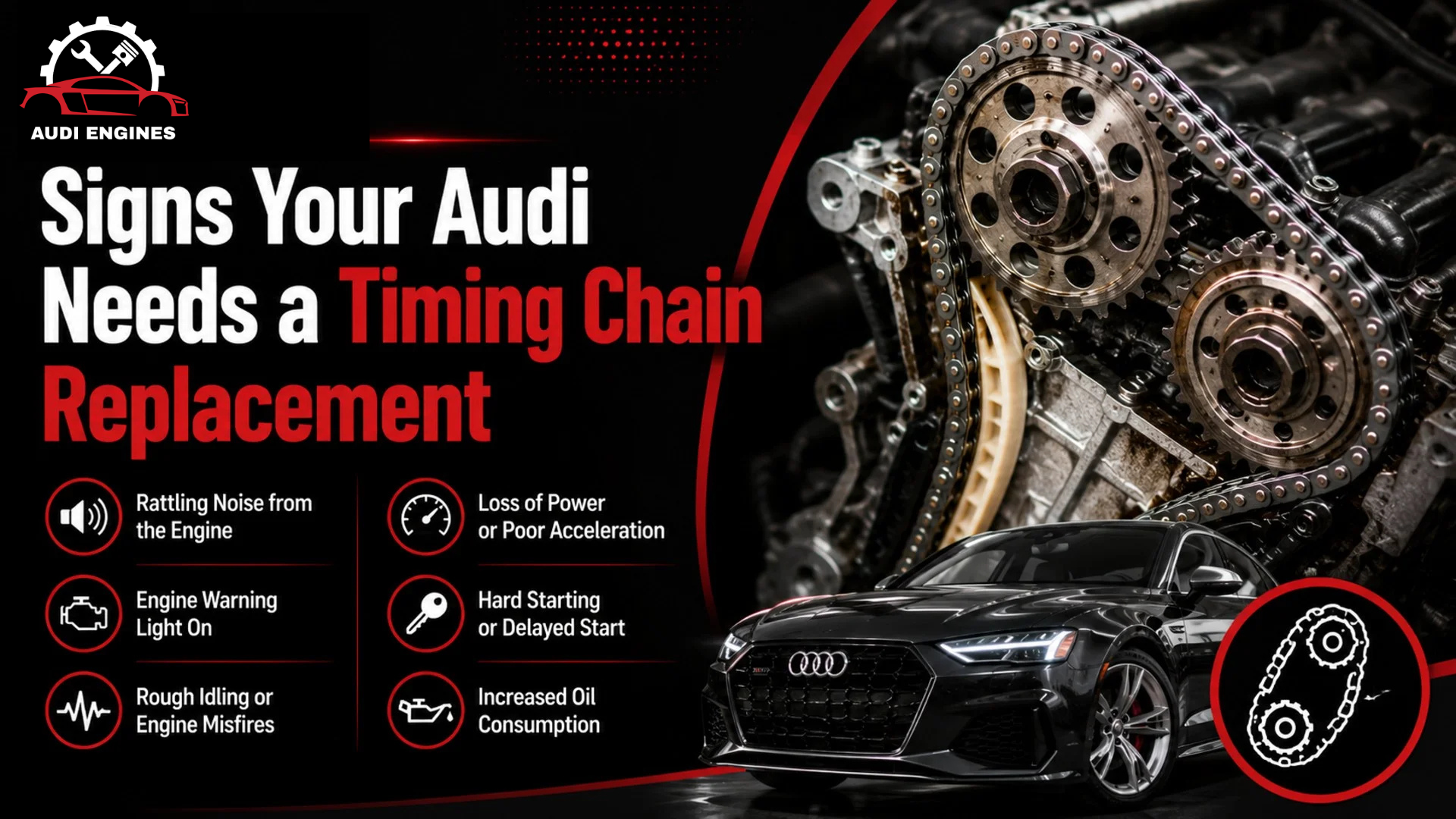
Timing chain problems rarely appear out of nowhere. They build gradually, and catching the early signs is often the difference between a straightforward replacement and a full engine rebuild.
Audi Cold Start Rattle Explained
This is the symptom most Audi owners come to us describing first: a distinct rattling or chattering noise for a second or two when starting the engine from cold, which then disappears once oil pressure builds. It sounds minor. It isn't always.
The cold start rattle typically points to the timing chain tensioner losing its ability to keep the chain properly tensioned before oil pressure fully circulates. On engines like the EA888, fitted across a huge range of Audi models, this is a well-documented issue, and one that tends to worsen gradually rather than resolve itself. A rattle that lasts half a second occasionally is worth monitoring; one that's getting longer or louder over weeks is worth booking in.
Common Audi Timing Chain Warning Signs
Beyond the classic cold start rattle, several other signs point to timing chain wear:
- A rattling or chattering noise from the engine bay, particularly noticeable on startup or at idle
- Engine warning light appearing on the dashboard, sometimes alongside a stored fault code related to camshaft timing
- Rough idle or misfire, as chain stretch begins to affect valve timing accuracy
- Poor acceleration or reduced engine performance, since incorrect valve timing directly affects combustion efficiency
- A knocking noise under load, distinct from the cold start rattle and often indicating more advanced wear
If you're noticing more than one of these together, it's a stronger signal that the chain itself, not just the tensioner, needs attention.
Timing Chain Stretch Symptoms
Timing chains don't stretch in the way a rubber belt might, but the individual links do wear over time, effectively lengthening the chain's overall path. Once stretch exceeds tolerance, the camshaft and crankshaft fall out of precise sync, which the engine control unit often detects and flags as a camshaft timing fault code. Symptoms include rough running, reduced power, and occasionally a check engine light with no other obvious cause.
Chain Tensioner Failure Symptoms
The hydraulic tensioner keeps constant pressure on the chain to stop it slapping against guides as it runs. When the tensioner fails, often due to oil pressure issues, wear, or a manufacturing weakness in certain generations of the EA888 engine specifically, you'll typically hear a more persistent rattle, sometimes at idle rather than just on startup, along with visible wear or metal debris found in the oil during an oil change.
Engine Warning Light & Rough Idle
A stored fault code referencing camshaft position or timing deviation is one of the clearer diagnostic signals a mechanic can act on. Combined with a rough idle, this combination strongly suggests the chain, tensioner, or guides need inspection rather than a component elsewhere in the engine.
Can You Drive with a Faulty Timing Chain?
This depends entirely on severity, and it's not a question to answer casually. A mild, occasional cold start rattle that clears quickly is generally lower risk for short-term driving, though it should still be booked in promptly. A persistent rattle, a rattle that's getting worse, or any accompanying performance loss is a different situation entirely, and continuing to drive genuinely risks the chain skipping a tooth or failing outright.
Our honest advice: if you're hearing a timing chain rattle of any kind, book a diagnostic check as soon as possible. It's a considerably cheaper conversation to have before the chain fails than after.
What Happens If an Audi Timing Chain Breaks?
On most modern Audi engines, including the EA888, a broken or badly slipped timing chain is an interference engine scenario, meaning the pistons and valves occupy the same physical space at different points in the engine cycle. If the chain breaks or jumps significantly, valves can be struck by pistons, causing bent valves, damaged pistons, and in severe cases, a cracked cylinder head. This typically escalates a chain replacement, a repair costing hundreds to low thousands, into a full engine rebuild or replacement costing considerably more.
Audi Timing Chain Replacement Cost UK
Now to the number you actually came here for. Pricing varies by model, engine, and how much of the timing system needs replacing, but here's a realistic breakdown based on typical UK garage pricing.
Average Audi Timing Chain Repair Prices
Repair Scope | |
| Diagnostic inspection | |
| Timing chain tensioner only | |
| Full timing chain kit (chain, tensioner, guides) | |
| Full kit + labour (complex engine access) | |
| Engine damage repair (if chain has slipped/broken) |
The wide range reflects a genuine reality: a straightforward tensioner replacement on an accessible engine is a very different job from a full chain kit replacement on an engine where the timing components sit deep behind the front cover, requiring significant labour to access.
Cost by Audi Model (A3, A4, A5, A6, Q5, Q7, TT)
Model affects cost mainly through labour complexity and part accessibility rather than the chain kit itself being drastically different in price. As a general guide:
- Audi A3 / A1, typically at the lower end of the range, given more accessible engine bays
- Audi A4 / A5 / TT, mid-range pricing, reflecting moderately more involved labour
- Audi A6 / A7 / A8, often towards the higher end, particularly on larger engines with more complex ancillary systems to remove for access
- Audi Q5 / Q7 / Q8, labour costs can run higher due to engine positioning and additional components requiring removal
Always get a quote specific to your exact model and engine code rather than relying on a general figure, even within the same model line, different engine generations can vary significantly in labour time.
Audi EA888 Timing Chain Replacement Cost
The EA888 is one of the most widely fitted engines across the Audi range, found in various generations of the A3, A4, TT, Q2, Q3, and more. It's also one of the more commonly discussed engines when it comes to timing chain tensioner issues, particularly in earlier generations of the engine. A full EA888 timing chain kit replacement typically falls in the range including labour, though this varies by the specific generation of the engine and the vehicle it's fitted to.
Factors That Affect Timing Chain Replacement Costs
Several variables shape your final quote, and understanding them helps you compare garage estimates properly rather than just chasing the lowest number.
- Engine accessibility, some engines require far more disassembly to reach the timing chain than others, directly affecting labour hours
- Scope of the repair, a tensioner-only fix costs considerably less than a full kit replacement covering the chain, guides, and tensioner together
- Genuine vs aftermarket parts, part quality affects both upfront cost and long-term reliability
- Whether engine damage has already occurred, if the chain has slipped and caused valve or piston damage, costs escalate significantly beyond a straightforward replacement
- Labour rates by region and garage type, independent specialists typically offer more competitive labour rates than main dealers for the same quality of work
Genuine vs Aftermarket Timing Chain Kits
This is worth understanding before comparing quotes, since it genuinely affects long-term value.
Factor | Genuine Audi/OEM Kit | Quality Aftermarket Kit |
| Manufacturer | Audi-specified, often supplied by brands like INA, Bosch, or Continental to OEM spec | Reputable brands (Febi Bilstein, SKF, INA) matching OEM tolerances |
| Cost | Higher | Typically 15–30% lower |
| Fit & Reliability | Guaranteed exact match | Very close match when sourced from a reputable brand |
| Best For | Newer vehicles, those under manufacturer warranty | Most repairs where value and quality both matter |
We're straightforward with customers about this choice, a well-known aftermarket brand like INA or Febi Bilstein, which frequently supplies OEM parts to Audi anyway, is often a sensible middle ground between price and reliability. What we'd never recommend is an unbranded budget kit with no traceable manufacturing standard, since timing chain components are exactly the wrong place to cut corners.
Labour Costs Across the UK
Labour rates for timing chain work vary by region and garage type, generally running higher in London and the South East compared to other parts of the UK, and higher still at main dealerships compared to independent Audi specialists. A specialist workshop with genuine VAG platform experience can often match dealership-level expertise at a noticeably more competitive labour rate.
Is a Timing Chain Repair Worth It?
In almost all cases, yes, provided the engine hasn't already sustained damage from a slipped or broken chain. A timing chain replacement, even at the higher end of the pricing range, is still considerably less expensive than an engine rebuild or replacement, and it restores your Audi to full reliability rather than leaving an underlying fault unresolved. The only scenario where it's genuinely worth questioning is a very high-mileage vehicle where multiple other major components are also approaching end of life, in which case the wider condition of the car, not just the timing chain, should factor into the decision.
Audi Timing Chain vs Timing Belt & What's Included in the Repair
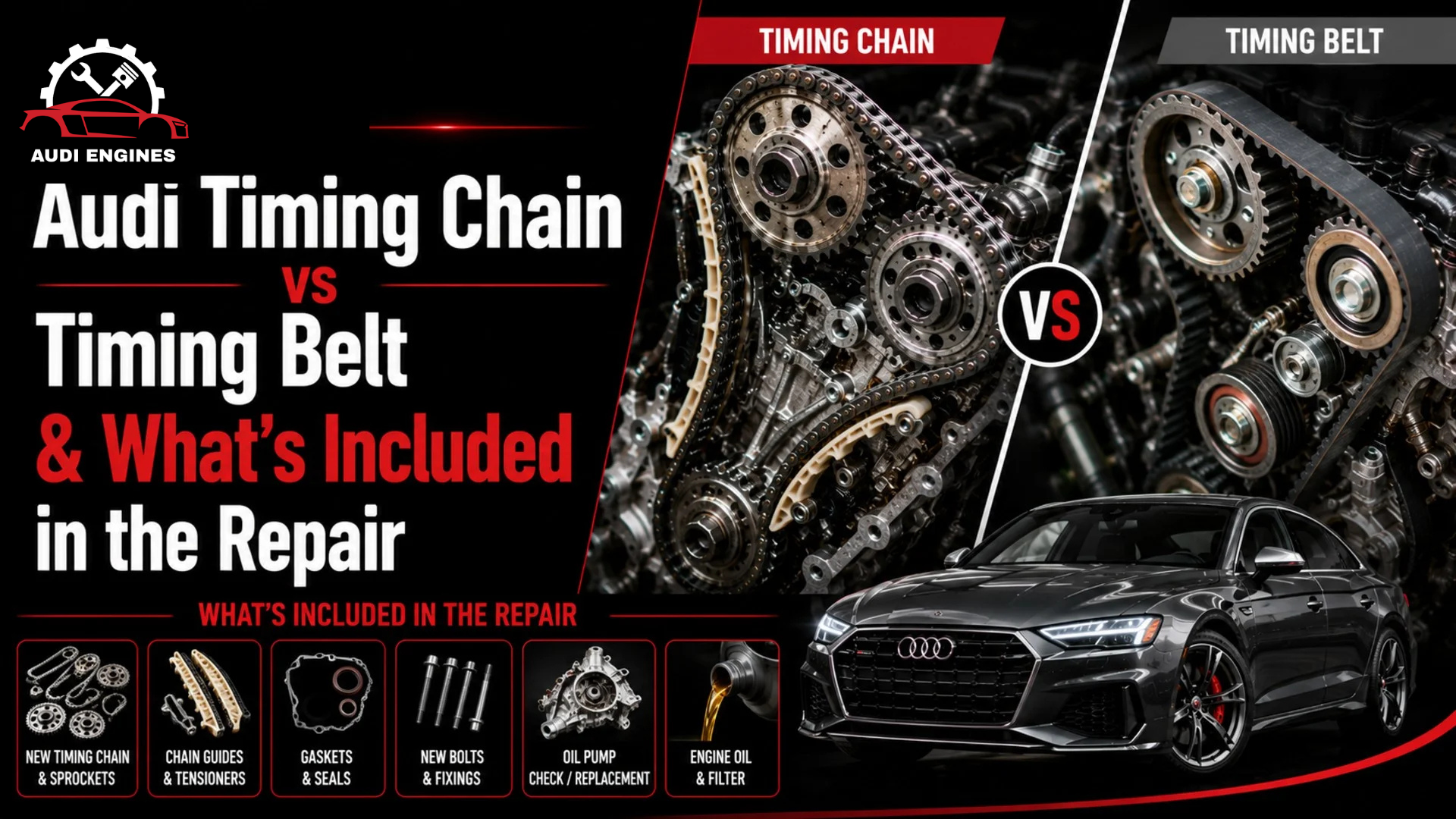
There's understandable confusion here, since not every Audi engine uses the same timing system, and the maintenance implications differ considerably between the two.
Timing Chain vs Timing Belt, Which Does Your Audi Have?
Broadly, most modern Audi petrol TFSI engines use a timing chain, while several TDI diesel engines, particularly older four-cylinder units, use a timing belt with a defined replacement interval. Timing chains are generally designed to last the engine's lifetime without scheduled replacement, which is precisely why unexpected chain issues catch owners off guard, there's no routine maintenance reminder telling you it's due, unlike a timing belt with its clear mileage or age-based interval.
This is an important distinction: a timing belt failing due to a missed replacement interval is a maintenance oversight; a timing chain failing is usually a component or design issue rather than something a routine service schedule would have flagged. If you're unsure which system your Audi uses, checking your specific engine code against your handbook, or simply asking your specialist, will confirm it immediately.
What's Included in an Audi Timing Chain Replacement Service?
A proper replacement should go well beyond simply fitting a new chain. Here's what a thorough service typically involves.
Diagnostic & Inspection Process
Before any parts are ordered, a proper diagnosis should include:
- A road test and cold start check to confirm and characterise the noise or fault
- An OBD diagnostic scan to check for stored camshaft or crankshaft position fault codes
- A physical inspection of chain tension and visible wear where accessible
- Assessment of oil condition, since contaminated or degraded oil accelerates chain and tensioner wear
This process confirms whether the issue is isolated to the tensioner, or whether the full kit, chain, guides, and tensioner together, needs replacing.
Replacement Checklist
A complete timing chain replacement should include:
- Removal of ancillary components required to access the timing cover
- Full removal of the old chain, guides, and tensioner
- Fitting of the new timing chain kit, with correct timing marks precisely aligned between camshaft and crankshaft
- Replacement of the timing cover gasket to prevent oil leaks
- An oil and filter change, since debris from a worn chain and tensioner commonly circulates through the oil system
- A post-repair diagnostic scan and road test to confirm correct running and clear any stored fault code
Skipping the oil change step is a shortcut some cheaper repairs take, and it's a false economy, since metal debris from the old worn components left circulating in the oil can accelerate wear on the brand-new chain and tensioner.
How Long Does Audi Timing Chain Replacement Take?
Timeframes vary by engine and access complexity, but as a general guide, a straightforward tensioner replacement can often be completed within a day, while a full timing chain kit replacement, particularly on engines where the timing system sits behind significant ancillary components, typically takes one to two full working days. Always confirm the expected timeframe with your specialist before booking, particularly if you need to arrange alternative transport.
Why Choose an Audi Timing Chain Specialist
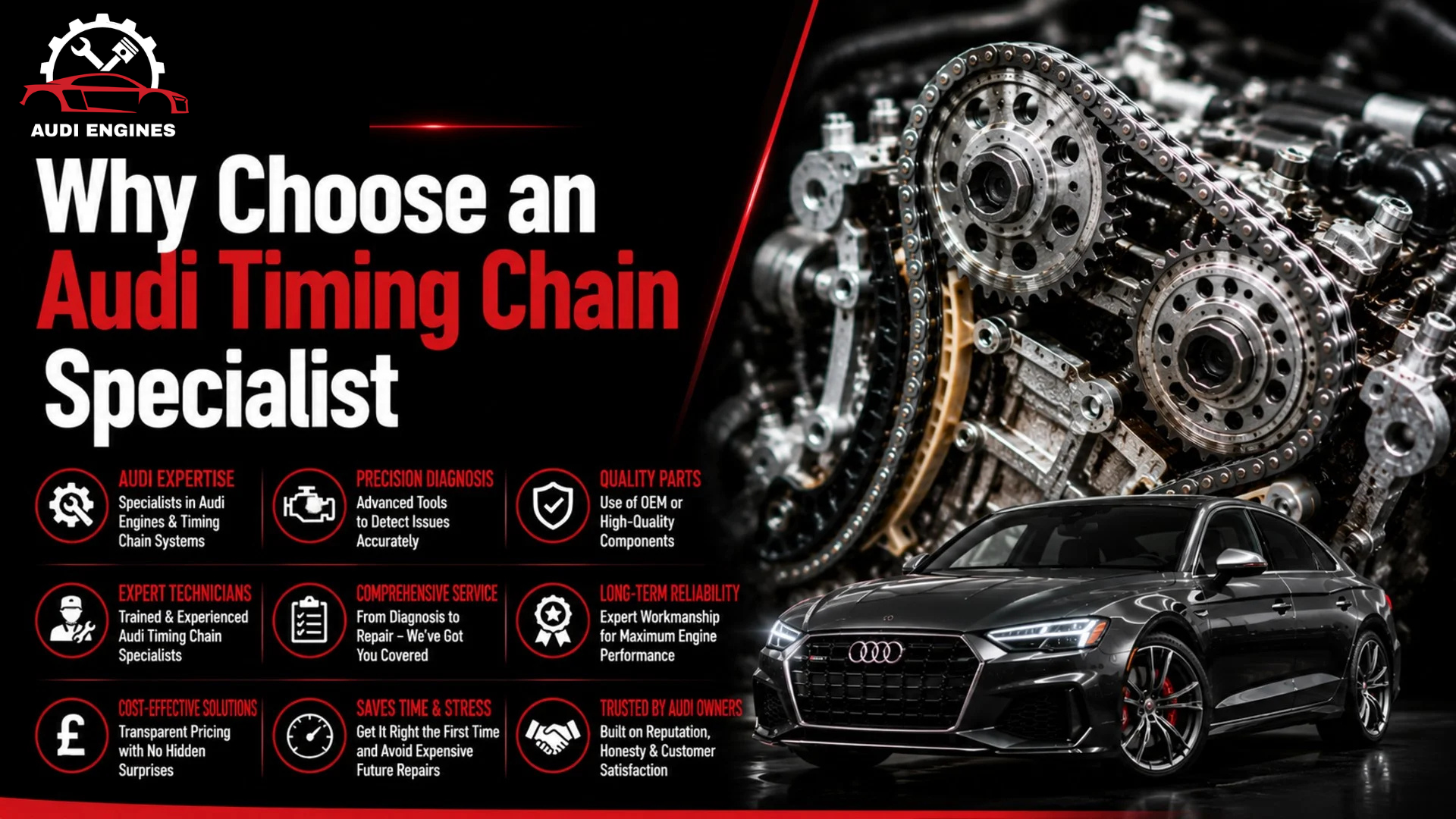
Where you have this work done matters just as much as the parts used, this is precision engine work, and getting the timing marks even slightly wrong has serious consequences.
Audi Specialist vs Main Dealer, What's the Difference?
Factor | Main Dealer | Independent Audi Specialist |
| Technical Expertise | Audi-trained | Often equally experienced, frequently ex-dealer trained technicians |
| Parts | Genuine Audi only | Genuine or reputable OEM-equivalent, customer's choice |
| Labour Rates | Typically higher | Generally more competitive |
| Diagnostic Equipment | Manufacturer-specific | VAG-specific diagnostic tools, equally capable |
| Turnaround | Can involve longer booking lead times | Often more flexible scheduling |
A genuine Audi or VAG specialist brings the same technical depth as a dealership, often including technicians with direct dealership training and experience, without the premium labour rate that comes with a franchised service department.
Genuine Audi Parts & Warranty Cover
Whichever specialist you choose, make sure the parts used meet genuine Audi specification, whether that's an OEM Audi part or a reputable equivalent from a manufacturer like INA, Bosch, or Febi Bilstein. Equally important: a proper repair should come with a clear warranty covering both parts and labour, not just a verbal assurance. This protects you if a fault does recur, and it's a strong signal of a specialist's confidence in the quality of their own work.
Preventing Future Timing Chain Problems
While timing chains are generally designed to last the engine's lifetime, a few habits genuinely help protect against premature wear.
Oil Quality & Timing Chain Life
Oil condition matters enormously to timing chain and tensioner health, since the tensioner relies on oil pressure to function correctly. Using the correct specification oil for your specific Audi engine, and keeping to recommended oil change intervals, directly reduces the risk of tensioner wear and chain-related noise. Delayed oil changes or using an incorrect oil specification are among the most common contributing factors we see in early tensioner failures, a detail that's easy to overlook but genuinely protects a very expensive component.
Get a Fixed-Price Audi Timing Chain Quote
We provide clear, fixed-price quotes after a proper diagnostic inspection, so you know exactly what you're paying for before any work begins, no vague estimates, and no surprises once the engine's already stripped down.
Frequently Asked Questions
How much does Audi timing chain replacement cost?
Pricing typically ranges for a tensioner-only repair, up to a full timing chain kit including labour, depending on your specific Audi model and engine. Get a quote specific to your vehicle for an accurate figure.
When should an Audi timing chain be replaced?
Unlike a timing belt, Audi timing chains don't have a fixed manufacturer replacement interval and are generally designed to last the engine's lifetime. Replacement becomes necessary when wear, stretch, or tensioner failure produces symptoms like rattling, warning lights, or rough running.
Can an Audi timing chain fail?
Yes. While designed for long-term use, timing chains can fail due to tensioner wear, chain stretch, or oil-related issues, particularly on certain generations of engines like the EA888, which has documented tensioner concerns.
Does an Audi timing chain last forever?
No component lasts genuinely forever, though timing chains are built to outlast a timing belt's fixed replacement interval under normal conditions. Poor maintenance, oil issues, or a manufacturing weakness in specific engine generations can shorten this considerably.
What are Audi timing chain symptoms?
The most common signs are a rattling noise on cold start, a persistent rattle at idle, engine warning lights related to camshaft timing, rough idle, and reduced engine performance.
How long does timing chain replacement take?
A tensioner-only repair can often be completed within a day, while a full timing chain kit replacement typically takes one to two working days, depending on engine accessibility.
Is an Audi timing chain covered by warranty?
This depends on your vehicle's age and warranty status. If your Audi is still under manufacturer warranty, timing chain issues may be covered, particularly if linked to a known manufacturing concern. Older or out-of-warranty vehicles would need the repair covered independently, though a reputable specialist should offer their own warranty on the completed work.
Can I drive with a noisy timing chain?
A mild, brief cold start rattle is lower risk for short-term driving, but a persistent or worsening rattle carries a genuine risk of chain failure and should be diagnosed as soon as possible rather than driven on indefinitely.
Is a timing chain better than a timing belt?
Both have advantages. Timing chains generally don't require scheduled replacement, but can fail unexpectedly if the tensioner wears. Timing belts have a defined, predictable replacement interval, but require that maintenance to be kept up to avoid failure. Neither is universally "better", they simply carry different maintenance profiles.
What happens if an Audi timing chain breaks?
On interference engine like most Audi TFSI units, a broken or badly slipped chain can cause the pistons to strike the valves, resulting in significant internal engine damage. This typically turns a timing chain repair into a much more expensive engine rebuild or replacement.
Which Audi engines have timing chain issues?
Various generations of the EA888 engine, fitted across the A3, A4, TT, Q2, Q3, and other models, are among the more commonly discussed engines for timing chain tensioner concerns, though issues can occur across different engine families depending on age, mileage, and maintenance history.
Can low oil pressure cause timing chain noise?
Yes. The timing chain tensioner relies on oil pressure to maintain correct chain tension. Low oil level, degraded oil, or an oil pump issue can all contribute to reduced tensioner performance and audible chain noise, particularly on cold starts.
Get Your Audi's Timing Chain Sorted Before It Becomes Something Bigger
A rattling timing chain isn't a noise to live with or hope disappears, it's a warning sign attached to one of the most critical components in your engine. Catching it early, with a proper diagnostic and a fixed-price quote from a genuine Audi specialist, is a fraction of the cost and hassle of dealing with the engine damage a failed chain can cause.
Book a diagnostic inspection today, and get a clear answer on what's actually needed for your specific Audi, along with a fixed-price quote and genuine parts, so you know exactly where you stand before any work begins.