
Audi V6 Diesel EGR Valve Cleaning & Replacement: 3.0 TDI Specialists in the UK
Your Audi has started to feel wrong. The engine management light is on, the car hesitates when you ask for power, or it drops into limp mode on a motorway slip road. Then comes the worry: is this a simple clean, or a part that will cost serious money. On a 3.0 TDI, the cause is often the Exhaust Gas Recirculation (EGR) system.
Your Audi has started to feel wrong. The engine management light is on, the car hesitates when you ask for power, or it drops into limp mode on a motorway slip road. Then comes the worry: is this a simple clean, or a part that will cost serious money?
On a 3.0 TDI, the cause is often the Exhaust Gas Recirculation (EGR) system. It sends a controlled amount of exhaust gas back into the intake to cut NOx emissions. When carbon builds up, or an actuator or sensor fails, that balance goes wrong and the engine tells you about it.
If you are searching for Audi V6 diesel EGR valve cleaning and replacement, you probably want three answers. What is actually wrong? Will cleaning fix it, or does the valve need replacing? And who can sort it without throwing parts at the problem?
At Audi Engines, we start with diagnosis and let the test results decide the repair. That means EGR valve cleaning when the valve is mechanically sound, and compliant replacement when it is not.
Book an Audi EGR diagnostic check and we will tell you what your engine needs before any work begins.
What Are the Symptoms of a Faulty Audi V6 Diesel EGR Valve, and What Causes Them?
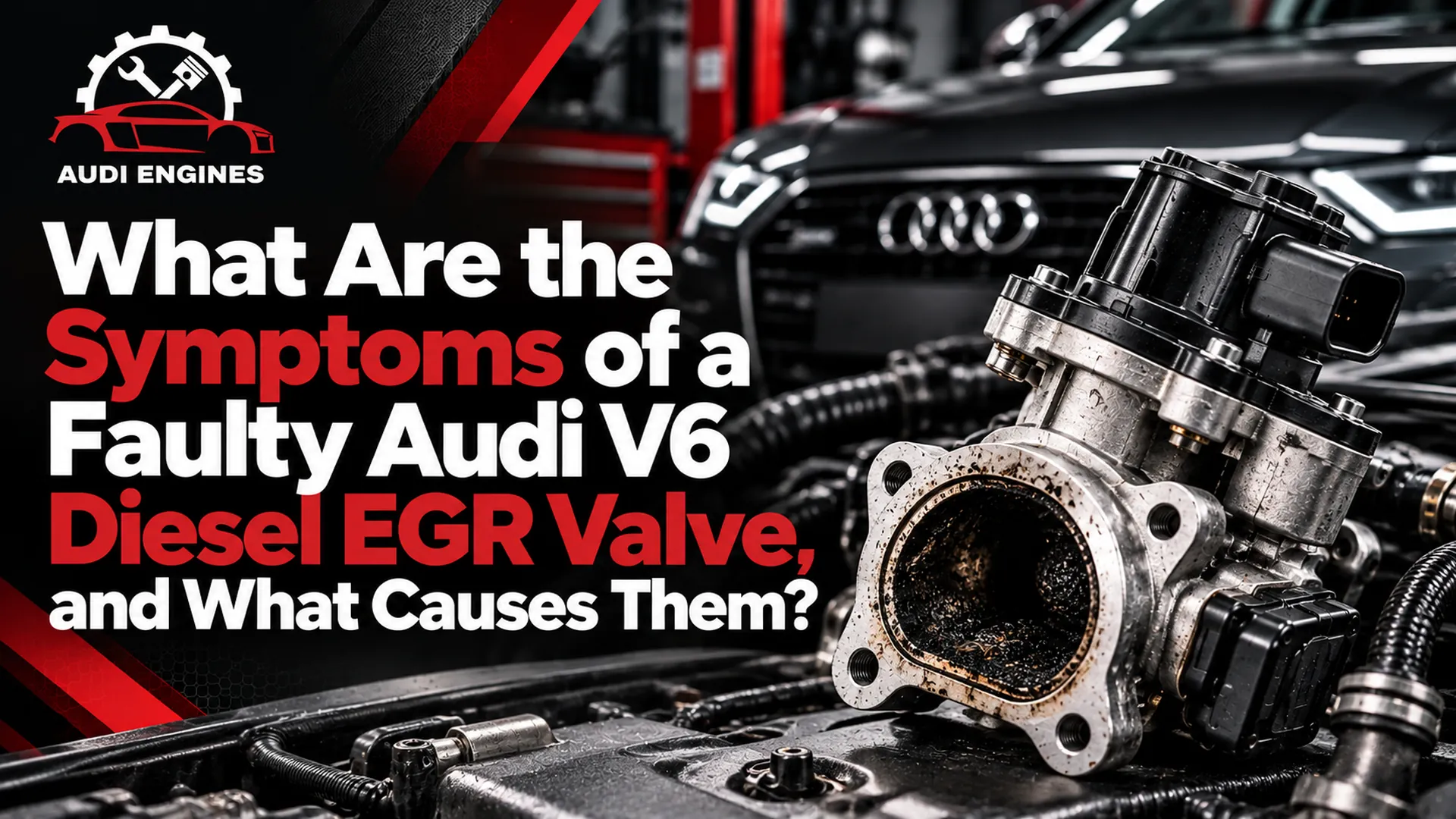
The EGR valve opens and closes to control how much exhaust gas re-enters the engine. It sits in a harsh spot, surrounded by soot, oil vapour and heat. Over time, that environment catches up with it.
The result is rarely sudden. Most owners notice a slow decline in performance, then a warning light, then a fault that keeps coming back.
How Do I Know If My Audi 3.0 TDI EGR Valve Is Blocked or Failing?
Here are the signs we see most often on Audi diesel engines:
- Engine management light. The ECU has spotted EGR flow or valve position that does not match what it expects.
- Reduced power and poor acceleration. The engine feels flat, especially under load or when overtaking.
- Rough idle and hesitation. The car shudders at traffic lights or stumbles when you pull away.
- Black exhaust smoke and excess soot. Incomplete combustion shows up at the tailpipe.
- Increased fuel consumption. The engine works harder to deliver the same performance.
- Limp mode. The ECU limits power to protect the engine, and the fault often returns after a restart.
These symptoms point to a problem, but not always to the valve itself. A restricted EGR cooler, a dirty intake manifold, a faulty MAF sensor or a blocked DPF can produce similar behaviour. That overlap is exactly why guessing gets expensive.
Why does carbon build up? Recirculated exhaust gas carries soot and oil vapour. Short journeys make it worse, because the engine rarely gets hot enough to burn deposits off. Low-temperature running leaves sticky carbon that hardens over time.
Stuck open and stuck closed faults feel different:
Fault | What happens | What you may notice |
| EGR valve stuck open | Too much exhaust gas enters the intake | Rough idle, stalling, poor throttle response, sooty running |
| EGR valve stuck closed | Little or no exhaust gas recirculates | Warning light, higher NOx, sometimes harsher combustion and a failed emissions check |
If the engine warning light comes on and you notice a real loss of power, get the car checked promptly. Avoid driving it hard until it has been scanned, because repeated limp mode events and poor combustion can lead to further problems.
What Do the Audi EGR Fault Codes P0401, P0402, P0403 and P0404 Actually Mean?
A diagnostic scan reads the fault codes stored by the engine control unit (ECU). The codes are useful, but they describe a condition, not a verdict.
- P0401: insufficient EGR flow detected.
- P0402: excessive EGR flow detected.
- P0403: EGR control circuit malfunction.
- P0404: EGR control range or performance problem.
Here is the key point. A code is not proof that the EGR valve has failed. A P0401 can come from a blocked passage, a sticking valve, a weak actuator, a wiring or connector fault, or a sensor reading that does not match reality. Replace the valve without testing, and the code can simply return.
So what does a technician check beyond the code?
- Live data. We compare the commanded valve position with the actual position.
- Actuator operation. We test whether the valve moves smoothly and fully.
- Wiring and connectors. We inspect the harness for damage, corrosion and poor contact.
- Airflow readings. We review MAF and related sensor data to see whether airflow makes sense.
- Passages and intake. We check for restriction in the EGR passages and intake manifold.
Each step rules something in or out. By the end, we know whether the repair is cleaning, replacement or something else entirely, such as the EGR cooler or an electrical fault.
Book an Audi diesel diagnostic scan before you buy any parts.
Which Audi Models and Engines Can Have EGR Problems, and How Do I Confirm Mine?
The 3.0 TDI V6 appears across several Audi models. EGR concerns can affect:
- Audi A6 3.0 TDI, including the Avant.
- Audi A7 3.0 TDI.
- Audi A4 and A5 3.0 TDI.
- Audi Q5 3.0 TDI.
- Audi Q7 3.0 TDI.
- Audi A8 3.0 TDI.
Do not assume every model shares the same valve, cooler or repair procedure. Engine generations and layouts differ, so the engine code and VIN decide what applies to your car.
To confirm your engine and give you accurate guidance, we ask for:
- Your registration number and mileage.
- The symptoms you have noticed and when they happen.
- Any fault codes already read.
- Your recent service history.
Here is a scenario we see often. An owner brings in a 3.0 TDI with intermittent power loss and a P0401 code. A garage elsewhere suggested a new valve. On testing, the valve moves but sticks under heat, and the passages are heavily coated. The valve responds to proper cleaning and the car runs normally again. Another owner with the same code has a failed actuator, and cleaning would not have helped. Same code, different repair.
For model-specific detail, see our guides on Audi A8 3.0 TDI EGR problems and Audi Q7 3.0 TDI EGR problems. The A6 and Q5 guides will cover those models in the same depth.
Should I Clean or Replace My Audi V6 Diesel EGR Valve, and What Does It Cost?
Most owners asking about Audi 3.0 TDI EGR valve replacement cost are also asking something else: "Am I being sold a part I do not need?" Fair question. The answer comes from the diagnosis, not from the price list.
When Does an Audi EGR Valve Need Cleaning, When Does It Need Replacing, and What Affects the Price?
Cleaning may be the right answer when the valve is mechanically sound and the problem is deposits that can be removed. Replacement is usually the right answer when the actuator has failed, the position sensor is faulty, the electrical side is damaged or the valve mechanism is worn or broken.
This table summarises how we think about it:
What testing shows | Likely action | What to expect |
| Valve moves correctly but is coated in carbon | EGR valve cleaning | Removal, deposit removal, inspection, refit and verification |
| Valve sticks or moves slowly, and the mechanism is sound once cleaned | Cleaning, then recheck | Live data confirms normal movement afterwards |
| Actuator or position sensor fault | EGR valve replacement | New valve or assembly, adaptation where required |
| Electrical or circuit fault with a damaged valve | Replacement and wiring repair | Circuit checked before and after |
| Valve fine, but passages, cooler or intake heavily restricted | Wider cleaning or EGR cooler work | Related components inspected and repaired as needed |
How EGR cleaning works at a professional level. The valve is removed, deposits are cleaned away, and the passages and intake are inspected. We then refit the valve and verify operation with live data. Removal and deep cleaning is not the same as a chemical treatment sprayed into the intake. Chemical cleaning may help with light deposits, but it will not clear heavy restriction, and it cannot fix an electrical fault.
How replacement works. We fit a new valve or assembly, clear the fault codes, and carry out adaptation or basic settings where the vehicle requires them. Then we verify live data and road test the car. A new valve that has not been adapted properly can leave the fault in place, so this step matters.
What if the fault returns after cleaning? It happens, and it is not a mystery. The usual causes are:
- Deposits further along the passages or in the intake manifold.
- A cooler that is partly restricted.
- A related sensor, such as the MAF, giving poor readings.
- An actuator that cleaned up but is weakening.
- Driving conditions that keep feeding the problem, such as repeated short trips.
If the fault returns, we go back to testing rather than repeating the same repair.
What affects the cost? We do not publish a single figure, because a V6 TDI is not a single job. These factors shape your quote:
- Diagnostic charge. Testing comes first and tells us what the car needs.
- Parts choice. OEM parts and aftermarket parts both exist, and we explain the difference so you can decide.
- Engine access and labour time. Layout varies by model, and some jobs take longer to reach.
- EGR cooler or related work. If testing shows the cooler, intake or a sensor is involved, the scope changes.
- What the inspection finds. We tell you before we carry out any extra work.
Use this checklist when you compare quotes:
Ask the garage | Why it matters |
| Is a diagnostic scan and testing included? | A quote without diagnosis may be a guess |
| Is the valve removed and cleaned, or just treated chemically? | The method changes the result |
| Are the passages and intake inspected? | Deposits elsewhere can bring the fault back |
| Are parts OEM or aftermarket? | Quality affects durability |
| Is adaptation or basic settings included? | A new valve may need it |
| Is there post-repair testing and a road test? | This confirms the fix |
| What does the warranty cover, and for how long? | Terms should be written down |
A note on compliance. Audi Engines repairs and replaces the EGR system. We do not offer EGR delete. On UK road cars, removing or disabling emissions equipment can cause legal and MOT problems, and it is not a repair we will carry out.
Request your written Audi EGR repair quote and see exactly what is included, line by line.
Why Choose Audi Engines for Audi V6 Diesel EGR Repair, and How Do I Book?
Choosing a garage for EGR work is a trust decision. The valve sits deep in the engine bay, the fault codes can mislead, and the wrong repair wastes money. A good specialist explains what they found and why they recommend it.
What Makes an Audi EGR Specialist Worth Choosing, and How Do I Prevent the Problem Returning?
Here is what we hold ourselves to:
- Focused experience. Our work centres on Audi diesel engines, including the 3.0 TDI, so the symptoms and layouts are familiar.
- Diagnosis before parts. We test first, so you pay for the repair your car needs.
- Clear process. From scan to road test, you know what happens at each step.
- Honest scope and quotes. We list what is included and flag what is extra.
- Evidence. Where it helps, we show you what we found, so the recommendation makes sense.
Prevention matters too. EGR carbon is easier to manage than to cure. These habits help:
- Take regular longer runs. Sustained motorway driving helps the engine reach temperatures that burn off deposits.
- Service on time with the correct oil. Oil condition affects how much vapour and soot reaches the intake.
- Act on warning lights early. A small fault fixed early is cheaper and safer than a big one later.
- Ask for periodic intake and EGR inspection. Catching buildup early can avoid a heavier clean.
Booking takes three steps:
- Send your registration and symptoms. Use our form or call us.
- Receive your diagnosis and written quote. We confirm the cause and explain the options.
- Book your slot. Choose a date that suits you, and we take care of the rest.
Frequently Asked Questions
Can an Audi V6 diesel EGR valve be cleaned?
Yes, when the valve is mechanically sound and the problem is removable deposits. If the actuator or electrical side has failed, replacement is the better route.
Is cleaning an Audi EGR valve better than replacing it?
Neither is better in every case. Testing shows which one your car needs. Cleaning suits a sound valve with deposits, and replacement suits a failed component.
What are the symptoms of a faulty Audi EGR valve?
Common signs include the engine management light, reduced power, rough idle, hesitation, black smoke, higher fuel consumption and limp mode.
What does P0401 mean on an Audi diesel?
It indicates insufficient EGR flow. The cause can be a blocked passage, a sticking valve, an actuator fault, wiring or a sensor issue, so it needs testing.
Is it safe to drive with an EGR fault?
Short, gentle journeys to a garage are usually manageable, but we would not keep driving hard with a warning light and power loss. Get it checked promptly.
Will cleaning the EGR valve clear the warning light?
It can, if deposits caused the fault. If the light returns, something else is involved, such as the actuator, cooler, intake or a sensor.
Does a new EGR valve need adaptation?
Often, yes. Many vehicles need adaptation or basic settings after replacement, followed by live data checks.
Why did my EGR fault return after cleaning?
Usually because deposits remain further along the system, or a related component is also faulty. We go back to testing to find the real cause.
Can a faulty MAF sensor trigger an EGR-related fault?
It can. The ECU compares airflow readings, so a poor MAF signal can mimic or contribute to an EGR fault.
Can an EGR cooler problem affect the engine?
Yes. A restricted or leaking cooler can affect EGR flow and, in some cases, coolant levels, so we inspect it when symptoms suggest it.
Is a diagnostic scan available before repair?
Yes. We recommend it, because it shows whether cleaning, replacement or other work is needed.
How can a mechanic confirm the EGR valve has failed?
By reading codes, checking live data, testing valve movement and actuator operation, inspecting wiring and reviewing airflow readings.
Get Your Audi Running Properly Without Guessing
A warning light and a flat-feeling engine are stressful, but they are rarely hopeless. On a 3.0 TDI, the right answer depends on what testing shows. Sometimes the valve needs a proper clean. Sometimes it needs replacing. Sometimes the real fault is the cooler, the intake or a sensor.
What matters is that you pay for the repair your car needs, done properly, with the system verified afterwards.
If you drive an A6, A7, A4, A5, Q5, Q7 or A8 with a 3.0 TDI and you are seeing warning lights, power loss or a rough idle, start with a diagnostic check.
Book your Audi EGR diagnostic check today. Send your registration and symptoms, and we will confirm the cause, explain your options and give you a clear written quote.