Audi White Smoke From Exhaust Causes, Diagnosis & Repair (UK Guide)
You start your Audi on a cold morning, glance in the rearview mirror, and see a cloud of white smoke rolling out behind you. Your first thought is probably somewhere between "is this normal?" and "how much is this about to cost me.
You start your Audi on a cold morning, glance in the rearview mirror, and see a cloud of white smoke rolling out behind you. Your first thought is probably somewhere between "is this normal?" and "how much is this about to cost me?"
Here's the honest answer: sometimes it's nothing. Sometimes it's the early warning sign of a head gasket failure that could write off your engine if ignored. The difference lies in the details, when it happens, how thick it is, and what else your car is telling you.
We've diagnosed hundreds of Audi engines across the A3, A4, A5, A6, Q3, Q5, TT and RS ranges, and white smoke is one of the most common, and most misdiagnosed, issues we see. This guide walks through exactly what causes it, how to tell a harmless puff of condensation from a genuine mechanical fault, and what it actually costs to put right.
Why Is My Audi Blowing White Smoke From the Exhaust?
White exhaust smoke almost always comes down to one thing: water, in some form, passing through your engine and out the tailpipe. The question is where that water is coming from.
It could be as simple as condensation that built up overnight. Or it could mean coolant is finding its way into the combustion chamber, a much more serious problem that points toward a blown head gasket, a cracked cylinder head, or a failing engine block.
Audi's TFSI and TDI engines, particularly the widely used EA888 family, are known for specific failure patterns that produce this symptom. Getting the diagnosis right matters, because treating a genuine coolant leak like harmless condensation can turn a straightforward repair into a full engine rebuild.
Is White Smoke From an Audi Normal on Cold Start?
A small amount of white vapour on a cold start is usually completely normal, especially on cold or damp mornings. It's condensation that's built up in the exhaust system overnight, and it typically clears within thirty to sixty seconds of driving.
What's not normal is smoke that:
- Continues well past the first minute of driving
- Returns every single time you start the car, regardless of weather
- Gets thicker rather than thinning out as the engine warms
If your Audi is producing white smoke on every cold start throughout the year, not just on frosty mornings, that consistency is a red flag worth investigating rather than dismissing.
Thin White Vapour vs Thick White Smoke, What's the Difference?
This distinction matters more than most drivers realise, and it's one of the first things we check during an inspection.
Type | Appearance | Likely Cause | Urgency |
| Thin white vapour | Light, dissipates quickly, mostly on cold starts | Condensation in the exhaust | Low, normal |
| Thick white smoke | Dense, persistent, visible in your mirrors while driving | Coolant burning in the combustion chamber | High, needs inspection |
| White smoke with sweet smell | Thick, often accompanied by low coolant | Head gasket failure or cracked cylinder head | Urgent |
Thick white smoke that doesn't clear as the engine warms up is the clearest sign that coolant is being burned alongside fuel, and that's not something to put off.
White Smoke at Idle vs While Accelerating vs After Warm-Up
Where in the driving cycle the smoke appears gives us useful diagnostic clues before we even open the bonnet.
- White smoke at idle: Often points to a slower, low-pressure coolant leak seeping into a cylinder while the engine sits at low RPM.
- White smoke when accelerating: Under load, combustion pressure increases, which can force coolant through a compromised head gasket more aggressively, smoke that worsens noticeably under acceleration is a strong head gasket indicator.
- White smoke after warm-up: If smoke appears only once the engine reaches operating temperature, it often suggests a thermal expansion issue, a gasket or seal that seals fine when cold but opens a gap once metal components expand with heat.
Each pattern narrows down where we look first during diagnostics, which saves you time and labour costs.
Common Causes of White Smoke From an Audi Exhaust
Once we've ruled out simple condensation, the causes generally fall into a handful of categories. Some are Audi-wide; others are specific to whether you're running a TFSI petrol engine or a TDI diesel.
Blown Head Gasket or Cracked Cylinder Head
The head gasket seals the gap between your cylinder head and engine block, keeping coolant, oil, and combustion gases in their separate channels. When it fails, coolant can leak directly into a cylinder, where it burns and exits as thick white smoke.
A cracked cylinder head or cracked engine block causes the same underlying problem through a different mechanical failure, and both are far more common on high-mileage or overheated engines.
Typical accompanying symptoms include:
- Coolant disappearing from the expansion tank with no visible external leak
- A sweet smell from the exhaust (burning coolant has a distinct sugary odour)
- Milky, mayonnaise-like residue under the oil filler cap, a sign of oil contamination
- Engine overheating or fluctuating temperature gauge readings
- Visible bubbling in the coolant reservoir, which suggests combustion gases are pushing back into the cooling system
Coolant Leaking Into the Combustion Chamber
Beyond gasket failure, coolant can enter the combustion chamber through a failing oil cooler, a cracked cylinder head, or a damaged intake manifold gasket on certain EA888 variants. The result looks and smells the same as a head gasket failure, but the repair path is different, which is exactly why proper diagnostics matter before you approve any repair quote.
Turbocharger Seal Failure (TFSI-Specific)
Audi's turbocharged TFSI engines add another possible culprit: turbo seal failure. When internal seals wear out, oil can be drawn into the intake and burned alongside fuel, occasionally producing a smoke colour that looks whiter or greyer than classic coolant-burning smoke, especially under boost.
This is more common on higher-mileage EA888 engines and after long periods of short, stop-start journeys that never let the turbo fully warm through and cool down properly.
TDI Injector or Glow Plug Faults
On diesel Audis, faulty diesel injectors or failing glow plugs can produce excess unburned fuel vapour, which sometimes presents as white-grey smoke, particularly on cold starts. This is a distinct issue from coolant-related white smoke, and it's one of the reasons a proper OBD scan is essential before assuming the worst.
How TFSI and TDI Engines Differ in Smoke Symptoms
Engine Type | Common White Smoke Trigger | Typical Timing | Additional Clue |
| TFSI (petrol) | Head gasket, coolant leak, turbo seal | Idle or acceleration | Sweet smell, coolant loss |
| TDI (diesel) | Glow plug fault, injector issue, coolant leak | Cold start | Rough idle, possible fault codes |
Because the causes overlap but aren't identical, we always tailor diagnostics to the specific engine code, an EA888 TFSI and a TDI diesel unit fail in genuinely different ways, even within the same model range.
Simple Condensation, When It's Nothing to Worry About
It bears repeating: light vapour on a cold, damp morning that clears within a minute of driving is normal and doesn't need attention. The exhaust system naturally collects moisture overnight, and burning it off is a routine part of any petrol or diesel engine's operation. Don't let a quick puff of vapour send you into panic mode, but do stay alert if the pattern changes.
How to Diagnose White Exhaust Smoke on an Audi
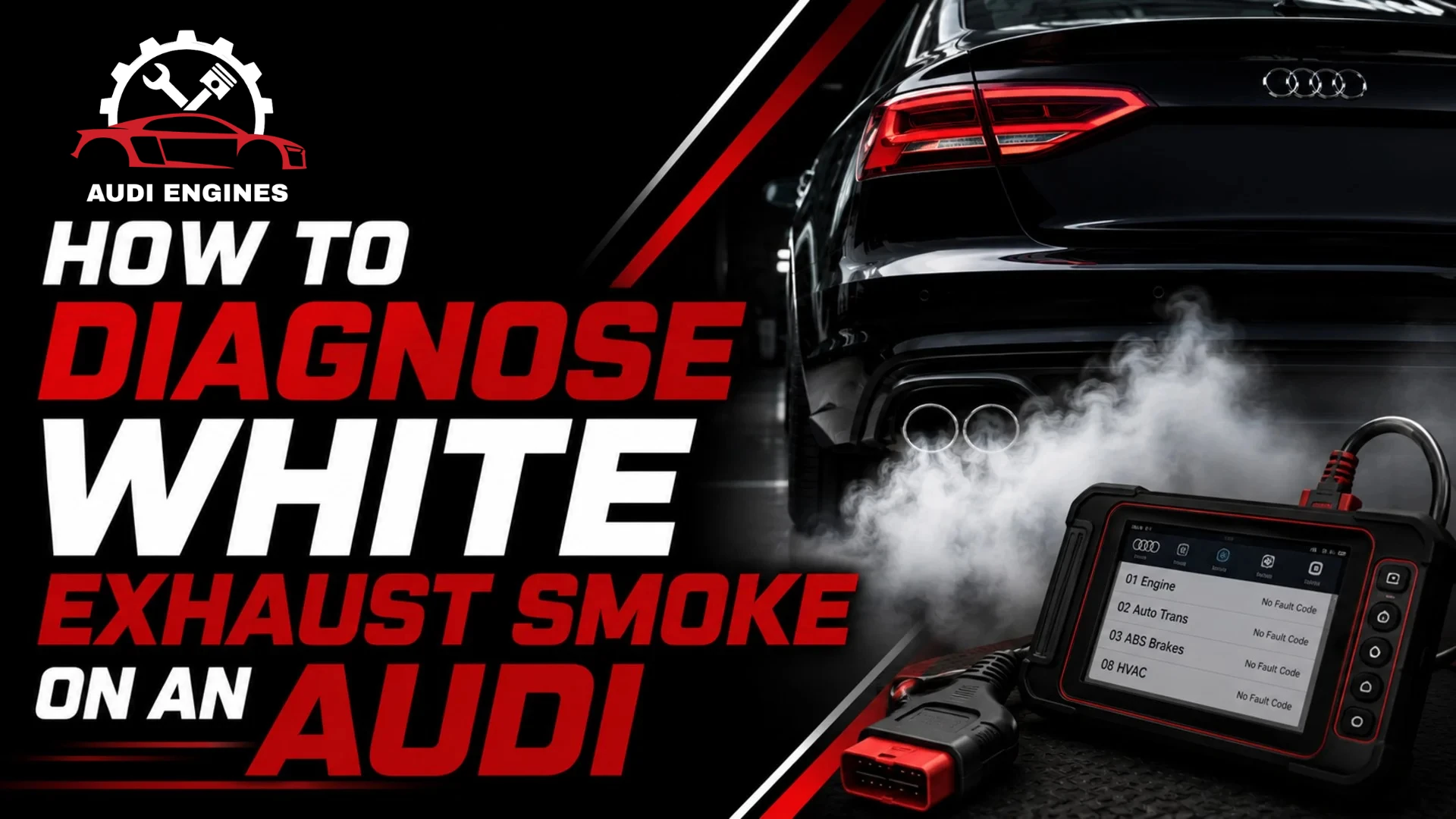
Guessing at the cause of white smoke is how drivers end up paying for a head gasket replacement when the real issue was a hose. A proper diagnosis follows a logical sequence, and it's worth understanding what that process actually involves.
Coolant Loss and Sweet Smell, Warning Signs to Check First
Before any test equipment comes out, we start with the basics:
- Check the coolant reservoir level against the minimum and maximum marks
- Look for a sweet smell near the exhaust or inside the cabin when the heater is running
- Inspect under the oil filler cap for a milky residue
- Check the engine temperature gauge for unusual fluctuation or overheating
These checks alone often tell an experienced technician which direction the diagnosis needs to head before a single tool touches the engine.
Compression Test, Leak-Down Test & Coolant Pressure Test Explained
These three tests form the backbone of proper white smoke diagnosis:
- Compression test: Measures the pressure each cylinder generates during compression. A cylinder reading significantly lower than the others often points to a gasket or cylinder head problem.
- Leak-down test: Pressurises each cylinder with compressed air and measures how quickly that pressure escapes, and, critically, where it escapes to. Air bubbling into the coolant reservoir during this test is close to a confirmed diagnosis of a blown head gasket.
- Coolant pressure test: Pressurises the cooling system independently of the engine running, allowing us to spot external leaks at hoses, seals, and connectors, or confirm an internal leak if the pressure drops with no visible external source.
Used together, these three tests remove most of the guesswork from an otherwise ambiguous symptom.
VCDS Diagnostic Scan and Common Audi Fault Codes
Audi-specific diagnostics through VCDS (VAG-COM Diagnostic System) go further than a generic OBD-II scanner, reading manufacturer-specific fault codes tied to misfires, coolant temperature sensor irregularities, and injector performance. On TDI models especially, VCDS can flag glow plug or injector faults that would otherwise be missed by a basic scan, helping separate a fuel-related smoke issue from a coolant-related one.
DIY Checks You Can Safely Do Before Booking a Garage
You don't need a full workshop to do some initial groundwork at home:
- Check your coolant level when the engine is cold, never open the cap on a hot engine
- Look for white or dried coolant residue around hose connections and the water pump
- Note exactly when the smoke appears, cold start, idle, acceleration, or after warm-up
- Smell the exhaust for a sweet odour from a safe distance
- Check your oil filler cap for milky contamination
If any of these checks raise concerns, it's time to book a proper inspection rather than keep driving and hoping it resolves itself.
Is It Safe to Drive? Repair Costs & Getting It Fixed
When You Should Stop Driving Immediately
Some situations call for stopping the car and arranging a tow rather than continuing your journey:
- The temperature gauge is climbing toward the red zone
- White smoke is thick and constant, not just an occasional puff
- You can smell burning coolant inside the cabin
- The coolant warning light has illuminated on the dashboard
Continuing to drive an overheating engine risks turning a head gasket repair into a full engine rebuild, which is a significantly larger bill. If in doubt, it's genuinely cheaper to get it looked at than to keep driving.
Audi Head Gasket & Turbo Repair Costs (UK Estimates)
Costs vary by model, engine code, and labour required to access the affected components, but here's a general guide:
Repair | |
| Coolant pressure test / diagnostics | |
| Hose, seal, or connector replacement | |
| Head gasket replacement | |
| Cracked cylinder head repair/replacement | |
| Turbocharger replacement (TFSI) | |
| Full engine rebuild (severe cases) |
These figures are general estimates rather than fixed quotes, the exact cost depends on your specific model (an A3 and an RS4, for example, involve very different labour times) and how far the damage has progressed before it's addressed.
Why Choose an Audi Specialist Over a General Garage
Audi's engines, particularly the EA888 and TDI ranges, have known failure patterns that a specialist recognises immediately but a general garage may need to diagnose from scratch. That difference typically means:
- Faster, more accurate diagnosis using Audi-specific VCDS scanning
- Familiarity with model-specific quirks (TFSI turbo seals vs TDI injector faults, for example)
- Access to the right parts and torque specifications for your exact engine code
- A more accurate first-time quote, rather than a diagnosis that changes once the engine is opened up
Book an Audi Diagnostic Inspection With Audi Engines
If you're seeing white smoke from your Audi's exhaust and you're not sure whether it's condensation or something more serious, don't wait for the temperature gauge to make the decision for you. Get it properly diagnosed with compression testing, coolant pressure test, and an Audi-specific VCDS scan, so you know exactly what you're dealing with, and exactly what it'll cost to fix.
Frequently Asked Questions
Why is my Audi blowing white smoke from the exhaust?
It's usually either harmless condensation clearing from the exhaust on a cold start, or coolant entering the combustion chamber through a failing head gasket, cracked cylinder head, or damaged engine block. The pattern and thickness of the smoke help distinguish between the two.
Is white smoke from a car normal?
A light puff on cold starts that clears within a minute is normal. Thick, persistent, or sweet-smelling smoke is not, and should be checked.
Can a turbo cause white smoke?
Yes. A failing turbocharger seal on TFSI engines can allow oil into the intake, which burns and produces smoke, sometimes appearing whiter or greyer under boost.
Does a blown head gasket always cause overheating?
Not always. Some head gasket failures are gradual and won't trigger an overheating warning immediately, which is why coolant level checks and pressure testing are important even without a temperature gauge spike.
Can I drive my Audi with white smoke coming from the exhaust?
If the smoke is light condensation on a cold start, it's fine. If it's thick, persistent, or paired with rising temperature or a sweet smell, stop driving and arrange an inspection or tow.
Why does my Audi's exhaust smell sweet? A sweet smell from the exhaust is a classic sign of coolant burning inside the combustion chamber, typically pointing to a head gasket or cylinder head issue.
How much does an Audi head gasket replacement cost in the UK?
Costs generally depending on the model and engine, though cracked cylinder heads or engines that have overheated further can push costs higher.
Why is my Audi losing coolant with no visible leak?
This is a common sign of an internal leak, where coolant is entering the engine oil or combustion chamber rather than leaking externally. A coolant pressure test will usually confirm it.
Final Thoughts:
White smoke from your exhaust isn't something to diagnose by guesswork, and it's not something to ignore either. Whether it turns out to be a five-minute condensation non-issue or a head gasket that needs urgent attention, the only way to know for certain is a proper inspection using the right diagnostic tools for your specific engine.
Book an Audi diagnostic inspection today and get a clear, honest answer on what's causing your white smoke, before it becomes a much bigger repair bill.