

How Long Does an Audi Engine Replacement Take? (UK Labour Hours & Turnaround Guide)
Your Audi's gone quiet in a way you don't like. Maybe there's a knock under load, a warning light that won't clear, or a garage has already told you the engine's beyond saving.
Your Audi's gone quiet in a way you don't like. Maybe there's a knock under load, a warning light that won't clear, or a garage has already told you the engine's beyond saving. Now you're staring down the one question that matters more than almost anything else right now: how long is my car actually going to be off the road?
It's a fair question, and it deserves a straight answer, not a vague "it depends" shrug.
So here it is upfront: most Audi engine replacements take between 8 and 25+ hours of actual labour, spread across a workshop turnaround of roughly 2 to 5 working days. Audi A1 The exact number depends on your model, your engine type, and whether the replacement engine is sitting on a shelf ready to go or needs sourcing first.
That's the short version. The rest of this guide breaks down exactly why the range is so wide, what happens hour by hour during the job, and how to get a realistic timeline for your specific car rather than a generic industry average.
How Many Hours Does an Audi Engine Replacement Take?
This is where most guides get sloppy, and it's worth clearing up immediately because it changes how you plan around the repair.
An Audi engine replacement isn't a single number, it's two separate clocks running at different speeds. One measures hands-on labour. The other measures calendar time, which includes waiting on parts, diagnostics, curing time for gaskets and sealants, and simple workshop scheduling. Mixing these two up is the single biggest reason people feel blindsided by how long their car is actually gone.
Labour Hours vs Workshop Turnaround, What's the Difference?
Think of labour hours as the time a technician physically spends with tools on your engine. Turnaround time is everything else wrapped around that, and it's almost always longer.
- Labour hours (roughly 8–20+ hours): This covers diagnosis, engine removal, ancillary transfer, installation, reconnection, fluid refills, ECU coding, and testing. A straightforward four-cylinder TFSI or TDI swap on something like an A3 sits toward the lower end. A V6 or V8 in an A6, Q7, or an RS model with a tighter engine bay and more ancillaries pushes toward the top.
- Workshop turnaround (typically 2–5 working days): This accounts for the engine actually being scheduled in, any diagnostic time before the job starts, curing time for certain seals and gaskets, and a proper road test before handover.
A specialist workshop that already stocks common Audi engine codes can often compress this gap significantly. A general garage sourcing a rare engine variant from a third-party supplier can stretch it well past a week, not because the labour itself is harder, but because the car is sitting idle waiting on parts.
Can an Audi Engine Be Replaced in One Day?
Technically, yes, but only in specific circumstances, and it's the exception rather than the rule.
A same-day Audi engine swap generally requires all of the following to line up:
- The replacement engine is already on-site and pre-inspected
- The engine code matches exactly, so there's no compatibility troubleshooting mid-job
- No ECU coding complications or immobiliser programming delays
- A dedicated bay and technician with no competing jobs
- No hidden damage discovered once the old engine is out
In reality, most Audi owners should plan for a minimum of two to three days, even on a "simple" job. Rushing an engine installation to hit a one-day deadline is one of the more common ways corners get cut, and it's not a trade-off worth making on a car you're planning to keep for years.
Why Can Audi Engine Replacement Take Several Days?
Several days isn't a red flag, it's usually just the job being done properly. Here's what typically eats the time:
- Diagnosis and confirmation before any wrench touches the engine, to make sure replacement is actually the right call rather than a repair
- Engine-code and VIN verification, which prevents a compatibility mismatch that would cause far bigger delays later
- Full ancillary transfer, turbo, injectors, manifolds, sensors, and wiring often move across from the old engine to the new one, and each connection needs checking
- Fluid system refills and bleeding, particularly coolant systems, which need to be done correctly to avoid airlocks
- ECU coding and programming, which on modern Audis with electronic security and drivetrain management isn't optional
- A genuine road test, not just a five-minute drive around the block, to catch anything that only shows up under real driving load
A garage quoting four to five days isn't necessarily slow. In many cases, it's the one being honest about what a thorough job actually requires.
Audi Engine Replacement Time by Model
Not every Audi engine replacement is created equal. Engine bay layout, transverse versus longitudinal mounting, and quattro drivetrain complexity all change how long the job takes.
Estimated Labour Hours by Audi Model
The table below gives indicative labour ranges based on typical job complexity across the Audi range. These are general estimates, not official Audi factory book times, and your actual quote should always come from a specialist who's assessed your specific car.
Audi Model | Typical Complexity | Estimated Labour Hours |
| Audi A1 | Lower | 8–12 hrs |
| Audi A3 | Moderate | 8–14 hrs |
| Audi A4 | Moderate | 10–16 hrs |
| Audi A5 | Moderate/High | 10–18 hrs |
| Audi A6 | High | 12–20 hrs |
| Audi Q5 | Moderate/High | 12–20 hrs |
| Audi Q7 | High | 15–25+ hrs |
| S/RS Models | High | 15–25+ hrs |
A quick way to read this table: smaller, front-wheel-drive hatchbacks like the A1 and A3 tend to have more accessible engine bays and simpler ancillary setups, which keeps labour lower. Larger quattro-equipped models like the Q7, A6, or any S/RS variant carry more components, tighter clearances, and often V6 or V8 configurations, all of which add hours.
Does Engine Type Affect Replacement Time? (TDI vs TFSI vs V6/V8)
Yes, and it's one of the most overlooked factors in replacement time estimates.
- TDI (diesel) engines, such as the 2.0 TDI or 3.0 TDI, often involve additional work around fuel injection systems, EGR components, and diesel-specific sensors, which can add time during ancillary transfer.
- TFSI (petrol turbo) engines, like the widely used EA888 platform found across the A3, A4, and TT ranges, are generally more straightforward, with well-documented removal and installation procedures.
- V6 and V8 engines found in A6, A7, A8, RS, and S models take considerably longer due to their size, weight, and the number of ancillary connections packed into the bay.
If you're not sure which category your Audi falls into, your registration or VIN will confirm the exact engine code, and that code should always be verified before a replacement engine is sourced.
What Affects Audi Engine Replacement Time?
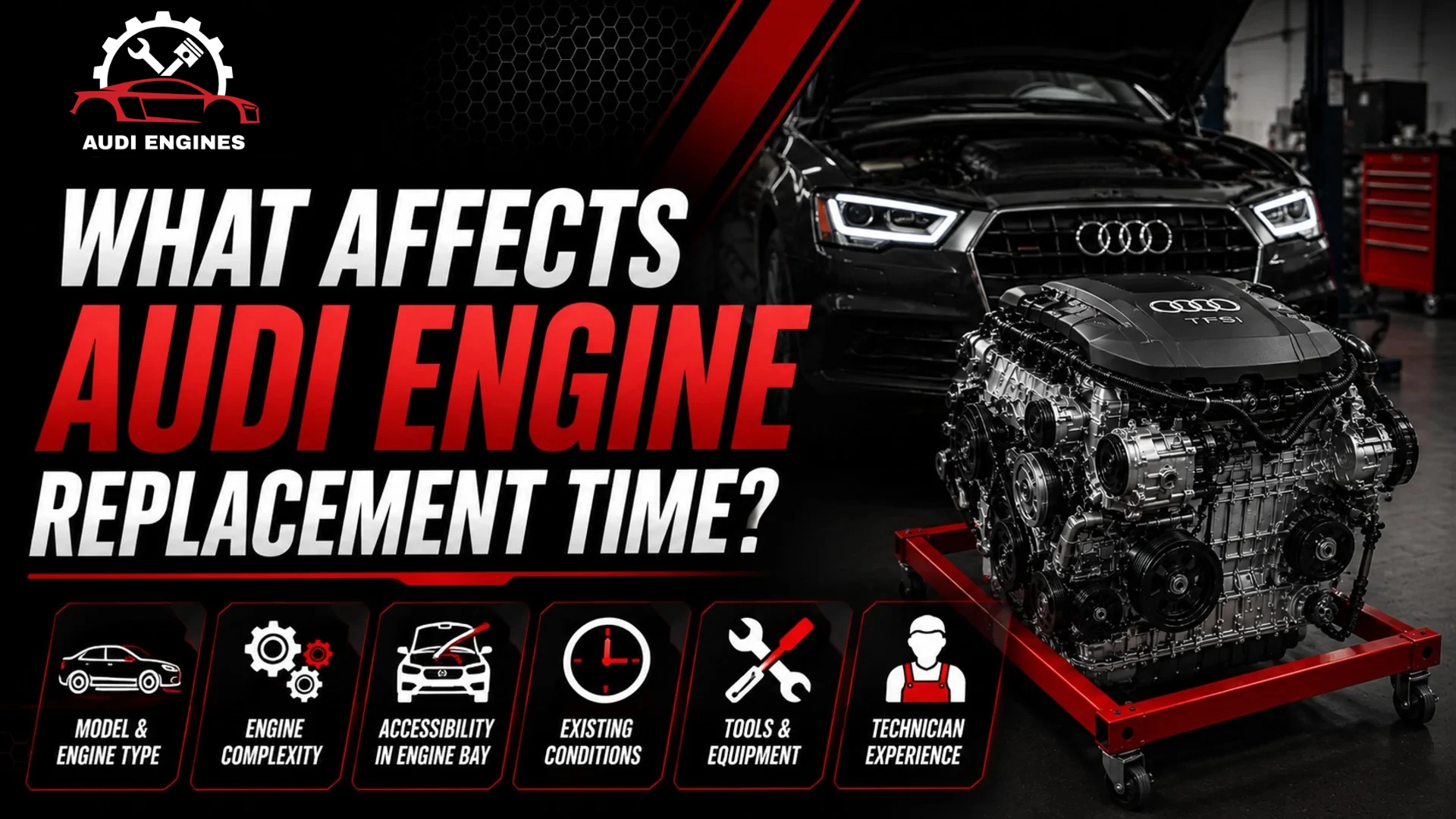
Beyond the model itself, several variables can stretch or compress the timeline. Understanding these helps you ask sharper questions when you're getting quotes.
What Happens During an Audi Engine Replacement? (Step-by-Step)
Here's a realistic walkthrough of the process from the moment your Audi arrives at a specialist to the moment it's handed back.
Diagnosis, Engine-Code & VIN Verification
Before anything is removed, the workshop confirms the failure through diagnostic scanning, fault code review, and, where needed, a compression or leak-down test. At this stage, the engine code is cross-checked against your VIN to make sure any replacement engine sourced will be fully compatible with your ECU, sensors, gearbox, and drivetrain.
This step matters more than it might seem. An engine-code mismatch discovered mid-installation is one of the most common causes of unexpected delays later in the job.
Removal, Installation & ECU Coding
Once the correct engine is confirmed and on-site, the old unit is removed and ancillary components, turbocharger, intercooler, intake and exhaust manifolds, injectors, alternator, starter motor, and the wiring harness, are carefully transferred or replaced where needed.
The replacement engine is then installed, reconnected, and refilled with oil and coolant. Modern Audis typically require ECU coding and, in some cases, immobiliser or security programming before the car will run correctly. A diagnostic scan, startup check, and road test round out the job before final inspection.
Does Engine Availability Affect Replacement Time?
Significantly, and this is often the biggest single variable in how fast the job actually gets done.
- Used engines can be the fastest option if the exact code is already in stock, but they need thorough inspection for mileage, provenance, and condition before fitting.
- Reconditioned engines offer a middle ground, availability varies by engine code, but they're usually prepared to a known standard and often come with a warranty.
- New engines are the most expensive route, and availability through official channels can be the deciding factor in lead time rather than the fitting itself.
A specialist that stocks common Audi engine codes in-house, rather than sourcing on a case-by-case basis, will almost always beat a general garage on turnaround, simply because the waiting-for-parts stage disappears.
What Causes Delays in an Audi Engine Replacement?
Even a well-planned engine replacement can run long. The most common causes worth knowing about upfront:
- Replacement engine availability, the right code isn't always in stock locally
- Engine-code mismatches discovered after sourcing, requiring a second search
- Damaged engine mounts or seized components found only once the old engine is out
- Turbocharger or injector condition requiring replacement rather than transfer
- Wiring or sensor issues uncovered during reconnection
- Gearbox compatibility concerns on quattro models
- ECU coding or immobiliser programming complications
- Unexpected damage, corrosion, prior repair work, or contamination in the oil or cooling system
None of these are reasons to panic. They're simply reasons a realistic quote should always include some buffer, and why a specialist who's seen hundreds of Audi engines will spot potential issues before they turn into delays.
Get an Accurate Audi Engine Replacement Time Estimate
Every Audi is different, and the only way to get a timeline you can actually plan around is to have your specific model, engine code, and condition assessed by someone who works on these engines regularly.
Why Choose Audi Engines UK for Supply & Fit
At Audi Engines UK, engine replacement isn't a side service, it's the entire focus. That specialisation matters when it comes to turnaround time, because:
- Common Audi engine codes are stocked and ready, cutting out lengthy sourcing delays
- Every replacement engine is checked against your VIN and engine code before fitting begins
- ECU coding and programming are handled in-house, avoiding the back-and-forth delays that come with outsourcing this step
- Nationwide supply and fit means you're not limited by what's available locally
- Every job includes a full road test and final inspection before your Audi goes back on the road
If your Audi's engine has failed or is showing signs of serious trouble, getting an accurate, model-specific estimate is the fastest way to move from uncertainty to a clear plan, and a clear return date.
Frequently Asked Questions
How long does an Audi engine replacement take?
Most Audi engine replacement take between 8 and 25+ hours of labour, with a total workshop turnaround of around 2 to 5 working days depending on the model, engine type, and parts availability.
How long does an Audi engine swap take?
An Audi engine swap follows the same timeline as a standard replacement, typically a few days from diagnosis to road test, with labour hours varying by engine size and complexity.
Can an Audi engine replacement be done in one day?
It's possible if the correct engine is already on-site, the engine code matches exactly, and no complications arise, but this is the exception. Most jobs realistically take two to five days.
Does engine availability affect Audi engine replacement time?
Yes, significantly. A used or reconditioned engine already in stock can be fitted far faster than one that needs to be sourced from a third party, which can add days or even weeks.
Is it worth replacing an Audi engine rather than repairing or rebuilding it?
This depends on the extent of the damage, the age of the vehicle, and the cost comparison between repair, rebuild, and replacement. A specialist assessment will usually make this decision straightforward.
Does an Audi replacement engine need ECU coding?
In most cases, yes. Modern Audi engines are tied closely to the ECU, immobiliser, and drivetrain systems, so coding and programming are typically required for the car to run and start correctly.
How long does a used Audi engine take to fit compared to a reconditioned one?
A used engine can sometimes be faster if it's already in stock and inspected, while a reconditioned engine may take slightly longer to prepare but often comes with added warranty peace of mind.
The Bottom Line
An Audi engine replacement isn't a job you want rushed, but it also shouldn't be a mystery. In most cases, you're looking at 8 to 25+ hours of labour and a 2 to 5 day workshop turnaround, with the exact number shaped by your model, engine type, and how quickly the right replacement engine can be sourced.
The fastest, safest way to shrink that timeline is working with a specialist who already stocks your engine code, verifies compatibility before the job starts, and handles ECU coding without outsourcing delays.
If your Audi needs an engine replacement, get in touch with Audi Engines UK for a model-specific quote and realistic turnaround time, so you know exactly when you'll be back on the road, not just roughly.