
How Much Does an Audi Engine Rebuild Cost? UK Price Guide by Model & Engine Type
There's a specific kind of sinking feeling that comes with a knocking sound from under the bonnet, followed by a garage saying the word "rebuild." Your mind jumps straight to worst-case numbers.
There's a specific kind of sinking feeling that comes with a knocking sound from under the bonnet, followed by a garage saying the word "rebuild." Your mind jumps straight to worst-case numbers, and suddenly you're wondering whether it's even worth fixing the car at all.
Here's the reassurance up front: an Audi engine rebuild is very often the more sensible option compared to a full engine replacement, and the cost, while not small, is usually far more predictable than people expect once you understand what actually goes into the job. This guide breaks down real UK pricing by model and engine type, what you're actually paying for, and how to tell whether a rebuild is the right call for your car.
Average Audi Engine Rebuild Cost in the UK
Audi engine rebuild cost depends on three main things: which model and engine you have, how much damage there is to repair, and whether you're paying for a full rebuild or a partial one. As a general guide, Audi engine rebuild cost in the UK typically ranges for a straightforward partial rebuild on a smaller petrol engine, up to for a full rebuild on a high-performance or larger-capacity unit like an RS or V6 engine.
That's a wide range, so let's narrow it down properly.
Audi Engine Rebuild Cost by Model (A3, A4, A6, Q5, TT & More)
Different Audi models use different engine families, and that's the biggest single factor in pricing, more than the model badge itself. Still, as a rough starting point by model:
- Audi A1 / A3 engine rebuild cost, generally the most affordable, given the smaller displacement engines (1.4 TFSI, 1.9/2.0 TDI)
- Audi A4 engine rebuild cost, mid-range pricing, varies significantly between the 2.0 TDI and 2.0 TFSI variants
- Audi A6 engine rebuild cost, higher, particularly on V6 3.0 TDI and 3.0 TFSI units due to complexity and parts cost
- Audi Q5 engine rebuild cost, comparable to A4/A6 depending on whether it's the 2.0 TDI, 2.0 TFSI, or 3.0 TDI quattro
- Audi TT engine rebuild cost, varies widely between the standard TFSI and TTS/TT RS performance variants
- Audi S3, S4, RS3 engine rebuild cost, significantly higher, since performance engines use forged internals, larger turbos, and tighter tolerances that cost more to machine and rebuild correctly
The honest truth is model alone doesn't set the price, engine code does. A 2.0 TDI A4 and a 2.0 TDI Q5 will land in a similar bracket, because it's frequently the same engine under different badges.
Audi Engine Rebuild Cost by Engine Type (TFSI, TDI, EA888, EA839)
This is where pricing actually gets decided. Audi, as part of the Volkswagen Group, shares engine families like the EA888 (2.0 TFSI), EA839 (V6 TFSI/TDI), and EA189 (older 2.0 TDI) across multiple models, so the engine code matters more than the car it's fitted to.
Engine Family | Common Models | Typical Rebuild Complexity | Relative Cost Level |
| 1.4 TFSI | A1, A3 | Lower complexity, fewer parts | Lowest |
| 2.0 TFSI (EA888) | A3, A4, TT, Q3, Q5 | Moderate, timing chain, turbo work common | Mid |
| 2.0 TDI (EA189/EA288) | A3, A4, A6, Q5 | Moderate, injector and turbo sensitivity | Mid |
| 3.0 TDI V6 (EA897) | A6, A7, Q7 | High, larger block, more labour | High |
| 3.0 TFSI V6 (EA839) | S4, S5, RS models | High, performance internals | High |
| 4.2 FSI V8 | RS4, RS5, R8 | Highest, specialist labour required | Highest |
This table gives a relative sense of where costs sit rather than fixed figures, since exact pricing depends on parts availability, labour rates in your area, and the extent of damage found during diagnostics.
Audi Engine Rebuild Labour Cost Explained
Labour typically makes up a substantial portion of any Audi engine rebuild quote, often as much as the parts themselves, sometimes more. That's because a proper rebuild involves:
- Engine removal and reinstallation, a multi-hour job on its own for most transverse and longitudinal Audi engine layouts
- Full strip-down and inspection, assessing the cylinder head, engine block, crankshaft, and pistons before any parts are ordered
- Machining work, cylinder honing or boring, crank grinding, and valve seating, usually outsourced to a specialist machine shop
- Reassembly and calibration, fitting new components to precise torque specs, followed by ECU work and a compression test before the car leaves the workshop
Audi labour rates vary by workshop and region, but specialist independent Audi garages generally charge less per hour than a main dealer, without compromising on the technical standard of the work, provided the technicians are genuinely experienced with VAG engines specifically.
What Does Machining Cost on an Audi Engine Rebuild?
Machining is one of the most commonly underestimated costs in a rebuild quote. If the engine block has scoring, the cylinders need boring or honing to accept new pistons, and if the crankshaft has any damage, it needs grinding and rebalancing. These processes require specialist equipment most general garages don't have in-house, which is why machining is frequently subcontracted, and why it's worth asking your specialist directly what machining costs are included versus billed separately.
Is It Cheaper to Rebuild or Replace an Audi Engine?
This is genuinely one of the most important decisions you'll make, and the answer depends heavily on what's actually wrong.
Factor | Engine Rebuild | Engine Replacement |
| Best suited for | Localised damage (pistons, rings, head gasket, timing chain) | Catastrophic failure (seized engine, cracked block) |
| Typical cost | Lower to moderate | Moderate to higher, depending on used vs reconditioned unit |
| Parts used | Mix of new components + your original block | Complete replacement engine (used, reconditioned, or remanufactured) |
| Warranty | Usually 12 months on rebuild work | Usually 12 months on the replacement unit |
| Turnaround | Can take longer due to machining lead times | Often faster if a matching unit is in stock |
As a general rule: if the engine block and crankshaft are still sound, a rebuild is almost always the more cost-effective route, since you're not paying for an entire replacement unit. If the block itself is cracked or the damage is too extensive, replacement becomes the more practical option. A proper diagnostic inspection, not a guess, is what should decide this, and any reputable specialist will tell you honestly which route makes more financial sense for your specific engine.
What's Included in an Audi Engine Rebuild
A lot of confusion around pricing comes from not knowing what "rebuild" actually covers. It's not simply swapping one or two parts, a proper rebuild is a comprehensive process.
Parts Replaced During a Full Engine Rebuild
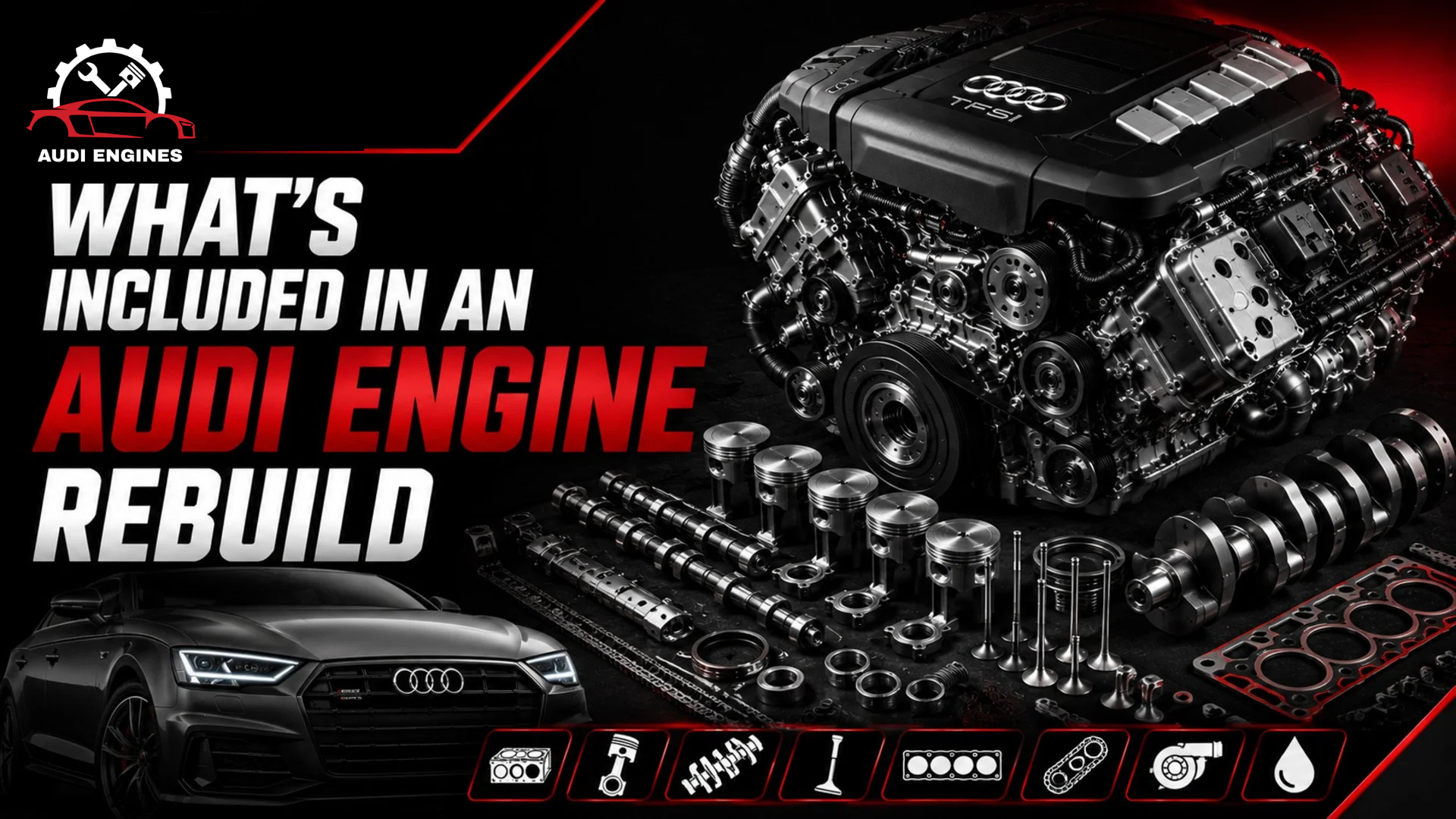
Depending on the extent of the damage, a full engine rebuild typically includes replacement of:
- Piston rings and pistons, especially where there's oil consumption or loss of compression
- Crankshaft bearings and connecting rod bearings, wear items that are almost always replaced regardless of visible damage
- Cylinder head gasket, replaced as standard practice any time the head is removed
- Timing chain or timing belt, depending on the engine, since a rebuild is the ideal opportunity to renew this before it becomes a separate future job
- Oil pump and water pump, often replaced proactively during a rebuild to avoid comeback issues
- Valve seals and valve guides, where wear is contributing to oil consumption or poor compression
Not every rebuild needs every one of these parts, a partial rebuild might only address the top end (cylinder head, valves, gasket) if the bottom end (crankshaft, pistons, bearings) tests sound during inspection.
OEM vs Aftermarket Parts, Which Costs More Long-Term?
Genuine Audi OEM parts guarantee exact fitment and match factory tolerances, but they carry a higher upfront cost. Quality aftermarket parts from established manufacturers can offer comparable performance at a lower price point, though consistency varies more between brands.
For critical components like pistons, rings, and bearings, many specialists recommend OEM or OEM-equivalent parts specifically because tolerances matter enormously to engine longevity, this isn't the place to cut corners purely on price. For less critical ancillary parts, quality aftermarket options are often a reasonable way to manage overall cost without compromising the rebuild.
Audi Engine Rebuild Process, Step by Step
Understanding the process helps explain where the cost actually comes from:
- Diagnostics and compression testing, identifying exactly what's failed before any work begins
- Engine removal, taking the engine out of the vehicle for full access
- Strip-down and inspection, every component assessed individually, with wear measured against manufacturer tolerances
- Machining, cylinder honing, boring, or crank grinding as needed
- Parts sourcing, OEM or quality aftermarket components ordered based on inspection findings
- Reassembly, engine rebuilt to torque spec with new gaskets, seals, and bearings throughout
- Refitting and calibration, engine reinstalled, ECU work completed, fluids replaced
- Testing, compression testing, leak-down testing, and a road test before handover
Skipping steps in this process is exactly how you end up with a rebuild that fails again within months, which is why the specialist you choose matters as much as the parts they use.
How Long Does an Audi Engine Rebuild Take?
Most Audi engine rebuilds take somewhere between one and three weeks, depending on the extent of the damage, machining lead times, and parts availability. Straightforward partial rebuilds can sometimes be completed faster, while a full rebuild involving custom machinig or hard-to-source parts for older engine codes can take longer. Any specialist worth using should give you a realistic timeline upfront rather than an optimistic guess, and keep you updated if machining delays push the completion date back.
Signs Your Audi Needs an Engine Rebuild

Catching engine problems early is often the difference between a moderate rebuild bill and a catastrophic failure that forces a full replacement instead.
Common Causes of Audi Engine Failure
Several patterns show up repeatedly across Audi's TFSI and TDI engine families:
- Timing chain failure, particularly associated with certain early EA888 engines, where chain stretch or tensioner failure can cause catastrophic internal damage if ignored
- Excessive oil consumption, a known characteristic on some TFSI generations, often linked to piston ring wear
- Turbocharger failure, from oil starvation, carbon build-up, or simple wear over high mileage
- Overheating, from water pump failure, coolant leaks, or a failing thermostat, which can warp the cylinder head if driven through
- Carbon build-up, a particular issue on direct-injection TFSI engines, which can affect performance and, over time, contribute to valve and ring wear
Cost to Rebuild a Seized or Overheated Audi Engine
A seized engine, typically caused by catastrophic oil starvation or severe overheating, is usually the most expensive rebuild scenario, since the damage often extends beyond pistons and rings into the crankshaft, bearings, and sometimes the block itself. In these cases, a full teardown and inspection is essential before any quote is finalised, because the true extent of damage often isn't visible from the outside. In some seized-engine cases, a full replacement genuinely does work out more cost-effective than an extensive rebuild, which is exactly why an honest inspection matters more than a fast quote.
Audi Engine Knocking, Smoke, or Oil Consumption, What It Means
Different symptoms point to different problems, and getting familiar with them can help you catch issues before they escalate:
Symptom | Likely Cause |
| Knocking or rod knock | Worn bearings or connecting rod damage |
| White smoke from exhaust | Coolant entering the combustion chamber, often a head gasket issue |
| Blue smoke from exhaust | Oil burning, typically worn piston rings or valve seals |
| Rough idle or misfire | Could be ignition-related, but also linked to compression loss |
| Rapid oil consumption | Worn rings, valve seals, or turbo seal failure |
| Warning light with reduced power | ECU has detected an issue, needs proper diagnostics, not guesswork |
If you're seeing any of these signs, the sensible next step is a proper diagnostic inspection rather than continuing to drive and hoping it resolves itself. Engine problems very rarely improve with time.
Is an Audi Engine Rebuild Worth It on High-Mileage Cars?
This depends more on the overall condition of the car than the mileage figure alone. A well-maintained Audi with full service history and 150,000 miles can absolutely be worth rebuilding, particularly if the rest of the car, gearbox, suspension, interior, is in good shape. The maths generally works in the rebuild's favour when the cost is meaningfully lower than buying a comparable replacement car, and the vehicle otherwise has years of use left in it. Where it stops making sense is when the rebuild cost approaches the car's actual market value, or when other major components are also nearing the end of their life, at that point, it's worth having an honest conversation with your specialist about the bigger picture.
Choosing an Audi Engine Rebuild Specialist
Not every garage that offers engine work is equipped to do a proper Audi rebuild. VAG engines, across TFSI, TDI, and performance variants, have specific quirks, tolerances, and known failure points that general mechanics don't always have deep experience with.
What to Look for in an Audi Engine Rebuild Specialist Near You
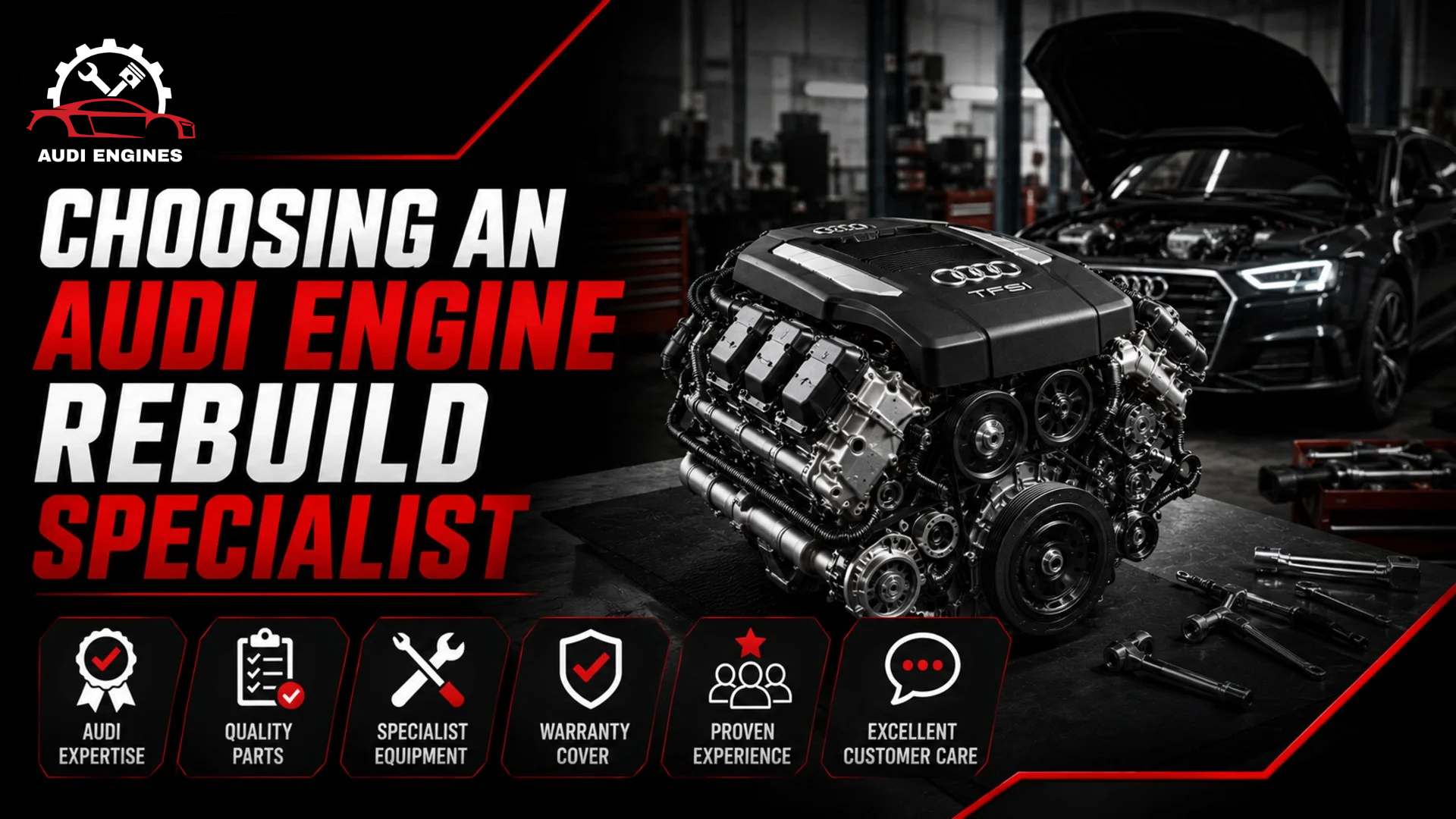
When comparing specialists, look for:
- Genuine Audi/VAG experience, not just general engine work, but specific familiarity with EA888, EA839, and related engine families
- Transparent, itemised quotes, parts, labour, and machining costs broken down separately, not a vague lump sum
- Proper diagnostic equipment, compression testing, leak-down testing, and ECU diagnostics as standard, not optional extras
- Clear communication throughout the job, updates if machining takes longer than expected, rather than silence until it's "done"
- Physical evidence of the work, some specialists will show you the worn parts removed from your engine, which is a strong trust signal
A specialist who explains what they found, why it needs doing, and what your options are, rather than just quoting a number, is generally the one worth trusting with a job this significant.
Warranty Coverage on a Rebuilt Audi Engine
A proper Audi engine rebuild should come with a meaningful warranty, typically covering both parts and labour for at least 12 months. This matters enormously, because it reflects the specialist's confidence in their own work. Before booking, always confirm exactly what the warranty covers, whether it's transferable if you sell the car, and what would void it (for example, servicing at an unapproved garage during the warranty period).
How Long Does a Rebuilt Engine Last Compared to New?
A correctly rebuilt Audi engine, using quality parts and proper machining, can perform just as reliably as a new engine, in many cases lasting well beyond 100,000 further miles with normal maintenance. The key word is "correctly." A rushed rebuild using minimum-spec parts and skipped machining steps will fail faster, sometimes within months. This is precisely why the quality of the specialist matters more than shaving a few hundred pounds off the quote.
Get a Free Audi Engine Rebuild Quote Today
If your Audi is showing any of the warning signs covered above, the smartest first step is a proper diagnostic inspection rather than guessing at the problem, or the price. A clear, itemised quote means no surprises later, and gives you the full picture to decide confidently between a rebuild and a replacement.
Frequently Asked Questions
How much does it cost to rebuild an Audi engine?
Costs vary by model and engine type, generally ranging for smaller petrol engines to larger V6, V8, or performance units. An accurate quote requires a proper inspection of your specific engine.
Is rebuilding an Audi engine worth it?
In most cases where the engine block and crankshaft are still sound, yes, a rebuild is typically more cost-effective than a full replacement, especially on a car that's otherwise well-maintained.
Is it cheaper to rebuild or replace an engine?
Rebuilding is usually cheaper for localised damage like worn pistons, rings, or a failed head gasket. Replacement tends to make more sense for catastrophic failures like a cracked block or severely seized engine.
How long does an Audi engine rebuild take?
Typically one to three weeks, depending on the extent of damage, machining requirements, and parts availability.
What is included in an engine rebuild?
Commonly pistons, rings, bearings, head gasket, and often the timing chain or belt, oil pump, and water pump, the exact scope depends on what the inspection reveals.
Can a seized Audi engine be rebuilt?
Often yes, but it depends on the extent of internal damage. A full strip-down inspection is needed to confirm whether rebuilding is viable or replacement is more sensible.
Can a blown Audi engine be repaired?
In many cases, yes, "blown" typically refers to significant internal damage rather than total destruction, and a specialist can assess exactly what's salvageable.
What causes Audi engine failure?
Common causes include timing chain failure, excessive oil consumption from worn rings, turbocharger failure, overheating, and carbon build-up on direct-injection engines.
How much is Audi labour per hour?
Independent Audi specialists generally charge less than main dealer rates, though exact pricing varies by workshop and region, always ask for a clear labour rate upfront.
How long does a rebuilt Audi engine last?
A properly executed rebuild with quality parts can last well beyond 100,000 further miles, performing comparably to a new engine with normal servicing.
Is a rebuilt engine as reliable as a new one?
When done correctly with proper machining and quality parts, yes. Reliability comes down entirely to the standard of the rebuild, not just the fact that it happened.
What parts are replaced during an engine rebuild?
Typically pistons, rings, bearings, gaskets, and seals as standard, with timing components, oil pumps, and water pumps often replaced proactively during the same job.
Can an Audi TFSI engine be rebuilt?
Yes, TFSI engines, including the EA888 family, are commonly rebuilt, particularly for timing chain issues, carbon build-up, and oil consumption problems.
How much does machining cost?
Machining costs vary depending on what's needed, cylinder honing, boring, or crank grinding, and are often a significant portion of the overall rebuild bill, so it's worth confirming what's included in your quote.
What warranty comes with a rebuilt engine?
Most reputable specialist offer at least a 12 months warranty covering parts and labour, always confirming the specific terms before booking.
Get an Honest Audi Engine Rebuild Quote
An engine problem always feels bigger than it is when you don't have clear information in front of you. The reality is that most Audi engine issues, even serious ones like timing chain failure or excessive oil consumption, have a sensible, cost-effective repair path, provided you're working with a specialist who genuinely understands VAG engines and gives you a straight answer.
If your Audi is showing any warning signs, don't wait for it to get worse. Get in touch for a proper diagnostic inspection and a clear, itemised rebuild quote, no guesswork, no pressure, just an honest assessment of what your engine actually needs.