

How to Check an Audi Engine Code Before Buying a Reconditioned Engine: UK Buyer's Guide
You found a reconditioned engine that looks right and the seller swears it fits your Audi. Then the doubts start. Is the code on the block the right one? Will the ECU accept it? What if the stamp has been ground off. One wrong character in an engine code can leave you with an engine that bolts in but never runs properly.
You found a reconditioned engine that looks right and the seller swears it fits your Audi. Then the doubts start. Is the code on the block the right one? Will the ECU accept it? What if the stamp has been ground off?
One wrong character in an engine code can leave you with an engine that bolts in but never runs properly. That is why knowing how to check an Audi engine code before buying a reconditioned engine matters more than any sales pitch.
A quick note on terms. This guide covers the engine identification code stamped on the block or printed on your vehicle data label. It does not cover diagnostic trouble codes from the check engine light. If you came here for fault codes you need an OBD-II scanner. If you want to buy the right engine first time keep reading.
At Audi Engines we have supplied and fitted reconditioned Audi engines for UK drivers and workshops since June 2000. Everything below comes from the problems we see on the workshop floor.
Where Is the Engine Code on an Audi and How Do You Check It by VIN?
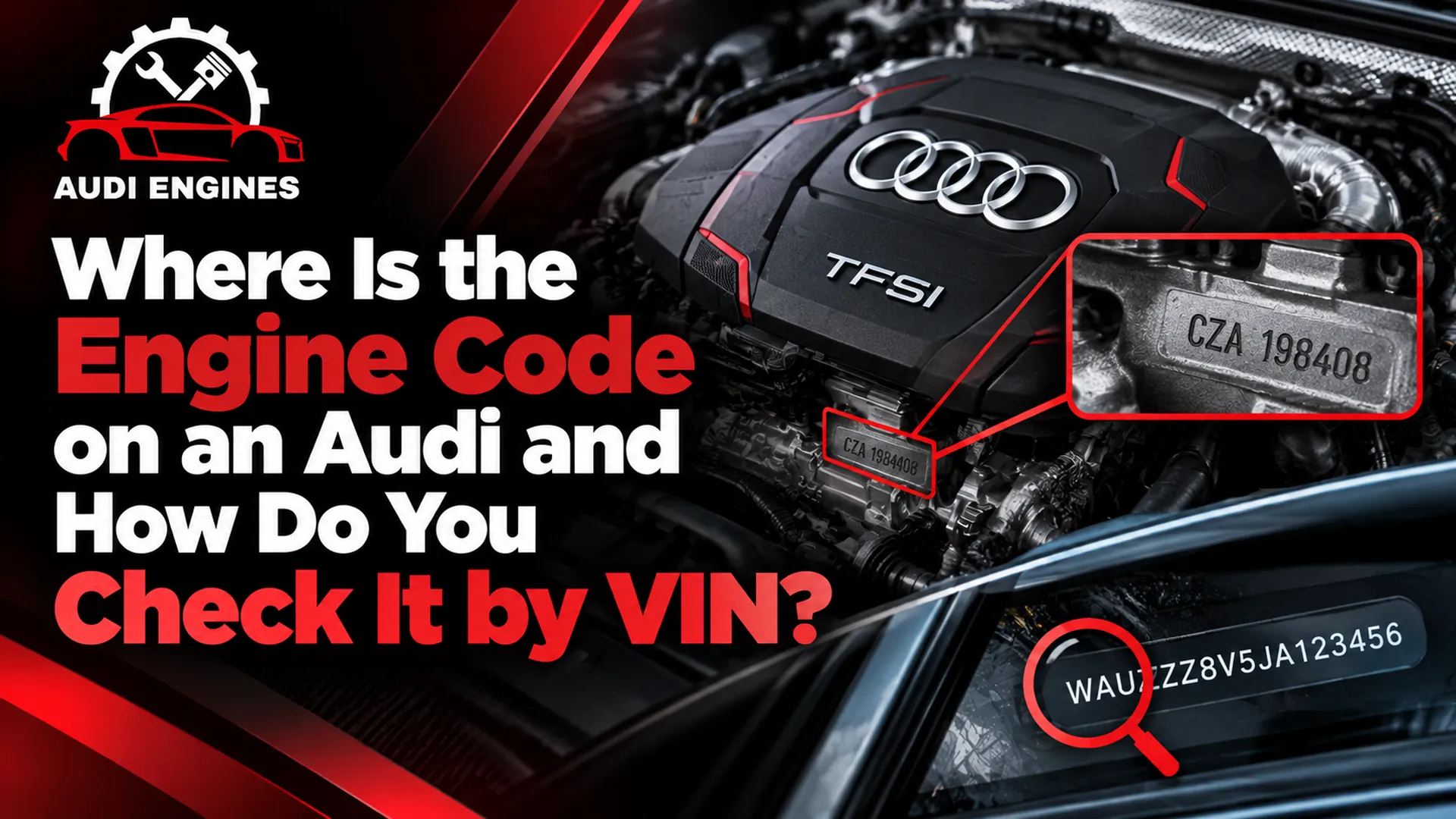
An Audi engine code is a short alphanumeric designation. It is usually three or four characters long. It tells a specialist the exact engine variant fitted at the factory. That includes the displacement and the fuel type and the power output and the generation of the engine.
Many buyers mix up four different identifiers. This table keeps them apart.
Term | What it tells you | Where you find it |
| Engine code | The engine type and variant | Block and vehicle data label and service book |
| Engine number | The individual serial of that one engine | Stamped on the block |
| Serial number | The same idea as the engine number on most supplier paperwork | Supplier invoice and block |
| VIN | The whole car and not just the engine | Windscreen plate and V5C and chassis plate |
The engine code decides which engine fits. The engine number identifies that single unit. Mixing them up is the most common mistake we see.
Where Can You Find the Audi Engine Code on the Block Sticker or Service Book?
Start with the easiest places and work down the list until two sources agree. Knowing where to find the engine code saves you from guessing.
- Vehicle data label: This sticker sits in the spare wheel well or on the boot floor. It lists the engine code and the gearbox code and the paint code. It is usually the fastest check.
- Service book: Many Audi service booklets carry a copy of the data label. Check it against the car and not just the book.
- Engine block: The code is stamped into the metal. On many VAG engines it sits near the gearbox joint or on the timing cover side. Covers and ancillaries often hide it. Expect to remove a plastic cover or use a mirror and a torch.
- Cylinder head or timing cover sticker: Some engines carry a sticker with the code and a barcode. Stickers can be swapped between engines so never trust one alone.
- Owner's manual wallet: Some cars keep a spare data label sheet here.
Two matching sources are a good sign. A sticker that disagrees with the block is a reason to stop and ask questions.
Here is a typical example. On a 2016 A4 with the 2.0 TFSI the data label under the boot floor is usually the quickest route. On a Q7 with the 3.0 TDI the block stamp may be easier to read once the lower cover is off. The process is the same whether you drive a 2016 A4 or a 2021 Q5 or a 2022 A3.
How Do You Find the Audi Engine Code From the VIN or Registration Number?
If you cannot reach the block or the label you can work from the VIN. People often search for how to find engine code from VIN when the car is not in front of them. Here is the process we follow.
- Copy the 17-character VIN from the windscreen plate or the V5C.
- Run it through a VIN decoder or an engine code finder to confirm the model line and year and market.
- Ask an Audi specialist to match the chassis to the factory engine using ETKA or ELSA style parts data.
- Compare the result with the data label and the block stamp.
- Get the supplier to confirm in writing that the engine on offer matches that code.
Free engine code check tools and any vehicle engine number check online give you a starting point only. They often show capacity and fuel type but not the exact code. The V5C lists capacity and fuel but rarely the code itself. A VIN also describes the car as it left the factory. It cannot tell you whether a previous owner fitted a different engine.
These examples show how codes group by family. Treat them as examples and verify the code against the specific vehicle.
Engine family | Example codes |
| 2.0 TFSI (EA888) | CAEB and CDNC and CCTA |
| 1.8T | AEB and AWT and BEX |
| 2.0 TDI | CAGA |
| 3.0 TDI | CDUC |
| 3.0 TFSI supercharged | CGWB and CREC |
| 4.2 V8 | BAR and BVJ |
If you are looking at a specific model you can browse our Audi A7 Sportback engines to see how engine options differ by model.
Does a Reconditioned Audi Engine Keep Its Original Code and What Should You Verify Before Paying?
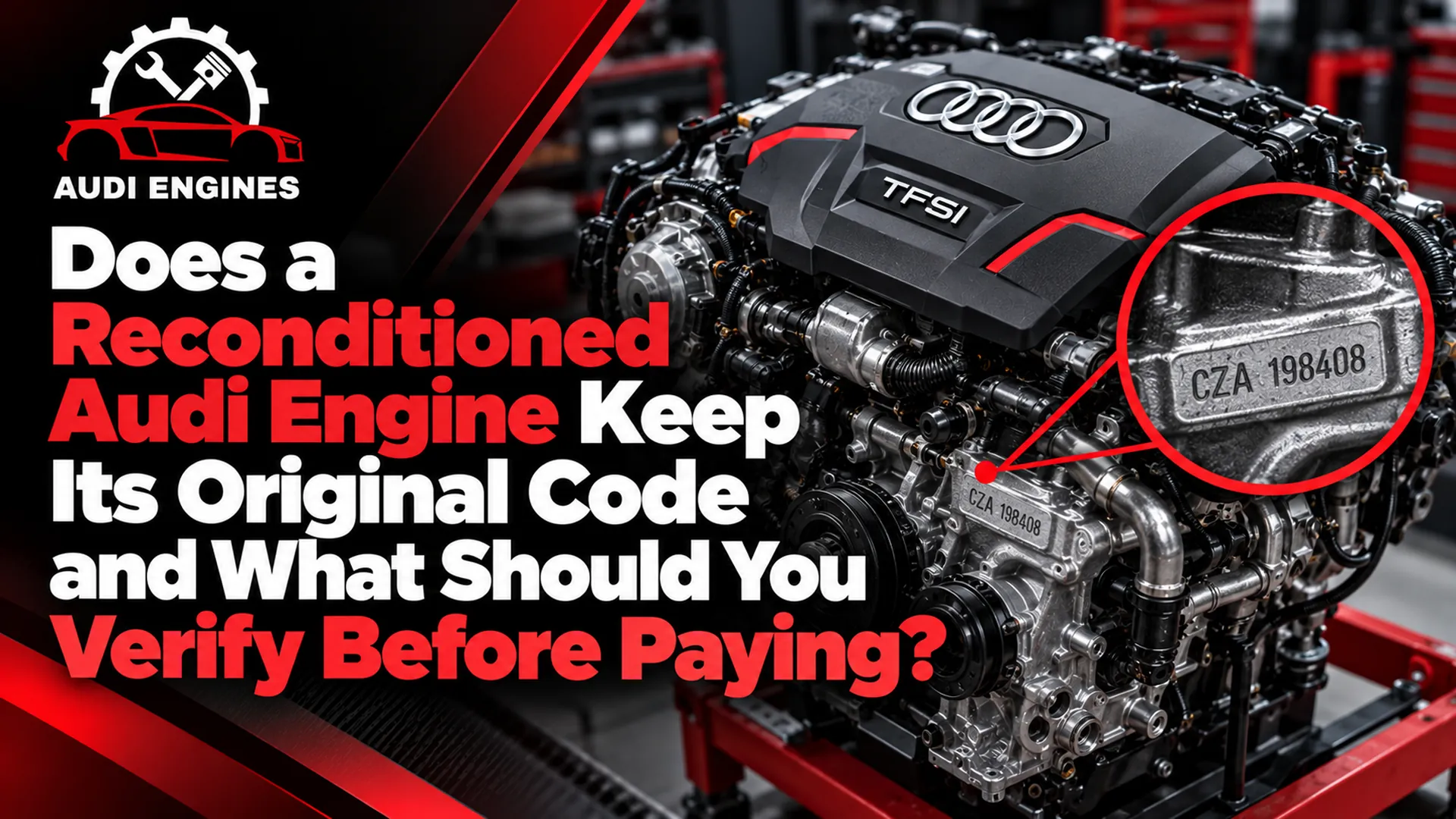
Often it does but not always. The answer depends on how the engine was built. Four terms get used loosely in the UK trade so here is how they differ.
Type | What happens | Code and stamp |
| Used | Pulled from a donor car and sold as it is | Original stamp stays intact |
| Reconditioned | Worn parts replaced and surfaces machined and the engine tested | Original block stamp normally stays |
| Rebuilt | Repaired to a working state and the standard varies by workshop | Varies |
| Remanufactured | Built to a factory style specification in a controlled process | May carry a new label or a different stamp |
This is why reconditioned engines can confuse buyers. Some remanufactured units arrive with no original stamp or with a replacement label. A good supplier explains this up front and backs it with paperwork. A poor one stays vague.
The difference between reconditioned and remanufactured matters for your decision. Reconditioning keeps the original block and renews what has worn. Remanufacturing follows a stricter process and often suits buyers who want a unit closer to factory standard. Either route can be a sound choice when the supplier proves what they did.
What Documents Should You Ask a Reconditioned Engine Supplier For?
Paperwork is your protection. Ask for these items before you pay anything.
- Invoice: It should state the engine code and the engine number and the work carried out.
- Core exchange record: This shows where the original core came from and how the unit was built.
- Test report: Look for results from a compression test or a leak-down test or an oil pressure test.
- Photo evidence: Ask for a close-up of the block stamp and a clear shot of the whole engine and any label.
- Warranty certificate: It should state the term and what it covers.
- Donor details: For used units ask about the donor vehicle and its approximate mileage.
Picture a 2021 Q5 owner who orders an engine from a seller who sends only a stock photo. The engine arrives and the stamp does not match the invoice. The owner has no test report and no paperwork to challenge the sale. A supplier who sends clear photos and records up front prevents that situation.
What Are the Red Flags of a Missing Polished or Mismatched Engine Code?
The stamp is the engine's identity. When it looks wrong you should slow down. Watch for these warning signs.
- A stamp that looks polished or ground flat
- Fresh paint over the stamped area
- A code on the invoice that differs from the block
- A seller who refuses close-up photos
- No clear record of where the engine came from
- Pressure to pay quickly or skip the inspection
Do not assume the worst every time. Machining can affect a stamp and a reputable workshop may re-stamp a block and document it. The key is a record that explains the change. A blank block with no explanation is a reason to walk away.
If you cannot identify the engine at all ask an independent Audi specialist to inspect it before you commit.
How Can You Tell If a Reconditioned Audi Engine Is Stolen or Cloned?
Stolen engines and VIN cloning are rare but real risks. VIN cloning is when a stolen vehicle takes the identity of a legitimate one. A stolen engine can be passed on with a polished stamp or a swapped label.
You can lower the risk in a few practical ways.
- Match the engine number on the block to the number on the invoice
- Ask for the supplier's trading history and verifiable contact details
- Ask for donor vehicle details on used units
- Be wary of any seller who will not let you inspect the unit
- Tell your insurer about any engine change and tell the DVLA when the capacity or fuel type changes
A supplier with a long record and a physical workshop is far easier to verify than an anonymous online listing. You can read what past customers say on our reviews page.
How Do You Confirm Compatibility and Buy a Reconditioned Audi Engine With Confidence?

A matching code is necessary but it is not the whole story. Two engines with the same displacement can carry different codes and need different parts. Check these points before you order.
- ECU and immobiliser: The engine control unit must work with the engine. A mismatch can cause starting problems or warning lights after the swap.
- Gearbox: Confirm the engine pairs with your gearbox code.
- Sensors and wiring: Different variants use different sensors and connectors.
- Model year splits: An engine from one production run may not suit a later car even when it looks identical.
- Ancillaries: Turbo and fuel pump and cooling parts may differ between variants.
Ask the supplier for written confirmation that the engine suits your VIN. A reliable specialist will check this against parts data before quoting.
Plan the fitting as well. A good installation usually includes these steps.
- Inspect the engine on arrival before fitting
- Replace the timing chain or belt and the water pump and the oil cooler seals and gaskets
- Flush the cooling system
- Code the ECU and run an OBD-II scan after installation
- Follow the run-in procedure and book the first oil change on time
Skipping these steps is how a good engine ends up failing early and a warranty claim gets refused.
What Warranty and Test Results Should You Insist On Before Ordering?
A warranty only helps if you understand it. Ask for the term in writing and check what it covers. Then ask what you must do to keep it valid. Many warranties require a fitting by a qualified workshop and a service at set intervals.
Ask to see test results too. A compression test shows the condition of the cylinders. A leak-down test shows where pressure escapes. An oil pressure test confirms the lubrication system works. Some specialists also use a boroscope or a dyno run. Results that arrive with the engine are a sign of a supplier who stands behind the work.
A reconditioned Audi engine from a trusted source should come with the code verified and the paperwork provided and the warranty explained clearly. If any of those are missing keep looking.
Ready to check an engine before you buy? Send us your VIN and we will confirm the correct code and compatibility for your Audi. Call us on 01375 531355 or visit our contact page. You can also read more about Audi Engines and our workshop in Grays.
Frequently Asked Questions
Where is the engine code on an Audi?
Check the vehicle data label in the spare wheel well first. You can also find the code in the service book and stamped on the engine block. Always confirm it from at least two sources.
How do I find my Audi engine code from the VIN?
Run the VIN through a decoder to confirm the model and year. Then ask an Audi specialist to match it to the factory engine using parts data. Decoders alone often miss the exact code.
Can I check an Audi engine code online?
Yes. Several online tools offer a free engine code check. They give a useful starting point but they can be incomplete. Confirm the result against the car and with a specialist.
Is the engine code the same as the engine number?
No. The engine code identifies the engine type and variant. The engine number is the unique serial of one individual engine.
How do I know if my Audi engine has been replaced?
Compare the block stamp with the data label and the VIN records. A different code or a mismatched number suggests a replacement. Service history and invoices can also confirm it.
Do reconditioned engines come with an engine code?
Most reconditioned engines keep the original block stamp. Some remanufactured units arrive with a new label or no original stamp. Ask your supplier to explain what you will receive.
What should I check before buying a reconditioned engine?
Verify the code and the engine number and ask for the invoice and the test report and clear photos. Confirm compatibility with your VIN and check the warranty terms in writing.
What is the difference between reconditioned and remanufactured?
Reconditioning renews worn parts on the original block. Remanufacturing follows a stricter factory style process. The right choice depends on the engine and your needs.
Conclusion
Checking the engine code takes a few minutes and it protects you from the most expensive mistake in an engine swap. Verify the code from two sources and ask for the paperwork and watch for polished stamps and confirm compatibility in writing. Then choose a supplier who answers every question without hesitation.
If you want a second pair of eyes on an engine before you buy contact Audi Engines. We will check the code against your VIN and tell you honestly whether the engine suits your Audi.