

Is Audi A8 4.0 TFSI Reliable Long Term? An Honest Verdict for Owners and Buyers
The Audi A8 4.0 TFSI is a superb car to drive. Smooth, quick, quiet and packed with technology. But it is also a complex twin-turbo V8, and a neglected one can cost more to fix than the car is worth. That's the dilemma every buyer and keeper faces. So, is the Audi A8 4.0 TFSI reliable long term.
The Audi A8 4.0 TFSI is a superb car to drive. Smooth, quick, quiet and packed with technology. But it is also a complex twin-turbo V8, and a neglected one can cost more to fix than the car is worth. That's the dilemma every buyer and keeper faces.
So, is the Audi A8 4.0 TFSI reliable long term? The honest answer: it can be, if it has been properly maintained and properly checked, and it is a risk if it hasn't. The result depends on three things: the model year, the engine code and the service history.
This guide separates documented issues from owner chatter, explains what each fault means, and gives you a checklist you can use before you buy or while you keep. If you want a specialist to look at a car for you, you can ask Audi Engines about a pre-purchase inspection at audiengines.co.uk.
How Reliable Is the Audi A8 4.0 TFSI, and Which Model Years Are Safest?

The Audi A8 4.0 TFSI is generally dependable when serviced on time with the correct oil and checked for known issues, but it is expensive to repair when something goes wrong. Reliability varies by model year and engine version, so no single verdict fits every car.
Think of it as a high-performance engine that rewards good care and punishes neglect. That's different from an unreliable engine, and the difference matters when you're deciding whether to buy.
Does the Audi A8 4.0 TFSI Last Past 100,000 Miles?
Many do. Mileage alone tells you very little, because condition and maintenance history matter far more than a single number on the odometer. A well-serviced car at 120,000 miles can be a safer purchase than a poorly documented one at 60,000.
Here is the engine in brief. The 4.0 TFSI is a 4.0-litre twin-turbocharged V8 with direct fuel injection and a "hot-V" layout, where the turbochargers sit inside the V of the engine. Some versions also use cylinder deactivation to save fuel. That layout makes the engine compact and powerful, but it also concentrates heat around the turbos and their oil and coolant lines.
Why does that matter for longevity? Heat and lubrication are the two big stress points. When oil supply, oil quality and cooling are looked after, the engine has a good chance of covering high mileage. When they aren't, wear accelerates.
A fair caution: stories from owners are useful, but they are not failure statistics. Nobody outside Audi has the full data, so be wary of anyone who claims an exact failure rate.
Is the D4 or D5 Audi A8 4.0 TFSI More Reliable?
Both generations have strengths, and neither is a guaranteed safe bet. The table below shows what to consider:
Factor | Audi A8 D4 (approx. 2010 to 2017) | Audi A8 D5 (approx. 2017 onwards) |
| Engine | 4.0 TFSI twin-turbo V8 | Updated 4.0-litre V8 applications |
| Documented concerns | Turbo oil strainer investigation covering certain 2013 to 2016 vehicles | Oil consumption guidance reported for specified later engines |
| Age and mileage | Older, so more likely to have high mileage and ageing seals | Newer, so often lower mileage, higher purchase price |
| What to verify | VIN check for recall or campaign status, turbo oil supply history | VIN check, engine code, oil consumption history |
| Repair cost risk | Rises with age and missed maintenance | Often still under or near warranty age, depending on the car |
Please treat that table as a starting point, not a verdict. Production changes happen mid-generation, so engine code and production date matter more than registration year. A dealer or specialist can check your VIN against technical bulletins and campaigns.
Also remember that the Audi S8, RS 6, RS 7, Q7 and SQ7 share related 4.0-litre engine designs. Problems documented on those models are worth knowing about, but they do not automatically prove that every A8 has the same failure rate. And compared with the 3.0 TFSI supercharged V6, the 4.0 TFSI offers more power but also more complexity, so more can go wrong and repairs cost more.
Not sure which engine you're looking at? Ask us to check it before you commit.
What Are the Most Common Audi A8 4.0 TFSI Problems, and Which Ones Should Worry You?
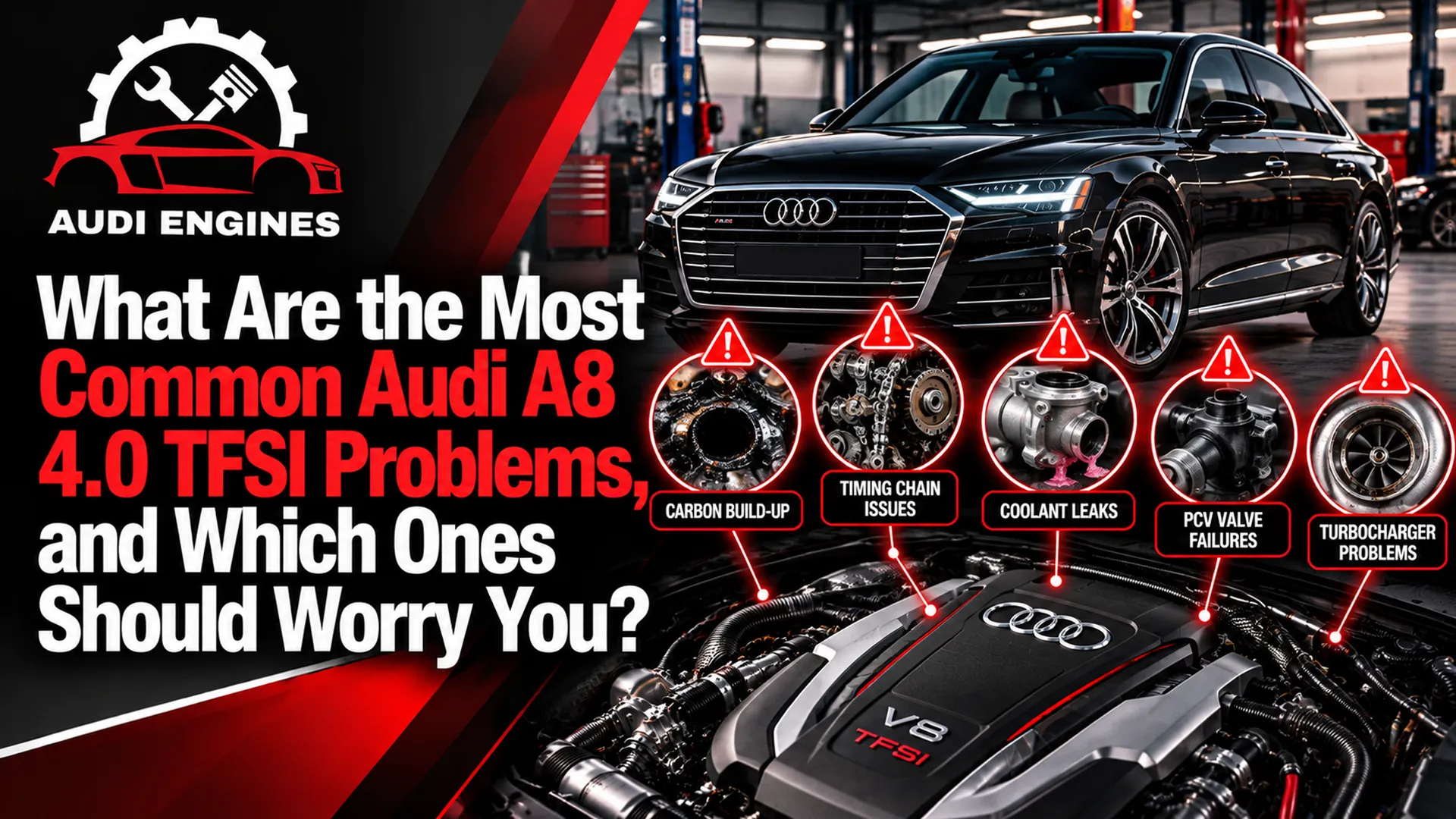
Common problems on the Audi A8 4.0 TFSI include turbocharger oil starvation in certain early cars, engine oil consumption, timing chain and camshaft wear, coolant leaks around the turbo area, and PCV or oil separator faults. Some are serious. Others are manageable if caught early.
Not every car will suffer every fault. The key is to know which ones carry real risk and which ones are inconvenient.
Does the Audi A8 4.0 TFSI Suffer From Turbo Failure and Oil Starvation?
On certain cars, yes. This is the best-documented concern on the engine.
US safety investigations and a related Audi recall covered certain 2013 to 2016 vehicles with the 4.0-litre twin-turbo engine. The problem centred on a turbo oil-supply strainer that could become blocked. When it does, the turbo bearings receive less oil. Without enough lubrication, the bearings wear, the turbo can fail, and some drivers reported the engine stalling.
Important qualification. This does not apply to every A8, and it doesn't explain every turbo fault. Whether it affects a particular car depends on the engine, build date and market. The only reliable way to know is to have the VIN checked for open recalls and service campaigns.
Warning signs of turbo trouble include loss of power, a whine or whistle under acceleration, blue smoke, rising oil consumption, an engine warning light or limp mode. We cover each one in detail in our guide to Audi A8 turbo failure symptoms, so we won't repeat it all here.
The takeaway for buyers: ask for evidence that the turbo oil supply has been checked or that any applicable campaign work was completed. A car with that paperwork is a safer proposition than one without.
Do Oil Consumption, Timing Chain and Coolant Leaks Make It Unreliable?
Not necessarily, but they are the problems most likely to add cost over time. Here is how they compare:
Problem | Typical symptom | How serious | How it's diagnosed |
| Turbo oil starvation | Power loss, whine, smoke, stalling | High, can lead to turbo and engine damage | Oil supply inspection, turbo checks, VIN campaign check |
| Excessive oil consumption | Frequent top-ups, blue smoke | Moderate to high if ignored | Oil consumption test, separating external leaks from internal burning |
| Timing chain and tensioner wear | Rattle on cold start | Moderate to high if neglected | Cold-start listening, live data, inspection |
| Camshaft wear | Rough running, misfire, ticking | Moderate to high | Inspection, fault codes, engine-specific procedures |
| Coolant leaks near the turbos | Coolant loss, sweet smell, warning light | Moderate, can lead to overheating | Pressure test, visual inspection of pipes and seals |
| PCV valve and oil separator faults | Rough idle, oil use, smoke | Low to moderate | Inspection and testing |
A few points of detail help here.
Oil consumption. Some oil use is normal in a high-performance turbocharged engine, but a car that needs regular top-ups deserves investigation. The first step is separating external leaks from internal consumption, because the repair paths differ. Technical guidance reported for specified later 4.0-litre engines refers to changes in piston-ring design. We can't generalise that to every car, so check your VIN with an Audi dealer or specialist to see whether it applies.
Timing chain and cold-start rattle. A brief rattle on a cold start can point to chain or tensioner wear, but it can have other causes too. Do not assume every engine will need a chain or camshaft repair. Listen for it, and have it assessed rather than guessing.
Coolant leaks. Heat in the hot-V area can degrade coolant pipes, O-rings and seals over time. Check the coolant level and look for staining around the engine.
Be careful, too, about sources. Documented investigations and bulletins carry more weight than forum posts. Both are useful, but they are not the same thing.
What Does It Cost to Own an Audi A8 4.0 TFSI Long Term, and What Maintenance Helps It Last?

Expect premium running costs. Routine servicing, tyres, fuel and consumables are all above average for a large executive saloon, and a major engine repair can run into thousands of pounds. Planning for that, not hoping to avoid it, is what separates happy owners from unhappy ones.
How Much Does It Cost to Maintain and Repair an Audi A8 4.0 TFSI in the UK?
Exact prices vary widely with the car's age, specification, the garage and the parts used, so we'd rather explain what drives cost than quote a number that could mislead you. The main cost areas are:
- Routine servicing and consumables. Oil, filters, brakes and tyres on a large, heavy car cost more than on a typical saloon.
- Turbocharger repair or replacement. The twin-turbo layout adds parts and labour compared with a single-turbo car.
- Timing chain work. A labour-intensive job where access is tight.
- Oil consumption diagnosis and repair. Testing is relatively modest, but a repair involving internal engine work is not.
- Engine rebuild versus replacement. Usually the largest single expense, and worth comparing carefully against the car's value.
- Warranty and unexpected repair budgeting. Setting aside a reserve each year protects you from a sudden bill.
Our indicative UK repair price ranges: (add your confirmed price ranges here).
Here is the commercial reality. A failed engine can cost more than the car is worth, so a planned preventive repair almost always beats an unplanned breakdown. That's why owners who budget for maintenance generally have a better experience than those who don't.
What Maintenance Helps an Audi 4.0 TFSI Last Longer?
Good habits make a measurable difference. These are the ones that matter most:
- Use the correct engine oil specification. The turbos depend on clean, correctly graded oil. The wrong oil can shorten bearing life.
- Choose sensible oil change intervals. Manufacturer intervals are a baseline, but many specialists recommend changing oil more often on a hard-working twin-turbo engine. Ask your specialist what suits your driving.
- Monitor oil consumption. Check the level regularly and keep a note of top-ups. A change in pattern is an early warning.
- Inspect the cooling system. Look for leaks, aged pipes and seals before they cause overheating.
- Check turbo lubrication components. Where relevant to your engine, have the oil supply to the turbos inspected.
- Act on warning lights and fault codes early. A minor fault left alone can become a major repair.
A quick reminder on the difference between sources. The manufacturer schedule tells you the minimum. A specialist's preventive advice reflects what workshops see on real cars. Both have a place.
Want to catch problems early? Book a preventive engine health check with Audi Engines.
What Should You Check Before Buying a Used Audi A8 4.0 TFSI, and Is It Worth It?
Before you buy, check the service history, listen to a cold start, ask about the turbo oil supply, inspect for coolant leaks, scan for fault codes, look for oil consumption signs and confirm recalls using the VIN. An independent inspection from an Audi specialist is the best protection against an expensive mistake.
What Is the Best Pre-Purchase Inspection Checklist for an Audi A8 4.0 TFSI?
Work through these steps in order:
- Full service history and invoices. Look for regular oil changes on schedule, evidence of turbo-related work and any recall or campaign completion.
- Cold-start listen. Ask the seller not to warm the engine before you arrive. A rattle for the first few seconds is a clue to investigate.
- Turbo oil supply history. Ask whether the turbo oil supply or strainer has been checked, especially on 2013 to 2016 cars.
- Coolant level and leaks. Look around the engine for staining or crusty residue.
- Fault code scan. A diagnostic scan can reveal stored faults and misfire history.
- Oil consumption and smoke. Check the oil level and look for blue smoke on acceleration.
- Recalls via VIN. Ask an Audi dealer to confirm any open campaigns.
- Independent inspection. A specialist can check what a quick test drive can't.
Red flags that justify walking away: no service history on a high-mileage car, unexplained oil loss, warning lights the seller dismisses, a cold-start rattle that comes with rough running, or a seller who refuses an independent inspection.
An honest note: a full service history helps, but it doesn't prove reliability. It shows care, not condition. That's why the physical checks above matter.
Here is a typical scenario. A buyer finds a well-presented A8 with 90,000 miles and a stamped service book. The price looks fair. A specialist's cold-start check reveals a brief rattle and a slight coolant stain near the turbo area. The buyer uses the findings to negotiate, or walks away, and avoids a bill larger than the saving. That's the value of looking before you buy.
Is the Audi A8 4.0 TFSI Worth Buying for Long-Term Ownership?
It suits some buyers very well, and others should avoid it.
It suits you if you want a refined, powerful luxury saloon, you can budget for premium maintenance, and you find a car with documented history and a clean inspection.
Think twice if you need the lowest running costs, you're buying the cheapest example you can find, or the car has no records and you can't afford a large repair bill.
Compared with the 3.0 TFSI, you gain performance and refinement but accept more complexity. Compared with some rivals, the cost of being wrong is high, so inspection and evidence matter more here than on a simpler car.
Our inspection includes: (add your confirmed inspection scope here). Warranty terms: (add your confirmed warranty). Technician credentials: (add your real details). Last technically reviewed: (add date).
Book an Audi A8 pre-purchase engine inspection. Send your registration through audiengines.co.uk, call us, or use the booking link, and we'll tell you exactly what we find.
Frequently Asked Questions About Audi A8 4.0 TFSI Reliability
Is the Audi A8 4.0 TFSI reliable long term?
It can be, if it has been serviced on time with the correct oil and checked for known issues. Neglected cars carry far more risk. Check engine code, model year and service history before you buy.
How long does an Audi A8 4.0 TFSI engine last?
There is no fixed figure. Well-maintained examples can cover high mileage, but condition and maintenance matter more than the odometer reading.
Can an Audi A8 V8 reach 200,000 miles?
Some can, with strong maintenance and timely repairs. It isn't guaranteed, and the cost of keeping a high-mileage car healthy should be part of your budget.
What are the most common Audi A8 4.0 TFSI problems?
Turbo oil starvation on certain early cars, oil consumption, timing chain and camshaft wear, coolant leaks near the turbos and PCV or oil separator faults. Not every car is affected.
Is the Audi A8 expensive to repair?
Yes, compared with a typical saloon. Complex engines, tight access and premium parts push labour and parts costs up. A specialist can often offer better value than a franchised dealer.
Is the Audi 4.0 TFSI more reliable than the 3.0 TFSI?
Not necessarily. The 4.0 TFSI is more powerful but more complex, so there's more that can go wrong. The right choice depends on the car's condition and history.
What mileage is too high for a used Audi A8?
There's no single cut-off. A well-documented car at higher mileage can beat a poorly documented one at lower mileage. Judge each car on evidence.
How do I check whether a recall applies to my Audi A8?
Give your VIN to an Audi dealer. Applicability depends on your engine, build date and market, and the official recall and bulletin documents describe the affected vehicles.
Is an extended warranty worthwhile?
It can be, given repair costs, but read the exclusions carefully. Many warranties exclude wear items or pre-existing faults, so check what's covered for turbos, engine internals and cooling parts.
Should I buy an A8 4.0 TFSI with no service history?
Be very cautious. Without records you can't know whether the oil has been changed on time, and the risk of hidden wear rises. If you still want it, insist on an independent inspection and price in the risk.
What causes a timing chain rattle on cold start?
It can point to chain or tensioner wear, but other causes exist. A proper inspection is needed to confirm it.
Does regular servicing improve engine longevity?
Yes. Correct oil, timely changes and early attention to warning lights are the most effective ways to protect a twin-turbo V8.
Final Word: Reliable If You Choose Well and Maintain It
The Audi A8 4.0 TFSI is not a car to buy on emotion. It's a rewarding long-term companion if you pick a documented example, confirm its engine code and campaign status, and keep up with the maintenance it needs. It's a costly mistake if you skip those steps.
Check the VIN, listen to the cold start, ask about the turbo oil supply and get an independent inspection. Those four steps remove most of the risk.
Ready to buy or keep an A8 with confidence? Send your registration through audiengines.co.uk to book a pre-purchase inspection or a preventive engine health check today.