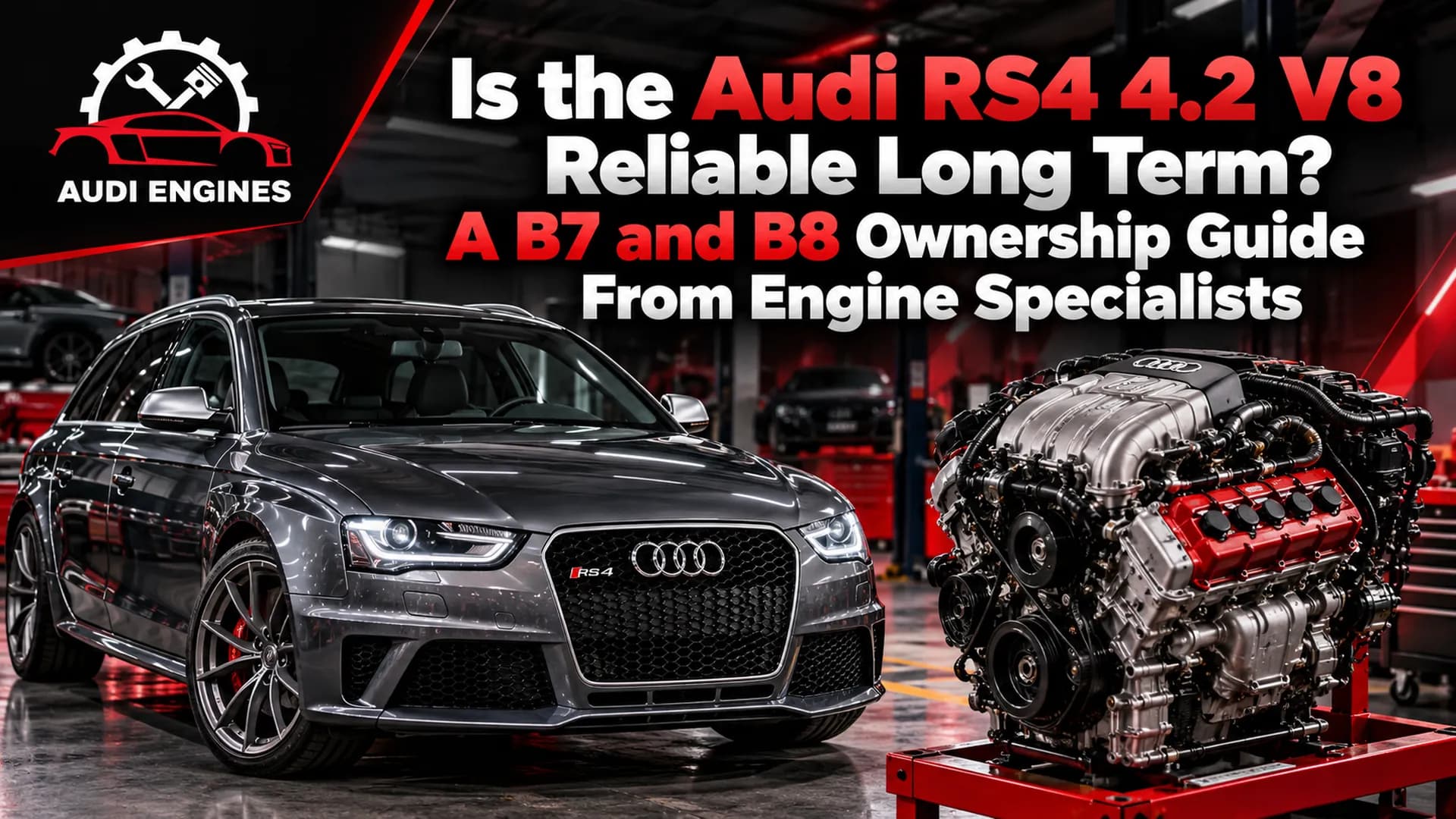
Is the Audi RS4 4.2 V8 Reliable Long Term? A B7 and B8 Ownership Guide From Engine Specialists
You've seen the listing. A naturally aspirated V8 that screams to 8,250 rpm, in an estate that can carry the dog and still embarrass a few sports cars. Then you read the forums, and the horror stories start: oil consumption, carbon build-up, rattling chains, five-figure bills.
You've seen the listing. A naturally aspirated V8 that screams to 8,250 rpm, in an estate that can carry the dog and still embarrass a few sports cars. Then you read the forums, and the horror stories start: oil consumption, carbon build-up, rattling chains, five-figure bills.
So, is the Audi RS4 4.2 V8 reliable long term?
Here's the straight answer. The 4.2 FSI is a fundamentally durable engine, and plenty of them run for years without internal drama. But long-term reliability depends on maintenance history, oil consumption, carbon deposits, the condition of the timing system and the health of the cooling system. A well-kept RS4 can be a rewarding long-term car. A neglected one can be a very expensive lesson. And durable does not mean cheap to own.
This guide separates the B7 from the B8, explains what actually fails, shows what kills these engines, and tells you what to check before you buy. We're an engine rebuild specialist, so we also explain when a repair is enough and when a rebuild or replacement makes more sense.
Is the Audi RS4 4.2 V8 Reliable Long Term, and Is the B7 or B8 the Safer Buy?

Both generations use a 4.2-litre FSI V8, a high-revving, naturally aspirated engine with direct injection. But they are different cars with different risk profiles, and mixing them up is the most common mistake in RS4 reliability discussions.
The B7 RS4 (roughly 2006 to 2008) pairs the engine, coded BNS, with a six-speed manual gearbox and quattro, and makes around 420 PS. The B8 RS4 (roughly 2012 to 2015) uses a development of the same V8, coded CFSA, with around 450 PS and a seven-speed S tronic gearbox. Check the exact output, code and dates against the car's documents before you rely on any list, ours included.
How Does the B7 RS4 4.2 FSI V8 Compare With the B8 for Long-Term Reliability?
Factor | B7 RS4 | B8 RS4 |
| Engine | 4.2 FSI V8, naturally aspirated | 4.2 FSI V8, naturally aspirated |
| Output | Around 420 PS | Around 450 PS |
| Gearbox | Six-speed manual | Seven-speed S tronic |
| Main long-term concerns | Carbon build-up, oil consumption, age-related wear | Timing-chain system, carbon build-up, oil consumption, S tronic servicing |
| Complexity | High | Higher |
| Risk profile | Depends heavily on age and condition | Depends heavily on maintenance and repair cost |
Neither generation is immune to anything. Direct injection means carbon deposits on the intake valves in both. Both can use oil. The B7's age means rubber, seals and cooling parts are now well past their best, while the B8's extra complexity can make a repair bill larger when something does go wrong.
Here's how we'd score long-term ownership honestly:
Category | Assessment |
| Engine durability | High, if maintained |
| Maintenance cost | High |
| Parts cost | High |
| Mechanical complexity | High |
| DIY friendliness | Low to moderate |
| Long-term potential | Good with a documented history |
| Neglected-car risk | Very high |
Which is the safer buy? Neither generation wins on paper. The car with the better history is the safer buy. A B7 with full invoices, regular oil changes and documented carbon cleaning beats a B8 with gaps in its record, and the reverse is just as true.
How Long Does an Audi RS4 4.2 V8 Last, and Is a High-Mileage Car Still Worth Buying?
No honest specialist can promise a mileage figure, and you should be wary of anyone who does. These engines can last a very long time, but how long depends on how they were treated, not on the odometer alone.
That leads to the most important buying principle: a properly maintained 100,000-mile RS4 can be a safer purchase than a neglected 60,000-mile car. Low mileage with stale oil, ignored warning lights and no paperwork is a gamble. High mileage with a clear record is a known quantity.
Here's how we think about mileage bands:
- Under 50,000 miles: Wear should be modest, but check for years of short trips, missed oil changes and a car that sat unused. Age-related issues such as seals, hoses and rubber parts still apply.
- 50,000 to 100,000 miles: This is where carbon build-up, ignition parts and cooling components often need attention. A car that has had this work done is a good sign.
- Over 100,000 miles: Condition and history matter far more than the number. Budget for catch-up maintenance, and have the engine inspected by someone who knows the 4.2 FSI.
A high-mileage RS4 suits an owner with a realistic repair budget who wants a driver's car and values a thick folder of invoices. It does not suit a buyer who is stretching to afford the purchase price and hoping nothing breaks.
What Are the Most Common Audi RS4 4.2 V8 Problems, and Which Ones Can Actually Kill the Engine?
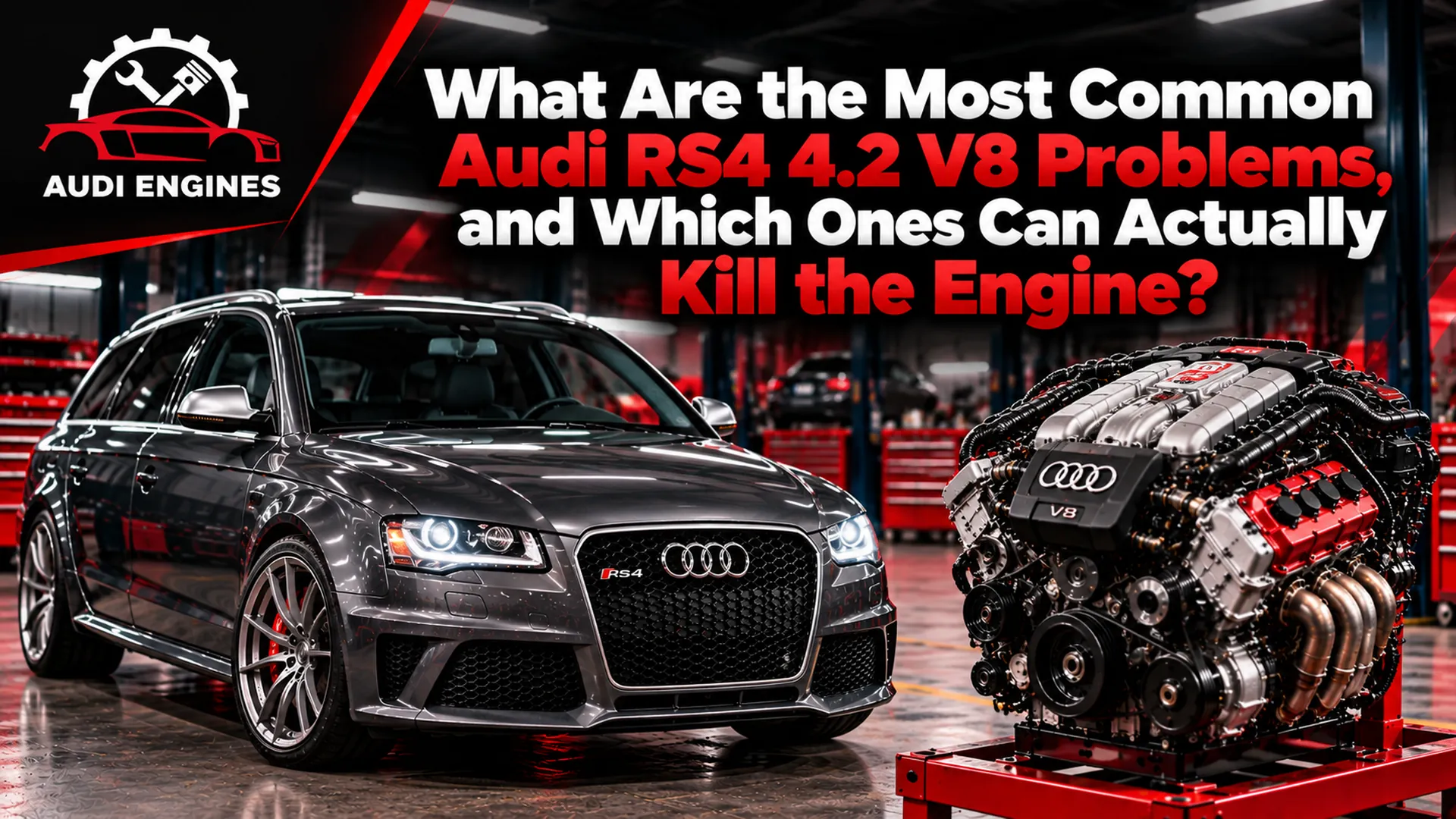
Every engine has weak points. The useful question is which ones are routine maintenance, which are warnings, and which are the beginning of the end. Here's where the 4.2 FSI sits.
Does the RS4 4.2 FSI Suffer From Carbon Build-Up, Oil Consumption, Timing Chain Wear and Misfires?
Yes, to varying degrees. None of these is unique to the RS4, but together they define what ownership looks like.
- Carbon build-up: Direct injection sprays fuel straight into the cylinder, so nothing washes the back of the intake valves. Deposits build up, causing rough idle, hesitation and misfires. It's a maintenance item, not a death sentence, and cleaning (often by walnut blasting) restores the engine.
- Oil consumption: Some use is normal for a high-performance engine. Heavy or increasing use is a warning. Check the oil level regularly, and never assume the dipstick can wait until the next service.
- Timing chain and tensioner wear: A persistent rattle on cold start deserves immediate attention. On this V8 the chain drive sits at the gearbox end of the engine, so access is labour-heavy, and an ignored chain problem can become a very expensive one.
- Camshaft adjusters: Wear can cause rattles, rough running and fault codes.
- Ignition coils and spark plugs: Common wear items on a high-output engine, and a frequent cause of misfires. Cheap to fix when caught early, damaging if ignored.
- Coolant and oil leaks: Age affects seals, hoses, the water pump and the thermostat. Cooling faults must be taken seriously, because overheating can take out an otherwise healthy engine.
- Vacuum leaks: A split hose or a failed seal can cause rough running that looks much worse than it is.
Here's how to read them:
Fault | Typical symptoms | Severity | Usual action |
| Carbon build-up | Rough idle, hesitation, misfire | Moderate | Clean intake valves |
| Oil consumption | Falling oil level, smoke | Moderate to serious | Investigate, monitor, possibly repair |
| Timing chain / tensioner wear | Cold-start rattle, fault codes | Serious | Inspect promptly, repair |
| Cam adjuster wear | Rattle, rough running | Moderate to serious | Diagnose and replace |
| Coils and plugs | Misfire, flashing engine light | Low | Replace |
| Coolant or oil leaks | Level loss, smell, stains | Moderate to serious | Trace and repair |
| Bearing wear or low oil pressure | Knocking, oil warning | Severe | Stop driving, consider rebuild |
What Actually Kills a 4.2 V8 RS4 Engine, and When Does It Need a Rebuild or Replacement?
A healthy 4.2 FSI rarely dies from nowhere. When we see one that has, the cause is usually one of these:
- Neglected oil changes: Dirty or degraded oil wears bearings, chains and adjusters
- Running low on oil: Especially on cars that consume it, where an unchecked level can drop fast
- Ignored misfires: Unburnt fuel washes oil from the cylinder walls and damages the catalysts
- Overheating: From a failed water pump, thermostat or leak that wasn't noticed in time
- A neglected cooling system: Old coolant and tired hoses fail without warning
- Poor modifications: Cheap tunes and badly fitted parts
- Track use without preparation: Sustained high load needs fresh fluids, healthy cooling and correct oil levels
Most faults are fixable without a rebuild. Carbon cleaning, coils, plugs, leaks and vacuum faults are all repair jobs. A rebuild or replacement enters the conversation when there's bearing damage, loss of compression, severe oil starvation or overheating damage that has gone beyond what a repair can sensibly fix.
That's where specialist knowledge matters. We offer Audi V8 engine diagnostics, repair and rebuild work, and our first job is always to establish what has actually failed, so you don't pay for a rebuild when a repair would do, or fit parts to an engine that's already beyond saving.
What Are the Warning Signs of a Failing Audi RS4 V8 Engine?
If you notice any of these, stop and get the car checked before driving further:
- A cold-start rattle that persists after the first few seconds
- Rough idle or repeated misfire warnings
- The oil pressure warning light, on or flickering. Stop driving immediately.
- Blue or heavy exhaust smoke
- Unexplained coolant loss or overheating
- Metal particles in the oil or on the filter
- A falling oil level between services
Continuing to drive with a low oil pressure warning is the quickest way to turn a repair into a rebuild.
How Much Does an Audi RS4 V8 Cost to Maintain, and What Should You Check Before Buying One?

This is where the reliability question gets honest. The engine may be durable, but the car isn't cheap to maintain.
What Does Long-Term Audi RS4 V8 Ownership Really Cost in the UK?
Running costs on an RS4 are not those of an A4 with a bigger badge. Parts are specialist, labour is intensive and the tolerances are tight. Budget for these ongoing categories:
- Servicing and oil: Regular oil and filter changes with the correct specification, and more frequent checks if the car consumes oil
- Spark plugs and ignition coils: Routine on a high-output V8
- Carbon cleaning: Needed periodically on direct-injection engines
- Timing system inspection and work: Rare, but heavy when needed
- Cooling system: Water pump, thermostat, hoses and coolant as the car ages
- Gearbox and differential servicing: Manual gearbox oil on the B7, S tronic and differential servicing on the B8
- A repair buffer: Because on a car this age, something will always need attention
We don't publish blanket prices, because the cost depends on the car's age, history and condition. Ask any specialist for an itemised, written quote that says exactly what's included. At voguetechnicsenginerebuild.co.uk, you can request a diagnostic or a quote, and we'll explain what each line covers.
The cheapest quote is rarely the best value on a car like this. A bargain RS4 with deferred maintenance often costs more in the first year than a well-kept one costs to buy.
What Should You Check Before Buying a Used Audi RS4 4.2 V8?
Treat a pre-purchase inspection as essential, not optional. Work through this checklist:
- Ask for a cold start. Listen for rattles in the first seconds. Don't buy a car that has already been warmed up for you.
- Check the idle. It should be smooth, with no hunting or shaking.
- Listen for engine noise. Ticking, rattling or knocking all need explaining.
- Check the exhaust for smoke on start-up and under load.
- Ask about oil consumption. Check the level and ask how often the owner tops up.
- Scan for fault codes. A diagnostic scan reveals misfire history and stored faults.
- Check coolant level and condition, and look for signs of leaks.
- Inspect for oil leaks around the engine and underneath.
- Review the service invoices. Look for regular oil changes and evidence of carbon cleaning.
- Test the gearbox. Check the clutch and shifts on the manual, and smoothness and behaviour on the S tronic.
- Check for modifications, and who carried them out.
- Inspect the suspension, brakes and tyres. Worn parts add to the true cost of the car.
A specialist inspection beats a generic one because the person looking knows what a healthy 4.2 FSI sounds and behaves like, and where these engines hide their problems. We offer pre-purchase engine inspections and diagnostics for Audi V8 models, and you can ask us about availability and turnaround when you get in touch.
Frequently Asked Questions About the Audi RS4 4.2 V8
How many miles will an Audi RS4 V8 last?
There's no guaranteed figure. With regular oil changes, a healthy cooling system and attention to known weak points, these engines can run for a very long time. Neglect shortens that dramatically.
Does the RS4 4.2 V8 burn oil?
Some oil use is normal for this type of engine. Heavy or rising consumption is a warning sign and should be investigated. Check the level regularly.
Does the RS4 V8 need walnut blasting, and how often?
Direct-injection engines build up carbon on the intake valves, so periodic cleaning is a normal part of ownership. How often depends on the car's use and condition, and a specialist can assess it.
Is the Audi RS4 expensive to maintain?
Yes. Parts and labour are specialist, and the car is complex. The engine can be durable, but running costs stay high.
Should I buy a B7 or a B8?
Choose by condition and history, not generation alone. The B7 offers a manual gearbox and a simpler driving experience, while the B8 is more powerful and brings S tronic and timing-system considerations.
Can an RS4 engine be rebuilt?
Yes, if the block and major components are sound. A rebuild makes sense after bearing damage, compression loss or oil starvation. The cost depends on the extent of the damage, so a proper inspection comes first.
Is the RS4 a good long-term car?
For an owner who budgets realistically and keeps on top of maintenance, yes. For someone hoping to avoid repair bills, no.
Is a high-mileage RS4 V8 worth buying?
Sometimes. A documented, well-maintained high-mileage car can be a better buy than a low-mileage one with no history.
The Verdict: Is the Audi RS4 4.2 V8 Reliable Long Term?
The 4.2 FSI V8 is a durable, characterful engine that rewards owners who look after it. It is not a bulletproof one, and it's certainly not a cheap one to run.
Buy on history, not mileage. Check the oil, cooling and ignition systems religiously. Deal with carbon build-up and misfires early. Get any cold-start rattle looked at immediately. And budget for the fact that this is a performance car with performance-car bills.
If you're considering an RS4, we can inspect it before you buy. If you already own one and it's rattling, smoking, misfiring or losing oil, we can diagnose the problem and tell you honestly whether it needs a repair, a rebuild or a replacement engine.