What Happens During Audi Engine Diagnostics? Complete Step-by-Step Guide
Your Audi's engine management light just came on, and now you're staring at it wondering what it actually means. Is it something serious? Will the garage just plug in a scanner, glance at a screen, and hand you a bill.
Your Audi's engine management light just came on, and now you're staring at it wondering what it actually means. Is it something serious? Will the garage just plug in a scanner, glance at a screen, and hand you a bill? Or is there more to it than that?
If you've ever booked a diagnostic and come away with a vague explanation and a replaced part that didn't actually fix the problem, you already know the frustration. That's usually not because diagnostics don't work, it's because a proper Audi engine diagnostic check involves a lot more than plugging in a generic scanner and reading whatever code pops up.
This guide walks through exactly what happens during Audi engine diagnostics, from the moment you describe the problem to the moment someone explains what's actually wrong and why. No vague generalities, the real process, step by step.
What Happens During an Audi Diagnostic Check, Step by Step
A proper Audi diagnostic check follows a consistent process, whether the symptom is a dashboard warning light, a misfire, or a car that's simply not running the way it should. Here's what actually happens.
Step 1–2: Discussing Your Audi's Symptoms & Visual Inspection
Every diagnostic worth paying for starts with a conversation, not a scan. A technician will ask when the problem started, what it feels or sounds like, whether it's constant or intermittent, and what conditions trigger it, cold starts, motorway speeds, hard acceleration.
This matters more than it might seem. An intermittent misfire that only happens on cold mornings points somewhere very different than one that only shows up under load. This context shapes everything that follows.
Next comes a visual inspection, checking for obvious issues before anything gets connected to the car. This includes:
- Fluid leaks around the engine, gearbox, and turbo
- Damaged or loose wiring, connectors, and vacuum hoses
- Worn or damaged belts and visible component wear
- Warning lights currently active on the dashboard
A five-minute visual check regularly catches things a diagnostic scan won't, a perished vacuum hose or a corroded connector doesn't always throw a fault code straight away, but it's often the actual root cause once you trace things back.
Step 3–4: Connecting the Diagnostic Tool & Scanning the ECU
With the initial checks done, the diagnostic tool connects to the car's OBD port, giving it access to the vehicle's electronic systems.
This is where the diagnostic scanner communicates with the Audi ECU (engine control unit) and other control modules across the car, not just the engine module, but potentially the transmission, ABS, and other systems depending on the symptom being investigated. Audi's engine management systems, like most modern manufacturers, run on a network of interconnected modules communicating over the CAN bus, so a fault in one area can sometimes show symptoms in another.
Audi-Specific Diagnostics vs Generic OBD Scanners
Not all diagnostic tools are equal, and this is one of the most misunderstood parts of the process.
Tool Type | What It Accesses | Limitations |
| Generic OBD-II scanner | Basic emissions-related fault codes | Can't access most Audi-specific modules or manufacturer fault data |
| Audi/VAG-specific tool (VCDS) | All control modules, Audi-specific fault codes, coding functions | Requires proper VAG software knowledge to interpret correctly |
| Dealer-level system (ODIS) | Full manufacturer diagnostic access, guided fault-finding, software updates | Typically only available through Audi dealers and specialist independents |
A basic OBD-II scanner reads generic, standardised codes, useful, but limited. It often can't reach Audi-specific modules covering things like the DSG/S-tronic transmission, adaptive cruise systems, or manufacturer-specific engine parameters.
VCDS and ODIS are built specifically for the Volkswagen Group (which includes Audi), giving access to the full range of control modules and manufacturer-level fault data, the same depth of access an Audi dealer would use. This is why an Audi specialist diagnostic will usually catch things a generic scan at a general garage might miss entirely.
Step 5–6: Reading Fault Codes & Analysing Live and Freeze-Frame Data
Once connected, the tool retrieves the car's diagnostic trouble codes, often shortened to DTCs. These are standardised (and manufacturer-specific) codes stored in the ECU's fault memory whenever the system detects something outside expected parameters.
Common examples include codes like P0300 (random/multiple cylinder misfire), P0171 (system too lean), and P0420 (catalyst efficiency below threshold), though what these actually mean in practice varies significantly depending on the surrounding data, which is exactly why the process doesn't stop at reading the code.
What Is Live Data? (RPM, Fuel Trims, Boost Pressure & More)
Live data is exactly what it sounds like, real-time readings from the car's sensors while the engine's actually running. Rather than looking at a stored code from the past, the technician watches the engine behave in real time.
Parameters typically reviewed include:
- RPM and engine load, confirms the engine's running as expected under different conditions
- Coolant temperature, flags cooling system issues or thermostat faults
- Fuel trims, show whether the engine's running rich or lean, and by how much
- Oxygen sensor readings, reveal how well combustion is being managed
- Boost pressure (on turbocharged TFSI and TDI engines), confirms the turbo's operating within spec
- Intake air pressure and airflow, help pinpoint intake or vacuum leaks
- Ignition timing, flags timing-related misfires or knock
- Throttle position, confirms the throttle body's responding accurately
- Injector data, shows fuel delivery consistency across cylinders
Live data is often where the real diagnosis happens. A stored code might say "cylinder 3 misfire," but watching live data during a road test can reveal whether that's caused by an ignition coil, a fuel delivery issue, or a mechanical problem like low compression.
Stored vs Pending Audi Fault Codes
Not every fault code means the same thing. Stored (confirmed) faults have triggered consistently enough for the ECU to log them permanently, usually alongside a warning light. Pending faults are ones the system has detected once or twice but hasn't confirmed yet, these often relate to intermittent issues that haven't happened often enough to trigger a warning light.
Pending codes are genuinely useful for catching problems early, before they become a dashboard warning and a bigger repair.
Step 7–9: Component Testing, Root Cause Confirmation & Road Test
This is the stage that separates a proper diagnostic from a quick code read, and it's the part a lot of cheaper "diagnostic checks" skip entirely.
Depending on what the codes and live data suggest, a technician tests individual components directly rather than assuming the part named in the fault code is actually the culprit. This can include:
- Fuel pressure testing, confirming the fuel system's delivering the correct pressure under load
- Boost pressure and intake/vacuum system checks, particularly relevant on TFSI and TDI engines, where a small vacuum leak can cause symptoms that look electrical
- Ignition component testing, coils, spark plugs, and related wiring on petrol engines
- Injector testing, checking delivery and spray pattern where injector faults are suspected
- Actuator testing, confirming components like the EGR valve or turbo wastegate physically respond to commands
- Electrical connection checks, wiring, connectors, and earth points, which cause a disproportionate number of "mystery" faults
- Smoke testing, introducing smoke into the intake or exhaust system to visually spot leaks that are otherwise hard to find
- Pressure testing, checking cooling system and turbo system integrity under pressure
Once component testing narrows things down, the technician confirms the actual root cause, not just the symptom, but the specific failure causing it. Then comes a road test, which is essential for intermittent faults that don't show up sitting on a ramp. Watching live data while the car's driven under real conditions, load, temperature, speed changes, often reveals faults that never appear at idle.
Step 10: Explaining the Results & Repair Recommendation
The diagnostic isn't finished until someone explains it to you in terms that actually make sense. A proper diagnostic report should cover:
- What the fault codes and live data showed
- What testing confirmed as the actual root cause
- What repair is recommended, and why
- What happens if the issue isn't addressed
If a garage can't explain why they're recommending a particular repair, only that a code came up, that's worth questioning. A code is a starting point, not a diagnosis.
Why a Fault Code Doesn't Always Mean a Failed Part
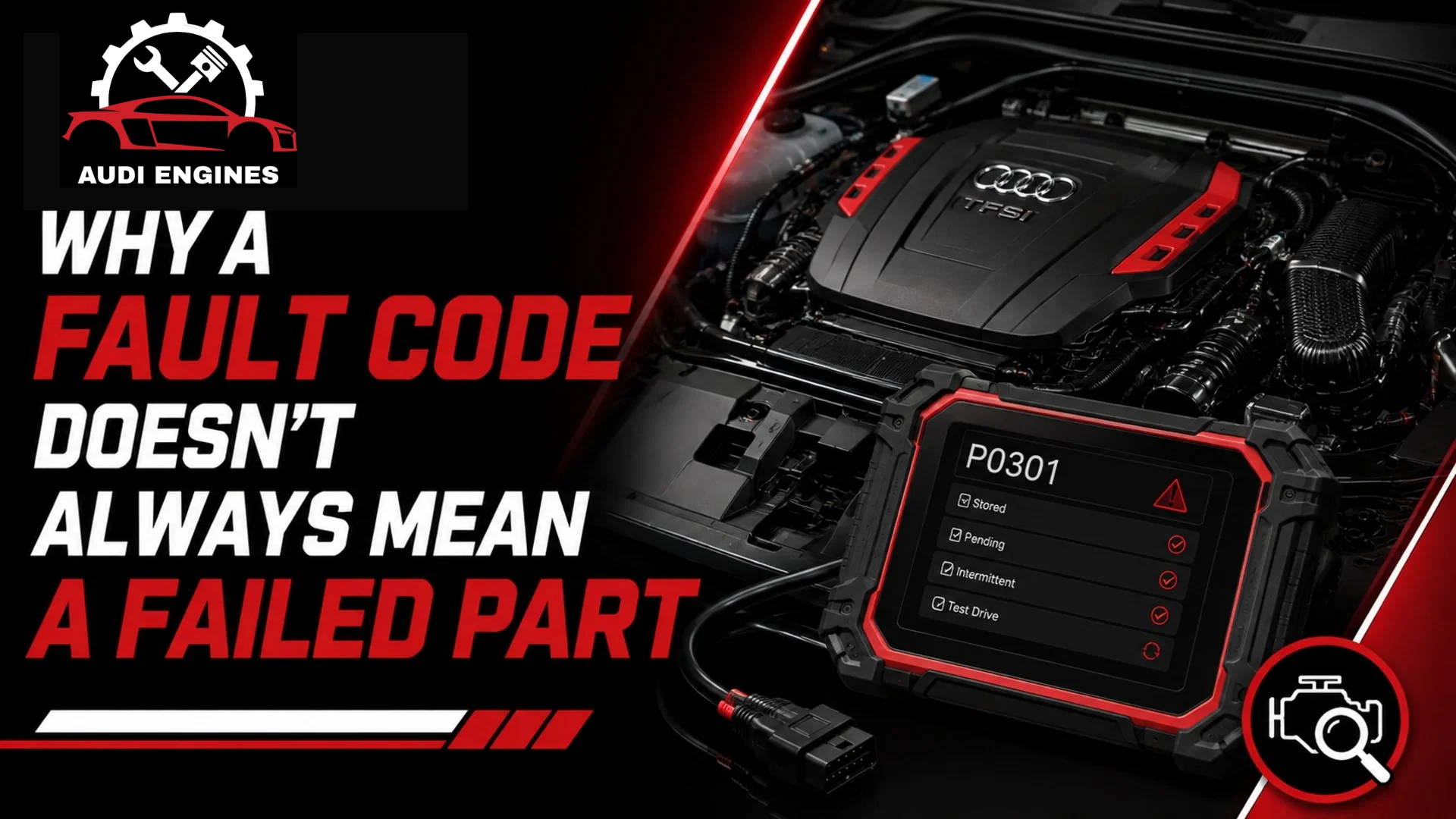
This is one of the most misunderstood aspects of car diagnostics, and it's worth explaining properly, because it's the difference between a repair that fixes the problem and one that doesn't.
How One Sensor Code Can Point to Several Different Causes
A stored fault code names the circuit or system where a problem was detected, it doesn't automatically mean that specific part has failed.
Take a common example: an oxygen sensor fault code. This might genuinely mean the sensor itself has failed. But it could equally point to:
- A wiring or connector issue between the sensor and the ECU
- A vacuum leak affecting the air-fuel mixture the sensor's reading
- An exhaust leak upstream of the sensor
- A completely unrelated fault (like a failing fuel injector) creating conditions the sensor's correctly flagging as abnormal
Replacing the sensor in every one of these scenarios except the first wouldn't fix anything, the same fault code would likely return within days.
Electronic Diagnosis vs Mechanical Diagnosis, What's the Difference?
Computer diagnostics and physical mechanical testing answer different questions, and a genuinely thorough diagnostic uses both.
What a Diagnostic Scan Can Detect
Electronic diagnosis covers fault codes, sensor readings, ECU data, and actuator response, essentially, anything the car's electronic systems can measure and report on. This is powerful for catching sensor faults, wiring issues, and anything the ECU is directly monitoring.
What Only a Physical Test Can Confirm (Compression, Smoke & Pressure Testing)
But a scan tool can't measure everything. Mechanical diagnosis, compression testing, smoke testing, pressure testing, and physical inspection, catches issues the ECU simply isn't monitoring, such as:
- Internal engine wear affecting compression
- Physical leaks in the intake, cooling, or exhaust systems
- Timing system wear or slack
- Cooling system integrity under pressure
A car can have genuinely poor compression on one cylinder and, depending on the fault, may not throw a specific code pointing directly at it, the ECU might just log a misfire code without telling you why. That's exactly where mechanical testing fills the gap electronic diagnosis leaves open.
Why Some Garages Clear Codes Before Diagnosing, And Why That's a Problem
Occasionally, a fault code gets cleared before a proper diagnosis happens, sometimes to see if it returns, sometimes simply to make a warning light disappear. The problem is that clearing codes without documenting them first destroys diagnostic history that can be genuinely useful, particularly for intermittent faults that took weeks to trigger in the first place.
A code that's been cleared without being properly recorded and investigated can mean starting the diagnostic process from scratch if the fault returns, costing you time and, often, money.
What Can Audi Engine Diagnostics Actually Detect?
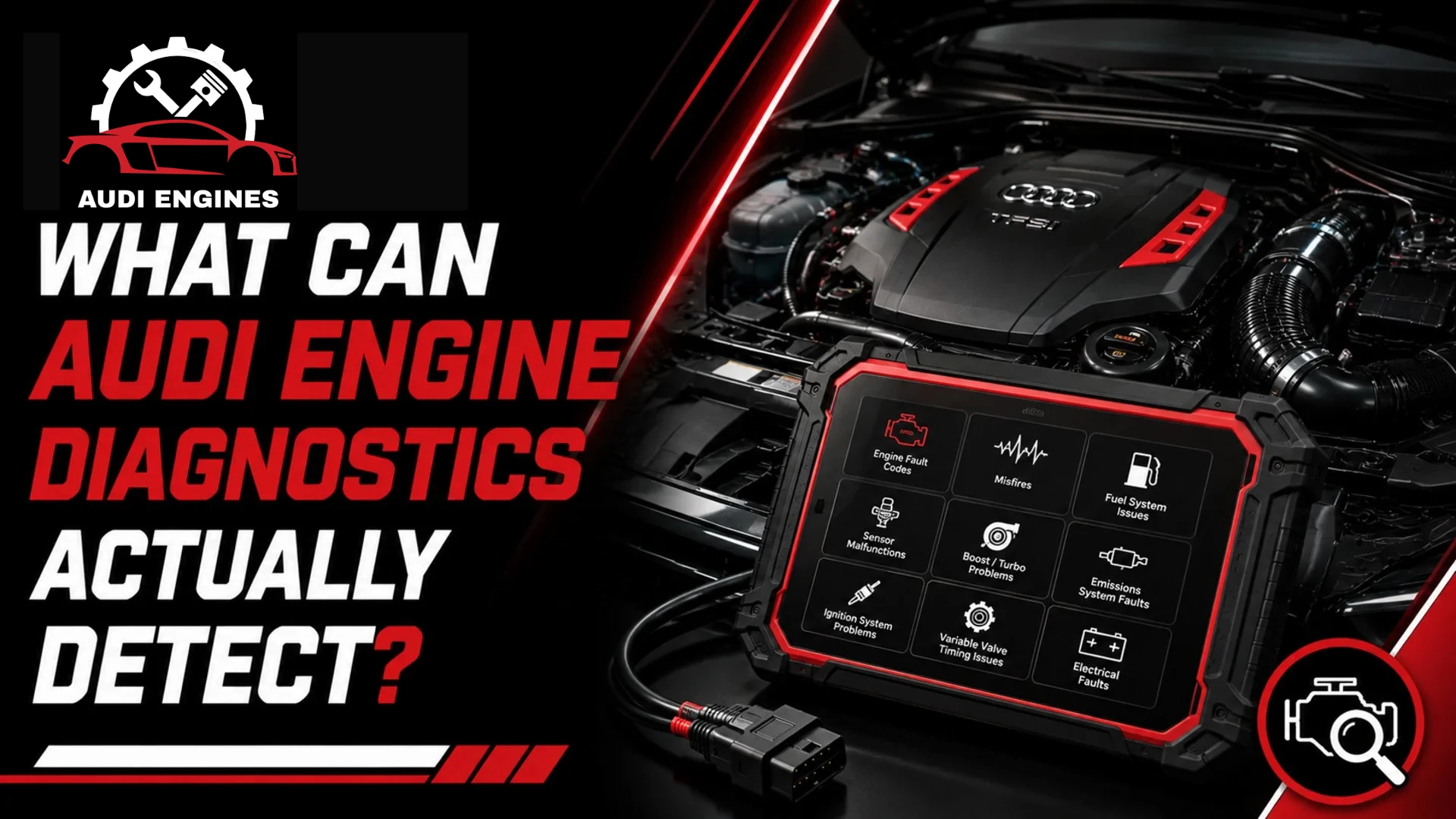
Audi engine diagnostics can identify a genuinely wide range of issues, though what gets found depends heavily on symptoms, testing depth, and whether electronic and mechanical diagnostics are both used properly.
Misfires, Rough Idle & Loss of Power
Misfire codes (like P0300 for random misfires, or cylinder-specific codes such as P0301–P0304) are among the most common diagnostic findings. Combined with live data, diagnostics can usually identify which cylinder's affected and narrow the cause down to ignition, fuel delivery, or a mechanical issue like low compression.
Rough idle and loss of power often trace back to similar causes, vacuum leaks, injector problems, or turbo boost issues on TFSI and TDI engines, and live data monitoring during a road test is usually what confirms the specific cause.
Turbo, Injector & Fuel System Faults
Turbocharger faults show up through boost pressure readings that don't match expected values, often combined with symptoms like whining noises or a noticeable lag in power delivery. Injector faults typically appear as inconsistent fuel trims or misfire patterns tied to specific cylinders.
Fuel system diagnostics cover the whole chain, fuel pressure, pump performance, and injector delivery, since a fault anywhere along that chain can produce very similar symptoms.
DPF, EGR & Emissions-Related Problems
Diesel Audis in particular can develop DPF (diesel particulate filter) and EGR (exhaust gas recirculation) related faults, especially on cars used mostly for short journeys that don't allow the DPF to regenerate properly. Diagnostics can identify blocked or failing DPF systems, along with EGR valve that are sticking or carbon-fouled, both common causes of warning lights and reduced performance on TDI models.
Electrical Faults & Warning Light Triggers
Electrical faults, wiring, connectors, earth points, and control module communication issues, are a genuinely common cause of symptoms that initially look like something else entirely. A wiring fault affecting one sensor's signal can trigger a code that, on the surface, looks like a component failure.
Check Engine Light vs Engine Management Light, What's the Difference?
These terms are often used interchangeably, and on most Audis, they refer to the same warning light, the malfunction indicator lamp (MIL), which illuminates when the ECU detects a fault affecting emissions or engine performance. What varies is the message shown alongside it, and Audi's onboard systems will sometimes display more specific alerts (like "Drive system: malfunction") that point toward a broader category of fault rather than one specific issue, which is exactly why the underlying diagnostic process matters more than the warning message alone.
Audi Diagnostics, Time, Cost & Booking a Specialist
Once you understand what's actually involved, it's easier to judge what a fair diagnostic appointment should look like, in terms of both time and price.
How Long Does an Audi Diagnostic Take?
A straightforward diagnostic, clear symptoms, a code that matches live data cleanly, can often be completed within an hour. Intermittent faults, or ones requiring extensive component testing and a road test, understandably take longer, sometimes requiring the car to be monitored over a longer period or even brought back for a repeat test under specific conditions.
Be cautious of anywhere offering a "five-minute diagnostic" for a genuinely complex fault, that's rarely enough time for anything beyond reading a stored code.
How Much Does Audi Engine Diagnostics Cost?
Diagnostic pricing varies based on complexity and the depth of investigation required. A basic fault-code read is typically the cheapest option, while a full diagnostic involving live data analysis, component testing, and a road test costs more, reasonably so, given the time and equipment involved.
It's worth asking upfront whether the diagnostic fee is credited toward the cost of any repair carried out afterward, which many specialists offer.
Why Choose an Audi/VAG Specialist Over a Generic Garage?
Audi's engine management systems, particularly on TFSI and TDI engines, are complex enough that manufacturer-specific knowledge genuinely changes diagnostic accuracy. A specialist familiar with common Audi fault patterns, like EA888-family timing chain tensioner wear, or typical carbon buildup symptoms on direct-injection engines, can often narrow down a cause faster than a generalist working from first principles.
ODIS, VCDS & Dealer-Level Diagnostic Equipment Explained
As covered earlier, ODIS and VCDS provide access to the same depth of diagnostic information Audi's own dealer network uses, full control module access, manufacturer-specific fault codes, and guided fault-finding procedures. An independent Audi specialist using this level of equipment can typically offer the same diagnostic accuracy as a main dealer, often at a more competitive price and with more time given to actually explaining the findings.
Frequently Asked Questions About Audi Engine Diagnostics
What happens during an Audi diagnostic scan?
The technician connects a diagnostic tool to the car, retrieves stored and pending fault codes from the ECU and other control modules, reviews live sensor data, and, where needed, carries out component testing and a road test to confirm the root cause before recommending a repair.
What can Audi diagnostics detect?
Diagnostics can identify a wide range of issues including misfires, sensor faults, turbo and boost problems, fuel and injector issues, DPF and EGR faults, and electrical faults, though accuracy depends on combining fault codes with live data and, where necessary, physical testing.
Can Audi diagnostics detect mechanical problems?
Partially. Electronic diagnostics can flag symptoms of mechanical issues (like a misfire linked to low compression), but confirming a genuinely mechanical fault often requires physical testing, compression testing, smoke testing, or pressure testing, alongside the electronic scan.
Does a diagnostic code always identify the failed part?
No. A code points to the system or circuit where a problem was detected, but the actual cause can lie elsewhere, wiring, a related component, or an unrelated fault producing similar symptoms. This is why proper diagnosis goes beyond just reading the code.
How long does an Audi diagnostic take?
A straightforward case can take under an hour; more complex or intermittent faults requiring live data monitoring and a road test can take considerably longer.
Is Audi-specific diagnostic equipment better than a generic OBD scanner?
Yes, for anything beyond basic emissions-related codes. Generic scanners can't access most Audi-specific control modules, while tools like VCDS and ODIS provide the same depth of access used by Audi dealers.
Should fault codes be cleared after diagnosis?
Only once the root cause has been identified, tested, and repaired. Clearing codes before diagnosis is complete removes useful fault history and can make future troubleshooting harder if the issue returns.
Getting a Proper Diagnosis for Your Audi
Understanding what happens during Audi engine diagnostics makes it much easier to know what a genuinely thorough diagnostic check should look like, and to spot the difference between a quick code read and a proper root-cause investigation.
If your Audi's showing a warning light, running rough, losing power, or behaving in a way that doesn't quite add up, a proper diagnostic, using Audi-specific equipment, live data analysis, and component testing where needed, is the step that actually gets you an accurate answer rather than a guess.
Get in touch to book an Audi engine diagnostic with equipment and expertise built specifically around Audi and VAG platforms, so you get a clear explanation of what's wrong and what it'll take to fix it properly the first time.